Quick Answer: Are Kandi Electric Utility Vehicles Right for Construction Work?
Kandi's electric utility terrain vehicles (UTVs) and side-by-sides — primarily the Kandi Cowboy and Kandi Boss lines — are low-speed, battery-electric work machines aimed at light construction, farm, and property-management use. They typically offer 25–45 miles of range on a full charge from a lead-acid or lithium battery pack (roughly 7–15 kWh usable), top speeds around 25–45 mph, and tow ratings between 500–1,200 lbs. Pricing generally falls between $7,000–$14,000 depending on configuration. They are not highway-legal in most states and do not qualify for the federal §30D EV tax credit, as they are classified as off-road vehicles. For light-duty job-site hauling, material transport, and quiet operation near noise-sensitive areas, they can be practical. For heavy construction or long-distance site work, they fall short of gas UTVs and full-size electric trucks.
What Kandi Electric Construction Vehicles Actually Are
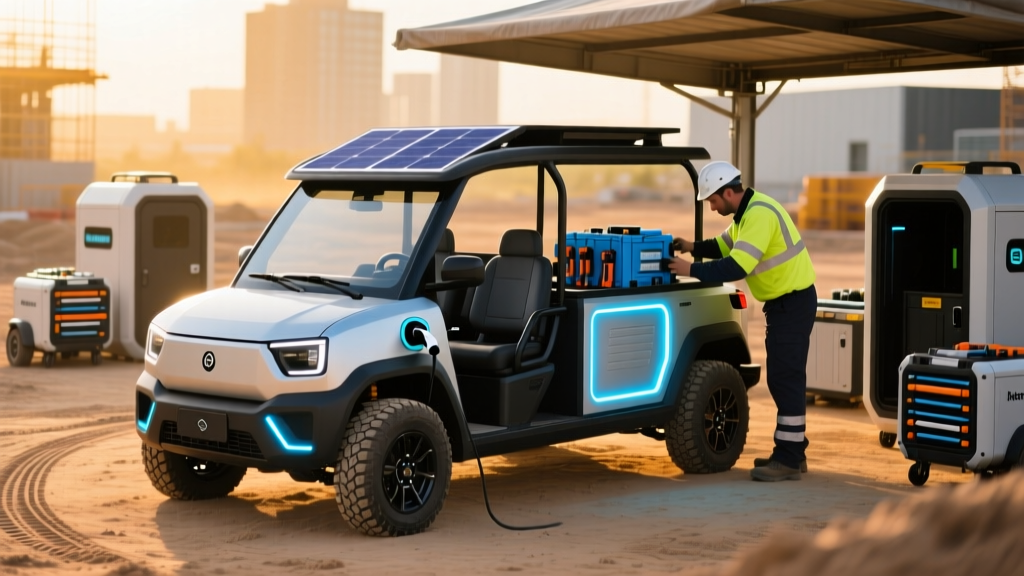
Kandi Technologies Group (NASDAQ: KNDI) is best known in the U.S. for importing affordable electric off-road vehicles, UTVs, and go-karts. When buyers search for "Kandi electric engineered construction accessories," they are typically looking for Kandi's utility side-by-sides configured for work use — machines that can haul tools, tow small trailers, and navigate job sites without the noise, fumes, or fuel costs of a gas-powered UTV.
Kandi's utility lineup for 2026 centers on a few key models:
- Kandi Cowboy — a compact two-seat electric UTV with a cargo bed, aimed at farm and light property work.
- Kandi Boss 4P / Boss 4Seater — a larger four-seat side-by-side with more payload capacity and optional accessories like windshields, winches, and light bars.
- Kandi Cruiser / Trailmate — recreational models sometimes adapted for light utility tasks.
These are low-speed electric vehicles (LSEVs) or off-road vehicles (ORVs), not street-legal passenger EVs. They do not appear on the EPA's fuel-economy database at fueleconomy.gov and are not subject to NHTSA's full motor-vehicle safety standards. That distinction matters for insurance, financing, and where you can legally operate them.
Specs That Matter on a Job Site
| Spec | Kandi Cowboy (Typical) | Kandi Boss 4P (Typical) | Gas UTV Baseline (e.g., Polaris Ranger 500) |
|---|---|---|---|
| Motor Output | ~4–7 kW (5–9 HP) | ~7–11 kW (9–15 HP) | ~32 HP (gasoline) |
| Battery Capacity | ~7–10 kWh (lead-acid or Li-ion) | ~10–15 kWh (Li-ion option) | N/A (gas tank, ~9 gal) |
| Range (Flat Terrain, Light Load) | 25–35 miles | 35–45 miles | 150–200+ miles |
| Top Speed | ~25 mph | ~40–45 mph | ~50–55 mph |
| Tow Capacity | ~500–800 lbs | ~800–1,200 lbs | ~1,500–2,500 lbs |
| Payload (Bed + Passengers) | ~400–600 lbs | ~600–900 lbs | ~1,000–1,500 lbs |
| Charge Time (120V Level 1) | 6–8 hours | 8–10 hours | Refuel: ~3 minutes |
| Base Price (Approx.) | $7,000–$9,000 | $10,000–$14,000 | $11,000–$16,000 |
| Warranty | 12 months (typical) | 12–24 months | 12–24 months |
Real-world range caveat: The range figures above assume flat terrain, moderate temperatures (60–80°F), and light loads. Expect 30–50% range reduction when hauling near max payload, climbing grades, or operating in cold weather (below 40°F). Lead-acid battery variants degrade faster than lithium-ion — plan for noticeable capacity loss after 300–500 charge cycles on lead-acid packs, versus 1,000+ cycles on lithium.
EV vs. Gas UTV: Real Cost Comparison for Construction Use
The main argument for going electric on a job site is operating cost. Here's a side-by-side breakdown over a typical 3-year ownership period, assuming 15 miles/day, 250 workdays/year (3,750 miles/year):
| Cost Category | Kandi Electric UTV (Lithium) | Gas UTV (e.g., Polaris Ranger) |
|---|---|---|
| Purchase Price | $10,000 | $13,000 |
| Fuel / Electricity (3 yrs) | $450 (at $0.14/kWh, ~250 Wh/mi) | $2,250 (at $3.75/gal, ~20 MPG) |
| Maintenance (Oil, Filters, Belts) | $150 (minimal — no oil changes) | $900 (oil, air filter, spark plugs, belt) |
| Insurance (3 yrs) | $600–$900 | $900–$1,200 |
| Estimated Resale (Year 3) | −$3,500 | −$5,500 |
| Net 3-Year Cost | ~$7,700–$8,200 | ~$11,550–$12,650 |
The electric UTV saves roughly $3,000–$4,500 over three years in fuel and maintenance alone. However, this assumes you have access to a standard 120V outlet on-site or at your shop for overnight charging. If you need to charge at multiple remote sites without grid access, the math gets more complicated — you may need a portable generator as a range extender, which partially defeats the purpose.
Charging Realities: What Job-Site Owners Need to Know
Kandi electric UTVs charge via a standard 120V household outlet (Level 1). They do not support Level 2 (240V) or DC fast charging — the onboard chargers are typically rated at 0.8–1.5 kW. Here's what that means in practice:
| Charging Method | Power (kW) | Miles Added Per Hour | Full Charge Time (10 kWh pack) |
|---|---|---|---|
| 120V Standard Outlet | 0.8–1.5 kW | 3–5 miles/hr | 7–10 hours |
| 240V (if supported, rare) | ~2.0 kW | ~6–8 miles/hr | 5–6 hours |
Practical implication: These machines are designed to work during the day and charge overnight. If your crew needs to use the UTV across two shifts with no downtime, a single electric UTV won't suffice — you'd need two units or a gas backup. For single-shift operations where the vehicle can sit on a charger for 8+ hours, overnight Level 1 charging is perfectly adequate.
One often-overlooked advantage: because they charge from standard outlets, you don't need to hire an electrician or install dedicated charging infrastructure. Plug into any 15A or 20A receptacle in the shop, garage, or job-site trailer. This keeps the "home charging install cost" at $0 — a significant advantage over full-size EVs that often require $500–$2,000 for Level 2 home charger installation.
Construction Accessories and Configurations
Kandi offers (and third-party vendors supply) a range of accessories that adapt these UTVs for construction and utility work:
- Electric winches — 2,500–3,500 lb capacity, useful for pulling materials or clearing debris.
- Cargo bed extensions and racks — increase hauling volume for tools, lumber, and supplies.
- Windshields and soft cabs — weather protection for year-round job-site use.
- LED light bars and work lights — essential for early-morning or low-visibility site work.
- Tow hitches and ball mounts — for small utility trailers and material carts.
- Tool boxes and gun racks — secure storage mounted to the bed or roll cage.
When budgeting, factor in $500–$2,000 in accessories beyond the base vehicle price. A fully configured Kandi Boss with winch, windshield, light bar, and bed rack typically lands in the $12,000–$15,000 range — still competitive with a similarly equipped gas UTV, which can easily exceed $18,000 with options.
Common Misconceptions About Electric Construction UTVs
| Myth | Fact |
|---|---|
| "They qualify for the $7,500 federal EV tax credit." | False. The IRS §30D credit applies to on-road motor vehicles meeting specific MSRP, income, battery-sourcing, and weight criteria. Kandi UTVs are off-road vehicles and do not qualify. |
| "Electric UTVs are silent — great for noise-restricted sites." | Mostly true. Motor noise is minimal, but tire noise and suspension clatter are still audible. At low speeds, they are dramatically quieter than gas UTVs — a real advantage near residential areas or indoor facilities. |
| "The battery will need replacing every 2 years." | Depends on chemistry. Lead-acid packs may lose significant capacity after 2–3 years of heavy daily use. Lithium-ion packs (available on higher trims) typically last 5–8 years before dropping below 80% state of health. Always choose lithium if your budget allows. |
| "They're street legal if I add turn signals." | Usually false. Most states do not allow LSEVs or ORVs on public roads regardless of added equipment. Check your state's DMV regulations — some states allow limited road use for UTVs in rural areas with specific modifications, but this is the exception. |
| "You can tow just as much as a gas UTV." | False. Kandi electric UTVs typically max out at 800–1,200 lbs towing. A mid-range gas UTV like the Polaris Ranger tows 1,500–2,500 lbs. For heavy trailer work, gas still wins. |
Decision Framework: Should You Buy a Kandi Electric UTV for Construction?
Use this framework to decide whether a Kandi electric UTV fits your work:
Choose a Kandi Electric UTV if:
- Your daily job-site travel is under 20 miles round-trip on relatively flat terrain.
- You have access to a 120V outlet for overnight charging at your shop or site trailer.
- Noise restrictions matter — you work near residences, hospitals, schools, or indoor facilities.
- Your towing needs are light (under 1,000 lbs) and payloads stay under 800 lbs.
- You want to eliminate fuel costs, oil changes, and spark-plug maintenance.
- You operate in enclosed or semi-enclosed spaces where gas exhaust is a hazard.
Stick with a Gas UTV if:
- You need 100+ miles of daily range across large or remote sites with no charging access.
- You regularly tow over 1,500 lbs or haul payloads exceeding 1,000 lbs.
- You work in extreme cold (below 20°F) where battery range drops 40–50%.
- You need highway-legal operation to drive between sites on public roads.
- You need quick refueling for multi-shift, continuous-use operations.
Consider a Full-Size Electric Truck (Ford F-150 Lightning, Chevy Silverado EV) if:
- You need highway speeds, full towing capacity (7,000–10,000+ lbs), and 250+ miles of range.
- You want a vehicle that qualifies for the §30D tax credit (up to $7,500, subject to MSRP caps, buyer income limits, and battery-sourcing requirements — check current rules at IRS.gov).
- You need DOT-compliant safety features (airbags, crash-test ratings) for on-road use.
First-Time Buyer Checklist: What to Know Before Ordering
- Confirm your state's off-road vehicle laws. Before purchasing, verify whether UTVs can be operated on any public roads in your jurisdiction and what registration/insurance requirements apply.
- Choose lithium-ion over lead-acid. The upfront cost is $1,000–$2,500 higher, but lithium packs last 2–3x longer, weigh less (improving range and payload), and maintain consistent voltage under load. Lead-acid is a false economy for daily commercial use.
- Measure your actual daily mileage. Use a GPS tracker on your current gas UTV for a week. If you consistently exceed 30 miles/day on hilly terrain, a Kandi electric UTV may not have sufficient range — especially in winter.
- Verify electrical access at every site. A standard 120V/15A outlet is all you need, but it must be available where the vehicle parks overnight. Extension cords over 50 feet can cause voltage drop and slow charging.
- Budget for accessories up front. Winch, windshield, light bar, and bed rack are not luxuries — they're essential for real construction work. Add $1,000–$2,000 to your base-price budget.
- Check dealer support and parts availability. Kandi sells primarily through online dealers and a limited network of physical dealers. Confirm that replacement parts (especially batteries, controllers, and motors) are available with reasonable shipping times in your area.
- Understand the warranty. Most Kandi UTV warranties cover 12 months on the vehicle and sometimes 24 months on the battery. This is significantly shorter than the 8-year/100,000-mile battery warranties standard on full-size passenger EVs. Factor in potential battery replacement cost ($1,500–$3,500 for lithium) in your 5-year ownership projection.
Frequently Asked Questions
Do Kandi electric UTVs qualify for any federal or state EV incentives?
No. The federal §30D clean vehicle credit applies only to on-road vehicles meeting specific criteria (MSRP caps, buyer income limits, battery component sourcing, and minimum battery capacity of 7 kWh). Kandi UTVs are classified as off-road vehicles and are not eligible. Some states or local utilities offer rebates for off-road electric equipment — check with your state energy office or utility provider.
How long does a Kandi electric UTV battery last before replacement?
Lithium-ion packs typically deliver 1,000–1,500 full charge cycles before dropping to 80% state of health. At one full cycle per workday, 250 days/year, that's roughly 4–6 years of service. Lead-acid packs may last only 300–500 cycles (1.5–2.5 years of daily use). Replacement lithium packs cost approximately $1,500–$3,500 depending on capacity.
Can I use a Kandi electric UTV in the rain or wet job-site conditions?
Yes, with caveats. Kandi UTVs are designed for outdoor use and can handle rain, mud, and shallow water crossings (typically up to 12–18 inches). However, the electrical connections and controller should not be submerged. Avoid high-pressure washing directly on the motor, controller, or battery compartment. Check the owner's manual for the specific IP (ingress protection) rating of your model.
How does cold weather affect range on a job site?
Lithium-ion batteries lose roughly 20–30% of usable capacity at 32°F and up to 40–50% at 0°F. A Kandi Boss rated for 40 miles in mild weather may deliver only 20–25 miles in sub-freezing conditions. Unlike full-size EVs with active battery thermal management (heat pumps and liquid cooling), Kandi UTVs lack these systems — so cold-weather range loss is more severe. If you work in northern climates during winter, plan for significantly reduced range or keep the vehicle in a heated shop when not in use.
What's the total cost per mile compared to a gas UTV?
At $0.14/kWh (national average residential electricity rate in 2025–2026 per EIA data) and an efficiency of roughly 250 Wh/mile, a Kandi electric UTV costs approximately $0.035 per mile in electricity. A comparable gas UTV getting 18–22 MPG at $3.75/gallon costs roughly $0.17–$0.21 per mile in fuel alone — not counting oil changes, filters, and belt replacements. Electric operating cost is roughly 80% lower per mile.
Can I tow a trailer loaded with construction materials?
Yes, within limits. The Kandi Boss typically tows up to 1,200 lbs (combined trailer + cargo weight). That's sufficient for a small utility trailer loaded with drywall, lumber, or bags of concrete mix. It is not sufficient for heavy equipment, large skid-steer loaders, or bulk gravel loads. Always stay within the rated tow capacity — exceeding it strains the motor, controller, and brakes, and can void the warranty.