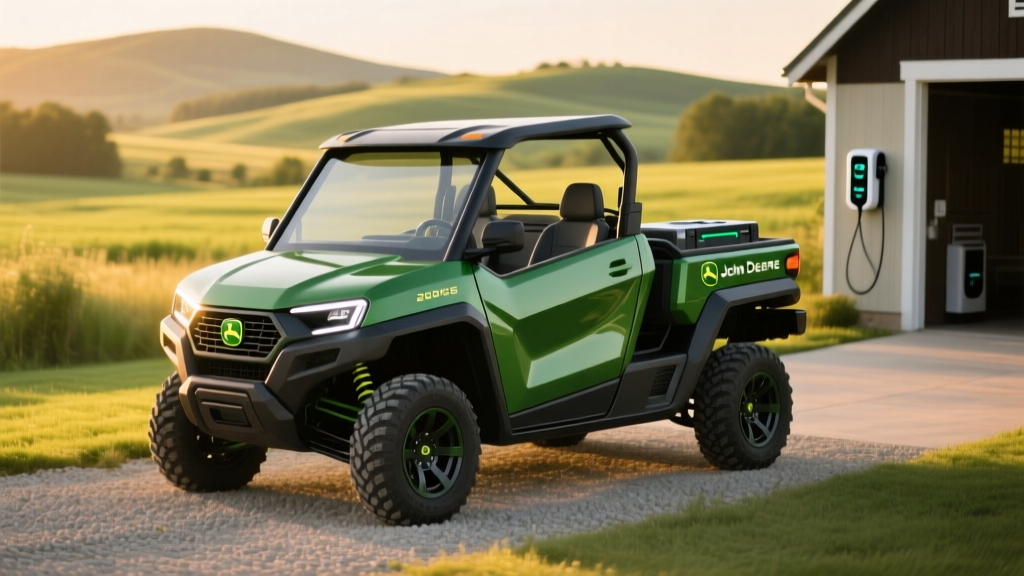
For property owners, ranchers, and fleet managers weighing a utility vehicle purchase in 2026, the John Deere Gator Electric (officially the Gator TE 4x2 and related electric variants) represents a shift from decades of small-displacement gasoline power. The core question is straightforward: does battery-electric propulsion deliver enough range, towing, and durability for real work, and what does it actually cost to own versus a gas Gator?
Quick Answer
The John Deere Gator Electric platform offers roughly 20–35 miles of real-world range depending on payload and terrain, powered by a lithium-ion battery pack in the 10–18 kWh range. It charges on standard 120V (Level 1) in 6–10 hours or a 240V outlet in 3–5 hours. Base pricing starts around $14,000–$18,000 depending on configuration. For low-speed, repetitive property work with home-base charging, it saves $800–$1,500/year in fuel and maintenance over a gas Gator. For all-day, long-distance ranch use, a gas or diesel Gator still wins on range and refueling speed.
This guide breaks down the exact specs, ownership economics, and decision criteria you need before spending five figures on a utility EV. Note: John Deere's electric Gator lineup has evolved across model years. Specs below reflect the most current published data and dealer-confirmed configurations available as of early 2026. Always verify exact pricing and availability with your local John Deere dealer, as utility vehicle configurations vary significantly by package.
Battery, Range, and Charging: The Numbers That Matter
Understanding the Gator Electric's capability starts with separating kW (power, or how fast energy flows) from kWh (energy capacity, or how much fuel is in the tank). The battery's kWh rating determines your range; the charger's kW rating determines how quickly you refill.
| Specification | Gator Electric (TE Series) | Gas Gator XUV835M (Baseline) |
|---|---|---|
| Battery / Fuel | ~14.4 kWh lithium-ion | 23.4 gal gasoline |
| Estimated Range | 20–35 miles (load/terrain dependent) | ~250+ miles |
| Top Speed | ~25 mph (governed, work-oriented) | ~48 mph |
| Towing Capacity | ~1,500 lbs (varies by config) | ~2,500 lbs |
| Payload Capacity | ~1,000 lbs | ~1,700 lbs |
| Charge / Refuel Time | 3–10 hours (240V/120V) | ~5 minutes |
| Drivetrain | Electric motor, 2WD/4WD options | CVT, 4WD |
| Approx. Starting Price | ~$14,000–$18,000 | ~$17,000–$22,000 |
Sources: John Deere Compact Utility Vehicles, dealer specification sheets. Exact kWh and range vary by model year and configuration.
Real-World Range Expectations
Unlike highway-rated EVs with EPA range stickers, utility vehicles operate in conditions that dramatically affect energy consumption. Here's what to expect from a ~14 kWh usable pack:
- Flat terrain, light load, moderate speeds: 30–35 miles
- Hilly terrain, 500-lb payload: 20–25 miles
- Cold weather (below 32°F), heavy use: 15–20 miles (lithium-ion loses 15–30% capacity in freezing temps)
- Stop-and-go property work with frequent starts: Efficiency improves vs. continuous high-speed operation thanks to regenerative braking
For context, most property owners report daily utility vehicle usage of 5–15 miles in typical ranch, farm, or estate applications. If your daily routes fall in that range and the vehicle returns to a charging point each night, the Gator Electric's range is adequate.
Charging Setup: What You Actually Need
The Gator Electric charges on standard household current, which is one of its strongest practical advantages for rural and agricultural users who may not have access to dedicated EV charging infrastructure.
| Charging Method | Power (kW) | Full Charge Time (0–100%) | Requirements |
|---|---|---|---|
| Level 1 (120V standard outlet) | ~1.2 kW | 8–12 hours | Standard 15A or 20A household outlet |
| Level 2 (240V outlet) | ~2.4–3.3 kW | 4–6 hours | NEMA 14-50 or hardwired 240V circuit |
Most Gator Electric owners charge overnight on a standard 120V outlet in a barn, garage, or shed. A full charge from empty takes roughly 8–12 hours, which works well for a vehicle used during the day and parked at night. If you need faster turnaround — for example, mid-day top-ups between morning and afternoon work sessions — a 240V circuit cuts that to 4–6 hours.
Home Charging Installation Cost
If you already have a 240V outlet (common for welders, dryers, or shop equipment in rural properties), your charging cost is essentially zero beyond the onboard cord. If you need a new 240V circuit installed:
| Item | Estimated Cost |
|---|---|
| 240V circuit (50A, NEMA 14-50) | $300–$800 |
| Electrical panel upgrade (if needed, 100A→200A) | $1,500–$3,000 |
| Permit and inspection | $50–$200 |
| Total (typical, no panel upgrade) | $350–$1,000 |
Most rural/agricultural properties with existing shop buildings already have 240V service available. Consult a licensed electrician for final specifications and local code compliance.
EV vs. Gas Gator: Total Cost of Ownership
The purchase price of a Gator Electric is often comparable to or slightly lower than a similarly equipped gas Gator. The real financial story emerges over 5 years of operation.
| Cost Category (5 Years) | Gator Electric | Gas Gator XUV |
|---|---|---|
| Purchase Price (approx.) | $16,000 | $19,000 |
| Fuel / Electricity | $300–$600 | $2,500–$4,500 |
| Oil Changes | $0 | $400–$700 |
| Air Filters / Spark Plugs | $0 | $150–$300 |
| Transmission / CVT Maintenance | $0 | $200–$500 |
| Brake Wear (regen extends life) | $100–$200 | $300–$600 |
| Insurance (est.) | $1,200–$1,800 | $1,200–$1,800 |
| Estimated 5-Year Total | $17,600–$19,600 | $23,750–$27,400 |
The Gator Electric saves an estimated $4,000–$8,000 over five years in fuel and maintenance, depending on usage intensity and local fuel/electricity prices. At an average of 500 miles/year and $3.50/gallon gasoline, a gas Gator burning fuel at roughly 15–20 mpg-equivalent in low-speed work consumes $350–$500 annually in fuel alone. The electric equivalent at $0.13/kWh costs roughly $50–$100/year.
Federal Tax Credit and Incentives
Utility vehicles like the Gator Electric occupy a different regulatory category than passenger EVs. The IRS §30D Clean Vehicle Credit applies to vehicles meeting specific on-road classification requirements. Many off-road utility vehicles do not qualify for the federal $7,500 credit because they lack a VIN meeting on-road vehicle standards.
However, some states and local utility cooperatives offer agricultural or commercial electrification incentives. Check with:
- Your local rural electric cooperative (many offer EV/UTV rebates of $200–$1,000)
- USDA Rural Energy for America Program (REAP) grants for agricultural operations
- State-level clean equipment incentive programs (varies by jurisdiction)
Always consult a tax professional to confirm eligibility for any credit or deduction.
Common Misconceptions About Electric Utility Vehicles
| Myth | Fact |
|---|---|
| "Electric Gators can't tow anything" | Rated for ~1,500 lbs towing depending on configuration — adequate for trailers, feed, and equipment on flat to moderate terrain |
| "You need a special EV charger" | Charges on any standard 120V household outlet; 240V is optional but faster |
| "The battery will need replacing in 3 years" | Lithium-ion packs in modern utility EVs are designed for 1,000+ charge cycles with 70–80% capacity retention over 5–8 years of normal use |
| "It's silent, so it's unsafe around livestock" | Most models include a backup alarm or can be fitted with one; operators quickly adapt to visual awareness |
| "Electric means zero maintenance" | No oil changes or spark plugs, but you still maintain tires, brakes, suspension, and cooling systems |
Real-World Ownership: Who Should Buy Electric?
The Gator Electric excels in specific use patterns and falls short in others. Here's a practical decision framework:
Choose the Gator Electric If:
- Your daily driving is under 20 miles on property
- You have access to a standard electrical outlet where the vehicle is stored
- Noise is a concern (residential areas, early morning/late evening work, hunting, wildlife management)
- You want to eliminate fuel storage, fuel degradation, and carburetor/EFI maintenance
- Your work involves frequent stop-and-go patterns (fence checking, feeding, property maintenance)
- You operate indoors or in enclosed spaces (barns, warehouses, greenhouses) where exhaust is a hazard
Choose a Gas or Diesel Gator If:
- You regularly drive 30+ miles per day without returning to a charging point
- You need highway-capable speeds (above 25 mph) for road-legal use
- You tow maximum loads over long distances or steep grades daily
- You operate in extreme cold (below 0°F) for extended periods
- You need rapid refueling for continuous multi-shift operations
Climate and Terrain Considerations
Cold weather: Lithium-ion batteries lose capacity in freezing temperatures — expect 15–30% range reduction below 32°F. If you operate in northern climates with extended sub-zero winters, plan for reduced range or consider a heated storage facility.
Hilly terrain: Electric motors deliver instant torque, which is excellent for climbing. However, sustained hill work with heavy loads drains the battery significantly faster than flat-terrain operation. Regenerative braking recovers some energy on descents.
Wet/muddy conditions: The Gator Electric's sealed electric drivetrain is inherently more water-resistant than a gas engine's intake and exhaust system. IP-rated electrical components handle typical agricultural moisture, but submersion is not recommended for any utility vehicle.
What First-Time EV Utility Vehicle Buyers Should Know
Transitioning from a gas UTV to an electric one requires adjusting a few expectations:
- Plan around range, not speed. The Gator Electric tops out around 25 mph. This is intentional — it's a work vehicle optimized for torque and efficiency at low speeds, not trail riding.
- Charge when you park. Unlike a gas vehicle where you refuel only when empty, lithium-ion batteries prefer partial charges. Plug in every evening regardless of remaining charge for optimal battery longevity.
- Don't store at 100% or 0%. For long-term storage (off-season), leave the battery at roughly 50–60% state of charge. Storing at full charge or fully depleted accelerates degradation.
- Maintenance is different, not zero. Budget for tire replacement, brake inspections, coolant checks, and software updates. The drivetrain is simpler, but the vehicle still has wear items.
- Dealer support varies. John Deere's dealer network is extensive, but electric-UTV-specific service training is still expanding. Confirm your local dealer can service the electric powertrain before purchasing.
Frequently Asked Questions
Does the John Deere Gator Electric qualify for the federal EV tax credit?
Generally, no. The IRS §30D Clean Vehicle Credit requires the vehicle to be street-legal with a qualifying VIN. Most off-road utility vehicles, including the Gator Electric, do not meet this classification. However, agricultural operations may qualify for USDA REAP grants or state-level equipment electrification incentives. Consult a tax professional for your specific situation.
How long does the Gator Electric battery last before replacement?
Modern lithium-ion packs in utility applications are rated for 1,000–2,000 charge cycles before degrading to 70–80% of original capacity. At typical usage patterns (200–400 cycles per year), expect 5–8 years of service before noticeable range loss. Full battery replacement costs vary widely by configuration but typically range from $3,000–$6,000. Check with your dealer for exact warranty terms, which typically cover 1–3 years on the battery pack.
Can I use a solar panel to charge the Gator Electric?
Yes, but indirectly. A solar array connected to your property's electrical system can offset the electricity used for charging. A typical full charge consumes roughly 14–18 kWh, which a 3–5 kW solar system can produce in a single day of good sunlight. Direct solar-to-vehicle charging without a battery buffer or inverter is not practical for most setups.
Is the Gator Electric suitable for hunting?
It's one of the strongest use cases. The near-silent electric drivetrain is a significant advantage for wildlife observation and hunting. The limited range is less of an issue when operating from a blind or stand within a few miles of a base camp or vehicle. Many hunters specifically choose electric UTVs for this reason.
What happens if the battery dies in the field?
Unlike a gas vehicle that can receive a fuel delivery, a depleted Gator Electric must be towed or trailered back to a power source. Plan your routes conservatively — a good practice is to turn back when you reach 30% remaining charge, especially in hilly or remote terrain. Some owners carry a portable generator with a battery charger as an emergency backup, though charging from a small generator is slow (1–2 kW).
How does the Gator Electric compare to electric UTVs from Polaris or other brands?
The electric utility vehicle market is growing. Polaris has offered electric Ranger variants, and several smaller manufacturers produce electric UTVs. Key differentiators include dealer support (John Deere's agricultural network is unmatched), battery chemistry and warranty, and integration with existing fleet management. Compare specific model-year specs, warranty terms, and dealer proximity before deciding.
Specifications and pricing in this guide are based on published John Deere data and dealer-confirmed configurations as of early 2026. Always verify current specs, availability, and pricing with your authorized John Deere dealer. Tax credit and incentive information reflects current IRS guidelines and is subject to change.