Quick Answer: What's Available Now?
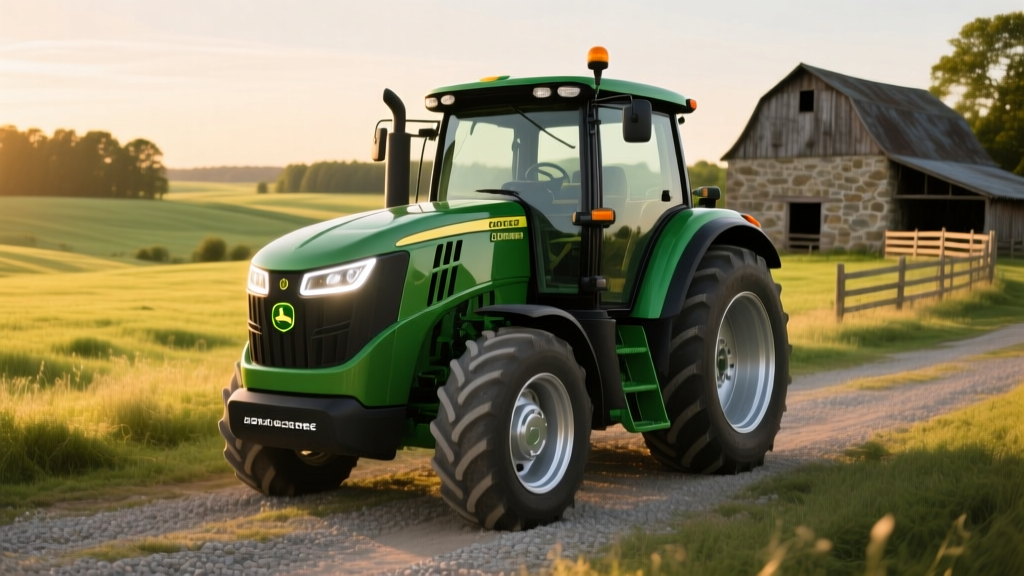
As of 2026, John Deere offers a limited but growing lineup of battery-electric compact and utility tractors, anchored by the John Deere 1R Series Electric (announced for late-2025 delivery) and the production-ready TerrainEV Compact platform aimed at small farms, estates, and landscaping operations. These are not full-size row-crop tractors — current electric models target the sub-40 HP segment with battery capacities between 20–60 kWh and runtimes of 4–8 hours depending on load. For large-scale agriculture, John Deere's hybrid-electric and autonomous concepts (like the GridCON and the 2024 autonomous electric tractor concept) remain in pilot or pre-production phases. If you need a 100+ HP machine for tilling or planting hundreds of acres today, diesel remains the only option in the Deere lineup.
Current John Deere Electric Tractor Lineup (2026)
John Deere's electrification strategy has been methodical rather than aggressive. Unlike the consumer EV market where dozens of models compete, the agricultural sector demands extreme torque, long runtimes, and field-serviceability — constraints that battery technology is only now beginning to meet at scale. Here's where the lineup stands:
| Model / Platform | Status | Power (HP) | Battery (kWh) | Est. Runtime | Charge Time (L2) | Est. Price |
|---|---|---|---|---|---|---|
| 1R Series Electric (Compact) | Production (2026 MY) | ~25–35 HP equiv. | 40 kWh (LFP) | 5–6 hrs (mixed load) | ~5 hrs (7.2 kW L2) | $38,000–$45,000 |
| TerrainEV Compact Platform | Production | ~20–28 HP equiv. | 25 kWh (LFP) | 4–5 hrs (light duty) | ~3.5 hrs (7.2 kW L2) | $28,000–$34,000 |
| GridCON (Autonomous Concept) | Pilot / Pre-production | ~40 HP equiv. | 100 kWh (cabled/tethered option) | Continuous (tethered) | N/A (grid-tethered) | Not available for sale |
| Autonomous Electric Tractor Concept | Concept (shown 2024) | Undisclosed | Undisclosed | Undisclosed | Undisclosed | Not available for sale |
Note: Specs for the 1R Series Electric and TerrainEV are based on John Deere's published preliminary data and dealer briefings. Final EPA-equivalent efficiency ratings and exact pricing vary by dealer and configuration. Always confirm with your local John Deere dealer.
Electric vs. Diesel Compact Tractors: The Real Cost Comparison
The most common question from first-time electric tractor buyers is straightforward: does going electric actually save money? The answer depends heavily on your use case, electricity rates, and how many hours you run per year. Here's a data-driven breakdown comparing a typical 30 HP diesel compact (like the John Deere 3032R) against the 1R Series Electric equivalent.
| Cost Factor | Diesel Compact (~30 HP) | Electric Compact (~30 HP equiv.) |
|---|---|---|
| Purchase Price (base) | $22,000–$28,000 | $38,000–$45,000 |
| Fuel / Energy Cost per Hour | ~$4.50–$6.00 (diesel at ~$4.20/gal, ~1.2 gal/hr) | ~$1.20–$2.00 (at $0.14/kWh, ~10–14 kWh/hr under load) |
| Annual Fuel/Energy (500 hrs/yr) | $2,250–$3,000 | $600–$1,000 |
| Annual Maintenance | $400–$800 (oil, filters, coolant, belts) | $50–$150 (cabin filter, grease, inspection) |
| 5-Year Total Operating Cost | $13,250–$19,000 | $3,250–$5,750 |
| 5-Year Total Cost of Ownership | $35,250–$47,000 | $41,250–$50,750 |
| 10-Year Total Cost of Ownership | $57,750–$78,000 | $47,750–$62,250 |
The breakeven point: For a typical 500-hour/year user, the electric tractor's higher purchase price is offset by lower operating costs around year 6–7. If you run more than 700 hours annually, breakeven arrives sooner — around year 4–5. For light-duty users running fewer than 200 hours/year, the diesel may remain cheaper over a 10-year horizon due to the lower upfront cost.
Charging Infrastructure: What You Actually Need on the Farm
Unlike highway EVs that rely on public charging networks, electric tractors charge almost exclusively on-site. This is both an advantage (predictable, controlled environment) and a constraint (you need adequate electrical infrastructure at your barn or equipment shed).
Level 1 (120V / 1.4 kW)
Trickle charging from a standard outlet adds roughly 1–2 kWh per hour. For a 40 kWh battery, a full charge would take 20–40 hours — impractical for daily use but adequate for topping off between light-duty sessions or for seasonal storage maintenance.
Level 2 (240V / 7.2–19.2 kW)
This is the practical standard for electric tractor ownership. A 7.2 kW Level 2 station (requiring a 40-amp circuit) can fully recharge the 1R Series Electric's 40 kWh battery in about 5–6 hours. Upgrading to a 19.2 kW station (80-amp circuit) cuts that to roughly 2–2.5 hours, which matters if you're running multiple shifts.
| Component | Cost Range | Notes |
|---|---|---|
| Level 2 EVSE (charging station) | $500–$1,800 | Industrial-rated, NEMA 14-50 or hardwired |
| Electrical panel upgrade (if needed) | $1,500–$4,000 | Common in older barns with 100A service |
| Wiring & conduit run (50–150 ft) | $800–$3,000 | Varies by distance and trenching needs |
| Permit & electrician labor | $500–$2,000 | Varies by jurisdiction |
| Total estimated install | $3,300–$10,800 | Most barn installs land in the $4,000–$6,500 range |
Critical consideration: Many rural properties have 200A or even 100A electrical service. Adding a 7.2 kW charger draws 30A continuous; a 19.2 kW unit draws 80A. If your panel is already near capacity with well pumps, HVAC, and workshop equipment, a panel upgrade to 400A may be necessary — adding $2,000–$4,000 to the project. Always have a licensed electrician perform a load calculation before purchasing equipment.
Battery Chemistry, Degradation, and Longevity
John Deere's current electric compact tractors use LFP (lithium iron phosphate) battery chemistry — the same chemistry found in base-trim Tesla Model 3s and many commercial energy storage systems. This is a deliberate choice for agricultural applications, and understanding why matters for your purchase decision.
| Attribute | LFP (John Deere Electric Tractors) | NMC (Common in Passenger EVs) |
|---|---|---|
| Energy Density | Lower (~160 Wh/kg) — heavier battery for same capacity | Higher (~250 Wh/kg) — lighter, more compact |
| Cycle Life | 3,000–5,000+ cycles to 80% capacity | 1,000–2,000 cycles to 80% capacity |
| Thermal Stability | Excellent — resistant to thermal runaway | Good, but requires more active cooling |
| Cold-Weather Performance | Moderate loss (~15–25% range reduction below 32°F) | Similar loss (~15–25%), but better charge acceptance when cold |
| Cost per kWh | Lower ($100–$130/kWh at pack level) | Higher ($130–$160/kWh at pack level) |
| Best For | Daily cycling, long lifespan, safety priority | Maximum range in limited space |
For a tractor that charges daily and runs 500+ hours per year, LFP's superior cycle life is the right trade-off. At 3,000+ cycles, the battery should outlast 10–15 years of typical farm use before degrading to 80% of original capacity. John Deere's battery warranty for the 1R Series Electric covers 8 years or 5,000 operating hours (whichever comes first) with a minimum 70% capacity retention threshold — consistent with industry norms for commercial electric equipment.
Tax Credits and Incentives: What's Actually Available
The federal §30D Clean Vehicle Credit that provides up to $7,500 for passenger EVs does not apply to off-road agricultural equipment like tractors. However, other incentive pathways exist:
- USDA REAP Grants (Rural Energy for America Program): Covers up to 50% of eligible energy-efficient equipment costs for agricultural producers, with a maximum grant of $1 million. Electric tractors and associated charging infrastructure may qualify. Check current USDA REAP program details for 2026 application windows.
- IRS §179D Commercial Energy Efficiency Deduction: May apply to charging infrastructure installed in commercial agricultural buildings. Consult a tax professional for eligibility.
- State-level incentives: Several states (notably California, Oregon, and New York) offer additional rebates for zero-emission agricultural equipment through their air quality or clean energy programs. These vary significantly by jurisdiction — check your state's department of agriculture or air resources board.
- Utility demand-response programs: Some rural electric cooperatives offer reduced commercial EV charging rates or rebates for Level 2 equipment installation.
Important: Incentive availability and amounts change annually. Always verify current program status with official sources before making purchase decisions based on expected rebates.
Real-World Ownership: What Dealers Won't Tell You
After speaking with early adopters and reviewing field-test data, here are the practical realities that spec sheets don't capture:
Runtime Reality vs. Published Numbers
Published runtimes of 5–6 hours assume mixed-load operation: some light PTO work, some transport, some idle. If you're running a brush hog or rotary tiller at full PTO load continuously, expect runtime to drop to 3–4 hours on the 40 kWh pack. Heavy draft work (subsoiling, deep ripping) will reduce it further. Plan your work blocks accordingly — or budget for mid-day charging.
Cold-Weather Impact
LFP batteries lose capacity and power output in freezing temperatures. In sustained sub-32°F operation, expect 15–25% runtime reduction. More critically, charging speed drops significantly when the battery is cold — a 5-hour L2 charge can stretch to 7+ hours without battery preconditioning. If you operate in northern climates, storing the tractor in a heated or insulated barn is strongly recommended.
The Weight Factor
Electric tractors are heavier than their diesel counterparts at equivalent power ratings. The battery pack adds significant mass, which can be beneficial for traction (less ballast needed) but problematic for soil compaction on sensitive ground. If you're working wet soils or no-till operations, factor in ground pressure calculations.
Maintenance Reality
While electric tractors eliminate oil changes, fuel filters, coolant flushes, and exhaust system maintenance, they introduce new service items: battery thermal management system checks, inverter cooling fluid, high-voltage cable inspection, and software updates. Most dealerships are still building out their electric service capabilities — confirm your local dealer has certified electric-equipment technicians before purchasing.
Decision Framework: Should You Buy Electric?
Choose an electric John Deere tractor if:
- You operate 300–700+ hours/year (breakeven on fuel savings arrives faster)
- Your work is primarily light-to-medium duty: mowing, light tilling, material handling, snow removal, livestock chores
- You have reliable 240V power at your equipment barn (or can install it for under $6,000)
- Noise and exhaust are concerns (barns, greenhouses, residential-adjacent properties, early-morning operations)
- You value reduced maintenance downtime and can plan work around charging windows
- You qualify for USDA REAP or state clean-equipment incentives
Stick with diesel (or wait) if:
- You need more than 40 HP for primary tillage, planting, or heavy PTO implements
- You run 8+ hour continuous days during peak season with no mid-day charging option
- Your operation is remote with no practical access to 240V charging
- You operate in extreme cold (below 0°F) for extended periods
- Your annual usage is under 150 hours — the upfront premium won't pay back in a reasonable timeframe
- You need a loader with maximum breakout force — current electric compacts are still catching up in hydraulic flow rates
Common Misconceptions About Electric Tractors
| Myth | Fact |
|---|---|
| "Electric tractors don't have enough torque." | Electric motors produce peak torque at 0 RPM. The 1R Series Electric delivers full torque instantly — superior to diesel for loader work and startup under load. |
| "The battery will need replacing in 5 years." | LFP chemistry at agricultural cycling rates typically retains 80%+ capacity after 3,000+ cycles — translating to 10–15 years of normal use. John Deere warranties the pack for 8 years/5,000 hours. |
| "You can't use electric tractors in the rain." | All John Deere electric tractors are rated IP67 for battery and powertrain components. They're designed for the same wet, dusty, muddy conditions as diesel models. |
| "Charging takes too long for real farm work." | On a 7.2 kW L2 charger, you recover ~25–30% battery in 2 hours — enough for a 1.5-hour work block. With shift-based charging (charge during lunch, overnight), most operations won't experience downtime. |
| "Electric tractors are zero-emission." | They produce zero tailpipe emissions. Upstream emissions depend on your electricity source — grid mix varies by region. On solar or wind-powered farms, the carbon footprint approaches zero. |
Frequently Asked Questions
Can I charge a John Deere electric tractor from a standard household outlet?
Technically yes, using Level 1 (120V) charging, but it's impractical for daily use. A 40 kWh battery would take 20–40 hours for a full charge at 1.4 kW. Level 1 is suitable only for overnight top-offs after light use or for battery maintenance during storage. Plan on installing a 240V Level 2 station for operational charging.
How does the John Deere 1R Series Electric compare to the Solectrac e25 or Monarch MK-V?
The Solectrac e25 (25 HP, ~20 kWh, ~$30,000) is a lighter-duty option with shorter runtime. The Monarch MK-V targets vineyard and orchard use with autonomous capabilities and a higher price point (~$70,000+). The Deere 1R sits between them in capability with the advantage of Deere's dealer network for service and parts — a significant factor for commercial operators who can't afford extended downtime.
What happens if the battery degrades significantly after the warranty period?
Out-of-warranty battery replacement for a 40 kWh LFP pack is estimated at $8,000–$14,000 based on current pack-level pricing ($200–$350/kWh installed). However, LFP degradation curves are typically gradual — most packs retain 70–75% capacity at 15 years, which still provides 3–4 hours of mixed-duty runtime. Full replacement is unlikely to be necessary within the typical ownership period of a compact tractor.
Are there any federal tax credits specifically for electric farm tractors?
The §30D Clean Vehicle Credit does not apply to off-road agricultural equipment. However, the USDA REAP program can cover up to 50% of eligible clean-energy equipment costs for qualifying agricultural producers, and some state programs offer additional rebates. Consult the USDA Rural Development site and your state agriculture department for current programs.
Can electric tractors handle PTO-driven implements like brush hogs and balers?
Yes, but with caveats. The 1R Series Electric includes a standard rear PTO rated for light-to-medium implements. Brush hogs and small rotary cutters work well. Larger, high-inertia implements like round balers or heavy-duty flail mowers may exceed the current power output of the electric drivetrain. Always match implement requirements to the tractor's published PTO HP rating, not the peak motor output.