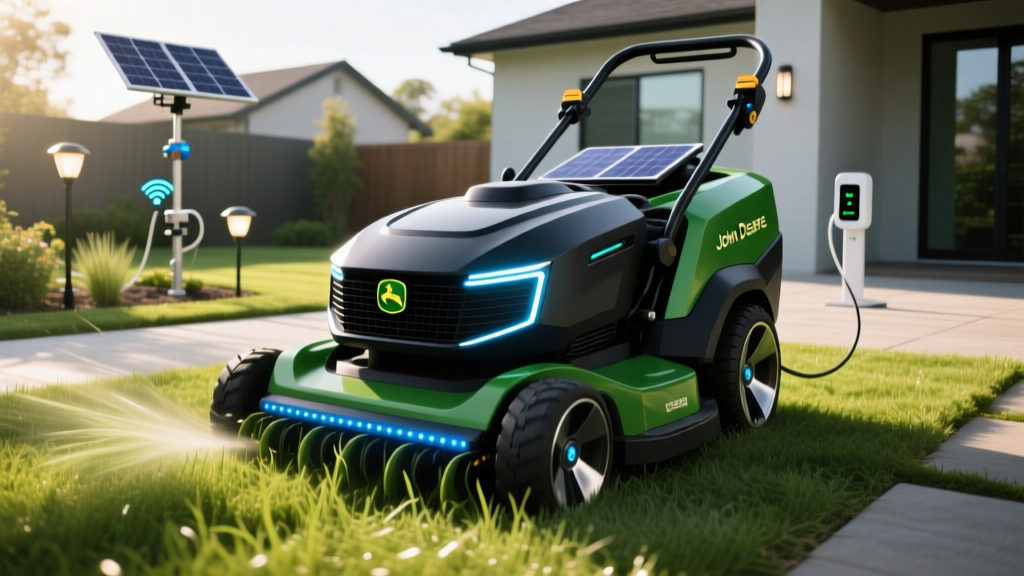
Quick Answer: As of 2026, John Deere does not sell a fully electric, battery-powered ride-on mower for residential consumers under the traditional "John Deere" branding in the way buyers expect EVs. The company's electrification efforts focus on commercial turf equipment and agricultural autonomy. However, the broader electric mower market (including brands like EGO, Ryobi, and Toro) offers compelling battery-electric alternatives that share similar lithium-ion technology found in EVs. If you're specifically searching for a John Deere electric mower, your closest options are the commercial-grade Turf Tractor concepts, electrified utility vehicles, or choosing a competitor's battery-electric rider while keeping John Deere for heavier landscaping needs.
What John Deere Actually Offers in Electric Lawn Equipment
John Deere has been vocal about electrification, but the roadmap is specific: commercial turf, autonomous agriculture, and compact utility vehicles — not yet a consumer battery-electric riding mower you can buy at your local dealer today. At CES and recent trade shows, John Deere has showcased electric and hybrid-electric prototypes, including autonomous electric mowers for commercial turf management.
For the residential buyer in 2026, John Deere's lineup remains dominated by gasoline-powered riding mowers (the S100, X300, and X500 series) and diesel compact utility tractors. The company's technology and innovation page outlines their long-term autonomy and electrification goals, but production electric mowers for homeowners are not yet available for purchase.
What is available from John Deere adjacent to electric power:
- John Deere Gator TE Electric — a battery-electric utility vehicle for commercial and farm use (48V system, limited to low-speed work tasks, not a mower)
- Autonomous electric mower concepts — targeted at golf courses and commercial turf, not residential
- Battery-powered handheld equipment — John Deere has partnered on select battery-powered trimmers and blowers, though availability varies by dealer
The Electric Mower Market in 2026: What You Can Actually Buy
If your goal is an electric riding mower or zero-turn with battery power, several manufacturers have stepped into the space John Deere hasn't yet filled. Here's how the current landscape looks with real numbers:
| Spec | EGO Z6 Zero-Turn (Electric) | Ryobi 42" Electric Rider | John Deere S130 (Gas) | Mean Green STALKER (Commercial Electric) |
|---|---|---|---|---|
| Power Source | 56V Lithium-ion (ARC) | 48V Lithium-ion | 22 HP Gasoline | 72V Lithium-ion |
| Battery Capacity | ~2.5 kWh (4x 12Ah packs) | ~2.4 kWh | N/A (3.5 gal tank) | ~8.6 kWh |
| Runtime per Charge | ~2 acres / 60-90 min | ~2 acres / 75 min | ~2.5-3 hours | ~5 acres / 3-4 hours |
| Charge Time (0-100%) | ~60 min (rapid charger) | ~4 hours (standard) | N/A | ~3 hours (Level 2) |
| Cutting Width | 52 inches | 42 inches | 48 inches | 52 inches |
| Approx. MSRP | $7,500-$8,500 | $5,500-$6,200 | $3,400-$3,800 | $18,000-$22,000 |
| Noise Level | ~65 dB | ~62 dB | ~92 dB | ~65 dB |
| Maintenance Needs | Blade sharpening only | Blade sharpening only | Oil, filters, belts, plugs | Blade sharpening, hydraulic check |
Cost Comparison: Electric Mower vs. Gas Mower Over 5 Years
The upfront cost of electric mowers is higher, but operating costs tell a different story. Here's a realistic 5-year ownership breakdown assuming 1 acre of lawn, mowed 30 times per year:
| Cost Category | Electric Rider (~$6,500) | Gas Rider (~$3,500) |
|---|---|---|
| Purchase Price | $6,500 | $3,500 |
| Fuel / Electricity (5 yrs) | $180 (~$0.12/kWh, 2.5 kWh/charge, 150 charges) | $1,125 (~$4.50/gal, 5 gal/week, 30 weeks/yr) |
| Oil Changes & Filters | $0 | $375 ($75/yr × 5) |
| Spark Plugs / Belts | $0 | $200 |
| Blade Sharpening/Replacement | $150 | $150 |
| Battery Replacement (if needed) | $600-$1,200 (year 4-5) | N/A |
| Total 5-Year Cost | $7,430-$8,230 | $5,350 |
The takeaway: Electric mowers cost more upfront and may not break even within 5 years for a single-acre property. However, for larger properties (2+ acres), commercial use, or owners who value noise reduction and zero direct emissions, the math shifts. The battery is the wildcard — most lithium-ion mower batteries last 800-1,200 charge cycles before significant degradation, translating to roughly 5-8 years of residential use.
Battery Technology: What EV Owners Should Recognize
If you already own an EV, electric mower batteries will feel familiar. Most residential electric mowers use lithium-ion cells in configurations similar to EV packs, just at much smaller scale:
| Myth | Fact |
|---|---|
| "Electric mower batteries die after 2 years" | Quality Li-ion packs (EGO, Ryobi, DeWalt) typically last 5-8 years / 800-1,200 cycles before dropping below 80% capacity. Commercial-grade packs like Mean Green's can exceed 2,000 cycles. |
| "You need solar panels to make it worthwhile" | At $0.12/kWh national average, a full charge of a 2.5 kWh mower battery costs about $0.30. Even without solar, electric mowing costs pennies per session. |
| "Electric mowers can't handle thick or wet grass" | Modern brushless motors deliver instant torque comparable to 20-25 HP gas engines. Wet grass reduces runtime by ~15-20% but doesn't stall electric motors the way it bogs down gas engines. |
| "Cold weather ruins the battery" | Li-ion batteries lose ~20-30% capacity below 40°F — identical to EV cold-weather range loss. Store batteries indoors and they'll perform normally. Mowing season rarely overlaps with extreme cold in most US climates. |
| "John Deere will release an electric mower soon" | As of 2026, John Deere has not announced a production residential electric riding mower. Their electrification roadmap focuses on commercial autonomy and agricultural equipment. |
Charging Setup: What You Need at Home
Unlike EVs that require dedicated Level 2 circuits, most electric mowers charge from a standard 120V household outlet. Here's the practical breakdown:
- Level 1 (120V standard outlet): Most residential electric mowers include a 120V charger. Expect 3-6 hours for a full charge depending on battery size. This is adequate for weekly mowing.
- Rapid chargers (120V/240V): Brands like EGO offer rapid chargers that cut charge time to 45-60 minutes. These draw more current (up to 12A) but still use standard outlets.
- No panel upgrade needed: Unlike installing a 40A or 48A EV home charger, mower charging requires no electrical panel upgrade or dedicated circuit in most homes.
- Charging cost per session: At 2.5 kWh per charge and $0.12/kWh, each full charge costs roughly $0.30 — compared to $4-6 for a gallon of gas.
Practical tip: If you have a larger property (2+ acres) requiring multiple charges per session, invest in a second battery pack. Swapping batteries eliminates downtime, and the cost ($200-$400 per pack) is far less than keeping a gas mower fueled.
Decision Framework: Should You Buy Electric or Gas?
Choose an electric mower if:
- Your property is 2 acres or less (most battery riders handle this on a single charge)
- You have indoor/garage storage to protect batteries from extreme temperatures
- You mow in noise-sensitive areas (early mornings, HOAs, near neighbors)
- You want to eliminate gas storage and engine maintenance
- You already use a battery ecosystem (EGO 56V, Ryobi 48V) across other tools
- You value instant torque and smooth acceleration over raw horsepower
Choose a gas mower (or wait for John Deere electric) if:
- Your property exceeds 3 acres and you can't afford commercial-grade electric
- You need to tow heavy loads (aeration, dump carts) — gas engines still dominate towing capacity
- You mow commercially and need 6+ hours of continuous runtime without charging infrastructure
- You operate in rural areas where replacement batteries are hard to source quickly
- You're a loyal John Deere owner who values dealer support, parts availability, and the brand's attachment ecosystem
What First-Time Electric Mower Buyers Should Know
Transitioning from gas to electric lawn equipment shares similarities with switching from a gas car to an EV, but at a smaller scale. Here are the realities that matter:
Runtime is your "range anxiety." Just as EV buyers fixate on EPA range, electric mower buyers should focus on rated acreage per charge. Manufacturers rate mowers for specific acreage — treat this like an EPA estimate. Real-world runtime drops 15-25% with thick grass, hills, or hot weather. If your property is rated at the mower's maximum, buy a model rated for 50% more acreage than you need.
Battery degradation is real but slow. Expect 80% capacity retention after 800-1,200 full cycles. For a homeowner mowing 30 times per year, that's 25-40 years of theoretical use — but calendar aging (5-8 years) will likely end the battery's life before cycle count does. Budget for one battery replacement over the mower's lifetime.
No federal tax credit applies. Unlike EVs eligible for the IRS §30D clean vehicle credit, electric lawn mowers do not qualify for federal tax incentives. Some local utilities offer rebates for battery-powered outdoor equipment — check with your provider.
Dealer networks matter for repairs. John Deere's extensive dealer network is a major reason buyers stay loyal. Competitor electric mowers (EGO, Ryobi) are sold through big-box retailers with limited in-person service. If something fails on an electric mower, you'll likely ship the battery to a service center rather than visiting a local dealer.
The Bottom Line on John Deere Electric Mowers
If you're a John Deere loyalist hoping for a battery-electric riding mower, 2026 isn't your year. The company's electrification strategy targets commercial and agricultural applications first, with residential electric mowers likely still several years away. In the meantime, the electric mower market offers viable alternatives from EGO, Ryobi, Toro, and commercial brands like Mean Green — all using lithium-ion technology that will feel familiar to anyone who owns an EV.
The economics favor gas for now on pure 5-year cost for average properties, but electric wins on noise, maintenance simplicity, and per-session operating cost. As battery prices continue declining and energy density improves, expect John Deere and competitors to bring more compelling electric options to market by the end of the decade.
Does John Deere make a fully electric riding mower?
Not for residential consumers as of 2026. John Deere's electrification focuses on commercial turf equipment, autonomous mowers, and the Gator TE electric utility vehicle. Residential electric riding mowers are available from EGO, Ryobi, Toro, and Mean Green.
How long do electric mower batteries last?
Quality lithium-ion mower batteries last 5-8 years or 800-1,200 charge cycles before dropping below 80% capacity. Replacement costs range from $200-$600 for residential packs to $1,500+ for commercial-grade batteries.
Can I charge an electric mower from a standard outlet?
Yes. Most residential electric mowers charge from a standard 120V household outlet in 3-6 hours. Rapid chargers reduce this to 45-60 minutes. No electrical panel upgrade or dedicated circuit is needed.
Do electric mowers qualify for any tax credits?
No. The federal §30D clean vehicle credit applies only to on-road vehicles meeting specific MSRP, income, and battery-sourcing requirements. Some local utilities offer rebates for electric outdoor equipment — check with your provider.
Will John Deere release an electric mower in the future?
John Deere has publicly committed to electrification and has shown electric prototypes at trade shows. However, no production timeline for a residential electric riding mower has been announced. Their near-term focus is commercial and agricultural electrification.