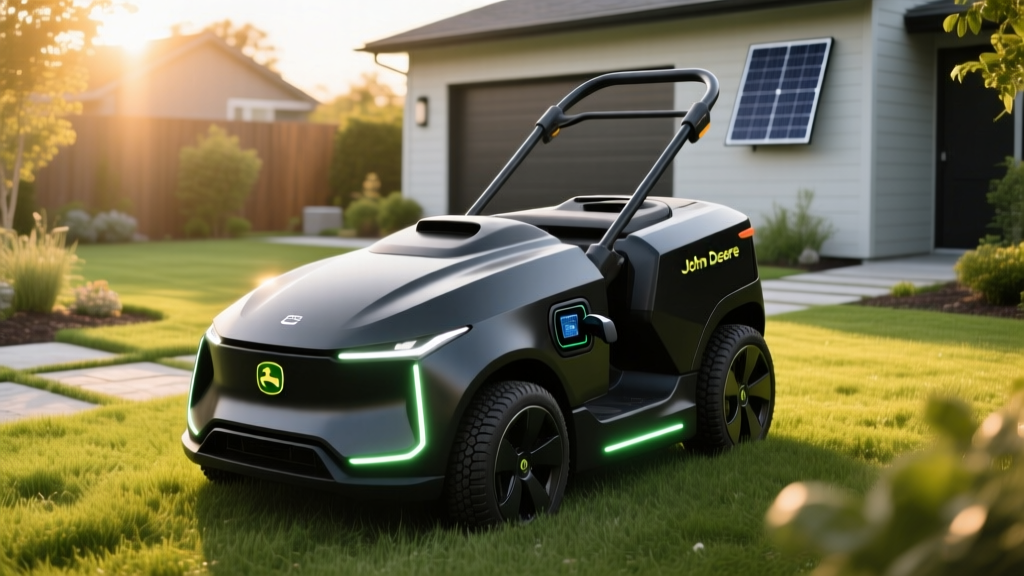
Searching for a John Deere electric mower? Here is the fast answer you need before you buy: as of the 2026 model year, John Deere does not sell a mainstream residential battery-electric riding or push mower under its own brand in the United States. The company's electric mower lineup is focused on commercial turf equipment (like the battery-powered John Deere 260SL PrecisionCut triplex mower for golf courses) and its acquisition of electric-utility-vehicle maker Electric Autonomy / Kreisel-adjacent platforms. Residential buyers looking for a cordless John Deere-branded walk-behind mower will not find one on dealer lots today.
Quick Answer: Does John Deere Make an Electric Mower for Homes?
No — not for typical residential use in 2026. John Deere's battery-electric mowers are commercial-grade turf machines priced well above $15,000, aimed at golf courses and municipalities. For homeowners, John Deere still sells gas-powered push and riding mowers. If you want a cordless electric mower in the John Deere dealer ecosystem, you are currently out of luck. Competitors like EGO, Toro, Ryobi, and Craftsman dominate the residential battery-electric mowing segment.
That said, the question of whether to go electric for lawn care is one of the most practical EV-ownership decisions a homeowner can make. Below, we break down the real numbers — cost, run time, charging, and total ownership — so you can decide whether an electric mower (from whichever brand) makes sense for your yard, and how the economics compare to sticking with gas.
Why John Deere Hasn't Gone Electric for Residential Mowers
John Deere's core residential mower business is built around its well-known gas-powered push mowers (the JS series) and riding tractors (the S-series and X300/X500 lines). These machines use Briggs & Stratton or Kawasaki engines ranging from 190cc to 726cc, producing 6.5 to 25 horsepower. They are proven, serviceable at any small-engine shop, and price-competitive at $350–$4,500 MSRP.
The company's electrification strategy has prioritized larger equipment: agricultural tractors (the Autonomous Electric Tractor concept shown at CES), compact utility loaders, and commercial turf machines. The John Deere 260SL PrecisionCut electric triplex mower, for example, uses a lithium-ion battery pack to deliver zero-emission greens mowing — but it costs roughly $30,000+ and is sold exclusively to golf-course superintendents.
For the residential segment, John Deere appears to be watching the market rather than leading it. Brands like EGO Power+ (with their 56V ARC Lithium platform), Toro (60V Flex-Force), and Ryobi (40V ONE+) have already captured the cordless mower market with models priced between $300 and $900.
Electric Mower vs. Gas Mower: The Real Cost Comparison
Even though a John Deere electric mower is not available for homes, the electric-vs-gas decision is still relevant if you are considering a competitor brand. Let's run the numbers on a typical 21-inch self-propelled mower over a 5-year ownership period.
| Cost Category | Battery-Electric Mower | Gas-Powered Mower |
|---|---|---|
| Purchase price (MSRP) | $450–$700 | $350–$550 |
| Extra battery (if needed for large lots) | $150–$250 | N/A |
| Fuel/energy cost (5 years) | $25–$45 (electricity at $0.16/kWh) | $180–$280 (gasoline at $3.50/gal) |
| Oil changes & air filters | $0 | $50–$90 |
| Blade sharpening/replacement | $40–$75 | $40–$75 |
| Spark plug / carburetor service | $0 | $30–$60 |
| Battery replacement (year 4-5) | $100–$200 | N/A |
| Estimated 5-Year Total | $765–$1,345 | $650–$1,055 |
Key takeaway: Electric mowers cost more upfront but save $50–$100 per year on fuel and maintenance. The break-even point typically arrives in year 3 or 4. On a larger lot (0.5+ acres) where you need a second battery, the electric premium grows — but so do the gas costs.
Battery Specs That Actually Matter: kWh, Voltage, and Run Time
If you are shopping for any cordless electric mower, ignore marketing terms like "extended runtime" and focus on these concrete specifications:
- Battery capacity (watt-hours or kWh): This is the energy stored — directly analogous to a gas tank size. A typical residential mower battery holds 200–500 Wh (0.2–0.5 kWh). Higher Wh = longer run time.
- Voltage (V): Most residential platforms are 40V, 56V, or 60V. Higher voltage generally means more torque and better cutting performance in thick grass. Note: voltage is electrical pressure; watt-hours is total energy. Do not confuse them.
- Run time per charge: Expect 40–70 minutes from a fully charged 5.0–7.5 Ah battery on a 56V platform. That covers 0.25–0.5 acres of typical lawn. Lots over 0.75 acres will likely need a second battery or a mid-mow recharge (most batteries charge in 60–90 minutes on the included charger).
- Charge time: Standard chargers deliver 80–200 watts. A 5.0 Ah / 56V battery (280 Wh) on a 160W charger takes roughly 1.75 hours from empty. Fast chargers (available separately for some brands) can cut this to 30–45 minutes.
Common Electric Mower Misconceptions
| Myth | Fact |
|---|---|
| "Electric mowers can't cut thick or wet grass." | Modern 56V–60V brushless-motor mowers match gas mowers in most conditions. Very wet or overgrown grass will bog down any mower, but high-voltage platforms handle typical spring growth fine. |
| "The battery will die in 2 years." | Lithium-ion mower batteries from major brands (EGO, Toro, Ryobi) typically carry 3-year warranties and last 5–8 years with normal use. Store them indoors, avoid full discharges, and don't leave them on the charger indefinitely. |
| "You need solar panels to make electric mowing green." | Even on the average U.S. grid, mowing 30 times per year uses roughly 5–8 kWh of electricity — about $1.30 worth. The upstream emissions from that electricity are a fraction of burning 5–8 gallons of gasoline. |
| "John Deere makes a residential electric mower I just can't find." | As of 2026, John Deere does not sell a residential battery-electric walk-behind or riding mower. Their electric turf equipment is commercial-only. |
Real-World Ownership: What First-Time Electric Mower Buyers Should Know
Switching from gas to electric for lawn care is one of the simplest and most satisfying EV transitions a homeowner can make — but a few practical realities matter:
Charging Access Is Simple (You Already Have It)
Unlike electric cars, which may require a 240V Level 2 home charger installation ($500–$2,000 depending on panel capacity and wiring), electric mowers charge from any standard 120V household outlet. There is no installation cost, no electrician visit, and no permit. You simply plug in the charger. This is the equivalent of "Level 1" EV charging — slow by car standards (hours, not minutes), but perfectly adequate for a mower you use once a week.
Climate Affects Battery Performance
Lithium-ion batteries lose capacity in cold weather — just like EV car batteries. If you mow in early spring when temperatures are below 50°F, expect 15–25% less run time. Store your battery indoors at room temperature and install it just before mowing for best results. Extreme heat (above 95°F in direct sun) can also trigger thermal protection and reduce performance.
Battery Ecosystem Lock-In Is Real
Most cordless mower brands use proprietary battery platforms. If you buy an EGO 56V mower, the battery will also power EGO string trimmers, blowers, and chainsaws — but it will not fit a Ryobi or Toro tool. Choose your platform based on the full lineup of outdoor power equipment you plan to buy, not just the mower alone.
Decision Framework: Should You Buy Electric or Stick With Gas?
If / Then Decision Guide
- If your lot is under 0.5 acres → A single-battery electric mower (40V–60V, 4.0–7.5 Ah) will handle it on one charge. Go electric. Savings on gas and maintenance pay back the premium in ~3 years.
- If your lot is 0.5–1.0 acres → Budget for a second battery ($150–$250) or a fast charger. Electric still wins on operating cost, but make sure the run time covers your mowing pattern before buying.
- If your lot exceeds 1.0 acre → Consider a gas riding mower or a commercial-grade electric platform. Residential cordless mowers are not designed for large properties. This is where you might wish for a John Deere electric riding mower — but one does not yet exist at the residential level.
- If you hate small-engine maintenance (carburetor cleaning, oil changes, winterization with fuel stabilizer) → Electric eliminates all of it. This is the single biggest quality-of-life upgrade.
- If you already own tools on a cordless platform (Ryobi 40V, EGO 56V, Toro 60V, DeWalt 20V/60V) → Buy the mower in the same ecosystem to share batteries and chargers.
- If noise is a concern (early morning mowing, close neighbors, HOA rules) → Electric mowers run at roughly 65–75 dB vs. 85–95 dB for gas. That is a significant real-world difference.
What About a Used or Aftermarket Electric Conversion?
Some DIY-minded owners have attempted to convert gas-powered John Deere riding mowers to electric using aftermarket motor kits and lithium battery packs. While technically possible, these conversions are:
- Not supported by John Deere and will void any remaining warranty.
- Expensive: A proper conversion (brushless DC motor, motor controller, 48V–72V lithium pack, BMS, charger, and fabrication) typically costs $1,500–$3,500 in parts alone — often more than buying a new cordless walk-behind mower from EGO or Toro.
- Safety-sensitive: Improperly wired high-current battery systems can cause fires. Unless you have electrical engineering experience, this is not a beginner project.
For most homeowners, the practical path is to buy a purpose-built cordless electric mower from a brand that currently offers one, and keep your John Deere gas tractor for heavy-duty tasks like towing, leaf collection, or snow removal if you own one.
Federal Tax Credits and Incentives for Electric Lawn Equipment
As of 2026, the IRS §30D Clean Vehicle Credit applies only to on-road vehicles (cars, trucks, vans) that meet MSRP, income, and battery-sourcing requirements. Lawn mowers — electric or otherwise — do not qualify for the federal EV tax credit.
However, some state and local programs offer rebates for electric outdoor power equipment. California's CARB (California Air Resources Board) has historically offered rebates for zero-emission lawn equipment under its CORE and related programs. Certain utility companies also run seasonal promotions offering $50–$150 rebates on Energy Star-qualified cordless mowers. Check with your local air quality management district and electric utility for current offers — these vary significantly by jurisdiction and change frequently.
Frequently Asked Questions
Does John Deere make any electric mower I can buy for my home?
No. As of the 2026 model year, John Deere's electric mowers are commercial turf machines (such as the 260SL PrecisionCut triplex mower for golf courses) priced above $15,000–$30,000. The company does not offer a residential battery-electric walk-behind or riding mower.
What is the best electric mower alternative if I want John Deere quality?
For build quality and dealer support, the closest analogues are the Toro Recycler 60V series (sold at Toro dealers, ~$500–$700) and the EGO Power+ 56V Select Cut (widely available at home centers, ~$450–$650). Neither matches John Deere's steel-deck durability on their gas tractors, but both offer excellent cut quality for residential lawns.
How much does it cost to charge an electric mower per season?
A typical residential electric mower uses about 0.2–0.4 kWh per charge. At the U.S. average electricity rate of ~$0.16/kWh, each full charge costs roughly $0.03–$0.06. Over a 30-mow season, you will spend approximately $1.00–$2.00 on electricity — compared to $35–$55 for gasoline.
Will a John Deere electric mower be available in the future?
John Deere has publicly committed to expanding its electric and hybrid equipment portfolio, and the company's investments in battery technology (including partnerships with Kreisel Electric) suggest residential electric mowers could eventually arrive. However, no specific product announcement or timeline has been confirmed as of early 2026. Any future model should be treated as announced/preliminary until it appears on dealer price lists.
Is an electric mower powerful enough for thick Southern grass?
High-voltage platforms (56V–60V with brushless motors) handle St. Augustine, Bermuda, and Zoysia grass well when mowed regularly (weekly during peak growth). The key is to not let grass exceed 5–6 inches between cuts. If you mow infrequently or have a heavily shaded, damp lawn, a gas mower's sustained torque advantage may still be noticeable.