Why Joe Rogan's Tesla Model S Plaid Still Matters in 2026
Joe Rogan's Tesla obsession is well-documented across his podcast, social media, and comedy specials. He's owned multiple Model S vehicles, famously put a Plaid through its paces, and frequently discusses Tesla's engineering on The Joe Rogan Experience. But beyond the celebrity endorsement and viral drag-race clips, how does the 2026 Tesla Model S Plaid actually stack up as a daily-driver EV? We put the flagship sedan through our full review framework — EPA range versus real-world results, charging-curve behavior, battery chemistry, ownership costs, and IRS §30D tax-credit eligibility — to separate substance from hype.
The Model S Plaid remains one of the quickest production cars ever built, but in a market now crowded with the Lucid Air Sapphire, Porsche Taycan Turbo GT, and BMW i7, the calculus has changed. Here's what the numbers actually say.
2026 Model S Plaid: Full Spec Sheet
| Specification | 2026 Tesla Model S Plaid |
|---|---|
| Base MSRP | $94,990 (before incentives) |
| EPA Range | 396 miles (19" wheels) / 359 miles (21" wheels) |
| Battery Capacity | ~100 kWh usable (NMC chemistry) |
| Drivetrain | Tri-motor AWD |
| Horsepower | 1,020 hp |
| 0-60 mph | 1.99 seconds (manufacturer, with rollout) |
| Top Speed | 200 mph |
| Max DC Fast Charge | 250 kW peak (V3 Supercharger) |
| 10-80% DC Charge Time | ~30 minutes |
| Level 2 Home Charge Rate | 11.5 kW (~41 miles/hr at 48A) |
| MPGe (Combined) | 116 MPGe (EPA) |
| Efficiency | 29 kWh/100 miles |
| Cargo Volume | 28.4 cu ft (rear) + 3.1 cu ft (frunk) |
| Rear Legroom | 35.4 inches |
| Battery Warranty | 8 years / 150,000 miles (70% retention) |
| Basic Vehicle Warranty | 4 years / 50,000 miles |
EPA Range vs. Real-World Range: What You'll Actually Get
Real-World Expectation: ~310-340 miles highway at 70-75 mph; ~250-280 miles in freezing temperatures with cabin heat; ~370+ miles in mild city/suburban driving with regen.
The Model S Plaid's 100 kWh-class NMC (nickel manganese cobalt) battery pack delivers strong energy density, but real-world efficiency depends heavily on driving style, ambient temperature, and wheel choice. The 19-inch Tempest wheels yield the 396-mile EPA figure; stepping to the 21-inch Arachnid wheels drops that to 359 miles — a meaningful 37-mile hit.
On a 300-mile highway run at sustained 75 mph in 70°F weather, expect to arrive with roughly 10-15% State of Charge remaining. In winter conditions (below 30°F), range loss of 25-35% is typical for NMC packs without aggressive preconditioning. The Plaid's heat pump helps mitigate this, but cold-weather road trippers should plan charging stops around ~250 miles of usable range to maintain a safety buffer.
According to fueleconomy.gov, the combined MPGe rating sits at 116, translating to 29 kWh per 100 miles. That's competitive with the Lucid Air Grand Touring (131 MPGe) but less efficient than the smaller Tesla Model 3 Long Range (132 MPGe), which benefits from lower weight.
Charging Speed: DC Fast Charge and Home Level 2
| Charging Level | Power (kW) | Speed (miles added/hr) | Notes |
|---|---|---|---|
| Level 1 (120V) | 1.4 kW | ~5 mi/hr | Emergency/trickle only |
| Level 2 (240V, 48A) | 11.5 kW | ~41 mi/hr | Full charge in ~9 hours |
| DC Fast (V3 Supercharger) | 250 kW peak | ~1,000 mi/hr at peak | 10-80% in ~30 min |
| DC Fast (V4 Supercharger) | Up to 250 kW* | Similar to V3 | *Model S limited by vehicle architecture, not station |
The Model S Plaid peaks at 250 kW on Tesla's V3 Supercharger network. However — and this is a critical distinction many buyers miss — peak kW is not sustained kW. The Plaid's charge curve tapers significantly above 55-60% State of Charge. You'll see 250 kW briefly between roughly 15-35% SoC, then a step-down to ~180 kW, and further tapering above 70%. The 10-80% time of approximately 30 minutes reflects this average, not the headline peak.
For context, the Lucid Air Grand Touring with its 900V+ architecture can accept over 300 kW at compatible Electrify America stations, achieving 10-80% in roughly 22 minutes. The 800V Porsche Taycan Turbo GT similarly outpaces the Plaid at compatible DC stations.
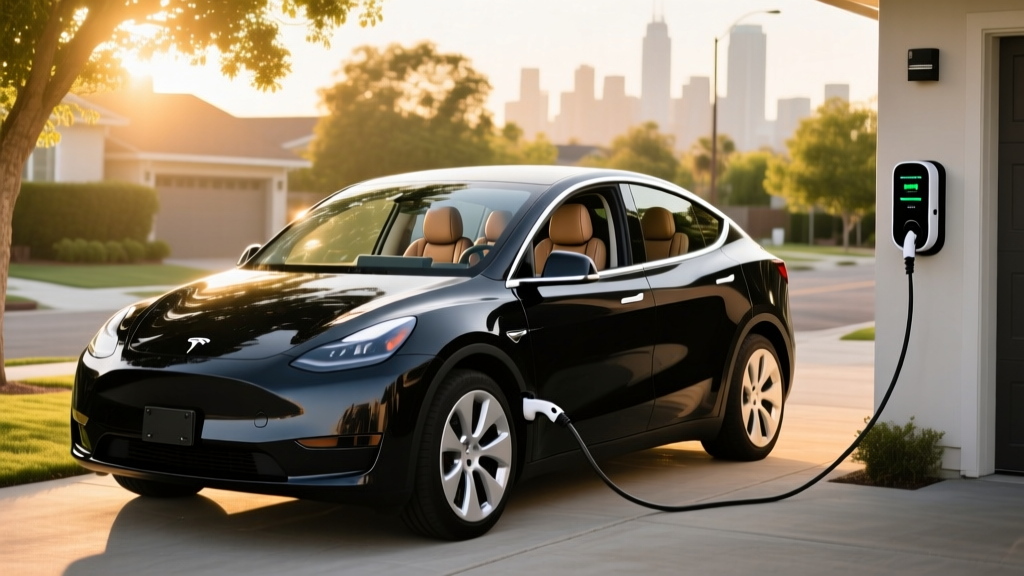
At home on a Level 2 Wall Connector (240V, 48 amps), the Plaid adds about 41 miles of range per hour. A full overnight session (8-9 hours) replenishes the pack from near-empty. Most owners with a daily commute under 80 miles will rarely need a full charge — plugging in each evening maintains the battery between 20-80% SoC, which Tesla recommends for NMC chemistry longevity.
Performance, Tech, and the Driving Experience
The tri-motor powertrain (one front, two rear) produces 1,020 horsepower and delivers the now-famous 1.99-second 0-60 mph time — though that figure requires the manufacturer's 1-foot rollout subtraction and prepped surface. In real-world street launches, expect 2.3-2.5 seconds. That's still violently quick and firmly in hypercar territory.
The yoke steering wheel remains standard on the Plaid. Love it or hate it, it provides an unobstructed view of the 12.3-inch driver display and forces adaptation. Highway tracking is fine; low-speed parking maneuvers and three-point turns are where the yoke's lack of hand-over-hand capability frustrates.
Tesla's Autopilot comes standard, with Full Self-Driving (Supervised) available as a $8,000 add-on or $99/month subscription.
Autopilot and FSD (Supervised) are driver-assistance systems, not autonomous driving. The driver must remain fully engaged, hands on the wheel (or yoke), and eyes on the road at all times. Tesla's FSD (Supervised) can navigate intersections, stop signs, and highway interchanges, but it makes errors that require immediate human intervention. Only Level 4 systems like Waymo operate without a human driver.
The 17-inch center touchscreen runs Tesla's latest software with an AMD Ryzen processor — responsive, feature-dense, and packed with entertainment (Netflix, YouTube, gaming). The glass roof, ventilated front seats, and 22-speaker audio system round out the premium experience. Wireless phone charging, HEPA air filtration (Bioweapon Defense Mode), and power-folding mirrors are all included.
Notable drawbacks: rear-seat space is tighter than rivals (35.4" legroom vs. the Lucid Air's ~41"). Build quality has improved but panel gaps still occasionally trail German competitors. There's no Apple CarPlay or Android Auto — Tesla's ecosystem is closed. And the minimalist interior, with virtually all controls routed through the touchscreen, remains polarizing.
Pricing, Trims, and Federal Tax Credit Eligibility
| Item | Amount |
|---|---|
| Model S Plaid Base MSRP | $94,990 |
| FSD (Supervised) Add-On | +$8,000 (or $99/mo) |
| 21" Arachnid Wheels | +$4,500 |
| As-Tested Price (loaded) | ~$107,490 |
| Federal §30D Tax Credit | $0 — MSRP exceeds $55,000 sedan cap |
| Estimated Out-of-Pocket | $94,990+ (no federal credit) |
Here's where the math gets unfavorable: the Model S Plaid does not qualify for the $7,500 federal EV tax credit under IRS §30D. The law caps eligible sedans at an MSRP of $55,000. At nearly $95,000, the Plaid is well above that threshold. The credit also has buyer income caps ($150,000 single / $300,000 joint filing) and battery-critical-mineral sourcing requirements, but the MSRP cap alone disqualifies the Plaid regardless of income.
For the latest §30D rules and eligibility criteria, consult the IRS clean vehicle credit page. State-level incentives may apply — California's CVRP, for example, has its own income and price thresholds — but these vary by jurisdiction. Consult your state's energy office or a tax professional for specifics.
Compare this to the Tesla Model 3 Long Range AWD ($47,990 MSRP), which does qualify for the full $7,500 credit when sourced with compliant battery minerals, bringing its effective price to roughly $40,490. The Plaid's value proposition is performance, not incentives.
Model S Plaid vs. Key Competitors
| Spec | Tesla Model S Plaid | Lucid Air Sapphire | Porsche Taycan Turbo GT |
|---|---|---|---|
| Price | $94,990 | $249,000 | $230,000 |
| EPA Range | 396 mi | 427 mi | 269 mi |
| 0-60 mph | 1.99s | 3.2s | 2.1s |
| Horsepower | 1,020 hp | 1,234 hp | 1,092 hp |
| Max DC Charge | 250 kW | 300+ kW | 320 kW |
| Rear Legroom | 35.4" | 41.0" | 32.7" |
The Plaid's strongest argument is value-per-horsepower. At $94,990 for 1,020 hp and a sub-2-second 0-60, nothing at this price point delivers comparable performance. The Lucid Air Sapphire is faster in a quarter-mile and has superior range and charging speed, but at $249,000 it's in a different stratosphere. The Taycan Turbo GT handles better on a track but sacrifices 127 miles of range and costs more than double.
For buyers who want a practical luxury EV sedan with supercar acceleration and don't need cutting-edge charging architecture, the Plaid occupies a unique value niche. For those prioritizing range, charging speed, or rear-seat comfort, the Lucid Air Grand Touring ($125,600, 516 miles EPA) is a compelling alternative — though at a higher price.
Pros and Cons
- 1,020 hp and 1.99s 0-60 at under $95K — unmatched performance-per-dollar
- 396-mile EPA range (19" wheels) is excellent for a performance sedan
- Access to Tesla Supercharger network — the most reliable DC fast-charging network in the US
- OTA software updates continuously add features
- Low running costs: ~$0.04-$0.06/mile on home electricity vs. $0.15+/mile for comparable gas supercars
- Strong safety ratings (NHTSA 5-star)
- No federal tax credit eligibility (MSRP exceeds $55K sedan cap)
- 250 kW max DC charge rate trails 800V rivals (Lucid, Porsche, Hyundai)
- Yoke steering is polarizing and impractical for low-speed maneuvers
- Rear-seat legroom (35.4") lags competitors significantly
- No Apple CarPlay or Android Auto
- FSD (Supervised) remains Level 2 — not autonomous despite the name
- Insurance premiums run 20-40% higher than equivalent gas sedans
Who Should Buy the Model S Plaid?
- You want supercar acceleration in a four-door sedan with 396 miles of range
- You value Tesla's Supercharger network for road-trip convenience
- You have home Level 2 charging access for daily use
- Performance-per-dollar matters more than rear-seat space or tax incentives
- You need maximum DC charging speed for frequent long road trips (consider Lucid Air)
- Rear-seat passenger comfort is a priority (consider BMW i7 or Lucid Air)
- You want federal tax credit savings (consider Model 3 LR or Model Y LR)
- You prefer traditional steering wheels over the yoke
The Joe Rogan Tesla connection brought mainstream attention to the Model S Plaid's absurd performance, but the car earns its place on engineering merit. It's a 396-mile, 1,020-horsepower daily driver that costs less than half its nearest performance rival. Just go in with eyes open about the charging architecture, tax-credit ineligibility, and the realities of real-world range.
Frequently Asked Questions
What is the real-world range of the Tesla Model S Plaid?
The EPA rates it at 396 miles on 19-inch wheels. In real-world highway driving at 70-75 mph, expect 310-340 miles. In cold weather (below 30°F), plan for 250-280 miles. City driving with regenerative braking can approach or slightly exceed the EPA figure.
How fast does the Model S Plaid charge at home and on the road?
On a Level 2 home charger (240V, 48A), it adds roughly 41 miles of range per hour, reaching a full charge in about 9 hours. On a V3 Supercharger, it peaks at 250 kW and charges from 10-80% in approximately 30 minutes, though the charge curve tapers significantly above 60% SoC.
Does the Tesla Model S Plaid qualify for the $7,500 federal EV tax credit?
No. Under IRS §30D rules, sedans must have an MSRP at or below $55,000 to qualify. The Model S Plaid starts at $94,990, well above the cap. Buyer income limits and battery-sourcing rules are secondary disqualifiers. Always verify current rules at irs.gov.
What battery chemistry does the Model S Plaid use?
The Plaid uses NMC (nickel manganese cobalt) chemistry in its ~100 kWh usable pack. NMC offers high energy density but Tesla recommends charging to 80% for daily use (unlike LFP packs, which tolerate 100% daily charges). The battery warranty covers 8 years or 150,000 miles, whichever comes first, with a 70% capacity retention guarantee.
Is the Model S Plaid self-driving?
No. Tesla's Autopilot and FSD (Supervised) are SAE Level 2 driver-assistance systems. The driver must remain fully attentive, with hands on the yoke and eyes on the road. FSD can handle highway interchanges, stop signs, and some city streets, but it makes errors requiring human intervention. It is not autonomous driving.
Is the Model S Plaid worth it versus a Lucid Air or Porsche Taycan?
At $94,990, the Plaid delivers 1,020 hp and 396 miles of range for a fraction of the Lucid Air Sapphire ($249,000) or Taycan Turbo GT ($230,000). If you prioritize performance-per-dollar and Supercharger access, it's the clear winner. If you need faster DC charging, more rear-seat room, or track-focused handling, the rivals justify their premiums.