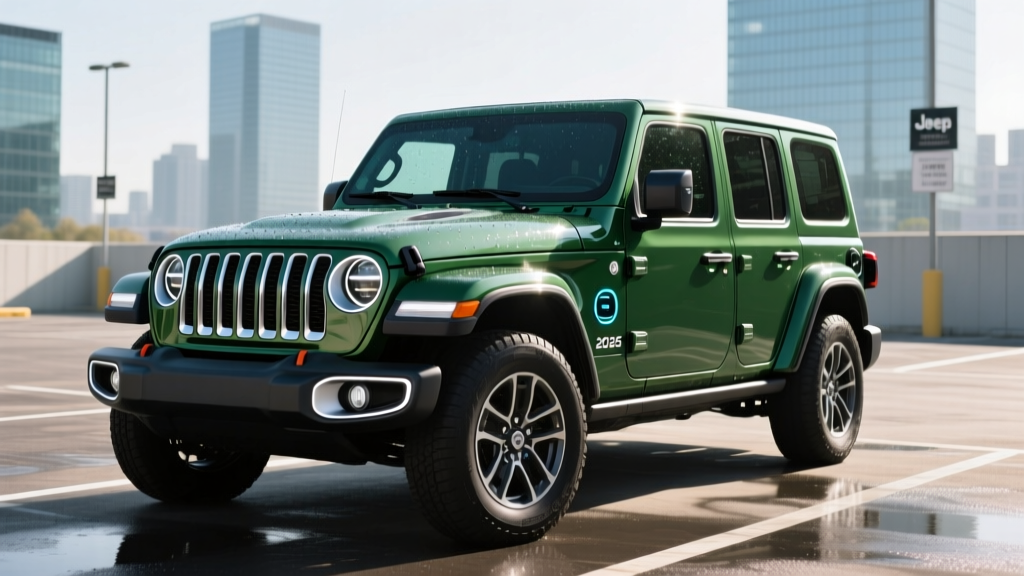
If you've spent any time browsing Jeep forums, you've likely seen the question: what is the 2008 Jeep Wrangler bolt pattern? The answer — 5×127 mm (also expressed as 5×5 inches) — is more than trivia. That same 5-lug bolt pattern carried forward through every JK and JL generation, meaning the 2026 Jeep Wrangler 4xe plug-in hybrid still shares its wheel architecture with its 2008 ancestor. For wheel-swap enthusiasts, off-road builders, and PHEV buyers alike, that continuity matters.
But bolt patterns are only part of the story. The 2026 Wrangler 4xe is a plug-in hybrid that pairs a turbocharged gasoline engine with a 17.3 kWh battery pack, delivering an EPA-estimated 22 miles of electric-only driving before the 2.0L turbo I4 kicks in. Below, we break down the real-world range, charging speeds, pricing after federal tax credits, and whether the Wrangler 4xe earns its place in your garage.
Quick Verdict: Who the Wrangler 4xe Is For
Buy the Wrangler 4xe if: You want genuine off-road capability with an electric-only commute buffer, need a removable roof and doors, and plan to leverage the federal tax credit to offset the premium over the gas-only Wrangler.
Look elsewhere if: You want 40+ miles of electric range (check the RAV4 Prime), prioritize on-road refinement, or never leave pavement.
Electric Range, Battery, and Real-World Efficiency
| Spec | Value |
|---|---|
| EPA Electric-Only Range | 22 miles |
| Battery Capacity (Usable) | 17.3 kWh (NMC lithium-ion) |
| Combined MPGe (Electric) | 49 MPGe |
| Gas-Only Combined MPG | 20 MPG |
| Total Range (Electric + Gas) | ~370 miles |
| Drivetrain | 4WD (part-time, with electric motor integrated into 8-speed auto) |
Real-World Range Note: The EPA's 22-mile electric estimate assumes moderate temperatures and mixed driving. Expect 16–18 miles of electric range in sustained highway driving at 70+ mph, and as little as 13–15 miles in freezing temperatures with cabin heat on. The Wrangler 4xe's boxy aerodynamics and heavy curb weight (~5,100 lbs) eat into electric efficiency at speed. For a 10-mile round-trip commute in mild weather, though, most owners report staying in EV mode all week.
The 17.3 kWh pack uses NMC (nickel manganese cobalt) chemistry, chosen for its energy density in a space-constrained under-seat location. Unlike LFP packs found in some competitors, NMC offers more range per pound but benefits from staying between 20–80% state of charge for long-term longevity. Jeep's battery management system includes a buffer, so you won't see the full 17.3 kWh as usable capacity on the dash.
Charging Speed: DC Fast Charge and Home Level 2
Charging is where the Wrangler 4xe reveals its PHEV limitations — and its practical strengths.
| Level | Power (kW) | 0–100% Time | Notes |
|---|---|---|---|
| Level 1 (120V household) | ~1.4 kW | ~12 hours | Overnight top-up only |
| Level 2 (240V home/public) | 7.2 kW | ~2.5 hours | Full charge while you work or sleep |
| DC Fast Charge | Not supported | N/A | No DC fast-charge port on PHEV |
Like most plug-in hybrids, the Wrangler 4xe does not support DC fast charging. The battery is too small to justify the hardware cost, and Level 2 at 7.2 kW refills the pack in roughly 2.5 hours — fast enough to recharge during a workday or while running errands. If you install a home Level 2 charger (a 240V/32A circuit), you'll wake up to a full battery every morning, which is the whole point of PHEV ownership.
For home charging setup, budget $500–$1,200 for a quality Level 2 EVSE (ChargePoint Home Flex, Emporia Level 2, or similar) plus $300–$1,500 for electrician labor depending on panel proximity. A full home charging installation guide covers panel-upgrade scenarios.
Performance: Horsepower, 0–60, and Off-Road Capability
The 4xe powertrain pairs a 2.0L turbocharged inline-four with an electric motor integrated into the ZF 8-speed automatic transmission. Combined output:
- Combined horsepower: 375 hp
- Combined torque: 470 lb-ft
- 0–60 mph: 6.0 seconds
- Drivetrain: Part-time 4WD with low range (Rubicon trim includes front/rear locking differentials and electronic sway-bar disconnect)
The electric motor fills the turbo lag gap beautifully, delivering instant torque off the line. Around town in electric mode, the Wrangler 4xe is surprisingly quiet and responsive — a stark contrast to the gas-only model's idle rumble. Off-road, the electric motor's low-speed precision is a genuine advantage on technical trails, letting you crawl without feathering the throttle.
Towing capacity drops slightly vs. the gas V6: 3,500 lbs for the 4xe vs. 3,500 lbs for the turbo-four gas model (the 3.6L V6 gas Wrangler can tow 3,500 lbs as well, so no real penalty here).
Pricing, Trim Levels, and Federal Tax Credit Eligibility
| Trim | Base MSRP | Est. After §30D Credit |
|---|---|---|
| Willys 4xe | $51,790 | ~$48,040* |
| Sport S 4xe | $53,790 | ~$50,040* |
| Sahara 4xe | $57,790 | ~$54,040* |
| Rubicon 4xe | $59,790 | ~$56,040* |
| High Altitude 4xe | $63,790 | ~$60,040* |
*Estimated effective price assumes $3,750 federal tax credit. Actual credit amount and eligibility vary — see details below. Destination charge (~$1,995) not included.
Does the Wrangler 4xe Qualify for the Federal EV Tax Credit?
The Wrangler 4xe qualifies as a plug-in hybrid under IRS §30D clean vehicle rules, but the credit amount is not a flat $7,500. As of 2026, the Wrangler 4xe typically qualifies for $3,750, reflecting partial compliance with critical-mineral and battery-component sourcing requirements. Full eligibility depends on:
- MSRP cap: SUVs must be under $80,000 — all Wrangler 4xe trims clear this easily.
- Buyer income cap: Modified AGI must not exceed $150,000 (single), $225,000 (head of household), or $300,000 (joint).
- Battery sourcing: Critical minerals and battery components must meet phased-in domestic/free-trade-partner thresholds. Jeep's supply chain currently earns the 4xe half-credit ($3,750) in most configurations.
- Point-of-sale transfer: You can elect to transfer the credit to the dealer at purchase, reducing your out-of-pocket cost immediately rather than waiting for tax filing.
Consult a tax professional to confirm your personal eligibility. Rules change annually, and battery-sourcing compliance can shift with model-year production runs.
Bolt Pattern Continuity: 2008 Jeep Wrangler to 2026 4xe
Here's why off-road enthusiasts care about bolt patterns: the 2008 Jeep Wrangler bolt pattern is 5×127 mm (5×5 inches), and Jeep has maintained this exact pattern through the entire JK generation (2007–2018) and into the current JL generation (2018–present), including the 4xe. That means:
- Wheels from a 2008 Wrangler JK will physically bolt onto a 2026 Wrangler 4xe JL (assuming correct offset, backspacing, and center bore compatibility).
- The vast aftermarket wheel ecosystem built around the 5×127 pattern — Method Race, Black Rhino, Fuel Off-Road, Pro Comp — fits the 4xe without adapters.
- Brake rotor and hub assemblies share dimensional lineage, simplifying upgrades.
However, the 4xe's additional ~500 lbs of battery and motor weight means you should prioritize load-rated wheels (Load Range D or E for larger tires) and verify that any used JK-era wheels are structurally sound for the heavier PHEV platform.
Interior, Cargo, and Technology
The Wrangler 4xe sacrifices nothing in utility vs. its gas sibling. The battery pack sits under the rear seat, preserving cargo volume:
- Cargo behind rear seats: 31.7 cu ft (4-door Unlimited)
- Cargo with rear seats folded: 72.4 cu ft
- Rear legroom: 38.3 inches
- Front legroom: 41.2 inches
The 2026 model year brings the Uconnect 5 infotainment system with a standard 8.4-inch touchscreen (12.3-inch on Sahara and above), wireless Apple CarPlay/Android Auto, and available integrated off-road trail mapping. The 4xe-specific display pages show real-time energy flow, battery state of charge, and regen-braking contribution — useful for hypermiling your electric miles.
Driver-assist features include adaptive cruise control, forward collision warning with automatic emergency braking, lane-keep assist, and blind-spot monitoring. These are SAE Level 2 driver-assist systems — you must keep hands on the wheel and eyes on the road at all times. This is not autonomous driving.
Notable Drawbacks: The 4xe's added weight is noticeable in body roll during cornering, and the regenerative braking feel is less aggressive than full EVs — you won't get true one-pedal driving. Road noise at highway speed remains significant (removable roofs have trade-offs), and the rear-seat cushion is slightly elevated due to the battery underneath, reducing headroom for taller passengers.
Warranty and Long-Term Ownership
| Component | Coverage |
|---|---|
| Hybrid Battery | 8 years / 100,000 miles (10 yr/150,000 mi in CARB states) |
| Powertrain (engine + transmission + motor) | 5 years / 60,000 miles |
| Bumper-to-Bumper | 3 years / 36,000 miles |
| Hybrid Battery Capacity Retention | Warranted to retain ≥70% capacity over coverage period |
The hybrid battery warranty is the headline here. At 8 years/100,000 miles (extended in CARB-emission states like California, New York, and Colorado), it provides meaningful peace of mind. The 70% capacity-retention threshold is industry-standard for PHEVs. Given the 17.3 kWh pack size, a 30% degradation would reduce electric range to ~15 miles — still functional, but noticeably diminished.
Wrangler 4xe vs. Key Competitors
Choose the Wrangler 4xe if:
- You need real 4WD with low range and locking diffs
- You want a removable roof/doors and fold-down windshield
- Trail crawling and overlanding are priorities
- You value bolt-pattern continuity with the aftermarket ecosystem dating back to the 2008 Jeep Wrangler
Consider competitors if:
- Toyota RAV4 Prime: 42-mile electric range, 94 MPGe, better on-road manners — but no serious off-road hardware
- Ford Bronco Sport PHEV (if available): More car-like ride, but less trail capability
- Grand Cherokee 4xe: Same powertrain, more comfort and range, but no removable top
Frequently Asked Questions
What is the 2008 Jeep Wrangler bolt pattern, and does it fit the 2026 4xe?
The 2008 Jeep Wrangler bolt pattern is 5×127 mm (5×5 inches). This same pattern carries through to the 2026 Wrangler 4xe. Wheels will physically mount, but verify offset, backspacing, center bore, and load rating for the 4xe's heavier curb weight.
What is the real-world electric range of the Wrangler 4xe?
The EPA rates it at 22 miles electric-only. Real-world testing shows 16–18 miles at highway speed, 13–15 miles in freezing weather, and up to 22 miles in mild-temperature city driving with regen braking active.
Does the Wrangler 4xe support DC fast charging?
No. Like nearly all PHEVs, the Wrangler 4xe charges on Level 1 (120V, ~12 hours) or Level 2 (240V at 7.2 kW, ~2.5 hours). DC fast charging is not available.
How much does the Wrangler 4xe cost after federal tax credits?
Base MSRP starts at $51,790 for the Willys 4xe. With the current $3,750 partial federal tax credit (subject to income and sourcing rules), effective pricing starts around $48,040 before destination and dealer fees.
Is the Wrangler 4xe worth buying over the gas-only Wrangler?
If you can charge at home and your daily commute falls within the 22-mile electric window, the 4xe saves on fuel and delivers smoother, quieter around-town driving. The $3,750+ tax credit narrows the price gap. If you never charge, you're carrying 500 lbs of dead battery weight — get the gas model instead.
Sources: EPA Fuel Economy — Jeep Wrangler 4xe, IRS Clean Vehicle Tax Credits, Jeep Official Wrangler 4xe Page.