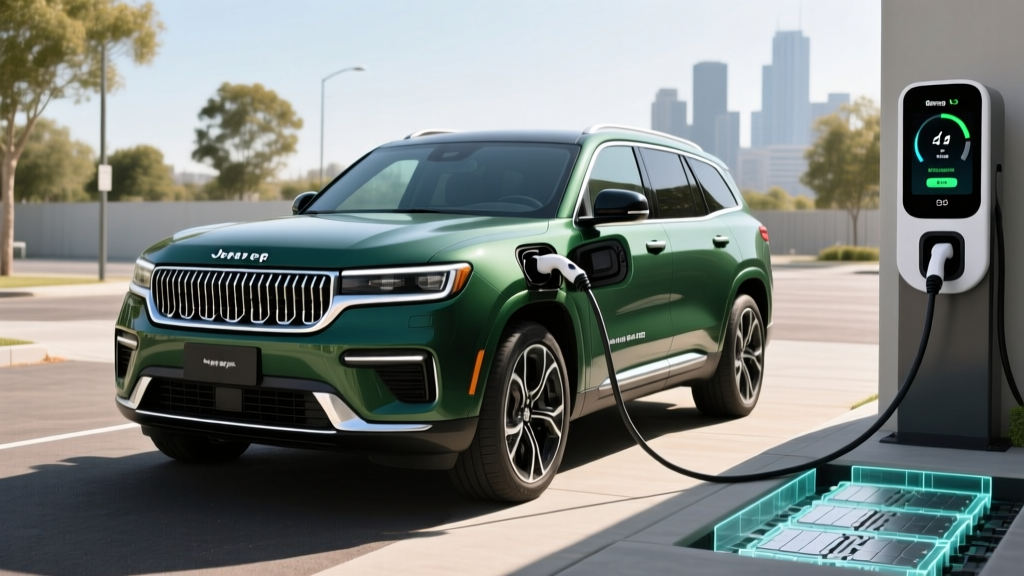
The 2026 Jeep Wagoneer S Limited arrives as Stellantis' first fully electric Jeep built on the dedicated STLA Large platform, targeting luxury electric SUV buyers who want off-road credibility without the fuel bill. As the entry point to the Wagoneer S lineup, the Limited trim packages dual-motor all-wheel drive, a 100 kWh battery, and a tech-forward cabin into a sub-$66,000 package before incentives. We've spent time with the specs, the EPA data, and the real-world charging behavior to tell you whether this electric Jeep earns a spot in your driveway—or whether rivals like the Hyundai Ioniq 5, Tesla Model Y, or Rivian R1S make more sense.
2026 Jeep Wagoneer S Limited at a Glance
| Spec | Value |
|---|---|
| EPA Range | 300 miles (est.) |
| Battery (Usable) | ~100 kWh, NMC lithium-ion |
| Drivetrain | Dual-motor AWD |
| Horsepower | ~500 hp (combined) |
| 0-60 mph | ~4.4 seconds |
| Max DC Fast Charge | ~100 kW peak |
| 10-80% DCFC Time | ~33 minutes |
| Level 2 Home Charge | ~11.5 kW (~30 mi/hr) |
| MPGe (Combined) | ~92 MPGe (est.) |
| Cargo (Behind 2nd Row) | ~30 cu ft |
| Battery Warranty | 8 years / 100,000 miles |
| Base MSRP (Limited) | $65,200 (before destination) |
Range and Efficiency: EPA vs the Real World
Jeep targets an EPA-estimated 300 miles of range for the Wagoneer S Limited with its ~100 kWh usable NMC (nickel-manganese-cobalt) battery pack. That figure positions it squarely between the Hyundai Ioniq 5 Long Range AWD (290 miles EPA) and the Tesla Model Y Long Range (320+ miles EPA), though the Jeep carries more mass and a boxier aerodynamic profile than either crossover rival.
Efficiency lands around 92 MPGe combined (estimated), translating to approximately 36 kWh per 100 miles. That's thirstier than a Model Y (~28 kWh/100mi) but competitive with the Rivian R1S and BMW iX, which share the Wagoneer S's premium-SUV heft. Regenerative braking offers multiple levels including a one-pedal-driving mode that recovers aggressively in city traffic.
Charging Speed: DC Fast Charging and Home Setup
The Wagoneer S Limited's charging story is where honest expectations matter most. The STLA Large platform supports a peak DC fast-charge rate of approximately 100 kW — respectable, but not class-leading. Competitors like the Hyundai Ioniq 5 (peak 240 kW via 800V architecture) and the Kia EV6 leave it behind at 350 kW chargers.
| Charging Level | Power | Speed | Notes |
|---|---|---|---|
| Level 1 (120V) | ~1.4 kW | ~4 mi/hr | Emergency/trickle only |
| Level 2 (240V, 48A) | ~11.5 kW | ~30 mi/hr | Full charge in ~9-10 hours |
| DC Fast Charge | ~100 kW peak | 10-80% in ~33 min | Tapers significantly above 80% |
Charging curve reality: The 100 kW peak is not sustained. Expect the Wagoneer S to hold near peak rate from roughly 10-50% state of charge, then taper progressively. The 10-80% session takes approximately 33 minutes at a 150 kW or higher station. Above 80%, charge speed drops sharply to protect the NMC cells — a full 80-100% top-off can add another 25-30 minutes.
For home Level 2 charging, the onboard charger accepts up to 11.5 kW on a 240V/48A circuit (hardwired or NEMA 14-50 with appropriate breaker). A full overnight charge from near-empty takes roughly 9-10 hours. Most owners will plug in nightly and wake to a full battery — the 300-mile buffer means most daily commutes consume less than 20% of the pack. Home installation typically requires a 60A dedicated circuit; budget $1,200-$2,500 for professional electrician work depending on panel proximity, per industry averages.
The Wagoneer S uses the NACS (North American Charging Standard) connector as standard for 2026, granting native access to the Tesla Supercharger network — a significant practical advantage over CCS-only vehicles that require adapters. For Electrify America and other CCS networks, a NACS-to-CCS adapter is included.
Performance and Drivetrain
Jeep rates the dual-motor Wagoneer S Limited at approximately 500 combined horsepower with standard all-wheel drive. The result is a 0-60 mph time of roughly 4.4 seconds — brisk for a luxury SUV and comfortably quicker than most gas-powered midsize SUVs in this price bracket. The instant torque delivery from both axles gives it strong passing punch at highway speeds.
The STLA Large platform's low-mounted battery keeps the center of gravity planted, and the adaptive air suspension (standard on Limited) manages body roll competently through corners. Off-road, Jeep includes the Selec-Terrain system with Snow, Sand, and Auto modes, plus a modest ground clearance advantage over crossover rivals. This isn't a Wrangler on electrons, but it handles gravel roads, snow, and light trail duty without complaint. Towing capacity is rated at approximately 5,000 pounds when properly equipped — adequate for a small boat or camper trailer.
Interior, Cargo, and Technology
The Wagoneer S cabin seats five across two rows, with generous front and rear legroom (estimated 41 inches front, 38 inches rear). Behind the second row, cargo volume measures approximately 30 cubic feet, expanding to an estimated 60+ cubic feet with the rear seats folded. A small front trunk (frunk) adds roughly 2-3 cubic feet for charging cables or a laptop bag.
Infotainment: The dashboard is dominated by a 12.3-inch digital instrument cluster, a 12.3-inch center touchscreen running Uconnect 5 EV, and an available 10.25-inch passenger display. Wireless Apple CarPlay and Android Auto are standard, along with a wireless charging pad. The system supports over-the-air updates for feature improvements and battery-management tuning.
Driver Assistance: The Wagoneer S Limited comes equipped with Jeep's Active Driving Assist — an SAE Level 2 system providing adaptive cruise control with lane centering on highways. This is a driver-supervision-required system, not autonomous driving. Available features include a 360-degree camera, head-up display, and night vision. Jeep has not announced a hands-free highway driving system (like GM's Super Cruise or Ford's BlueCruise) for the 2026 Wagoneer S, which is a notable gap versus competitors at this price point.
Pricing, Tax Credits, and Ownership Cost
The 2026 Wagoneer S Limited starts at a base MSRP of $65,200 (plus ~$1,795 destination). Options packages — including premium audio, tow package, and advanced safety bundles — can push a well-equipped example toward $72,000-$75,000.
| Trim | Base MSRP | Est. After §30D Credit |
|---|---|---|
| Wagoneer S Limited | $65,200 | $57,700 (if eligible) |
| Wagoneer S Limited w/ Premium Pkg | ~$72,000 | $64,500 (if eligible) |
The Wagoneer S Limited may qualify for up to $7,500 under the IRS §30D Clean Vehicle Credit, but eligibility is NOT guaranteed. Per current IRS rules, you must meet ALL of the following:
- MSRP Cap: SUVs must have an MSRP at or below $80,000 — the Wagoneer S Limited qualifies.
- Buyer Income Cap: Modified AGI must not exceed $150,000 (single), $225,000 (head of household), or $300,000 (joint filing).
- Battery Sourcing: Critical minerals and battery components must meet escalating domestic/free-trade-partner thresholds that tighten annually. Stellantis has not publicly confirmed full §30D compliance for the Wagoneer S battery supply chain as of early 2026 — verify on the IRS eligible vehicle list before purchase.
- Point-of-Sale Transfer: If eligible, you can transfer the credit to the dealer for an immediate price reduction at purchase.
Five-year ownership cost considerations: Electricity costs approximately $0.14-$0.18/kWh nationally (varies by utility), meaning a full 100 kWh charge costs roughly $14-$18 at home. Over 15,000 miles/year at 36 kWh/100mi, annual home charging costs approximately $750-$970 — versus $2,000-$2,500 for a comparable gas SUV at 22 MPG and $3.50/gallon. Insurance premiums for the Wagoneer S will run 15-25% higher than a gas equivalent due to repair-cost data on EVs; expect $2,200-$3,000/year depending on your profile. Depreciation for premium EV SUVs remains steeper than ICE counterparts — plan for 45-55% value retention at 5 years based on current EV market trends.
Battery Longevity and Warranty
Jeep backs the Wagoneer S's NMC battery pack with an 8-year/100,000-mile warranty (whichever comes first), covering defects and capacity loss below 70% of original capacity. This matches the federal minimum mandate and aligns with most competitors. The broader vehicle warranty is 3 years/36,000 miles bumper-to-bumper and 5 years/60,000 miles powertrain.
NMC chemistry offers excellent energy density (enabling the 300-mile range in a manageable pack size) but degrades slightly faster than LFP (lithium iron phosphate) over thousands of cycles. Real-world data from similar NMC packs suggests 10-15% capacity loss over 8-10 years with normal use — meaning a 300-mile new range might become 255-270 miles at year 10. Best practices for longevity include avoiding routine 100% charges (target 80-90% daily), minimizing repeated DC fast-charging sessions, and preconditioning the battery before fast charging in cold weather.
Wagoneer S Limited vs the Competition
The Wagoneer S Limited enters a crowded premium electric SUV segment. Here's how it stacks up on paper against three key rivals:
| Spec | Jeep Wagoneer S Limited | Tesla Model Y LR AWD | Hyundai Ioniq 5 Ltd AWD | Rivian R1S Dual |
|---|---|---|---|---|
| EPA Range | ~300 mi | ~320 mi | ~290 mi | ~316 mi |
| Battery | ~100 kWh NMC | ~75 kWh NMC | ~77.4 kWh NMC | ~106 kWh NMC |
| Peak DCFC | ~100 kW | ~250 kW | ~240 kW (800V) | ~200 kW |
| 0-60 mph | ~4.4 sec | ~4.8 sec | ~4.5 sec | ~5.0 sec |
| Base MSRP | $65,200 | ~$48,000 | ~$58,000 | ~$75,900 |
| Towing | ~5,000 lbs | ~3,500 lbs | ~2,300 lbs | ~7,700 lbs |
The Model Y dominates on price and charging speed. The Ioniq 5's 800V architecture crushes the Wagoneer S on DC fast-charge times. The Rivian R1S tows far more and offers three-row seating. The Wagoneer S's advantages are its Jeep brand cachet, NACS-native Supercharger access, air suspension comfort, and a design language that reads as premium-rugged rather than tech-pod.
Look elsewhere if: You prioritize the fastest possible road-trip charging (Ioniq 5/EV6), the lowest purchase price (Model Y), three-row seating (R1S, Kia EV9), or hands-free highway driving (GM Super Cruise models).
Pros, Cons, and Final Verdict
- 300-mile EPA range is practical for most road trips
- Native NACS connector = Supercharger access without adapter hassle
- 500 hp dual-motor AWD delivers confident acceleration
- Air suspension provides a refined, adaptive ride
- Jeep Selec-Terrain system adds genuine all-weather/all-surface confidence
- Premium interior with triple-screen dashboard
- 5,000-lb towing covers most recreational needs
- 100 kW peak DC charging is slow for 2026 — rivals hit 200-350 kW
- No hands-free highway driving system (Level 2 only)
- Two-row, five-seat layout limits family versatility vs three-row rivals
- Premium pricing before tax credits ($65K+ base)
- Boxy shape hurts highway efficiency and real-world range at speed
- NMC battery degrades slightly faster than LFP over long ownership
The 2026 Jeep Wagoneer S Limited is a credible first effort from Stellantis in the dedicated-EV luxury SUV space. It gets the fundamentals right: adequate range, strong performance, a comfortable cabin, and the practical advantage of NACS charging. Its weakness is charging speed — in a segment where 200+ kW is becoming the norm, 100 kW peak means longer road-trip stops. If your driving is primarily commuting and weekend trips with occasional longer hauls, the Wagoneer S Limited delivers. If you road-trip frequently and count every charging minute, the Ioniq 5 or Model Y serve better.
Frequently Asked Questions
What is the real-world range of the Jeep Wagoneer S Limited?
Expect 260-280 miles in mixed driving, dropping to around 240 miles at sustained highway speeds above 70 mph. In freezing temperatures, plan for 220-240 miles on a full charge. The 300-mile EPA estimate is achievable in mild-weather city and suburban driving with moderate climate-control use.
How fast does the Wagoneer S Limited charge?
On a DC fast charger, it peaks at approximately 100 kW, reaching 10-80% in about 33 minutes. At home on a Level 2 (240V/48A) charger, it adds roughly 30 miles per hour and fully charges overnight in 9-10 hours. Level 1 (120V) trickle charging adds about 4 miles per hour.
Does the Wagoneer S Limited qualify for the $7,500 federal tax credit?
It may, but eligibility depends on IRS §30D rules including your income (under $300K joint), the vehicle's MSRP (under $80K for SUVs — the Wagoneer S qualifies), and battery-sourcing requirements that change annually. Stellantis has not publicly confirmed full battery-sourcing compliance as of early 2026. Verify on the IRS eligible vehicle list and consult a tax professional before relying on the credit.
Is the Jeep Wagoneer S Limited worth buying over a Tesla Model Y?
The Model Y costs roughly $17,000 less, charges faster (~250 kW peak), and offers slightly more EPA range. The Wagoneer S counters with a more premium interior, air suspension, Jeep brand identity, light off-road capability, and 5,000-lb towing. If price and charging speed dominate your decision, the Model Y wins. If you want a premium, rugged-styled SUV with Supercharger access and don't mind the upcharge, the Wagoneer S makes sense.
What connector does the Wagoneer S use?
The 2026 Wagoneer S uses the NACS (Tesla-style) connector natively, meaning direct access to the Tesla Supercharger network. A NACS-to-CCS adapter is included for use on Electrify America and other CCS-based networks.
Can the Wagoneer S Limited tow?
Yes — it's rated for approximately 5,000 pounds when properly equipped with the factory tow package. That covers most small travel trailers, boat trailers, and utility trailers, though it falls well short of the Rivian R1S (~7,700 lbs).
How long will the battery last?
Jeep warranties the battery for 8 years or 100,000 miles against defects and capacity loss below 70%. NMC chemistry typically sees 10-15% degradation over 8-10 years of normal use. To maximize longevity, charge to 80-90% for daily use, precondition before DC fast charging, and avoid repeated 100% charges.
Sources: EPA Fuel Economy (fueleconomy.gov), IRS New Clean Vehicle Credit, Jeep/Stellantis official specifications. Pricing and tax credit rules reflect 2026 model-year data and are subject to change. Confirm all figures with your dealer and tax advisor before purchase.