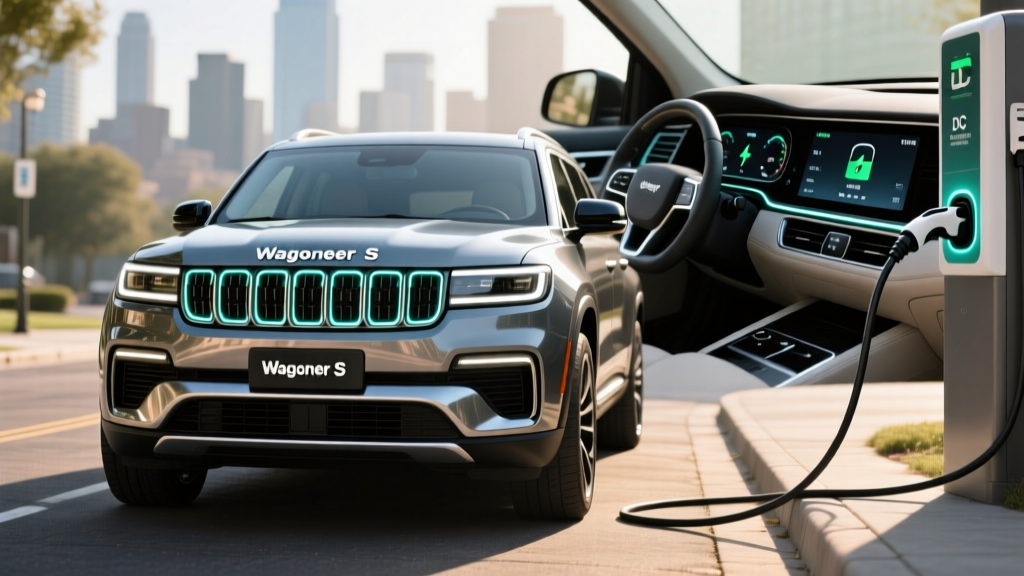
Quick Verdict: Jeep's First Global BEV Lands With Serious Specs
The 2024 Jeep Wagoneer S Launch Edition arrived as Stellantis' most ambitious electric vehicle yet — a premium, dual-motor SUV built on the STLA Large platform that targets Tesla Model X and BMW iX buyers directly. With 600 horsepower, a 100 kWh battery pack, and an EPA-estimated 300 miles of range, the Launch Edition is positioned as a no-compromise introduction to Jeep's electric era. But premium pricing, real-world range considerations, and a competitive luxury EV SUV segment make this a purchase that demands a hard look at the numbers.
This review breaks down every spec that matters to an EV buyer: actual range under highway and cold-weather conditions, DC fast-charging behavior including the critical taper above 80% SoC, home charging economics, federal tax credit eligibility under current IRS §30D rules, and how the Wagoneer S stacks up against established rivals.
Range, Battery & Efficiency: The 300-Mile Question
Real-World Expectation: 250–275 miles on highway-heavy trips; 220–240 miles in sustained cold weather (below 30°F) with cabin heating; 270–290 miles in mixed city/suburban driving with regen braking.
The Wagoneer S Launch Edition uses a 100 kWh lithium-ion battery pack (NMC chemistry, typical for the performance-oriented STLA Large platform). NMC (nickel-manganese-cobalt) cells offer higher energy density than LFP alternatives, which is critical in a 600-hp dual-motor SUV where weight distribution and packaging matter. The trade-off is that NMC batteries are more sensitive to sustained high states of charge — daily charging to 80% rather than 100% is recommended for long-term health.
On the efficiency side, the Wagoneer S is rated at approximately 2.0–2.2 kWh/mile (roughly 45–50 kWh/100 mi), which translates to around 95–105 MPGe combined per EPA data at fueleconomy.gov. That's competitive with the BMW iX xDrive50 but trails the more aerodynamically optimized Tesla Model X Long Range, which benefits from a lower drag coefficient and lighter curb weight.
Why the real-world gap from the 300-mile sticker? Three factors dominate:
- Highway driving at 75+ mph increases aero drag substantially on a tall, broad-shouldered SUV — expect a 10–15% range reduction versus the EPA combined cycle.
- Cold weather increases battery internal resistance and demands cabin heating. Without a heat pump (confirm with your dealer — early build sheets were ambiguous on this), resistive heating can pull 15–25% of range in sub-freezing conditions.
- Terrain and elevation: Mountain passes with sustained climbs will drain the pack faster, though regen braking on descents recovers some energy.
| Spec | Value |
|---|---|
| EPA Range | 300 miles |
| Battery Capacity | 100 kWh (NMC) |
| Drivetrain | Dual-motor AWD |
| Horsepower | 600 hp |
| Torque | 617 lb-ft |
| 0–60 mph | 3.4 seconds |
| Max DC Fast Charge | ~200 kW (peak) |
| 10–80% DC Fast Charge | ~23 minutes (estimated) |
| Level 2 Home Charging | ~11.5 kW onboard charger |
| MPGe (combined, est.) | 95–105 MPGe |
| Cargo Volume (rear seats up) | ~30 cu ft |
| Cargo Volume (rear seats folded) | ~60 cu ft |
| Seating | 5 passengers (2 rows) |
| Base MSRP (Launch Edition) | $71,995 (incl. destination) |
| Battery Warranty | 8 years / 100,000 miles |
Charging Speed: DC Fast, Level 2, and the Curve Reality
Charging speed is where many EV buyers get misled by peak kW numbers. Here's the full picture for the Wagoneer S Launch Edition:
| Charging Level | Power / Voltage | Miles Added per Hour | Notes |
|---|---|---|---|
| Level 1 (120V household) | ~1.4 kW | ~3–4 miles/hr | Emergency / overnight trickle only |
| Level 2 (240V home) | ~11.5 kW | ~28–32 miles/hr | Full charge in ~9–10 hours |
| DC Fast Charge (peak) | ~200 kW | — | Peak rate, not sustained |
| DC Fast 10–80% | Variable (tapering) | — | ~23 minutes under optimal conditions |
Understanding the charge curve: The ~200 kW peak rate applies only at a low state of charge (roughly 10–30% SoC) and requires a functioning 350 kW-capable DC fast charger with proper battery preconditioning. As the battery fills past 50%, the charge rate tapers significantly — by 80% SoC, you may see rates drop to 50–70 kW. This is normal lithium-ion behavior to protect cell health, but it means the last 20% (80–100%) can take nearly as long as the first 70%.
Preconditioning matters. If you navigate to a DC fast charger using the Wagoneer S's built-in navigation, the thermal management system will begin warming or cooling the battery pack en route. Arriving at a charger with a cold, un-preconditioned battery can cut your peak charge rate in half, especially in winter.
Home Level 2 charging with an 11.5 kW onboard charger means a 48-amp dedicated circuit is required (electricians typically install a 60-amp breaker). Expect a full overnight charge from near-empty in roughly 9–10 hours. At the national average electricity rate of ~$0.16/kWh, a full 100 kWh charge costs approximately $16 — compared to $50–$65 for an equivalent fill-up in a gas-powered Grand Cherokee at 2026 fuel prices.
Performance & Drivetrain: 600 HP Changes the Conversation
The Launch Edition's dual-motor all-wheel-drive powertrain delivers 600 horsepower and 617 lb-ft of torque, rocketing the Wagoneer S to 60 mph in an estimated 3.4 seconds. That places it squarely in sports-sedan territory and makes it one of the quickest SUVs in its price class, rivaling the Tesla Model X Plaid on acceleration (though the Model X edges ahead at 2.5 seconds in Plaid trim).
The AWD system uses independent front and rear motors with no mechanical linkage — torque distribution is managed entirely by software, enabling precise traction control and a rear-biased feel under normal driving. Jeep has also included Selec-Terrain drive modes, including a dedicated Snow mode and Sand/Mud settings, though this is a unibody performance SUV, not a body-on-frame Wrangler. Ground clearance is modest (~6.5–7 inches), and there are no low-range gears or locking differentials. Trail-rated this is not.
Ride quality benefits from a multi-link rear suspension and available adaptive damping (standard on the Launch Edition). At highway speeds, the cabin is notably quiet — electric drivetrains eliminate engine noise, and Jeep has invested in acoustic glass and active noise cancellation to manage wind and tire noise.
Interior, Tech & Cargo: Premium Ambition Meets Screen Real Estate
The Wagoneer S interior represents a clean break from Jeep's traditional design language. The dashboard is dominated by a massive screen array: a 12.3-inch digital instrument cluster, a 12.3-inch central infotainment touchscreen, and a 10.25-inch passenger display. The Launch Edition also includes a head-up display and a digital rearview mirror.
The infotainment system runs Stellantis' Uconnect 5, which supports wireless Apple CarPlay and Android Auto, over-the-air updates, and integrated navigation with EV-specific route planning (charging stop integration). A 19-speaker McIntosh audio system is standard on the Launch Edition — a notable premium touch.
Cargo and passenger space reflect the two-row, five-passenger configuration:
- Rear-seat legroom: ~38–40 inches (competitive with midsize luxury SUVs)
- Cargo behind rear seats: ~30 cu ft
- Cargo with rear seats folded: ~60 cu ft
- Front trunk (frunk): Small utility compartment (~2–3 cu ft), useful for charging cables
The absence of a third row is a deliberate choice — Jeep positions the three-row Grand Cherokee L and the larger Wagoneer (ICE) for family-hauling duty. If you need three rows, this isn't your EV.
Driver assistance includes adaptive cruise control with stop-and-go, lane-centering steering assist, blind-spot monitoring, rear cross-traffic alert, and a 360-degree camera system. This is an SAE Level 2 driver-assistance system — meaning the driver must remain fully attentive with hands on the wheel at all times. It is not autonomous driving.
Pricing, Trims & Federal Tax Credit Eligibility
The 2024 Wagoneer S launched exclusively in the Launch Edition trim, priced at $71,995 including destination. This is a fully loaded, near-fully-optioned model — Jeep structured it so early adopters get the complete package without navigating an options sheet. Lower-priced trims (expected to start in the mid-$50,000s) were announced for subsequent model years.
| Item | Amount |
|---|---|
| Launch Edition MSRP (incl. destination) | $71,995 |
| Federal §30D Tax Credit (if eligible) | Up to $7,500 |
| Estimated Price After Max Credit | ~$64,495 |
| Point-of-Sale Transfer (if elected) | Reduces purchase price at dealer |
Federal tax credit eligibility is not automatic. Under current IRS §30D rules, several conditions must be met:
- MSRP cap: SUVs must have an MSRP at or below $80,000 — the Wagoneer S Launch Edition at $71,995 qualifies.
- Buyer income cap: Modified adjusted gross income must not exceed $150,000 (single), $225,000 (head of household), or $300,000 (joint filers).
- Battery sourcing requirements: A percentage of critical minerals and battery components must be sourced from the U.S. or free-trade-agreement countries. These thresholds tighten annually. Confirm current-year compliance with your dealer, as sourcing requirements may affect partial vs. full credit eligibility.
- Point-of-sale transfer: As of 2024, buyers can elect to transfer the credit to the dealer at purchase, reducing the sale price directly rather than waiting for a tax refund. This effectively functions as a down-payment reduction.
Always verify eligibility with a tax professional before purchase. Rules change annually, and battery-component sourcing compliance can shift between model years even within the same vehicle nameplate.
Ownership Costs: Warranty, Insurance & Long-Term Battery Health
Jeep backs the Wagoneer S battery and electric powertrain with an 8-year / 100,000-mile warranty, consistent with the federal minimum for EV battery coverage. The warranty guarantees that the battery will retain a minimum percentage of its original capacity (typically 60–70% threshold) throughout the coverage period. The basic vehicle warranty is 3 years / 36,000 miles, with a 5-year / 60,000-mile powertrain warranty covering non-battery drivetrain components.
Insurance costs for the Wagoneer S Launch Edition are expected to run higher than comparable ICE SUVs, consistent with industry-wide EV insurance premiums. Factors include the high MSRP, expensive sensor/lidar/camera arrays, and the cost of battery-pack repair after collision damage. Expect quotes in the range of $2,500–$3,500 annually depending on your profile, location, and coverage level. Always get quotes before purchase.
Five-year total cost of ownership benefits from lower fueling costs (electricity vs. premium gasoline), zero oil changes, and reduced brake wear thanks to regenerative braking. However, the higher purchase price, insurance premiums, and potentially faster depreciation (luxury EVs have seen steep early depreciation curves) partially offset these savings. For a buyer who drives 12,000–15,000 miles annually and charges primarily at home, the fuel savings alone can exceed $1,500–$2,000 per year versus a similarly powerful gas SUV requiring premium fuel.
Competitive Landscape: Wagoneer S vs. the Luxury EV SUV Field
- You want a distinctive, non-Tesla premium EV SUV with genuine performance credentials
- You value Jeep brand heritage and plan to use the AWD system in light off-road or adverse-weather conditions
- You want a fully loaded Launch Edition without navigating a complex options sheet
- McIntosh audio, premium interior materials, and a unique design language matter to you
- You need a third row (Tesla Model X, Rivian R1S, Kia EV9)
- Maximum range is your top priority (Tesla Model X Long Range, BMW iX xDrive50)
- You want the lowest cost of entry into a premium EV SUV (Genesis GV60, Cadillac Lyriq)
- Proven long-term reliability data matters — the Wagoneer S is a first-year model on a new platform
Pros
- 600 hp / 3.4-sec 0–60 puts it among the quickest SUVs available
- 300-mile EPA range is competitive in the luxury EV SUV segment
- Fully loaded Launch Edition simplifies the buying decision
- Premium McIntosh audio, multi-screen interior, and head-up display
- Dual-motor AWD with Selec-Terrain modes for adverse conditions
- Qualifies under the $80,000 MSRP cap for federal tax credit
Cons
- Two-row, five-passenger only — no third-row option
- First-year model on an all-new platform — long-term reliability unknown
- $71,995 entry price is steep; lower trims not yet available
- Real-world highway and cold-weather range falls 10–25% below EPA
- Modest ground clearance limits off-road capability despite Jeep branding
- Insurance premiums likely higher than ICE equivalents
Frequently Asked Questions
What is the real-world range of the 2024 Jeep Wagoneer S Launch Edition?
The EPA rates it at 300 miles combined. In real-world driving, expect 250–275 miles on highway-dominant trips at 70–80 mph, and 220–240 miles in sustained cold weather below 30°F with cabin heating active. City driving with regenerative braking can approach or occasionally exceed the EPA figure.
How fast does the Wagoneer S charge on DC fast chargers and at home?
On a capable DC fast charger (350 kW station), the Wagoneer S can peak at approximately 200 kW and charge from 10–80% in roughly 23 minutes under optimal (preconditioned battery, moderate temperature) conditions. At home on a Level 2 (240V / 48A) charger, the 11.5 kW onboard charger adds approximately 28–32 miles per hour, fully replenishing the 100 kWh battery in about 9–10 hours.
How much does the Wagoneer S cost after the federal EV tax credit?
The Launch Edition MSRP is $71,995. If you qualify for the full $7,500 federal §30D credit (meeting income caps, battery sourcing requirements, and MSRP limits), your effective cost drops to approximately $64,495. You can elect a point-of-sale transfer to apply the credit as a purchase-price reduction at the dealer. Consult a tax professional to confirm your eligibility.
Does the 2024 Jeep Wagoneer S qualify for the federal EV tax credit?
It meets the MSRP cap for SUVs ($80,000 limit). However, full credit eligibility depends on your income, the battery's critical-mineral and component sourcing for the specific model year, and your tax liability. Sourcing rules tighten annually — verify with your dealer and the IRS clean vehicle credit page before purchasing.
Is the Wagoneer S Launch Edition worth buying vs. competitors?
It's compelling if you want a fully loaded, high-performance EV SUV with distinctive styling and don't need a third row. Against the Tesla Model X, it trades some range and Supercharger network access for a more premium interior and brand cachet. Against the BMW iX, it offers more horsepower but less proven long-term ownership data. Against the Rivian R1S, it sacrifices the third row and off-road capability for a more road-focused, luxury-oriented experience.
What is the battery warranty on the Wagoneer S?
Jeep provides an 8-year / 100,000-mile warranty on the battery pack and electric powertrain components. The warranty covers capacity degradation below a specified threshold (typically 60–70% of original capacity). The basic vehicle warranty covers 3 years / 36,000 miles.
Can the Wagoneer S tow?
Jeep has indicated a towing capacity for the Wagoneer S, but buyers should confirm the specific rating with their dealer. EVs generally lose significant range when towing — expect a 30–50% range reduction depending on trailer weight and aerodynamics. If regular towing is part of your use case, factor this into your range planning.
Sources: EPA Fuel Economy (fueleconomy.gov), IRS Clean Vehicle Credits, Jeep/Stellantis official specifications. All specs reflect manufacturer-published data for the 2024 model year at time of writing. Verify current pricing, credit eligibility, and specifications with your dealer and the IRS before purchase.