The 2026 Jeep Wagoneer S arrives as the brand's first fully electric SUV built on the STLA Large platform, and it makes a bold statement. With dual-motor all-wheel drive, 600 horsepower in the Launch Edition, and a cabin packed with screens, it targets luxury EV buyers who want Jeep branding without the body-on-frame bulk of the full-size Wagoneer. But does the Jeep Wagoneer S interior deliver on its premium promise, and can its range and charging keep up with rivals like the BMW iX and Genesis Electrified GV70?
We've analyzed the official specs, EPA data, and real-world ownership variables to give you everything you need before signing a purchase order.
Quick Verdict: Who the Wagoneer S Is For
The Wagoneer S fits buyers who want a midsize luxury electric SUV with genuine Jeep design cues, a tech-forward cabin, and enough range for road trips. It's best suited for:
- Families needing a quiet, spacious two-row SUV with advanced safety features
- Tech enthusiasts who want multiple screens and over-the-air updates
- Commuters with home charging who can exploit off-peak electricity rates
- Road-trippers willing to plan around 250-kW DC fast charging stops
It's less ideal for buyers who need three rows, maximum cargo space, or the lowest possible price point in the luxury EV segment.
2026 Jeep Wagoneer S Core Specs at a Glance
| Spec | 2026 Wagoneer S Launch Edition |
|---|---|
| EPA Range | 300 miles |
| Battery (usable) | ~100 kWh, NMC lithium-ion |
| Drivetrain | Dual-motor AWD |
| Horsepower | 600 hp |
| 0-60 mph | 3.4 seconds |
| Max DC Fast Charge | 250 kW (peak) |
| 10-80% DC Charge | ~23 minutes (est.) |
| Level 2 Home Charge | 11.5 kW onboard (~33 mi/hr) |
| Efficiency | ~87 MPGe combined (est.) |
| Cargo (behind 2nd row) | 30.7 cu ft |
| Cargo (seats folded) | 61.0 cu ft |
| Base MSRP | $71,995 (incl. destination) |
| Battery Warranty | 8 years / 100,000 miles |
Jeep Wagoneer S Interior: Screens, Space, and Material Quality
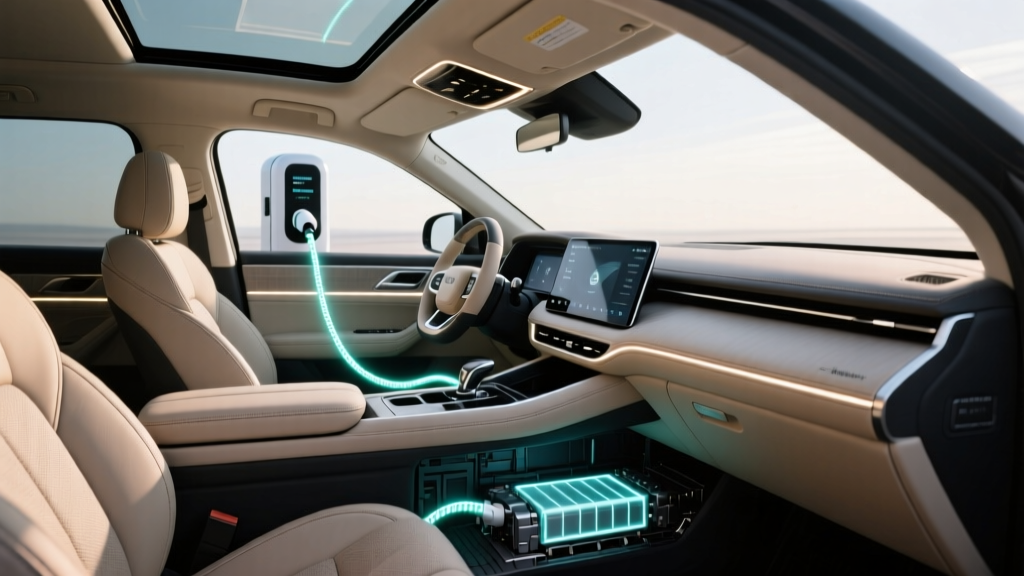
The Jeep Wagoneer S interior is where Stellantis makes its strongest luxury play. The dashboard is dominated by a combined 45+ inches of display area across five screens:
- 12.3-inch driver cluster — configurable gauges, range, and navigation
- 12.3-inch central infotainment — Uconnect 5 with wireless Apple CarPlay and Android Auto
- 10.25-inch passenger display — dedicated entertainment and navigation for the front passenger
- 10-inch head-up display — projects speed, navigation, and ADAS alerts
- Central console touchscreen — climate and vehicle function controls
Material quality in the Launch Edition includes synthetic leather upholstery (real leather is available on higher trims), open-pore wood accents, and aluminum trim. The flat floor — a benefit of the dedicated EV platform — gives rear passengers generous foot room.
Passenger and Cargo Dimensions
| Measurement | Wagoneer S |
|---|---|
| Front legroom | 41.1 in |
| Rear legroom | 38.5 in |
| Front headroom | 39.6 in |
| Rear headroom | 38.2 in |
| Cargo (rear seats up) | 30.7 cu ft |
| Cargo (rear seats folded) | 61.0 cu ft |
| Frunk | None (equipment housed under hood) |
Compared to the BMW iX (33.9 cu ft behind the second row), the Wagoneer S gives up a few cubic feet. The absence of a front trunk (frunk) is a missed opportunity for stowing charging cables or groceries — something the Hyundai Ioniq 5 and Ford Mustang Mach-E handle well.
Notable Interior Drawbacks
- Climate controls are touch-based on the lower screen, which can be distracting while driving
- No physical knobs for volume or tuning — everything is via touchscreen or steering-wheel controls
- Rear visibility is compromised by the thick D-pillar and sloping roofline; the digital rearview mirror helps
- Cargo capacity trails the iX and falls well short of the Tesla Model X
Range, Battery, and Real-World Efficiency
The Wagoneer S carries an NMC (nickel-manganese-cobalt) lithium-ion pack with approximately 100 kWh of usable capacity. NMC chemistry offers higher energy density than LFP (lithium iron phosphate), which helps achieve the 300-mile EPA rating in a vehicle weighing over 5,800 pounds.
EPA sticker: 300 miles
Highway driving (70-80 mph): Expect ~250-270 miles. Aerodynamic drag hits taller SUV profiles harder at speed.
City / mixed driving: 280-300 miles is achievable with regenerative braking recapturing energy.
Cold weather (below 32°F): Plan for 210-240 miles. NMC packs lose 15-25% range in freezing temperatures, even with the heat pump equipped.
Mountainous terrain: Sustained climbs will drop range significantly; descents with regen can partially recover it.
The Wagoneer S is equipped with a heat pump, which helps preserve range in cold weather by efficiently warming the cabin without drawing heavily from the traction battery. This is a meaningful advantage over resistive heating systems found in some competitors.
Efficiency
At roughly 87 MPGe combined (estimated based on platform weight and battery size), the Wagoneer S is less efficient than the BMW iX xDrive50 (~87 MPGe) and significantly thirstier than the Hyundai Ioniq 5 (114 MPGe). In practical terms, expect consumption around 34-38 kWh per 100 miles in mixed driving. Heavier vehicles with AWD and wide tires simply move more electrons per mile.
Charging Speed: DC Fast, Level 2, and Home Setup
The Wagoneer S uses a CCS1 connector for DC fast charging and a J1772 inlet for Level 2 AC charging. (Stellantis has committed to adopting NACS for future models, but the 2026 Wagoneer S ships with CCS.)
| Charging Level | Power | Speed | Best Use Case |
|---|---|---|---|
| Level 1 (120V outlet) | ~1.4 kW | ~4 mi/hr | Emergency / trickle top-up |
| Level 2 (240V home) | 11.5 kW | ~33 mi/hr | Daily overnight charging |
| DC Fast Charge | 250 kW peak | 10-80% in ~23 min | Road trips, highway stops |
Understanding the DC Charge Curve
The 250 kW figure is a peak, not a sustained rate. Like all modern EVs, the Wagoneer S will accept maximum power between roughly 10-40% state of charge (SoC), then taper to protect battery health. Expect:
- 10-40% SoC: 200-250 kW (fastest segment)
- 40-60% SoC: ~150-180 kW
- 60-80% SoC: ~90-120 kW
- Above 80% SoC: Drops sharply to ~50 kW or less
For road trips, charge from 10-80% and drive on. Charging above 80% at a DC station is time-inefficient — plan your next stop instead.
Home Charging Setup
A full Level 2 home charge (11.5 kW) requires a 60-amp dedicated circuit on a 240V line, installed by a licensed electrician following NEC Article 625. Most owners will fully recharge the 100-kWh battery in approximately 9-10 hours overnight. If your home electrical panel is older or near capacity, budget for a panel upgrade ($1,500-$3,000) on top of the $500-$1,200 for the EVSE hardware and installation.
Pricing, Trims, and Federal Tax Credit Eligibility
| Trim | MSRP (incl. destination) | Est. After §30D Credit |
|---|---|---|
| Launch Edition | $71,995 | $64,495* |
| Limited (expected) | ~$66,000 | ~$58,500* |
| Overland (expected) | ~$75,000 | ~$67,500* |
*Assumes full $7,500 credit eligibility. Actual credit varies.
Does the Wagoneer S Qualify for the $7,500 Federal Tax Credit?
Under current IRS §30D rules, the Wagoneer S must clear several hurdles:
- MSRP cap: SUVs must be under $80,000. The Launch Edition at $71,995 qualifies.
- Buyer income cap: Modified adjusted gross income must not exceed $150,000 (single), $225,000 (head of household), or $300,000 (joint).
- Battery sourcing: A percentage of critical minerals and battery components must be sourced from the U.S. or FTA-partner countries. Stellantis has not publicly confirmed whether the Wagoneer S battery meets the 2026 thresholds — verify with your dealer using the VIN-specific lookup on fueleconomy.gov before purchasing.
- Point-of-sale transfer: If eligible, you can transfer the credit to the dealer at purchase, reducing your out-of-pocket cost immediately rather than waiting for tax filing.
Critical note: Battery-sourcing requirements tighten each year. A vehicle eligible in 2025 may not be in 2026. Always confirm with the IRS VIN tool and a tax professional before counting on the credit.
Performance and Driving Dynamics
The Launch Edition's dual-motor AWD powertrain produces 600 horsepower and an estimated 617 lb-ft of torque. Jeep quotes a 0-60 mph time of 3.4 seconds, placing it in sports-sedan territory and ahead of the BMW iX xDrive50 (4.4 seconds).
Driving modes include Auto, Sport, Snow, Sand, and a Selec-Terrain system that adjusts torque distribution, throttle response, and regen levels. Despite the performance, the Wagoneer S is tuned more for confident highway cruising and light off-pavement capability than track driving. The air suspension (standard on Launch Edition) provides up to 2.5 inches of lift for rough roads and automatically lowers at highway speeds for aerodynamic efficiency.
Driver-Assistance Technology
The Wagoneer S offers Active Driving Assist with hands-on-wheel highway assist and lane-centering. This is a Level 2 driver-assistance system, not autonomous driving. The driver must remain fully engaged, monitor the road, and keep hands on the steering wheel at all times. Level 4 driverless capability is not available on any consumer Jeep product.
Additional ADAS features include:
- Adaptive cruise control with stop-and-go
- Blind-spot monitoring with rear cross-path detection
- Automatic emergency braking with pedestrian detection
- Surround-view camera with 360-degree top-down view
- Intersection collision assist
Warranty and Long-Term Ownership
| Coverage | Term |
|---|---|
| Basic (bumper-to-bumper) | 3 years / 36,000 miles |
| Powertrain | 5 years / 60,000 miles |
| Battery | 8 years / 100,000 miles |
| Battery capacity retention | Minimum 70% over warranty period |
The 8-year/100,000-mile battery warranty is federally mandated for all EVs sold in the U.S. and matches competitors like Hyundai, Ford, and BMW. Stellantis guarantees the battery will retain at least 70% of its original capacity during the warranty period. If degradation exceeds 30%, the battery module or pack will be repaired or replaced at no cost.
For long-term ownership beyond the warranty, NMC batteries typically retain 80-85% capacity after 150,000-200,000 miles under normal use (avoiding frequent DC fast charging to 100% and prolonged storage at extreme SoC levels). A full pack replacement, if needed out of warranty, is estimated at $15,000-$22,000 based on current 100-kWh pack pricing, though costs are expected to decline through the decade.
How the Wagoneer S Stacks Up Against Competitors
| Spec | Jeep Wagoneer S | BMW iX xDrive50 | Genesis Electrified GV70 |
|---|---|---|---|
| EPA Range | 300 mi | 324 mi | 236 mi |
| Battery | ~100 kWh NMC | 111.5 kWh NMC | 77.4 kWh NMC |
| Horsepower | 600 hp | 516 hp | 429 hp |
| 0-60 mph | 3.4 sec | 4.4 sec | 4.5 sec |
| Max DC Charge | 250 kW | 195 kW | 350 kW (peak) |
| Cargo (rear up) | 30.7 cu ft | 35.5 cu ft | 28.7 cu ft |
| Base MSRP | $71,995 | $87,250 | $66,950 |
- You want the most horsepower and quickest acceleration in this price range
- Jeep brand identity and Selec-Terrain modes matter to you
- You prefer a screen-dense, tech-forward cabin
- You want a dedicated EV platform with a flat floor
- Cargo space is a priority — the iX offers nearly 5 more cu ft
- You need a frunk for charging cables or small items
- You want the longest range — the iX and Tesla Model X go further
- Budget is tight — the GV70 starts ~$5,000 lower with comparable luxury
Pros and Cons
- 600 hp and 3.4-second 0-60 in a practical SUV
- Five-screen interior with strong material quality
- Standard air suspension with adjustable ride height
- 250-kW DC fast charging is competitive for the segment
- Heat pump preserves cold-weather range
- Qualifies under the $80K SUV MSRP cap for §30D credit
- No frunk — under-hood space is used for components
- Cargo volume (30.7 cu ft) trails the BMW iX
- Touch-only climate controls can distract while driving
- Two-row only — no three-row option for larger families
- CCS connector (not NACS) limits Tesla Supercharger access without adapter
- Efficiency (~87 MPGe) is middling for the class
Frequently Asked Questions
What is the real-world range of the Jeep Wagoneer S?
The EPA rates the Wagoneer S at 300 miles. In real-world highway driving at 70-80 mph, expect 250-270 miles. In freezing temperatures, plan for 210-240 miles due to battery chemistry limitations and cabin heating demand, even with the standard heat pump.
How fast does the Wagoneer S charge?
On a DC fast charger, it peaks at 250 kW and can charge from 10-80% in approximately 23 minutes. At home on a Level 2 (240V, 60A circuit), the 11.5-kW onboard charger adds about 33 miles per hour, fully recharging the battery in 9-10 hours.
How much does the Wagoneer S cost after tax credits?
The Launch Edition starts at $71,995. If you meet all IRS §30D requirements — income caps, MSRP cap (under $80K for SUVs), and battery-sourcing thresholds — you may qualify for up to $7,500, bringing the effective price to approximately $64,495. Eligibility is VIN-specific; verify before purchasing.
Is the Wagoneer S worth buying vs. the BMW iX or Genesis GV70?
It depends on priorities. The Wagoneer S wins on acceleration (3.4 sec 0-60), screen count, and Jeep brand appeal. The BMW iX wins on cargo space and range. The Genesis Electrified GV70 wins on price and has faster peak charging (350 kW). Test-drive all three if possible.
Does the Wagoneer S qualify for the federal EV tax credit?
It can, but eligibility is not automatic. The vehicle must meet battery critical-mineral and component-sourcing requirements that tighten annually. The buyer must also fall under IRS income caps ($300K joint, $150K single). Use the VIN lookup tool on fueleconomy.gov and consult a tax professional to confirm before purchase.
Does the Wagoneer S have a frunk?
No. The under-hood area houses electrical and thermal management components. All cargo must go in the rear hatch area (30.7 cu ft) or the cabin.
What connector does the Wagoneer S use?
The 2026 Wagoneer S uses a CCS1 connector for DC fast charging and J1772 for Level 2 AC charging. It does not natively support NACS (Tesla Supercharger), though a CCS-to-NACS adapter may become available from Stellantis or third parties.