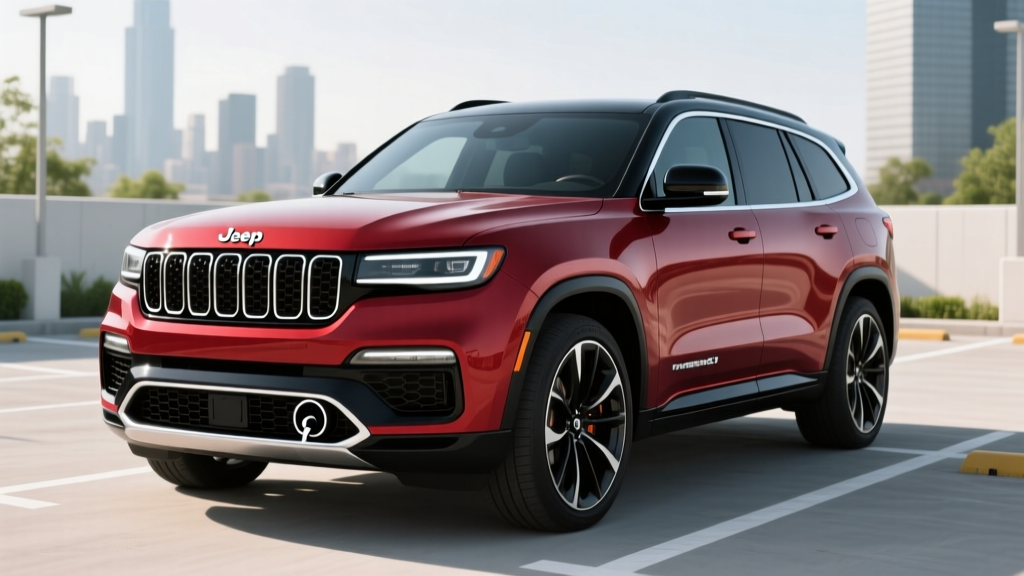
Jeep's first global battery-electric vehicle lands with a serious performance promise: a sub-four-second sprint to 60 mph, standard dual-motor all-wheel drive, and the off-road brand's first serious bid at the premium electric SUV segment. The 2026 Jeep Wagoneer S is built on Stellantis's STLA Large platform, slots in just below the three-row Grand Cherokee in size, and targets buyers who want Tesla-rivaling acceleration wrapped in a more traditional luxury SUV silhouette. But speed is only one chapter — range, charging infrastructure access, and real-world efficiency determine whether this EV actually fits your garage and your life.
We spent time with the Wagoneer S Launch Edition and the newly added lower trim to break down every number that matters, from battery chemistry to cold-weather range loss to the charging curve taper that no spec sheet advertises.
Spec Sheet: 2026 Jeep Wagoneer S at a Glance
| Spec | Value |
|---|---|
| EPA Range | 300 miles (Launch Edition est.) |
| Battery (Usable) | ~100 kWh, NMC lithium-ion |
| Drivetrain | Dual-motor AWD (eAWD) |
| Horsepower | 600 hp |
| Torque | 617 lb-ft |
| 0-60 mph | 3.4 seconds (mfr. claim) |
| Peak DC Fast Charge | ~175 kW (CCS via NACS adapter) |
| 10-80% DC Charge | ~23 minutes |
| Level 2 Home Charge | 11.5 kW (~33 mi/hr) |
| Efficiency | ~98 MPGe / 34 kWh/100 mi (est.) |
| Cargo (behind 2nd row) | ~30 cu ft |
| Cargo (max, seats folded) | ~60 cu ft |
| Base MSRP (Launch Ed.) | $71,995 |
| Battery Warranty | 8 yr / 100,000 mi |
Jeep Wagoneer S 0-60 Time and Performance Reality
The headline figure — 3.4 seconds from 0-60 mph — places the Wagoneer S Launch Edition in elite company. That puts it within a half-second of the Tesla Model Y Performance (3.5 sec) and ahead of the BMW iX xDrive50 (4.4 sec). Jeep achieves this with a dual-motor setup producing a combined 600 hp and 617 lb-ft of torque, routed through an electronic AWD system that can redirect power front-to-rear in milliseconds.
On pavement, the instant torque delivery is exactly what you'd expect from a high-output EV: relentless and linear. Where the Wagoneer S differentiates itself from crossover rivals is its Selec-Terrain system, which includes a dedicated Snow mode and a Sand/Mud setting unusual for a unibody EV. Ground clearance sits at approximately 7.9 inches — enough for fire roads and ski-resort access, though this is not a Wrangler substitute for technical trails. The eAWD system can simulate torque vectoring by braking the inside wheel, but there is no mechanical locking differential or low-range gearing.
The trade-off for 600 hp in a ~5,800-lb SUV is energy consumption. Aggressive acceleration pulls heavily from the pack, and repeated hard launches will meaningfully reduce your range for that trip. This is a performance SUV that rewards restraint on long highway legs.
EPA Range and What You'll Actually See
EPA Estimated: 300 miles
Expect in mixed real-world driving: ~250–275 miles
Highway-only at 75 mph: ~235–255 miles
Cold weather (below 30°F): ~200–225 miles (20–30% reduction typical for NMC packs without preconditioning)
The Wagoneer S carries an NMC (nickel-manganese-cobalt) lithium-ion battery pack with approximately 100 kWh of usable capacity. NMC chemistry offers higher energy density than LFP (lithium iron phosphate), which is how Jeep fits this much energy into a midsize SUV footprint — but the trade-off is slightly faster calendar degradation and more sensitivity to extreme cold compared to LFP.
The 300-mile EPA figure is competitive for the segment, but real-world results depend heavily on conditions. At sustained highway speeds above 70 mph, expect the effective range to drop to roughly 235–255 miles due to aerodynamic drag on the bluff SUV body. In sub-freezing temperatures, NMC chemistry combined with cabin heating demands can reduce range by 20–30%, bringing realistic winter figures to around 200–225 miles. The Wagoneer S includes battery preconditioning — warming the pack before DC fast charging or hard acceleration — which helps mitigate cold-weather charging slowdowns and preserves battery longevity.
For daily commuting under 80 miles round-trip, the Wagoneer S will require charging only every third or fourth day. For road trips exceeding 250 miles, you will need at least one DC fast-charging stop.
Charging Speed: DC Fast, Level 2, and the Curve
| Charging Level | Power | Miles Added per Hour | Notes |
|---|---|---|---|
| Level 1 (120V household) | ~1.4 kW | ~3–4 mi/hr | Emergency/trickle only |
| Level 2 (240V home) | 11.5 kW | ~33 mi/hr | Full charge in ~9 hours |
| DC Fast Charge | Peak ~175 kW | Up to ~150 mi in 20 min | 10-80% in ~23 min |
The Wagoneer S peaks at approximately 175 kW on DC fast charging, which is respectable but not class-leading. Competitors on 800-volt architectures — such as the Hyundai Ioniq 5 (peak 240 kW) and Kia EV6 (peak 239 kW) — charge noticeably faster in the 10-80% window. Jeep's claimed 23-minute 10-80% time assumes ideal conditions: a charger capable of delivering the full 175 kW, a preconditioned battery, and ambient temperatures in the 60–80°F range.
Here's the charging-curve reality that spec sheets omit: peak kW is not sustained kW. The Wagoneer S will likely hold near 175 kW only between roughly 10% and 35% State of Charge (SoC). As the battery fills, the charge rate tapers — first to around 120 kW near 50% SoC, then further to 60–80 kW above 70%, and finally to under 30 kW as it tops off past 90%. This is normal behavior for NMC packs protecting cell longevity, but it means the last 20% takes disproportionately longer. On a road trip, the optimal strategy is to charge from 10% to 80% and move on rather than waiting for a full top-off.
For home charging, the onboard 11.5 kW Level 2 charger is a strong point. With a 48-amp hardwired Level 2 station (the kind most electricians recommend for a dedicated 60-amp circuit), you'll add roughly 33 miles of range per hour, meaning a full 0-100% charge takes about 9 hours overnight. This is plenty for daily use — plug in when you get home, wake up full every morning.
Regarding connector standards: The Wagoneer S ships with a NACS (North American Charging Standard) port for the 2026 model year, giving it native access to Tesla Supercharger stations — the most reliable and extensive DC fast-charging network in the US. A CCS adapter is available for Electrify America and other legacy CCS stations. This dual-network compatibility is a genuine ownership advantage over CCS-only vehicles as the industry transitions to NACS.
Interior, Tech, and Cargo Space
Jeep positions the Wagoneer S as a premium two-row SUV, and the cabin reflects that aspiration. The Launch Edition features a combined screen real estate that totals over 45 inches across the dashboard — a 12.3-inch digital instrument cluster, a 12.3-inch passenger display, and a central 12.3-inch infotainment touchscreen running Stellantis's Uconnect 5 system. Uconnect 5 is widely regarded as one of the better automotive infotainment platforms, with responsive touch inputs, wireless Apple CarPlay and Android Auto, and native integration for OTA (over-the-air) updates.
Driver-assistance technology includes adaptive cruise control with stop-and-go, lane-centering assist, blind-spot monitoring, and a 360-degree camera system. Note: These are SAE Level 2 driver-assist features, meaning the driver must remain fully engaged with hands on the wheel and eyes on the road. This is not an autonomous or self-driving system.
Cargo space is the area where the Wagoneer S makes the most compromises relative to its footprint. With the second row upright, you get approximately 30 cubic feet — adequate for a week of luggage for two but tight for a family of four on a long road trip. Fold the second row and maximum cargo expands to roughly 60 cubic feet. There is no front trunk (frunk), which is a missed opportunity for an EV on a dedicated platform; competitors like the Ford Mustang Mach-E and Rivian R1S offer meaningful additional front storage.
Passenger space is generous for a midsize two-row SUV, with approximately 41 inches of front legroom and 38 inches of rear legroom. The flat floor (no transmission tunnel) benefits middle-seat comfort. Heated and ventilated front seats are standard on the Launch Edition; a panoramic glass roof is included but does not open — it's a fixed panel that brightens the cabin but adds no ventilation function.
Pricing, Trims, and Federal Tax Credit Eligibility
The 2026 Wagoneer S Launch Edition carries a base MSRP of $71,995 (including destination). A lower trim is expected to bring the entry point down to approximately $65,000–$67,000 later in the model year, though final pricing on that trim was not confirmed at publication time.
| Requirement | Wagoneer S Status |
|---|---|
| MSRP Cap (SUVs: ≤$80,000) | ✅ Qualifies ($71,995 MSRP) |
| Buyer Income Cap (MFJ: ≤$300,000 AGI) | ⚠️ Varies by buyer |
| Battery Component Manufacturing (N. America) | ⚠️ Confirm per VIN — sourcing rules tighten annually |
| Critical Minerals Sourcing | ⚠️ Confirm per VIN — must meet annual threshold |
| Point-of-Sale Transfer | ✅ Available — reduces purchase price at dealer |
| Max Credit | Up to $7,500 (partial if only one requirement met) |
The Wagoneer S falls under the SUV MSRP cap of $80,000, so it clears that hurdle. However, the full $7,500 federal EV tax credit under IRS §30D depends on battery-component and critical-minerals sourcing requirements that tighten each year through 2032. Stellantis has indicated efforts to source components domestically, but buyers should verify credit eligibility by checking the specific VIN on fueleconomy.gov before purchasing, as eligibility can change with supply-chain adjustments.
The point-of-sale transfer option, available since 2024, allows qualifying buyers to apply the credit as an immediate price reduction at the dealership rather than waiting to claim it on their tax return. This effectively brings the Launch Edition to approximately $64,495 if the full $7,500 credit applies — a significant difference. Always consult a tax professional to confirm your personal eligibility, as income caps ($300,000 for married filing jointly, $150,000 for single filers) and prior credit usage can affect your claim.
Efficiency, Ownership Costs, and Warranty
With an estimated 98 MPGe combined (approximately 34 kWh per 100 miles), the Wagoneer S is not the most efficient EV in its class. The Tesla Model Y achieves around 122 MPGe combined, and the Hyundai Ioniq 5 AWD lands near 110 MPGe. The Wagoneer S's heavier curb weight (~5,800 lbs) and less aerodynamic profile explain the gap. At a national average residential electricity rate of $0.17/kWh, charging the Wagoneer S costs roughly $0.058 per mile — still dramatically less than a comparable gas SUV at $0.14–$0.18/mile, but not as cheap as lighter EVs.
Jeep backs the Wagoneer S battery and electric powertrain with an 8-year / 100,000-mile warranty, with a capacity-retention threshold of 70% (meaning if the battery degrades below 70% of original capacity within the warranty period, Stellantis will repair or replace it). The limited vehicle warranty is 3 years / 36,000 miles. This is industry-standard for the battery warranty but slightly below Hyundai/Kia's 10-year/100,000-mile battery coverage.
Insurance premiums for the Wagoneer S will likely run 15–25% higher than a comparable gas-powered midsize SUV, consistent with the EV insurance premium seen across the industry. Get quotes before purchasing — this is a frequently overlooked ownership cost.
Pros, Cons, and the Verdict
- 3.4-sec 0-60 mph — genuine sports-SUV acceleration
- NACS native — direct Tesla Supercharger access
- Strong 11.5 kW Level 2 onboard charger
- 600 hp / eAWD with Selec-Terrain modes
- Uconnect 5 with OTA updates and strong UX
- Qualifies for up to $7,500 federal credit (verify per VIN)
- 300-mile range is average — some rivals exceed 330 mi
- ~175 kW peak DC charge — slower than 800V competitors
- No frunk — missed cargo opportunity on a dedicated EV platform
- Cargo space (30 cu ft) tight for a premium two-row SUV
- Efficiency (~98 MPGe) trails lighter rivals
- Launch Edition pricing ($71,995) is steep before credits
Who this EV suits best: The Wagoneer S is ideal for buyers who want thrilling acceleration, standard AWD for snow and light off-pavement use, and the convenience of Tesla Supercharger access — without buying a Tesla. It works well as a daily commuter with home charging and a weekend adventure vehicle. It is less ideal for buyers who prioritize maximum cargo space, best-in-class range, or the lowest possible charging times on road trips.
Choose the Wagoneer S if: You want sub-4-second 0-60 performance, value NACS/Supercharger access, and need AWD with terrain modes for varied conditions.
Look elsewhere if: You prioritize maximum range (Tesla Model Y LR, 330+ mi), fastest DC charging (Ioniq 5/EV6 on 800V), or three-row seating (Kia EV9, Rivian R1S).
Frequently Asked Questions
What is the real-world range of the Jeep Wagoneer S?
The EPA estimates 300 miles, but expect approximately 250–275 miles in mixed real-world driving, 235–255 miles on sustained highway trips, and 200–225 miles in cold weather below freezing. Battery preconditioning helps mitigate cold-weather losses.
How fast does the Wagoneer S charge at home and on the road?
On a 48-amp Level 2 home charger, it adds roughly 33 miles per hour (full charge in ~9 hours). On DC fast charging, it peaks at ~175 kW and reaches 10-80% in approximately 23 minutes under ideal conditions. Expect 30–35 minutes in cooler weather or on lower-powered chargers.
Does the Jeep Wagoneer S qualify for the $7,500 federal EV tax credit?
The MSRP falls under the $80,000 SUV cap, so it qualifies on price. Full $7,500 credit eligibility depends on battery-component and critical-minerals sourcing rules that change annually. Verify your specific VIN on fueleconomy.gov and consult a tax professional. Point-of-sale transfer is available if eligible.
Is the Wagoneer S worth buying over a Tesla Model Y or BMW iX?
The Wagoneer S wins on acceleration (3.4 sec vs Model Y Performance's 3.5 sec) and offers terrain modes neither rival provides. The Model Y Long Range wins on range (330+ mi) and efficiency. The BMW iX wins on interior luxury and ride refinement but costs more and is slower. If you want Jeep brand identity, AWD versatility, and NACS access, the Wagoneer S has a distinct niche.
Does the Wagoneer S have a frunk?
No. Despite riding on a dedicated EV platform (STLA Large), the Wagoneer S does not include a front trunk. All cargo space is in the rear, totaling approximately 30 cu ft behind the second row and 60 cu ft with seats folded.
What is the battery warranty on the Wagoneer S?
Jeep provides an 8-year / 100,000-mile battery and powertrain warranty with a 70% capacity-retention threshold. The limited vehicle warranty covers 3 years / 36,000 miles.
Sources: Manufacturer specifications via jeep.com, EPA efficiency data via fueleconomy.gov, IRS §30D credit rules via irs.gov.