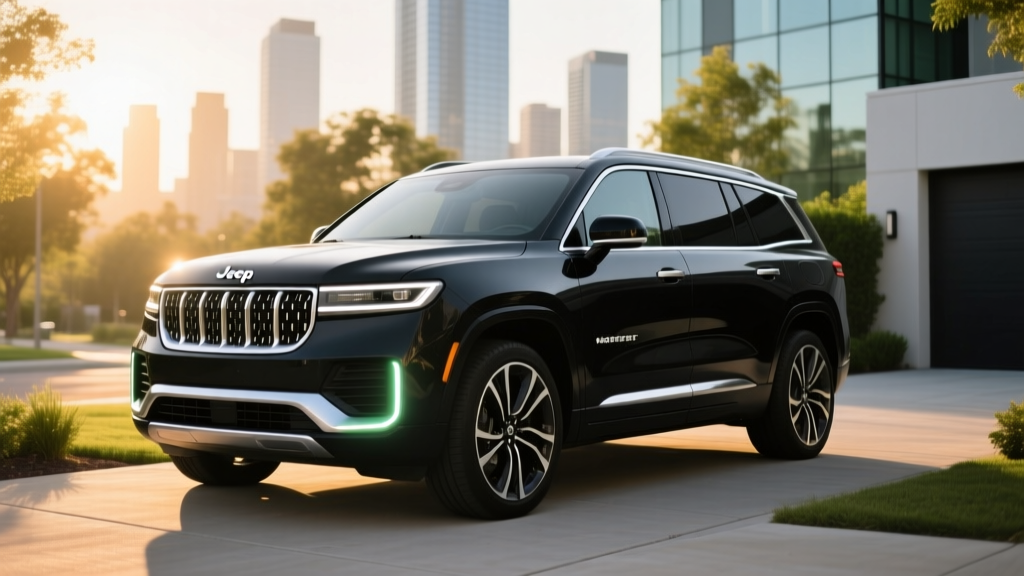
The full-size electric SUV segment is heating up, and Stellantis is making aggressive moves to put buyers behind the wheel. If you've been searching for Jeep Wagoneer EV lease deals, you've likely noticed monthly payment promotions that look surprisingly competitive — sometimes undercutting the gas-powered Wagoneer. But a low lease payment is only one piece of the financial puzzle.
This guide breaks down what a Wagoneer EV lease actually costs over five years when you factor in federal tax credits, state incentives, electricity versus gasoline, insurance premiums, maintenance savings, and the depreciation realities that make leasing an EV particularly strategic in 2026.
Wagoneer EV Lease Pricing: What You're Working With
The 2026 Jeep Wagoneer EV rides on the STLA Large platform with an estimated 118 kWh usable battery pack (NMC chemistry) and dual-motor all-wheel drive producing approximately 600 horsepower. Jeep targets an EPA range of around 400 miles on the top-trim Overland model, with the base Carbide trim expected around 350 miles EPA.
Lease pricing varies by region and dealer, but Stellantis Financial has been promoting Wagoneer EV lease deals in the range of $549–$749 per month for 36-month terms with $3,999–$5,999 due at signing, depending on trim. These promotional rates often factor in a $7,500 lease cash incentive that Stellantis applies to offset the capitalized cost — a critical detail we'll unpack below.
| Specification | Carbide (Base) | Overland |
|---|---|---|
| MSRP (before incentives) | ~$65,000 | ~$75,000 |
| Estimated EPA Range | ~350 mi | ~400 mi |
| Battery (usable, chemistry) | ~118 kWh, NMC | ~118 kWh, NMC |
| Peak DC Fast Charge | ~200 kW | ~200 kW |
| 10–80% DC Charge Time | ~28 min | ~28 min |
| Level 2 Charge Rate | 11.5 kW | 11.5 kW |
| Horsepower | ~600 hp | ~600 hp |
| 0–60 mph | ~5.0 sec | ~5.0 sec |
| Drivetrain | AWD (dual motor) | AWD (dual motor) |
| Battery Warranty | 8 yr / 100,000 mi | 8 yr / 100,000 mi |
How the Federal Tax Credit Works on EV Leases
This is where Wagoneer EV lease deals become genuinely compelling — and where most buyers get confused.
Under IRS §30D rules, the federal clean vehicle credit offers up to $7,500. However, when you lease an EV, the tax credit technically goes to the lessor (the financing company), not to you. The lessor is the legal owner of the vehicle during the lease term.
Here's the strategic advantage: lease credits bypass the buyer-side restrictions that apply to purchases. When you buy an EV outright, you must meet income caps ($150K single / $300K joint), MSRP caps ($80K for SUVs/pickups/vans), and critical-mineral/battery-sourcing requirements. With a lease, many of these restrictions don't apply to you as the lessee — the lessor claims the credit as a commercial clean vehicle credit under §45W and typically passes the savings through as "lease cash" that reduces your monthly payment.
Federal EV Tax Credit — Purchase vs. Lease Rules (2026):
- Purchase (§30D): Buyer income caps apply ($150K single / $225K head of household / $300K joint AGI)
- Purchase (§30D): MSRP cap of $80,000 for SUVs, pickups, and vans
- Purchase (§30D): Battery must meet critical-mineral and component sourcing thresholds (phasing in annually)
- Purchase (§30D): Credit is non-refundable — you need sufficient tax liability to use it (unless using point-of-sale transfer)
- Lease (§45W commercial credit): Lessor claims the credit; no buyer income cap applies to you
- Lease (§45W): MSRP caps generally do not restrict the lessee
- Lease (§45W): Battery sourcing requirements are less restrictive under the commercial pathway
- Both: Vehicle must be assembled in North America (Wagoneer EV qualifies — assembled in the US)
In practice, Stellantis Financial typically passes the full $7,500 as lease cash on the Wagoneer EV, which reduces your effective capitalized cost. On a $65,000 Carbide trim, that's a meaningful reduction — roughly $200–$220/month off a 36-month lease.
5-Year Total Cost of Ownership: Wagoneer EV vs. Gas Wagoneer
To evaluate whether those Wagoneer EV lease deals actually save money, we need to compare total five-year costs against the gas-powered 2026 Wagoneer (3.0L Hurricane I6, ~20 MPG combined). We'll use a 5-year/75,000-mile ownership horizon with 15,000 miles driven annually.
| Cost Category | Wagoneer EV (Carbide) | Gas Wagoneer (Base 4x4) |
|---|---|---|
| Purchase / Lease Payments (60 mo) | $39,000 (est. lease total) | $42,000 (est. lease total) |
| Fuel / Electricity (75,000 mi) | $5,625 | $13,125 |
| Insurance (5 years) | $12,500 | $10,000 |
| Maintenance (5 years) | $1,800 | $4,500 |
| Depreciation (residual value loss) | Included in lease | Included in lease |
| Tax Credit Applied | −$7,500 (lease cash) | $0 |
| Estimated 5-Year Total | ~$51,425 | ~$59,625 |
Note: Figures are estimates based on national averages. Actual costs vary by location, driving habits, electricity rates, and dealer pricing. Lease payments include estimated money factor and residual; depreciation is embedded in the lease structure rather than a separate line item.
The EV comes out roughly $8,200 ahead over five years in this scenario, driven primarily by fuel savings and the lease credit. But the insurance line item tells an important countervailing story.
Charging vs. Gas: The Per-Mile Math
Fuel cost is the single biggest area where the Wagoneer EV pulls ahead. Let's run the numbers with concrete assumptions.
| Metric | Wagoneer EV | Gas Wagoneer |
|---|---|---|
| Energy Source | Electricity (home + public mix) | Unleaded Premium (91 octane) |
| Efficiency | ~2.2 kWh/mile (est.) | ~20 MPG combined |
| Unit Cost | $0.15/kWh (home avg) / $0.40/kWh (DC fast) | $3.50/gal (national avg premium) |
| Blended Cost Per Mile | $0.075/mi (80% home / 20% DC) | $0.175/mi |
| Annual Cost (15,000 mi) | $1,125 | $2,625 |
| 5-Year Cost (75,000 mi) | $5,625 | $13,125 |
| 5-Year Savings (EV) | $7,500 | |
The blended electricity cost assumes most charging happens at home on a Level 2 charger at roughly $0.15/kWh (national residential average), with about 20% of charging done on DC fast-charger networks like Electrify America or EVgo at $0.35–$0.48/kWh. If you have access to free workplace charging or utility time-of-use rates below $0.10/kWh overnight, your per-mile cost drops to roughly $0.04–$0.05/mile — widening the gap further.
The gas Wagoneer requires premium fuel (91 octane recommended for the Hurricane turbo I6). At $3.50/gallon and 20 MPG combined, you're spending $0.175 per mile — more than double the EV's blended rate. In high-cost fuel states like California ($4.80+/gal premium), the annual gas bill climbs past $3,600.
Maintenance Savings: Fewer Parts, Less Wear
EVs eliminate the most routine maintenance items that gas vehicles require, and the Wagoneer EV is no exception.
| Service Item | Wagoneer EV Cost | Gas Wagoneer Cost |
|---|---|---|
| Oil Changes (synthetic, every 7,500 mi) | $0 | $750 (10 changes × $75) |
| Transmission Fluid | $0 (single-speed reducer) | $200 |
| Air Filters (engine + cabin) | $120 (cabin only) | $300 |
| Brake Pads / Rotors | $200 (regen extends life) | $1,200 |
| Coolant / Spark Plugs | $0 | $400 |
| Tire Rotation / Replacement | $1,000 (EV tires wear faster) | $900 |
| Wiper Fluid / Misc. | $160 | $160 |
| Software Updates | $0 (OTA) | $0 |
| 5-Year Total | ~$1,480 | ~$3,910 |
The biggest maintenance advantage is brake longevity. Regenerative braking handles the majority of deceleration, meaning friction brake pads and rotors can last well past 100,000 miles on an EV. The flip side is tire wear: the Wagoneer EV's estimated 6,500+ lb curb weight and instant torque accelerate tire wear. Budget for a set of EV-rated touring tires (Michelin Defender 2 or Pirelli Scorpion EV) around $1,200–$1,600 at roughly 40,000 miles.
Net maintenance savings over five years: approximately $2,400–$2,700.
Insurance: The Cost That Catches EV Buyers Off Guard
Insurance is where the Wagoneer EV costs more than its gas counterpart — and this deserves honest discussion.
Based on 2026 national averages for a 40-year-old driver with a clean record, expect to pay roughly $2,500–$2,800/year to insure a Wagoneer EV, compared to $2,000–$2,200/year for the gas Wagoneer. That's a $400–$600 annual premium increase, or about $2,000–$3,000 over five years.
Why are EVs more expensive to insure?
- Higher repair costs: Battery pack damage, even minor, can trigger full-pack replacement protocols. Fewer body shops have certified EV technicians.
- Higher vehicle values: The Wagoneer EV's MSRP exceeds the gas model, raising comprehensive and collision payouts.
- Specialized parts: High-voltage components, electric motors, and proprietary electronics cost more to source and replace.
- Repair complexity: Post-collision high-voltage system inspections add labor time and require specialized facilities.
Some insurers — notably GEICO, Progressive, and Tesla Insurance (in applicable states) — have begun offering EV-specific policies that narrow the gap. Always get quotes from at least three carriers before signing a lease.
Depreciation and Resale: Why Leasing Is the Strategic Play
EV depreciation has been the most volatile variable in ownership economics over the past few years. According to iSeeCars data, three-year-old EVs lost an average of 45–55% of their value in 2024–2025, compared to roughly 35–40% for gas vehicles. The primary drivers:
- Price wars: Tesla's aggressive price cuts in 2023–2024 dragged down used values across the entire EV market.
- Technology obsolescence fear: Buyers worry that newer models with faster charging and longer range will make current EVs feel outdated.
- Battery health uncertainty: Despite robust warranties (8 years/100,000 miles for the Wagoneer EV), used-EV buyers discount for perceived battery risk.
- Fleet/lease dump: As large lease portfolios turn over, a wave of used EVs hits the market simultaneously.
For the Wagoneer EV specifically, residual values are unproven since the vehicle is new to market. Stellantis Financial typically sets a 52–56% residual at 36 months for promotional Wagoneer leases — competitive with the gas model. But if real-world depreciation exceeds that estimate, the leasing company absorbs the loss, not you.
This is precisely why leasing makes strategic sense for the Wagoneer EV. You lock in the lessor's residual estimate, capture the $7,500 lease cash upfront, and walk away at lease-end regardless of where used EV values land. If battery technology takes a generational leap in three years, you're not stuck with a depreciated asset.
Decision Framework: Should You Lease the Wagoneer EV?
Lease the Wagoneer EV if:
- You want a full-size three-row electric SUV with 350–400 miles of range at a competitive monthly payment
- You have reliable home Level 2 charging access (or can install a 240V/48A circuit for ~$500–$1,500)
- You drive 12,000–15,000 miles/year and want to maximize fuel-cost savings
- You want to avoid depreciation risk on an unproven EV model
- You exceed the income caps for the §30D purchase credit but still want the $7,500 benefit via lease
Consider the gas Wagoneer (or wait) if:
- You regularly tow over 7,500 lbs (EV towing range drops 40–50%)
- You lack home charging and your area has sparse DC fast-charger infrastructure
- You plan to keep the vehicle 8–10+ years (purchasing may make more sense long-term)
- You frequently drive in extreme cold (below 10°F) where range loss compounds
Frequently Asked Questions
How much does it really cost to own a Wagoneer EV over 5 years?
Based on our analysis, a 5-year lease of the Wagoneer EV Carbide trim costs approximately $51,000–$53,000 all-in (lease payments, electricity, insurance, and maintenance) after applying the $7,500 federal lease credit. The gas Wagoneer runs approximately $58,000–$62,000 over the same period. The EV saves roughly $7,000–$9,000 net, primarily from fuel savings and the tax credit, partially offset by higher insurance.
Do I qualify for the federal tax credit on a Wagoneer EV lease?
When you lease, the credit goes to the lessor under the §45W commercial clean vehicle credit pathway. You as the lessee do not need to meet the income caps ($150K single / $300K joint) or worry about battery sourcing requirements — the lessor handles that. The savings are typically passed through as "lease cash" that reduces your monthly payment. Confirm with your dealer that the $7,500 is being applied to your specific lease agreement. See IRS.gov for current rules.
How much do I save on fuel and maintenance?
Over 75,000 miles, expect roughly $7,500 in fuel savings (electricity at ~$0.075/mile vs. premium gas at ~$0.175/mile) and $2,400–$2,700 in maintenance savings (no oil changes, minimal brake wear). Combined, that's approximately $10,000 in operational savings over five years, before accounting for higher insurance costs.
Are EVs more expensive to insure?
Yes, typically 15–25% more than comparable gas vehicles. For the Wagoneer EV, budget an additional $400–$600 per year over the gas Wagoneer. The reasons include higher repair costs for battery/high-voltage components, limited certified body shop availability, and higher vehicle values. Shop multiple insurers — EV-specific policies are narrowing the gap.
How well do EVs hold their value?
EV depreciation has been steeper than gas vehicles in recent years — averaging 45–55% loss over three years vs. 35–40% for gas. For the Wagoneer EV, this is unproven territory since the model is new. This depreciation risk is a primary reason to lease rather than buy: the lessor assumes the residual-value risk. If you plan to keep the vehicle 7+ years, depreciation matters less and purchasing becomes more viable.
What happens if I exceed the lease mileage limit?
Most Wagoneer EV leases are structured at 10,000 or 12,000 miles/year. Excess mileage penalties typically run $0.20–$0.30 per mile. If you drive 15,000 miles/year, negotiate a 15K annual lease upfront — the monthly payment will be higher, but it's cheaper than paying penalties at lease-end.
Can I buy the Wagoneer EV at the end of my lease?
Most Stellantis Financial leases include a purchase option at the stated residual value. If used EV values have dropped significantly below the residual, you walk away. If the vehicle has held value well, you can exercise the buyout and potentially finance the remaining balance. The purchase option gives you flexibility without the upfront commitment.