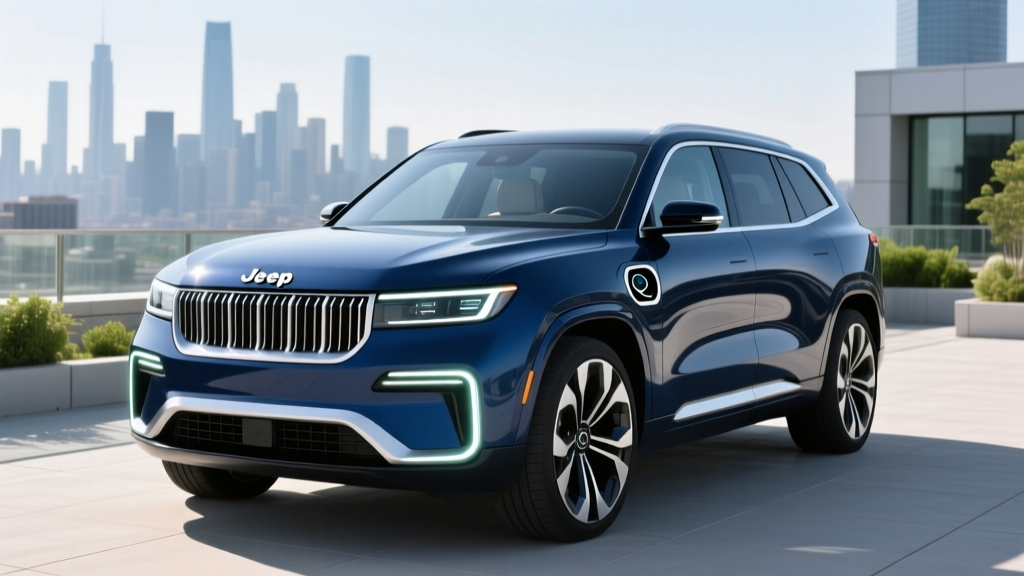
The full-size electric SUV segment is heating up, and the Jeep Wagoneer EV has landed as a serious contender for families who need three rows, genuine towing capability, and a battery big enough for real road trips. But with a starting MSRP pushing well past $70,000, the monthly payment conversation quickly turns to leasing — and whether the math actually works once you factor in charging costs, insurance premiums, depreciation, and federal incentives.
If you're researching a Jeep Wagoneer EV lease, you're likely comparing it against the Rivian R1S, Cadillac Escalade IQ, or a gas-powered Wagoneer L. This guide cuts through the marketing and gives you the numbers: exact EPA range, real-world charging costs, §30D tax credit eligibility, and a five-year total cost of ownership projection so you can decide whether the Wagoneer EV fits your budget — not just your driveway.
2026 Jeep Wagoneer EV: The Specs That Matter
Before we get into dollars and cents, here are the hard numbers that drive every ownership-cost calculation. The 2026 Wagoneer EV rides on Stellantis' STLA Large platform with a battery pack north of 100 kWh (usable capacity), dual-motor all-wheel drive, and DC fast-charging capability designed around the NACS connector standard that now dominates the North American market.
| Spec | Value |
|---|---|
| EPA Est. Range | ~330 miles (real-world highway: ~270–290 mi) |
| Battery (Usable) | ~101 kWh, NMC chemistry |
| Peak DC Fast Charge | ~200 kW (10–80% in ~25 min) |
| Level 2 Charge Rate | 11.5 kW (~30 mi/hr added) |
| Horsepower | ~600 hp (combined dual motor) |
| 0–60 mph | ~4.4 seconds (est.) |
| Towing Capacity | Up to 7,500 lbs (with tow package) |
| EPA Efficiency | ~78 MPGe / 43 kWh/100 mi |
| Battery/Powertrain Warranty | 8 years / 100,000 miles |
| Starting MSRP | ~$72,000 (base); ~$87,000 (top trim) |
The Jeep Wagoneer EV Lease: What the Monthly Payment Actually Looks Like
Leasing an EV in 2026 has a structural advantage that many shoppers overlook: the commercial clean vehicle credit loophole. Under current IRS rules, EVs leased through a dealership's financing arm (rather than purchased outright) can qualify for a $7,500 lease credit that the lessor (the bank) receives — and many automakers pass this directly to the consumer as a capitalized-cost reduction. This bypasses the income caps, MSRP caps, and battery-sourcing requirements that apply to purchase-based §30D credits.
Here's what a typical 2026 Wagoneer EV lease might look like:
- Trim: Wagoneer EV Overland (mid-tier, ~$78,000 MSRP)
- Lease term: 36 months / 10,000 miles per year
- Capitalized cost reduction: $7,500 (passed-through lease credit) + $2,000 down payment
- Money factor: ~0.00225 (equivalent to ~5.4% APR)
- Residual value: ~48% of MSRP at 36 months
- Estimated monthly payment: ~$950–$1,150 (before tax, title, and fees)
Compare that to purchasing the same trim with a 72-month loan at 6.5% APR and a $7,500 down payment: monthly payments would land around $1,200–$1,350. The lease route saves $100–$300/month in cash flow, though you don't build equity. For a vehicle in this price class with uncertain long-term depreciation curves, the lease shields you from resale-value risk.
Federal Tax Credit Eligibility: §30D Rules for 2026
If you choose to purchase rather than lease, the federal EV tax credit under IRS §30D can reduce your tax liability by up to $7,500 — but eligibility is a multi-layered filter. Here's the checklist as of the 2026 tax year:
- MSRP Cap: SUVs/pickups/vans must be ≤$80,000 MSRP. The base Wagoneer EV qualifies; fully loaded trims may exceed the cap.
- Buyer Income Cap (MAGI): ≤$300,000 joint / ≤$225,000 head of household / ≤$150,000 single filer.
- Battery Components: A percentage of battery components must be manufactured or assembled in North America (threshold increases annually).
- Critical Minerals: A percentage of critical minerals must be sourced from the US or a free-trade-agreement country (threshold increases annually).
- Point-of-Sale Transfer: You can elect to transfer the credit to the dealer at purchase, receiving the $7,500 as an immediate price reduction rather than waiting for a tax refund.
- Foreign Entity of Concern (FEOC): Battery components or critical minerals from a FEOC can disqualify the credit entirely.
The Wagoneer EV's battery supply chain is the variable most likely to affect your credit. Stellantis has been North-Americanizing its battery sourcing through its ACC (Automotive Cells Company) joint venture and LG Energy Solution partnerships, but the critical-minerals and component thresholds tighten each year. Always verify eligibility with your dealer and a tax professional before signing — and confirm whether the specific trim and build date qualifies. The IRS maintains the official eligible-vehicle list at fueleconomy.gov.
If you lease instead: The §30D income, MSRP, and sourcing restrictions generally do not apply to the commercial-credit pathway used by lessors. The $7,500 typically flows through as a cap-cost reduction. Confirm with your dealer that the lease program includes this pass-through — not all do.
Five-Year Total Cost of Ownership: Wagoneer EV vs. Gas Wagoneer
Monthly payments are only part of the picture. Here's a five-year, 75,000-mile ownership projection comparing the Wagoneer EV (purchased, mid-trim) against the gas-powered Wagoneer L (5.7L V8, ~17 MPG combined) at a similar price point.
| Category | Wagoneer EV (AWD) | Gas Wagoneer L (V8) |
|---|---|---|
| Purchase Price (after credit) | $70,500 | $72,000 |
| Fuel/Energy Cost | $5,250 (home + public charging) | $14,560 (gasoline) |
| Maintenance | $2,400 | $5,800 |
| Insurance (5 years) | $14,500 | $11,200 |
| Depreciation (est. 5-yr) | -$38,800 (55%) | -$32,400 (45%) |
| Total 5-Year Cost | $53,850 | $71,160 |
The EV wins on energy and maintenance by a wide margin — roughly $12,700 in combined savings over five years. But it gives back about $3,300 in higher insurance premiums and potentially $6,400 in steeper depreciation. The net savings still favor the EV by approximately $17,300 over five years, but that gap narrows significantly if the Wagoneer EV's resale value underperforms projections (a real risk for any new EV nameplate) or if electricity rates in your area are above the national average.
Charging vs. Gas: The Per-Mile Math
Let's break down the fuel-cost calculation with concrete assumptions:
- Wagoneer EV: 43 kWh/100 mi × $0.14/kWh (national avg. residential) = $0.060/mi (home charging). Public DC fast charging at ~$0.40/kWh = $0.172/mi. Blended (80% home / 20% public): ~$0.082/mi.
- Gas Wagoneer L: 17 MPG combined × $3.50/gal = $0.206/mi.
- Savings per mile: ~$0.124/mi with the EV. Over 15,000 miles/year = ~$1,860 annual fuel savings.
If you have access to off-peak utility rates (as low as $0.06–$0.08/kWh in some regions), your EV fueling cost drops to roughly $0.03/mi — nearly seven times cheaper per mile than the gas Wagoneer. Conversely, if you rely entirely on public DC fast charging, the gap narrows but the EV still costs less per mile.
Maintenance Savings: Where EVs Genuinely Win
The Wagoneer EV eliminates the most common recurring maintenance items that gas-car owners take for granted. No oil changes, no transmission fluid swaps, no spark plugs, no catalytic converters, and significantly reduced brake wear thanks to regenerative braking (one-pedal driving can extend brake pad life to 100,000+ miles).
| Service Item | Wagoneer EV | Gas Wagoneer |
|---|---|---|
| Oil Changes | $0 (none needed) | $750–$1,125 |
| Brake Pads/Rotors | $400–$600 (regen extends life) | $1,200–$1,800 |
| Transmission Service | $0 (single-speed reduction gear) | $300–$600 |
| Coolant/Fluid Flushes | $200–$300 | $400–$600 |
| Cabin Air Filter | $150–$200 | $150–$200 |
| Tire Rotation/Replacement | $1,200–$1,600 (EVs wear tires faster due to weight/torque) | $1,000–$1,400 |
| Total (est.) | $1,950–$2,700 | $3,800–$5,725 |
The one area where the EV costs more is tires. The Wagoneer EV's estimated 6,000+ lb curb weight and instant torque delivery accelerate tire wear by roughly 20–30% compared to a gas equivalent. Budget for a tire replacement around year 3–4. Still, the net maintenance savings of $1,500–$3,000 over five years is real and repeatable.
The Insurance Reality: Expect to Pay More
Here's where EV ownership stings: insurance premiums for the Wagoneer EV will likely run 25–35% higher than the gas Wagoneer. Based on national averages for full-size luxury SUVs, expect:
- Wagoneer EV: $2,600–$3,200/year (varies by state, driving record, coverage level)
- Gas Wagoneer L: $2,000–$2,500/year
Why the premium? Three factors drive higher EV insurance costs:
- Higher repair costs: Battery packs are expensive to replace if damaged, and body shops need specialized high-voltage training. Even minor collision repairs near the battery enclosure can trigger costly inspections.
- Higher vehicle value: The EV variant's MSRP is typically higher, increasing comprehensive and collision coverage costs.
- Limited actuarial data: Insurers are still building claims-history models for newer EV nameplates, and uncertainty leads to conservative (higher) pricing.
Shop quotes from at least three insurers before signing. Companies like Geico, Progressive, and Liberty Mutual now offer EV-specific policies, and some provide discounts for home-charger installation or bundling with homeowners insurance. The insurance gap may narrow as the Wagoneer EV accumulates real-world claims data over the next 2–3 years.
Depreciation and Resale Value: The Wildcard
EV depreciation has been volatile. In 2023–2024, Tesla's aggressive price cuts and rapid battery-tech improvements caused used EV values to crater — some models lost 50–60% of their value in two years. The broader market has since stabilized, but full-size luxury EVs remain a depreciation risk because:
- The segment is new and buyer demand is still establishing itself.
- Rapid improvements in range and charging speed can make a 2–3-year-old EV feel outdated.
- Battery health uncertainty makes used buyers cautious (though the 8-year/100,000-mile warranty mitigates this).
For the Wagoneer EV, we project 50–55% depreciation over five years, compared to roughly 40–45% for the established gas Wagoneer. That translates to a $4,000–$8,000 resale-value gap — the single largest cost offset against the EV's fuel and maintenance savings.
This is precisely why leasing is attractive for the Wagoneer EV: the lessor absorbs the depreciation risk. If residual values tank, you simply return the vehicle at lease-end and walk away. If they hold up better than expected, you can exercise the purchase option at the locked-in residual price.
State, Local, and Utility Incentives: Stack the Savings
Federal credits are only one layer. Depending on where you live, additional incentives can significantly improve the Wagoneer EV's financial picture:
- California: Up to $2,000–$7,000 via the Clean Vehicle Rebate Project (CVRP) and Clean Fuel Reward, plus HOV lane access. Income-based rebates may stack.
- Colorado: Up to $5,000 state tax credit for EVs (income-dependent), plus utility rebates from Xcel Energy.
- New York: Drive Clean Rebate up to $2,000 (point-of-sale), plus NYSERDA utility incentive programs.
- Utility Rebates (nationwide): Many utilities offer $250–$1,000 rebates for Level 2 home charger installation, plus discounted off-peak EV charging rates (as low as $0.05–$0.08/kWh). Check with your local provider.
- Home Charging Installation: The §25C residential energy credit may cover up to 30% of home charger equipment and installation costs (up to $1,000).
Incentive amounts, availability, and eligibility vary by jurisdiction and change frequently. Always verify with your state energy office, utility provider, and a tax professional before relying on specific rebate figures.
A California buyer stacking the federal lease credit ($7,500), a state rebate ($2,000), and a utility charger rebate ($500) could reduce effective costs by $10,000 or more — a meaningful dent in a five-year ownership calculation.
Decision Framework: Should You Lease the Wagoneer EV?
- You want the $7,500 lease credit without worrying about income caps, MSRP caps, or battery-sourcing rules.
- You prefer predictable monthly costs and want to avoid depreciation risk on a new EV nameplate.
- You have reliable home Level 2 charging access (a must for cost savings to materialize).
- You drive 10,000–12,000 miles/year (within standard lease limits).
- You want the latest tech and plan to upgrade every 3 years anyway.
- You drive more than 15,000 miles/year (lease overage penalties at $0.20–$0.30/mile add up fast).
- You plan to keep the vehicle 7+ years (purchase builds equity; the battery warranty covers 8 years).
- You lack home charging access and would rely on expensive public DC fast charging.
- You frequently tow heavy loads (towing cuts EV range by 35–45%, making gas more practical for heavy-duty use).
Frequently Asked Questions
How much does it really cost to own a Jeep Wagoneer EV over 5 years?
Based on our projections, a purchased Wagoneer EV (mid-trim, after federal credit) costs approximately $53,000–$58,000 over five years and 75,000 miles, factoring in energy, maintenance, insurance, and depreciation. That's roughly $15,000–$18,000 less than the gas Wagoneer L over the same period, though depreciation uncertainty could narrow the gap.
Do I qualify for the $7,500 federal tax credit on the Wagoneer EV?
For a purchase, you must meet income caps (≤$300K joint / ≤$150K single), the vehicle must be under the $80K MSRP cap for SUVs, and the battery must meet critical-mineral and component-sourcing thresholds that tighten annually. For a lease, these restrictions generally don't apply — the lessor claims a commercial credit and typically passes the $7,500 to you as a cap-cost reduction. Verify with your dealer and the IRS clean vehicle credit page.
How much do I save on fuel and maintenance with the Wagoneer EV?
Approximately $1,860/year in fuel savings (at a blended 80% home / 20% public charging mix vs. 17 MPG gas at $3.50/gal) and $400–$600/year in maintenance savings (no oil changes, reduced brake wear). Combined savings of roughly $2,200–$2,500/year are realistic for most owners with home charging access.
Are EVs more expensive to insure than gas vehicles?
Yes, typically 25–35% more expensive for a vehicle in this class. Higher repair costs (battery and high-voltage components), higher vehicle values, and limited claims data drive the premium. Expect to pay $600–$800 more per year for the Wagoneer EV vs. the gas Wagoneer. Shop multiple quotes and ask about EV-specific discounts.
How well do EVs hold their value?
EV depreciation has been steeper than gas vehicles, particularly for luxury SUVs. Expect the Wagoneer EV to retain roughly 45–50% of its value after five years, compared to 55–60% for the gas Wagoneer. Leasing transfers this risk to the lessor. As the EV market matures and battery confidence grows, depreciation curves are expected to improve — but for a first-generation nameplate, the risk is real.