The Short Answer on the Jeep Wagoneer EV Interior
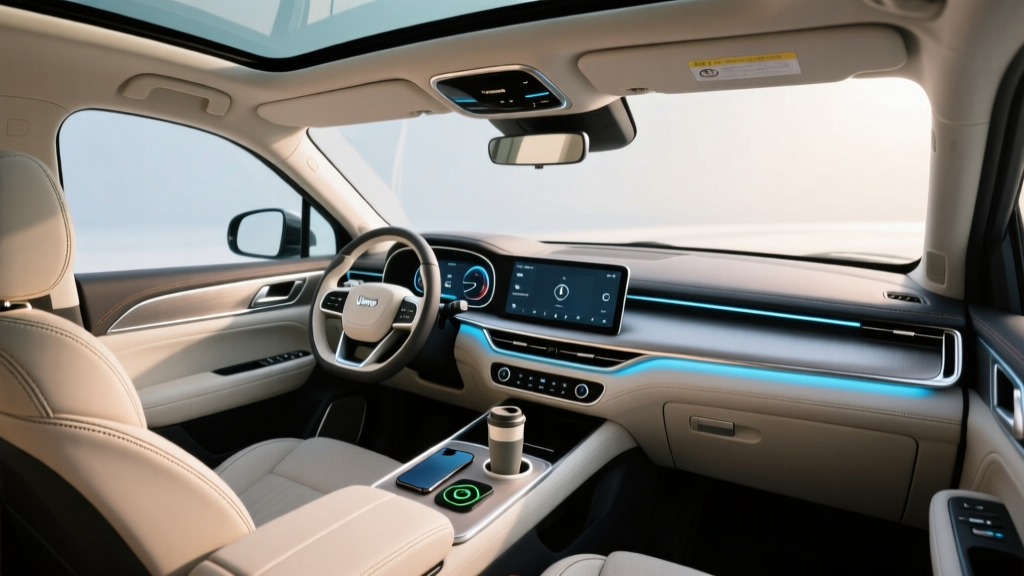
The Jeep Wagoneer EV (announced for the 2026 model year, built on Stellantis' STLA Large platform) features a three-row cabin with a dominant 12.3-inch digital cluster, a 15-inch center touchscreen, and an available 10.25-inch front-passenger display. Jeep targets a flat-floor architecture enabled by the skateboard battery pack, maximizing second- and third-row legroom versus the gas Wagoneer. Cargo volume is expected near ~40 cu ft behind the third row and over 100 cu ft with both rear rows folded, though final EPA-certified figures remain unconfirmed as of early 2026. The Wagoneer EV is positioned as a premium family hauler with an estimated starting MSRP around $65,000–$72,000 depending on trim, placing it above the §30D federal tax credit MSRP cap of $80,000 for SUVs but subject to strict battery-sourcing and buyer-income rules.
Interior Layout and Passenger Space: What Changes With Electrification
The transition from the gas Wagoneer's body-on-frame architecture to the STLA Large unibody skateboard platform fundamentally alters the interior packaging. Without a transmission tunnel, driveshaft hump, or rear differential housing, the Wagoneer EV's floor sits flat across all three rows. This translates to measurable gains:
- Second-row legroom: Estimated ~42 inches (vs. ~39 inches in the gas Wagoneer), thanks to the flat floor and sliding bench or available captain's chairs.
- Third-row usability: The gas Wagoneer's third row was already competitive at ~36 inches of legroom. The EV version is expected to match or slightly exceed this, with a lower step-in height due to the absence of a rear axle hump.
- Headroom: Battery-pack height under the floor may reduce headroom by ~0.5–1.0 inches compared to the gas model, a trade-off common to skateboard-platform EVs. Tall passengers (6'2"+) should test-fit before purchasing.
- Front-row cockpit: The 15-inch center stack runs Stellantis' Uconnect 5 EV interface with native route planning, DC fast-charger preconditioning controls, and real-time energy-flow visualization. The available passenger-side screen handles media and navigation input independently.
Material quality on Overland and top-spec trims includes open-pore wood, available Nappa leather, and a suede headliner — consistent with the gas Wagoneer's premium positioning. Base trims use synthetic leather and hard-plastic lower door panels, which is typical at this price point.
Range, Charging, and Battery: The Numbers That Matter
Interior comfort means little if the powertrain can't support your driving pattern. Based on Stellantis' preliminary disclosures for the STLA Large platform, here is what we know about the Wagoneer EV's powertrain:
| Spec | Estimated / Announced |
|---|---|
| Battery Capacity (usable) | ~110–118 kWh (NMC chemistry) |
| EPA Range (target) | ~350–400 miles (preliminary) |
| Real-World Highway Range | ~280–320 mi (70 mph, mild weather) |
| Cold-Weather Range (20°F) | ~240–280 mi (est. 25–30% loss) |
| Peak DC Fast-Charge Rate | ~200–250 kW (800V architecture) |
| 10–80% DC Charge Time | ~22–28 minutes (preliminary) |
| Level 2 Home Charging (11.5 kW) | ~10–11 hours (0–100%) |
| 0–60 mph | ~5.0–5.5 seconds (AWD, est.) |
| Horsepower | ~450–500 hp (dual motor, est.) |
Real-World Range Reality: The EPA sticker may read ~380 miles, but large, heavy three-row SUVs with boxy aerodynamics lose efficiency quickly at highway speeds. Expect ~280–320 miles on a flat interstate at 70 mph in moderate temperatures. In sub-freezing conditions, plan for 240–280 miles between charges. Always plan road trips around 250-mile legs to maintain a safety buffer.
The 800V architecture is critical: it enables sustained charging at higher state-of-charge levels, reducing the painful taper that plagues 400V systems above 60% SoC. At a 350 kW Electrify America or Tesla Supercharger (with NACS adapter, if applicable), the Wagoneer EV should sustain ~200 kW through 60% before tapering to ~100 kW by 80%.
EV vs Gas Wagoneer: Cost and Capability Compared
For buyers cross-shopping the Wagoneer EV against the gas Wagoneer (5.7L V8 with eTorque mild hybrid), here is how the numbers stack up over five years and 75,000 miles:
| Factor | Wagoneer EV (est.) | Gas Wagoneer L V8 |
|---|---|---|
| Base MSRP | ~$67,000 | ~$62,000 |
| Federal Tax Credit (§30D) | Up to $7,500 (if eligible) | $0 |
| Effective Starting Price | ~$59,500 | ~$62,000 |
| MPGe / MPG Combined | ~85 MPGe (est.) | 17 MPG combined |
| Energy Cost per Mile | ~$0.045 (home L2) | ~$0.21 ($3.50/gal gas) |
| 5-Year Fuel/Energy Cost | ~$3,375 | ~$15,750 |
| Maintenance (5 yr) | ~$1,800 | ~$4,500 |
| 5-Year Total Cost (excl. insurance) | ~$64,675 | ~$82,250 |
The EV's energy savings are substantial — roughly $12,375 over five years — but only if you can charge at home at residential electricity rates (~$0.14/kWh national average). Relying exclusively on DC fast charging at $0.35–$0.50/kWh erases most of the fuel-cost advantage.
Real Ownership Costs: Charging, Insurance, and Maintenance
| Cost Category | Annual Estimate | Notes |
|---|---|---|
| Home Charging (Level 2) | $675 | 15,000 mi/yr, $0.14/kWh, ~3 mi/kWh |
| Public DC Fast Charging | $1,050–$1,500 | If >50% of charging is public |
| Insurance | $2,400–$3,200 | EV premiums 15–25% higher than gas equivalent |
| Maintenance | $350–$400 | No oil changes; cabin filter, wipers, tire rotation, brake fluid |
| Tires | $400–$600 | EVs wear tires 20–30% faster due to weight and torque |
| Home Charger Install | $800–$2,500 (one-time) | Level 2, 48A hardwired; may require panel upgrade |
Home charging access is the make-or-break factor. If you have a garage or dedicated parking spot with 240V access, the Wagoneer EV's ~110 kWh battery charges fully in about 10–11 hours on a Level 2 station — perfect for overnight replenishment. If you rely on street parking or apartment living with no charging infrastructure, the large battery becomes a liability: public charging a 110+ kWh pack is expensive and time-consuming.
Insurance costs are higher for EVs across the board. The Wagoneer EV's premium pricing, high repair costs (aluminum and mixed-material body), and expensive battery pack push annual premiums to $2,400–$3,200 depending on your state, driving record, and coverage level. Get quotes before committing.
Federal Tax Credit Eligibility: The §30D Reality Check
The IRS §30D tax credit offers up to $7,500 for qualifying new EVs, but the Wagoneer EV faces several hurdles:
- MSRP Cap: SUVs must be under $80,000 MSRP. The Wagoneer EV's base trims should qualify, but loaded Overland or top-spec models may exceed the cap.
- Buyer Income Cap: AGI must be ≤$150,000 (single), ≤$225,000 (head of household), ≤$300,000 (joint). Above these thresholds, no credit.
- Battery Component Sourcing: Battery components must be manufactured or assembled in North America (phase-in percentages increase yearly through 2029). Stellantis' STLA Large battery supply chain is still scaling — confirm eligibility on fueleconomy.gov at time of purchase.
- Critical Minerals: A percentage of critical minerals must be sourced from the U.S. or FTA partners. This requirement tightens annually.
- Point-of-Sale Transfer: As of 2024, eligible buyers can transfer the credit to the dealer for an immediate price reduction rather than waiting for a tax refund. This is available in 2026 if the vehicle qualifies.
Bottom line: Do not assume you will receive $7,500. Verify the specific VIN's eligibility on the IRS portal and consult a tax professional. The Wagoneer EV's North American production (likely at the Windsor, Ontario or Illinois STLA Large plant) helps the sourcing requirement, but final certification is per-model-year and per-trim.
Myths vs Facts: Common Wagoneer EV Misconceptions
| Myth | Fact |
|---|---|
| "The EV has less cargo room because of the battery." | The skateboard platform eliminates the rear differential hump, often creating MORE usable volume than the gas model. The battery sits below the floor, not inside the cabin. |
| "I'll get 400 miles of range no matter how I drive." | EPA range assumes mixed driving at moderate speeds. Highway-heavy driving at 75+ mph, cold weather, or towing can reduce range by 25–35%. |
| "DC fast charging is just as cheap as home charging." | Public DCFC costs $0.35–$0.50/kWh — roughly 3x the cost of residential Level 2. Heavy public-charging users may spend MORE than gas. |
| "The battery will need replacing in 5 years." | Modern NMC batteries with active thermal management typically retain 85–90% capacity at 100,000 miles. Stellantis warranties the battery for 8 years/100,000 miles (minimum 70% retention). |
| "It qualifies for the full $7,500 tax credit automatically." | Eligibility depends on MSRP cap, buyer income, and battery-sourcing rules that change yearly. Always verify on fueleconomy.gov before purchase. |
Decision Framework: Is the Wagoneer EV Right for You?
Choose the Wagoneer EV if:
- You have home Level 2 charging access (garage, driveway, or dedicated spot with 240V).
- You drive mostly in urban/suburban environments with occasional road trips under 300 miles.
- You value three-row seating, premium materials, and the latest infotainment tech.
- You want to reduce per-mile energy costs and can capitalize on the §30D credit.
- You live in a region with reliable DC fast-charging networks for road trips (Electrify America, Tesla Supercharger with adapter).
Stick with the gas Wagoneer or consider a PHEV alternative if:
- You lack home charging access and rely on street parking or apartment living.
- You regularly tow heavy loads (>5,000 lbs) — towing crushes EV range by 40–50%.
- You frequently drive in extreme cold (below 10°F) where range loss exceeds 30%.
- Your budget is tight and you cannot absorb the higher upfront cost and insurance premiums.
- You live in a charging desert with sparse DCFC infrastructure (rural Great Plains, parts of the Mountain West).
Frequently Asked Questions
Does the Jeep Wagoneer EV have a front trunk (frunk)?
Stellantis has not confirmed frunk details for the Wagoneer EV. On the STLA Large platform, some models feature a modest frunk (~1–2 cu ft) suitable for charging cables and small bags, while others use the space for HVAC and power electronics. Expect an update as production specifications are finalized.
How does the Wagoneer EV interior compare to the Rivian R1S?
The Rivian R1S offers a more minimalist, tech-forward interior with a 15.6-inch landscape screen and vegan materials, but its third row is tighter (~32 inches legroom). The Wagoneer EV is expected to offer a more traditional luxury feel with greater third-row space, targeting buyers who prioritize passenger comfort over off-road-focused design.
Can the Wagoneer EV tow, and how does that affect range?
Stellantis targets a towing capacity of ~5,000–6,000 lbs for the Wagoneer EV. However, towing at maximum capacity can reduce range by 40–50%, meaning a 380-mile EPA range drops to roughly 190–230 miles while towing. Plan charging stops accordingly.
What is the battery warranty on the Wagoneer EV?
Federal law mandates a minimum 8-year/100,000-mile battery warranty with at least 70% capacity retention. Stellantis is expected to meet or exceed this standard. Some competitors offer 8-year/100,000-mile warranties at 70% retention (e.g., Hyundai, Kia) or 8-year/120,000-mile (Tesla).
Will the Wagoneer EV use NACS or CCS for charging?
Stellantis has committed to adopting the NACS (Tesla-style) connector across its North American EV lineup by 2025–2026. The Wagoneer EV is expected to ship with a native NACS port, granting access to Tesla Superchargers without an adapter, alongside Electrify America and other CCS networks via adapter if needed.