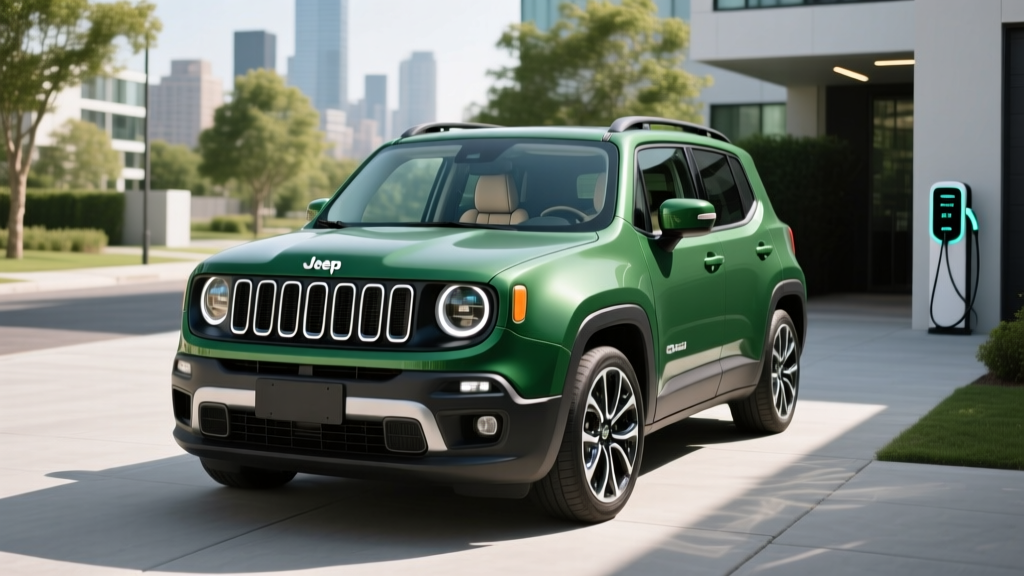
The short answer: The Jeep Renegade 4xe (plug-in hybrid) is the only electrified Renegade currently sold in the United States. A fully electric Renegade — sold in Europe as the Jeep Avenger — has not been confirmed for the U.S. market as of early 2026. If you're searching for a "Jeep Renegade electric car," you're likely looking at either the 4xe PHEV (25 mi electric-only, ~$33,000 base MSRP) or watching for a potential future U.S. Avenger launch. This guide breaks down exactly what's available now, what it costs to own, and how it compares to gas alternatives.
What the Jeep Renegade 4xe Actually Offers
The 2026 Jeep Renegade 4xe pairs a 1.3-liter turbocharged gasoline engine with an electric motor and an 11.4 kWh (usable) lithium-ion battery pack. The result is a compact SUV that can handle short commutes on electricity alone before the gas engine kicks in.
| Spec | 2026 Jeep Renegade 4xe |
|---|---|
| Electric-Only Range (EPA) | ~25 miles |
| Combined MPGe (electric mode) | ~50 MPGe |
| Combined MPG (gas-only mode) | ~28 MPG |
| Battery Capacity (usable) | 11.4 kWh, NMC chemistry |
| Total System Output | ~190 hp combined |
| 0–60 mph | ~7.5 seconds |
| Level 2 Charge Time (0–100%) | ~2 hours at 7.4 kW |
| Level 1 Charge Time (120V) | ~8 hours |
| Base MSRP (Latitude 4xe) | ~$33,095 |
| Battery/Powertrain Warranty | 8 years / 100,000 miles |
Real-world caveat: That 25-mile EPA electric range assumes moderate temperatures and mixed driving. In cold weather (below 40°F), expect 18–20 miles of electric range. Highway driving at 70+ mph will also pull that number down to roughly 20 miles. For a 15-mile round-trip commute, the 4xe covers it entirely on electricity in most conditions — but a 40-mile commute will require gas for the majority of the trip.
Renegade 4xe vs. Gas Renegade: Cost Breakdown
The core question for any PHEV buyer: does the electric drivetrain save enough to justify the higher purchase price? Let's run the numbers for a driver covering 12,000 miles per year, with 60% of driving falling within the 25-mile electric window.
| Cost Factor | Renegade 4xe (PHEV) | Renegade Gas (1.3L Turbo) |
|---|---|---|
| Base MSRP | ~$33,095 | ~$27,495 |
| Federal Tax Credit (§30D) | Up to $3,750* | $0 |
| Effective Purchase Price | ~$29,345 | $27,495 |
| Annual Fuel/Energy Cost | ~$1,050** | ~$1,680*** |
| 5-Year Fuel/Energy Total | ~$5,250 | ~$8,400 |
| Annual Maintenance | ~$450 | ~$550 |
| 5-Year Maintenance Total | ~$2,250 | ~$2,750 |
| 5-Year Total Cost of Ownership | ~$36,845 | ~$38,645 |
*§30D credit for PHEVs requires minimum 7 kWh battery capacity. The Renegade 4xe's 11.4 kWh pack qualifies, but the credit amount depends on critical-mineral and battery-component sourcing requirements per current IRS rules. Income caps apply ($150K single / $300K joint). Always verify with a tax professional.
**Assumes 7,200 electric miles at $0.14/kWh and 4,800 gas miles at 28 MPG / $3.50/gal.
***Assumes 12,000 miles at 28 MPG / $3.50/gal.
The 4xe pulls ahead on total cost within roughly 3–4 years of ownership, primarily through fuel savings. If your daily driving stays under 25 miles and you charge at home nightly, the savings widen considerably.
Real-World Ownership: What First-Time PHEV Buyers Must Know
A plug-in hybrid like the Renegade 4xe sits between a conventional hybrid and a full EV. You get electric commuting without range anxiety — but you also carry the maintenance burden of both a gas engine and an electric drivetrain.
Home Charging Access Is Critical
The 4xe's value proposition collapses without regular charging. If you plug in every night on a standard 120V outlet (Level 1), you'll wake up to a full 25-mile electric range. A Level 2 home charger (240V, 7.4 kW) cuts charge time to about 2 hours — useful if you make multiple short trips per day.
Installation reality: A Level 2 home charger installation typically costs $800–$2,500 depending on whether your electrical panel needs upgrading. If your panel is already 200 amps and the charger location is near the panel, expect the lower end. A panel upgrade to 200A can add $1,500–$3,000. Always get a quote from a licensed electrician before committing.
Cold Climate Considerations
The Renegade 4xe's NMC battery loses 20–30% of its electric range in freezing temperatures. That 25-mile range becomes roughly 18 miles at 20°F. The gas engine will also engage more readily in cold weather to provide cabin heat, further reducing electric-only driving. If you live in northern climates, plan your commute assumptions around the lower figure.
Driving Pattern Fit
The PHEV math works best when:
- Your daily round-trip commute is under 25 miles
- You can charge at home every night
- You take occasional longer road trips (where the gas engine eliminates range anxiety)
- You plan to keep the vehicle 4+ years to recoup the price premium
What About a Fully Electric Jeep Renegade?
Stellantis sells the Jeep Avenger in Europe — a subcompact electric SUV built on the same STLA Small platform that underpins the Renegade. The European Avenger features:
- 54 kWh battery (LFP chemistry)
- ~247 miles WLTP range (~200 miles EPA-equivalent)
- 156 hp electric motor
- 100 kW DC fast charging (10–80% in ~24 minutes)
- Starting price in Europe: ~€35,000
U.S. availability: As of early 2026, Jeep has not confirmed the Avenger for the American market. Industry analysts have speculated about a potential U.S. launch, but no official announcement, pricing, or EPA certification exists. Any range, price, or tax-credit figures for a U.S. Avenger would be purely speculative. We'll update this guide if Jeep confirms a launch.
For buyers specifically wanting a fully electric compact Jeep in the U.S., the closest current option is the Jeep Wagoneer S — but at ~$65,000 and a much larger footprint, it's a different vehicle entirely.
Common Misconceptions About the Renegade 4xe
| Myth | Fact |
|---|---|
| "It's a fully electric Jeep" | The Renegade 4xe is a plug-in hybrid. It requires gasoline for longer trips. Only the Europe-only Avenger is fully electric. |
| "I'll never need gas" | With only 25 miles of electric range, most drivers will use gas regularly. The 4xe reduces fuel consumption — it doesn't eliminate it. |
| "The battery will need expensive replacement soon" | Stellantis warranties the battery for 8 years/100,000 miles. PHEV batteries experience less stress than full EV batteries due to smaller daily cycles. Replacement, if needed out of warranty, typically runs $4,000–$7,000. |
| "I qualify for the full $7,500 tax credit" | PHEVs with smaller batteries may qualify for a partial credit ($3,750). Full $7,500 eligibility depends on battery sourcing and critical-mineral requirements. Check IRS §30D guidelines. |
| "I can DC fast-charge it" | The Renegade 4xe does not support DC fast charging. Maximum charge rate is 7.4 kW on Level 2 AC. |
Decision Framework: Should You Buy the Renegade 4xe?
Choose the Jeep Renegade 4xe if:
- Your daily commute is 15–25 miles round-trip
- You have reliable home charging (garage or driveway with outlet access)
- You want Jeep branding and light off-road capability with lower fuel costs
- You take 3+ road trips per year and don't want to plan around charging stations
- You plan to own the vehicle for 4+ years
Look elsewhere if:
- Your daily commute exceeds 30 miles — the gas engine will run most of the time, negating the PHEV advantage
- You lack home charging access — without regular plug-in, you're just carrying dead battery weight and paying a premium
- You want a fully electric vehicle — consider the Hyundai Kona Electric (~$33,000, 261 mi EPA range) or Chevrolet Equinox EV (~$33,000, 315 mi range)
- You want maximum electric range — the Toyota RAV4 Prime offers 42 miles of electric range at a higher price (~$43,000)
Ownership Costs Beyond the Sticker Price
First-time PHEV buyers often overlook these expenses:
- Insurance: PHEVs typically cost 10–15% more to insure than their gas counterparts due to higher repair costs for battery components. Expect $1,400–$1,800/year depending on your profile.
- Tire wear: The added weight of the battery pack (roughly 300 lbs over the gas Renegade) increases tire wear. Budget for replacement tires every 35,000–40,000 miles instead of 50,000.
- Oil changes: Yes, the gas engine still needs them. However, because the engine runs less frequently, some owners can extend intervals slightly. Follow the manufacturer's recommendation (typically every 8,000 miles or 12 months).
- Registration fees: Some states impose additional EV/PHEV registration fees ($50–$200/year) to offset lost gas-tax revenue. Check your state's DMV.
Frequently Asked Questions
Is the Jeep Renegade available as a fully electric vehicle in the U.S.?
No. As of 2026, the only electrified Renegade sold in the U.S. is the 4xe plug-in hybrid. The fully electric Jeep Avenger, which shares the Renegade's platform, is sold only in Europe. Jeep has not announced a U.S. launch date for the Avenger.
How much does it cost to charge the Renegade 4xe at home?
A full charge of the 11.4 kWh battery at the U.S. average electricity rate of $0.14/kWh costs roughly $1.60. That gives you approximately 25 miles of electric driving — equivalent to about 6.4 cents per mile, compared to roughly 12.5 cents per mile for the gas Renegade at $3.50/gallon and 28 MPG.
Does the Renegade 4xe qualify for the federal tax credit?
It may qualify for a partial credit (up to $3,750) under IRS §30D. The credit amount depends on battery-component and critical-mineral sourcing requirements, which change annually. Buyer income caps apply: $150,000 for single filers, $300,000 for joint filers. The credit can be applied at the point of sale as of 2024 onward. Verify current-year eligibility with your dealer and a tax professional.
What happens if I never plug in the Renegade 4xe?
The vehicle will still function as a conventional hybrid, but you'll see roughly 28 MPG combined — only marginally better than the gas-only Renegade. You'll also have paid a ~$5,600 premium (before any tax credit) for a battery and electric motor you're not utilizing. Regular charging is essential to the PHEV value proposition.
How does the Renegade 4xe compare to the Toyota RAV4 Prime?
The RAV4 Prime offers significantly more electric range (42 miles EPA vs. 25 miles), more power (302 hp vs. ~190 hp), and a larger vehicle. However, it starts at ~$43,000 — roughly $10,000 more than the Renegade 4xe. If your commute is under 25 miles and budget is a priority, the Renegade 4xe delivers solid value. If you need more range and space, the RAV4 Prime is the stronger PHEV.
Can the Renegade 4xe tow?
The Renegade 4xe has a maximum towing capacity of approximately 2,000 pounds when properly equipped — adequate for a small utility trailer or a pair of dirt bikes, but not for a boat or camper. Towing will significantly reduce electric-only range and increase fuel consumption.