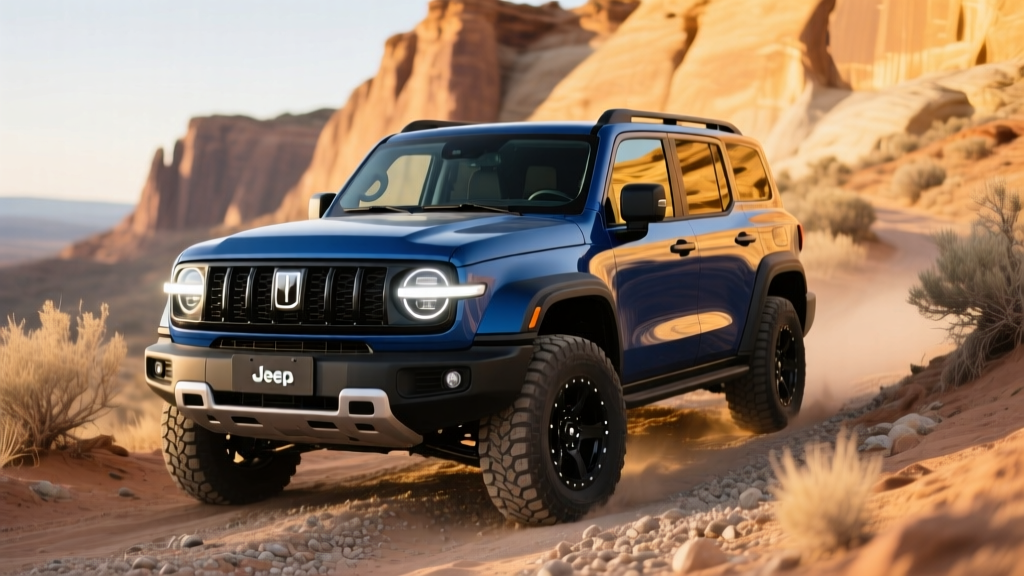
The 2026 Jeep Recon arrives as Stellantis's most ambitious electric off-roader yet — a boxy, Wrangler-inspired SUV built on the STLA Medium platform that promises Trail Rated capability without a drop of gasoline. After months of teaser campaigns and concept previews, Jeep has finalized specs for its first purpose-built electric 4x4 aimed squarely at the adventure-oriented buyer who wants silent trail crawling and zero tailpipe emissions.
But does a battery-electric Jeep make sense when range anxiety meets rocky terrain? We break down every spec that matters — from real-world range expectations and charging curves to the tax-credit math that determines whether this EV pencils out against the Ford Bronco Sport hybrid or Toyota RAV4 Prime.
2026 Jeep Recon: At-a-Glance Specifications
| Spec | 2026 Jeep Recon (AWD) |
|---|---|
| EPA Estimated Range | ~300 miles (preliminary) |
| Battery Capacity | ~85 kWh usable, NMC chemistry |
| Drivetrain | Dual-motor AWD (Selec-Terrain) |
| Horsepower | ~400 hp (est.) |
| 0–60 mph | ~5.5 seconds (est.) |
| Max DC Fast Charge | ~150 kW peak |
| 10–80% DC Charge Time | ~28 minutes (est.) |
| Level 2 Home Charge Rate | ~11.5 kW (~30 mi/hr) |
| EPA Efficiency | ~90 MPGe / ~35 kWh/100 mi (est.) |
| Cargo Volume | ~30 cu ft (rear seats up), ~65 cu ft (folded) |
| Ground Clearance | ~8.5 inches |
| Towing Capacity | ~3,500 lbs (est.) |
| Battery Warranty | 8 years / 100,000 miles |
| Base MSRP | ~$49,995 (est.) |
Note: The 2026 Jeep Recon is announced for production with specs listed as preliminary/estimated until EPA certification is finalized. Final figures may vary at launch.
Range and Efficiency: EPA Sticker vs. Trail Reality
The STLA Medium platform underpinning the Recon is designed for flexibility, but Jeep's Trail Rated ambitions add weight — skid plates, reinforced suspension, and all-terrain tires all create rolling resistance and drag that cut into efficiency. Expect the Recon to land around 90 MPGe combined, translating to roughly 35 kWh consumed per 100 miles of mixed driving.
For context, the EPA's EV testing methodology weights city and highway cycles differently than most adventure-SUV owners actually drive. If your weekends involve mountain passes and unpaved forest roads, plan your charging stops conservatively. The onboard navigation's range estimator and preconditioning features will be critical tools for trail-day route planning.
NMC (nickel manganese cobalt) chemistry offers higher energy density than LFP, giving Jeep more range in a compact battery footprint — important for preserving ground clearance and approach/departure angles. The trade-off: NMC cells are more sensitive to sustained high SoC (state of charge) and extreme heat, so daily charging to 80% rather than 100% will maximize long-term battery health.
Charging Speed: DC Fast Charging and Home Setup
| Charging Level | Power | Speed | Best For |
|---|---|---|---|
| Level 1 (120V) | ~1.4 kW | ~4 miles/hour | Overnight trickle, emergencies |
| Level 2 (240V, 48A) | ~11.5 kW | ~30 miles/hour | Daily home charging |
| DC Fast Charge | ~150 kW peak | 10–80% in ~28 min | Road trips, trailhead top-ups |
The Recon's ~150 kW peak DC fast-charge rate puts it in the middle of the pack — behind the Hyundai Ioniq 5's 240 kW but ahead of older-platform EVs capped at 100 kW. On a 350 kW Electrify America or Tesla Supercharger (via NACS adapter), the Recon should sustain strong charge rates from 10% to roughly 55% SoC before the charge curve tapers significantly. That 10–80% session should take approximately 28 minutes under ideal battery-temperature conditions.
Preconditioning matters here. If you navigate to a DC fast charger using the Recon's built-in route planner, the battery management system will warm or cool the pack to optimal temperature before you arrive. Skip preconditioning in cold weather and that 28-minute session could stretch to 40+ minutes as the battery limits charge rate to protect cells.
At home, a Level 2 wall connector on a 60-amp circuit (delivering 48 amps to the vehicle) replenishes roughly 30 miles of range per hour — meaning a full overnight session easily covers a 200-mile round-trip commute with range to spare. Budget $800–$2,000 for professional Level 2 installation depending on panel capacity and conduit run length; a 200-amp panel upgrade can add $1,500–$3,000 if your home's electrical service is older. Always get a quote from a licensed electrician before purchasing equipment.
Performance and Off-Road Capability
Dual electric motors provide the Recon with instant torque to all four wheels — no transfer case lag, no turbo spool, just immediate thrust. Jeep estimates roughly 400 horsepower and a 0–60 mph time around 5.5 seconds, making it genuinely quick for a body-on-frame-style off-roader. For comparison, the Wrangler 4xe PHEV hits 60 in about 6.0 seconds with 375 hp.
The Selec-Terrain system carries over from Jeep's ICE lineup with modes for Sand, Mud, Snow, and Rock, adapted for electric torque delivery. Electric motors excel at low-speed crawling — precise, stall-free torque at near-zero RPM is something no gas engine can match without a heavily modified drivetrain.
Jeep confirms the Recon will earn the Trail Rated badge, meaning it passes the company's standardized tests for traction, ground clearance, maneuverability, articulation, and water fording. With approximately 8.5 inches of ground clearance and an estimated 3,500-pound towing capacity, the Recon targets the moderate-difficulty trail and light-towing buyer rather than extreme rock-crawling enthusiasts.
One limitation to flag: regenerative braking on steep descents may behave differently than engine braking in a gas Wrangler. Jeep's one-pedal driving mode should handle most downhill trail scenarios, but drivers accustomed to selecting a low gear will need to trust the regen system — and understand that a fully charged battery limits regen capacity since there's nowhere for the energy to go.
Pricing, Trims, and Federal Tax Credit Eligibility
| Trim (Est.) | MSRP | After Potential Credit |
|---|---|---|
| Recon Sport (base) | ~$49,995 | ~$42,495 |
| Recon Overland | ~$54,995 | ~$47,495 |
| Recon Trailhawk | ~$58,995 | ~$51,495 |
The 2026 Jeep Recon's base MSRP is estimated around $49,995, positioning it against the Ford Mustang Mach-E Rally, Rivian R1S (used market), and upper-trim Toyota RAV4 Prime. Whether you actually pay that sticker price depends heavily on federal and state incentives.
Federal §30D tax credit eligibility requires meeting several conditions simultaneously, per IRS rules:
- MSRP cap: SUVs/vans must be priced at or below $80,000 — all Recon trims should qualify.
- Buyer income cap: Modified AGI must not exceed $150,000 (single), $225,000 (head of household), or $300,000 (joint).
- Battery sourcing: Critical minerals and battery components must meet escalating domestic/free-trade-partner thresholds — Stellantis has signaled North American battery assembly for STLA Medium vehicles, but final 2026 sourcing compliance is subject to IRS confirmation at launch.
- Point-of-sale transfer: Eligible buyers can apply up to $7,500 as an immediate dealer discount rather than waiting for tax filing.
The Recon's assembled-in-North-America positioning and Stellantis's battery partnerships give it a strong chance at the full $7,500 credit, but buyers should verify eligibility on the IRS qualified vehicles list at time of purchase — rules tighten annually on critical-mineral and component sourcing percentages.
Interior, Technology, and Daily Livability
The Recon's interior leans rugged-minimalist with waterproof, wipeable surfaces — a nod to its Trail Rated intentions. Expect a 12.3-inch digital cluster and a 12.3-inch (or larger) center touchscreen running Uconnect 5 with wireless Apple CarPlay and Android Auto. Jeep has confirmed over-the-air update capability for powertrain calibration, infotainment, and ADAS features.
Cargo space is estimated at ~30 cubic feet behind the second row and ~65 cubic feet with seats folded — competitive with the compact-to-midsize adventure-SUV segment. A front trunk (frunk) is expected but may be modest in size given the dual-motor layout up front.
Driver-assistance features should include adaptive cruise control with stop-and-go, lane-centering assist, automatic emergency braking with pedestrian detection, and a 360-degree camera system that doubles as a trail-spotting tool at low speeds. Importantly, these are SAE Level 2 driver-assist systems — the driver must remain engaged with hands on the wheel at all times. This is not autonomous driving.
Notable drawbacks to anticipate: the Recon's boxy silhouette and all-terrain tires will generate more wind and road noise at highway speed than aerodynamic crossovers like the Ioniq 5 or Model Y. Rear-seat legroom may also be tighter than expected if Jeep prioritized cargo volume and approach angle over passenger stretch room.
Pros and Cons
✓ Pros
- Trail Rated electric off-roader with instant torque crawling
- ~300 mi EPA range covers most adventure day trips
- ~$42,500 effective price after full $7,500 federal credit
- Waterproof interior surfaces for muddy gear and pets
- Quiet trail operation preserves the outdoor experience
- OTA updates for ongoing feature improvements
✗ Cons
- ~150 kW DC charging lags 800V competitors (240+ kW)
- Real-world range drops significantly in cold/off-road use
- Boxy shape means highway wind noise and lower efficiency
- Charging infrastructure sparse near remote trailheads
- ~3,500-lb towing limits utility for boat/camper trailers
- NMC battery requires more careful SoC management than LFP
Who the 2026 Jeep Recon Is For
Consider alternatives if: You regularly tow more than 3,500 lbs, frequently drive 300+ miles one-way to remote areas with no charging, or prioritize highway efficiency and cabin quietness over off-road capability.
The Recon makes the most sense for buyers who already have home charging access and whose "adventures" fall within a 150-mile radius of a DC fast charger. It's an excellent second vehicle for a two-car household or a primary vehicle for someone whose commute is under 60 miles round-trip with weekend trail use.
Frequently Asked Questions
What is the real-world range of the 2026 Jeep Recon?
While the EPA estimate targets approximately 300 miles, real-world range varies considerably. Highway driving at 70 mph in mild weather yields roughly 250–270 miles. Cold weather (below freezing) can reduce that to 200–220 miles. Off-road crawling at low speeds with elevation changes may consume energy faster than highway driving, so plan conservatively on trail days.
How fast does the Jeep Recon charge?
On a DC fast charger, the Recon peaks at approximately 150 kW, achieving a 10–80% charge in roughly 28 minutes under ideal conditions. At home on a Level 2 (240V, 48A) charger, it adds about 30 miles of range per hour, fully replenishing the ~85 kWh battery in about 8 hours.
How much does the Jeep Recon cost after tax credits?
The base Recon Sport is estimated at ~$49,995 MSRP. If you qualify for the full $7,500 federal §30D credit (meeting income caps, MSRP limits, and battery-sourcing requirements), the effective price drops to approximately $42,495. State incentives may reduce this further — check your local programs.
Does the Jeep Recon qualify for the federal EV tax credit?
It is expected to qualify, given its North American assembly and Stellantis's battery-sourcing strategy. However, final eligibility depends on IRS verification of critical-mineral and battery-component sourcing percentages at the time of purchase, plus buyer income and MSRP caps. Always confirm on the IRS qualified vehicle list before purchasing.
Is the Jeep Recon worth buying over competitors?
If off-road capability is a priority, the Recon has no direct electric rival at its price point — the Rivian R1S starts significantly higher, and the Ford Bronco Sport doesn't offer a full BEV variant. For buyers who rarely leave pavement, the Hyundai Ioniq 5, Tesla Model Y, or Ford Mustang Mach-E offer better efficiency, faster charging, and more refined on-road manners. The Recon is a purpose-built tool for a specific buyer.
What is the battery warranty on the Jeep Recon?
Jeep provides an 8-year/100,000-mile battery warranty covering defects and excessive capacity loss (typically below 70% state of health). This aligns with the federal minimum requirement for EV battery coverage and matches most competitors in the segment.