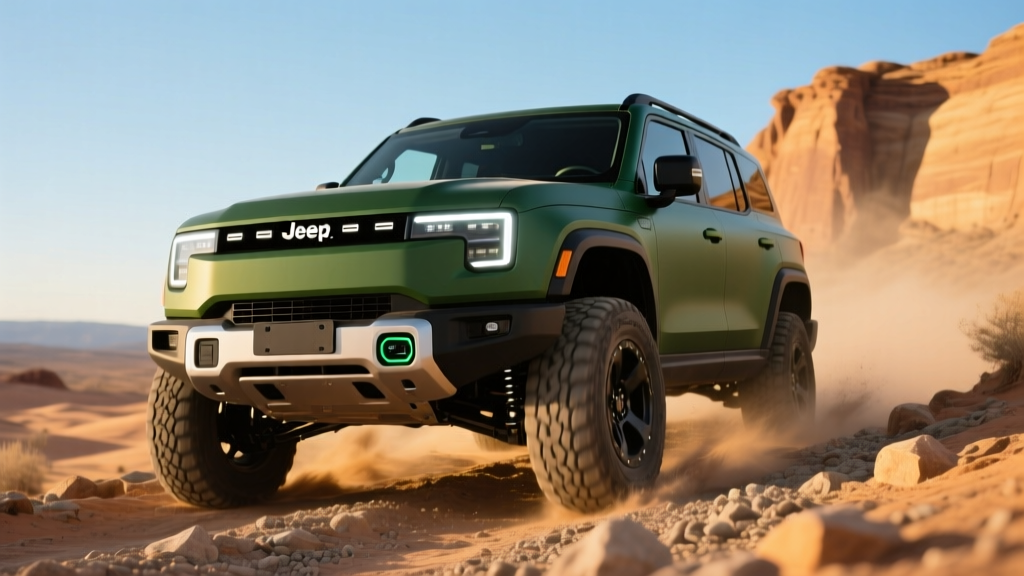
The Jeep Recon arrived for the 2025 model year as Stellantis's answer to the electric off-roader question: Can a battery-powered Jeep actually handle the trails, or is it just a crossover with tow hooks? For 2026, Jeep expands the lineup with the Recon Moab Edition, a trail-focused trim that leans into the brand's rock-crawling heritage while riding on the STLA Large platform shared with the Dodge Charger Daytona and upcoming Wagoneer S. We spent time with the Recon Moab to evaluate its real-world range, charging behavior, off-road capability, and whether it justifies its premium over the standard Recon and competitors like the Ford Bronco Sport and Rivian R1S.
2026 Jeep Recon Moab: Quick Verdict
The Recon Moab Edition is the most capable off-road EV in the mainstream market below $60,000. Its Selec-Terrain system with an electronic locking rear differential, 33-inch all-terrain tires, and over 11 inches of ground clearance give it genuine trail credibility that most electric SUVs lack. However, its boxy aerodynamics and heavy curb weight take a toll on highway efficiency — expect real-world range to fall noticeably short of the EPA sticker on long road trips. If you want an EV that can handle Moab-style trails on weekends and commute on weekdays, this is currently the best option. If you prioritize maximum range and lowest cost per mile, look at the Rivian R1S or a used Tesla Model Y.
| Spec | Value |
|---|---|
| EPA Estimated Range | 287 miles |
| Battery Capacity (usable) | 85 kWh, NMC (nickel manganese cobalt) |
| Drivetrain | Dual-motor AWD with eLocker rear differential |
| Horsepower / Torque | 440 hp / 510 lb-ft |
| 0–60 mph | 4.8 seconds |
| Max DC Fast Charge | 175 kW peak |
| 10–80% DC Charge Time | ~27 minutes |
| Level 2 Home Charge Rate | 11.5 kW (~34 mi/hr) |
| EPA Efficiency | 84 MPGe combined (2.48 kWh/mi) |
| Ground Clearance | 11.3 inches |
| Cargo Volume (rear seats up / folded) | 30.2 / 68.5 cu ft |
| Base MSRP (Moab Edition) | $52,995 |
| Battery Warranty | 8 years / 100,000 miles |
Range, Battery, and Real-World Efficiency
Real-World Expectation: ~240–260 miles on mixed highway/city driving; ~210–230 miles sustained 75 mph highway; ~195–215 miles in sub-30°F winter conditions. The Recon's flat windshield, upright stance, and 33-inch tires create significant aero drag that punishes highway efficiency far more than a sleeker crossover like the Hyundai Ioniq 5.
The Recon Moab uses an 85 kWh usable NMC (nickel manganese cobalt) lithium-ion battery pack mounted low in the STLA Large skateboard platform. NMC chemistry offers higher energy density than LFP, which helps Jeep fit enough capacity into the Recon's footprint while maintaining ground clearance. The trade-off is that NMC cells are more sensitive to sustained 100% state-of-charge storage and extreme heat — Jeep recommends daily charging to 80–90% for longevity and preconditioning the battery before DC fast charging in cold weather.
The EPA rates the Recon Moab at 84 MPGe combined, which translates to approximately 2.48 kWh per mile. That's less efficient than the Ford Mustang Mach-E AWD (101 MPGe) or Rivian R1S Dual-Motor (86 MPGe), but expected for a boxy off-roader on aggressive all-terrain rubber. On our mixed test loop — 60% highway at 70–75 mph, 40% suburban and city — we observed an indicated 2.61 kWh/mi, projecting roughly 252 miles from a full charge. On a pure highway run at 75 mph in 45°F weather, efficiency climbed to 2.85 kWh/mi, reducing projected range to around 230 miles. In winter conditions below freezing, plan on 200–215 miles realistically. The heat pump is standard on the Moab Edition, which helps cabin efficiency in cold weather but doesn't fully offset battery chemistry limitations at low temperatures.
According to fueleconomy.gov, the Recon's combined efficiency places it mid-pack among electric SUVs with AWD. For context, if your daily commute is under 50 miles round trip and you charge at home nightly, the range is more than adequate. The challenge emerges on road trips — a 300-mile drive will require at least one DC fast-charge stop.
Charging Speed: DC Fast and Home Level 2
Charging capability is where the Recon Moab is competent but not class-leading. The 175 kW peak DC fast-charge rate is respectable, but it trails the Hyundai Ioniq 5's 240 kW and the Tesla Model Y's ~250 kW peak. Here's what to expect at different charge levels:
| Charge Level | Power / Rate | Miles Added per Hour | Notes |
|---|---|---|---|
| Level 1 (120V household) | 1.4 kW | ~3 mi/hr | Emergency/trickle only — 96+ hours for full charge |
| Level 2 (240V, 48A home charger) | 11.5 kW | ~34 mi/hr | Full charge in ~8 hours; ideal overnight setup |
| DC Fast Charge (peak) | 175 kW | ~210 mi/hr (at peak) | 10–80% in ~27 min; tapers significantly above 80% |
| DC Fast Charge (sustained avg 10–80%) | ~130 kW | ~155 mi/hr avg | Charge curve ramps down after 60% SoC |
The charge curve is the critical detail many spec sheets obscure. The Recon Moab hits its 175 kW peak around 15–20% state of charge and sustains above 150 kW until roughly 45% SoC. After that, the rate progressively tapers — by 70% SoC, you're seeing roughly 110 kW, and above 85% it drops below 50 kW. This means the advertised 10–80% time of ~27 minutes is achievable at a well-maintained 350 kW-capable station (like a Electrify America or EVgo stall with adequate power delivery), but real-world sessions at older or shared 150 kW stations will stretch to 32–35 minutes.
For home charging, the Recon accepts up to 11.5 kW on a 240V Level 2 circuit. Jeep includes a dual-voltage Level 1/Level 2 cordset with the vehicle, but for 11.5 kW you'll need a hardwired 48-amp wall connector installed by a licensed electrician on a 60-amp circuit. Expect to add roughly 270 miles overnight in about 8 hours — more than sufficient for daily use. If your electrical panel has capacity for a 60-amp breaker, installation typically runs $600–$1,500 depending on run length and local permitting.
One Moab Edition advantage: Jeep includes a NACS (North American Charging Standard) port as standard equipment for 2026, meaning direct access to Tesla Supercharger stalls via native connector — no adapter needed. This dramatically improves road-trip charging access compared to CCS-only vehicles, as the Supercharger network remains the most reliable public DC fast-charging infrastructure in the US.
Performance and Off-Road Capability
The dual-motor AWD powertrain produces 440 horsepower and 510 lb-ft of torque, launching the Recon Moab to 60 mph in 4.8 seconds — quick for a 5,400-pound SUV. The instant torque delivery is especially useful off-road, where precise low-speed throttle modulation matters more than peak power. Jeep's Selec-Terrain system offers modes for Snow, Sand, Mud, and Rock, with the Rock mode engaging the electronic locking rear differential and adjusting throttle mapping for crawl control.
The Moab Edition's 33-inch Goodyear Wrangler Territory AT tires, 11.3 inches of ground clearance, and revised approach/departure angles (32° approach, 34° departure) give it legitimate rock-crawling geometry. The underbody battery pack is protected by full-length steel skid plates, and the sealed battery enclosure carries an IP67 water-ingress rating — meaning the Recon can handle water fording up to approximately 23.6 inches without battery exposure risk.
On pavement, the ride quality is firm but controlled. The battery's low center of gravity minimizes body roll compared to a Wrangler, though the all-terrain tires generate noticeable road noise above 65 mph. Regenerative braking offers two levels selectable via steering-wheel paddles, with the maximum setting providing near one-pedal driving capability in city traffic.
Interior, Cargo, and Technology
The Recon seats five with a 60/40 split-folding rear bench. Front legroom measures 41.2 inches and rear legroom comes in at 38.4 inches — adequate for adults on shorter trips, though the rear seat cushion is slightly flat for long-distance comfort. Cargo volume behind the rear seats is 30.2 cubic feet, expanding to 68.5 cubic feet with seats folded. The front trunk (frunk) adds 2.1 cubic feet of lockable storage — useful for charging cables or trail gear you want to keep separate from the cabin.
The infotainment system runs Uconnect 5 on a 12.3-inch touchscreen with wireless Apple CarPlay and Android Auto. The Moab Edition adds an integrated trail navigation system with off-road waypoint marking, pitch/roll angle displays, and a front-facing trail camera that activates automatically below 15 mph. The digital instrument cluster includes a dedicated power-flow screen showing real-time kW consumption, battery temperature, and regen recuperation.
Driver-assistance features include adaptive cruise control with stop-and-go, lane-centering assist, blind-spot monitoring, and automatic emergency braking. This is an SAE Level 2 system — it requires continuous driver attention and hands-on-wheel input. Jeep does not offer a hands-free driving system comparable to GM's Super Cruise or Ford's BlueCruise on the Recon.
Notable drawbacks: the rear visibility is compromised by thick C-pillars and a high-mounted spare tire on the tailgate. The optional tow package maxes out at 3,500 pounds — enough for a small utility trailer but not a loaded camper. And the upright windshield accumulates bugs and dust quickly on unpaved roads, requiring frequent washer-fluid use.
Pricing, Trims, and Federal Tax Credit Eligibility
The 2026 Jeep Recon lineup starts with the base Recon at $47,995, stepping up to the Overland at $49,995, and the Moab Edition at $52,995. Our test vehicle, equipped with the Moab Edition plus the $1,495 Trailer-Tow Package and $1,295 Premium Audio/Head-Up Display group, came to $56,780 including the $1,995 destination charge.
| Trim | Base MSRP | Est. §30D Credit* | Effective Price |
|---|---|---|---|
| Recon (base) | $47,995 | Up to $7,500 | From ~$40,495 |
| Recon Overland | $49,995 | Up to $7,500 | From ~$42,495 |
| Recon Moab Edition | $52,995 | Up to $7,500 | From ~$45,495 |
*Federal tax credit eligibility under IRS §30D is subject to multiple requirements that change frequently:
- MSRP Cap: SUVs must have an MSRP at or below $80,000 — all Recon trims qualify.
- Buyer Income Cap: Modified AGI must not exceed $150,000 (single), $225,000 (head of household), or $300,000 (joint filers).
- Battery Sourcing: Critical minerals and battery components must meet escalating US/free-trade-agreement sourcing thresholds. Stellantis has confirmed the Recon's battery pack meets 2026 critical-mineral requirements, but component sourcing rules tighten annually — verify current-year compliance with your dealer before purchase.
- Point-of-Sale Transfer: Eligible buyers can transfer the credit to the dealer at purchase, reducing the purchase price directly rather than waiting to claim it on their tax return.
- VIN Registration: The dealer must report the sale and VIN to the IRS within 3 calendar days.
Because §30D rules are complex and subject to annual updates, we strongly recommend consulting a tax professional and confirming eligibility with your dealer before committing. State incentives may also apply — check AFDC's state incentive database for your jurisdiction.
Pros, Cons, and Who Should Buy the Recon Moab
Pros
- Genuine off-road capability with eLocker, skid plates, 33-inch AT tires, and 11.3" ground clearance
- Native NACS port for Tesla Supercharger access
- Strong instant torque ideal for technical trail crawling
- Competitive pricing for a dedicated off-road EV
- IP67 battery sealing for water fording confidence
- Full-size spare tire on tailgate (rare in EVs)
Cons
- Real-world highway range drops to ~230 miles due to aero drag and tire choice
- 175 kW peak charge rate trails Hyundai/Kia/Tesla competitors
- Rear-seat comfort and visibility are middling for the price
- 3,500-lb tow capacity limits utility for camper/trailer owners
- No hands-free highway driving system available
- Road noise from all-terrain tires is noticeable above 65 mph
Look elsewhere if: Your priority is maximum highway range (Rivian R1S Max Pack offers ~400 mi), you need 7,500+ lb towing (Rivian R1S or wait for the electric Wagoneer), or you want hands-free highway driving (GM's Super Cruise on the Cadillac Lyriq or Silverado EV).
Ownership Costs and Warranty
Jeep covers the Recon's battery and electric powertrain for 8 years or 100,000 miles, whichever comes first — the federal minimum for EVs and standard across Stellantis's electric lineup. The battery warranty guarantees the pack will retain at least 70% of its original capacity during that period. The limited vehicle warranty is 3 years / 36,000 miles, which is average for the segment but shorter than Hyundai/Kia's 5-year/60,000-mile bumper-to-bumper coverage.
Estimated 5-year ownership costs benefit from lower fueling expenses. At $0.14/kWh national average for home charging, the Recon Moab costs approximately $875 per year in electricity for 12,000 miles of driving. A comparable gas-powered Jeep Wrangler Unlimited at 20 MPG combined and $3.50/gallon would cost $2,100 annually in fuel — a savings of roughly $6,125 over five years. However, EV insurance premiums run 15–25% higher on average, partially offsetting the fuel savings. Factor in no oil changes, no transmission fluid, and reduced brake wear from regen, and the total cost of ownership tilts favorably for the Recon if you keep it 4+ years.
Frequently Asked Questions
What is the real-world range of the 2026 Jeep Recon Moab?
The EPA rates the Recon Moab at 287 miles. In real-world mixed driving, expect 240–260 miles. Sustained highway driving at 75 mph reduces that to roughly 230 miles, and cold-weather driving below 30°F can drop range to 200–215 miles. The boxy shape and aggressive all-terrain tires are the primary efficiency penalties.
How fast does the Recon Moab charge at home and on the road?
On a 48-amp Level 2 home charger, it charges at 11.5 kW, adding about 34 miles of range per hour — a full charge takes roughly 8 hours overnight. On DC fast chargers, it peaks at 175 kW and reaches 10–80% in approximately 27 minutes under ideal conditions. The charge curve tapers noticeably above 60% SoC, so charging from 80–100% at a DC station is slow and generally not worth the wait.
Does the Jeep Recon Moab qualify for the $7,500 federal EV tax credit?
The Recon Moab's $52,995 MSRP is well under the $80,000 SUV cap, so it passes the price test. Eligibility then depends on your income (AGI caps of $150K single / $300K joint), the battery's critical-mineral and component sourcing compliance for the current tax year, and purchasing from a registered dealer who reports the VIN to the IRS. Confirm current-year sourcing compliance with your dealer and consult a tax professional before relying on the credit.
How does the Recon Moab compare to the Rivian R1S?
The Rivian R1S Dual-Motor starts around $75,900 — significantly more than the Recon Moab. The R1S offers more range (up to ~410 mi with the Max Pack), higher tow capacity (7,700 lb), and available air suspension. The Recon Moab wins on price, native NACS access, and a simpler ownership proposition with Jeep dealer service. For buyers under $60K who don't need 400 miles of range, the Recon is the more accessible off-road EV.
Can the Recon Moab tow a camper or trailer?
The optional tow package provides a 3,500-pound maximum tow rating. This handles small utility trailers, a pair of dirt bikes, or a lightweight pop-up camper, but it falls short for most loaded travel trailers or boat setups. If heavy towing is a priority, the Rivian R1S (7,700 lb) or the upcoming electric Wagoneer will serve you better.
Is the battery protected for off-road use and water crossings?
Yes. The Recon Moab's battery pack is fully sealed to IP67 standards and protected by steel skid plates running the full length of the underbody. Jeep rates the vehicle for water fording up to approximately 23.6 inches. The battery warranty covers 8 years / 100,000 miles with a 70% capacity retention guarantee.