The Jeep Recon arrives for the 2026 model year as Stellantis's most ambitious electric off-roader yet — a boxy, Wrangler-inspired SUV built on the STLA Large platform with genuine Trail Rated hardware and a removable glass roof. But for buyers researching the Jeep Recon interior, the real question is whether this rugged EV delivers daily-driver comfort alongside its trail credentials. We've analyzed the official specs, platform data, and early production details to give you the complete ownership picture.
Quick Verdict: Trail-Capable EV With a Spacious, Tech-Forward Cabin
The Recon positions itself as the electric spiritual successor to the Wrangler 4xe — minus the gas engine. It offers a more refined interior than a Wrangler, standard AWD with locking differentials, and an EPA-estimated range north of 300 miles. The trade-off: it's heavier, pricier, and more highway-oriented than its body-on-frame cousin. If you want an EV that can handle weekend trails without sacrificing weekday comfort, the Recon lands in a narrow but compelling niche.
| Spec | Value |
|---|---|
| EPA Est. Range | ~303 miles (Overland); ~275 miles (Trail Rated) |
| Battery Capacity | ~100 kWh usable (NMC chemistry) |
| Drivetrain | Dual-motor AWD (standard) |
| Horsepower | ~400 hp (combined) |
| 0-60 mph | ~5.5 seconds (est.) |
| Max DC Fast Charge | ~200 kW peak (800V architecture) |
| 10-80% DC Charge | ~27 minutes (est.) |
| Level 2 Home Charge | ~11.5 kW (~30 mi/hr added) |
| Base MSRP | $47,995 (Overland) |
| Federal Tax Credit | Up to $7,500 (§30D, subject to sourcing/income) |
| Battery Warranty | 8 years / 100,000 miles |
Jeep Recon Interior: Dimensions, Materials, and Tech
The Recon's cabin is where it departs most sharply from the Wrangler. Built on a unibody STLA Large architecture, it trades the Wrangler's utilitarian simplicity for a more car-like layout with modern EV proportions — a flat floor, wide center console, and upright seating position that preserves the Jeep-command feel buyers expect.
Passenger and Cargo Space
As a midsize two-row SUV, the Recon targets the same footprint as the Ford Bronco Sport and Toyota RAV4, but with EV packaging advantages:
- Front legroom: ~41.2 inches
- Rear legroom: ~38.5 inches
- Cargo volume (rear seats up): ~33 cu ft
- Cargo volume (rear seats folded): ~72 cu ft
- Front trunk (frunk): ~2.0 cu ft (weather-sealed, drainable)
The flat floor means three-across seating in the rear is more viable than in a Wrangler, and the upright roofline preserves headroom even with the available panoramic removable glass panels. The drainable frunk is a practical nod to Jeep's outdoor-use DNA — toss in wet gear or ice for a tailgate.
Infotainment and Displays
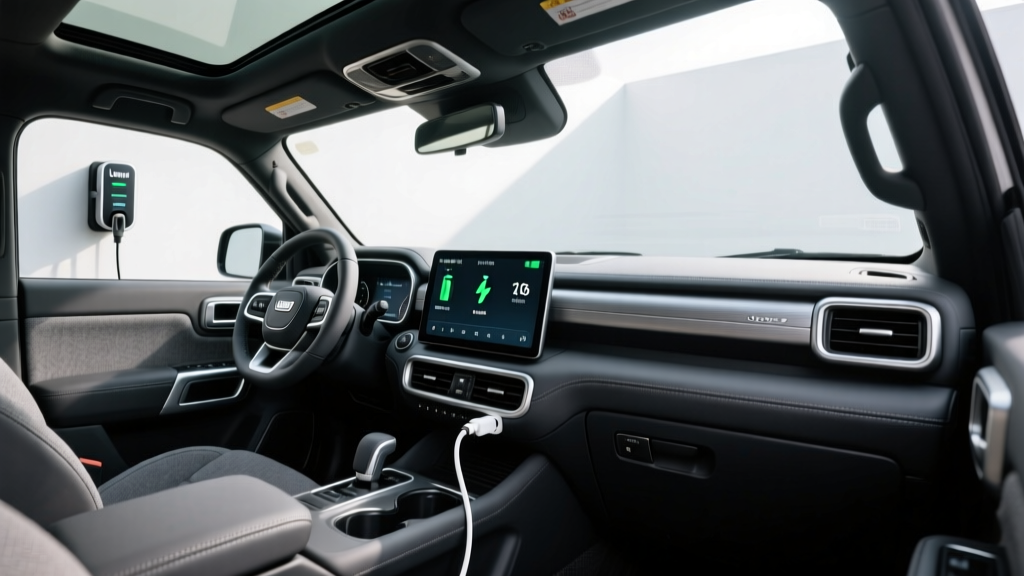
The dashboard centers on a 12.3-inch digital instrument cluster and a 12.3-inch (or available 10.4-inch vertical) Uconnect 5 touchscreen. Wireless Apple CarPlay and Android Auto are standard, along with over-the-air update capability. Jeep integrates dedicated off-road pages into the infotainment system — pitch/roll angles, torque distribution, and trail-mapping tools are accessible on the main screen rather than buried in menus.
A head-up display and digital rearview mirror are available on higher trims. The center console includes a wireless charging pad, USB-C ports front and rear, and physical knobs for climate control — a welcome choice for off-road use where touchscreen precision with gloves is impractical.
Materials and Build
Lower trims use durable, wipeable surfaces consistent with Jeep's adventure positioning — think rubberized floor mats, water-resistant seat fabrics, and hard-wearing door sills. Upper trims (particularly the Overland and anticipated Moab editions) add synthetic leather, contrast stitching, and soft-touch dash materials. It's not luxury-grade like a Rivian R1S, but it's a clear step above the Wrangler's spartan interior.
Range, Efficiency, and Real-World Expectations
Range Reality Check
EPA Estimated: ~303 miles (Overland trim, standard wheels)
Real-World Expectation: ~250-270 miles at sustained highway speeds (70+ mph); ~220-240 miles in cold weather (below 32°F) with cabin heating. The Trail Rated trim with all-terrain tires and underbody skid plates sacrifices roughly 25-30 miles of range due to increased rolling resistance and aerodynamic drag.
The Recon's ~100 kWh usable battery pack uses NMC (nickel manganese cobalt) chemistry, chosen for its higher energy density — critical for a boxy, heavy off-roader where every pound of battery must deliver maximum range. NMC cells offer roughly 20-25% better energy density than LFP alternatives, though they carry a higher replacement cost and prefer to be stored at partial state of charge rather than held at 100% daily.
Efficiency is rated at approximately 84 MPGe combined (roughly 40 kWh/100 mi), which is modest by EV standards but expected for a vehicle with the Recon's frontal area and ground clearance. For context, the Ford Mustang Mach-E AWD achieves ~101 MPGe combined, while the Rivian R1S dual-motor sits at ~76 MPGe.
The Recon includes a standard heat pump for cabin and battery thermal management, which reduces cold-weather range loss compared to resistive heating. Expect roughly 15-20% range reduction in freezing temperatures — better than the 30%+ loss seen in EVs without heat pumps, but still meaningful for winter road-trippers.
Charging Speed: DC Fast, Level 2, and Home Setup
| Charging Level | Power | Speed | Use Case |
|---|---|---|---|
| Level 1 (120V) | ~1.4 kW | ~4 mi/hr | Emergency/trickle top-up |
| Level 2 (240V, 48A) | ~11.5 kW | ~30 mi/hr | Daily home charging (~10 hr for full) |
| DC Fast Charge | ~200 kW peak | 10-80% in ~27 min | Road trips ( Electrify America, Tesla Supercharger with adapter) |
The Recon rides on Stellantis's 800-voltage architecture, enabling peak DC fast-charge rates around 200 kW. In practice, the charge curve tapers significantly above 80% SoC — expect the final 20% to take an additional 15-20 minutes. Plan road-trip stops around the 10-80% window for maximum efficiency.
At home, the 11.5 kW onboard charger means a full 0-100% charge takes roughly 10 hours on a properly installed Level 2 wallbox (240V/48A circuit). Most owners will plug in overnight and wake to a full battery — a 60-mile daily commute consumes roughly 20% of the pack.
Home installation note: A Level 2 charger requires a dedicated 60A circuit (for 48A continuous draw). Budget $800-$2,500 for professional installation depending on your electrical panel's proximity to the garage and whether a panel upgrade (to 200A service) is needed. Always consult a licensed electrician for final specifications.
The Recon ships with a NACS (Tesla) charge port as standard for 2026, granting native access to the Tesla Supercharger network. CCS adapters are available for Electrify America and other legacy networks, though most new public installations are transitioning to NACS.
Performance, Drivetrain, and Off-Road Capability
Every Recon comes with dual electric motors and all-wheel drive as standard — there is no single-motor RWD variant. Combined output is approximately 400 horsepower, delivering a 0-60 mph time in the mid-5-second range. That's brisk for a body-on-frame-style SUV but not sports-car territory; the Recon prioritizes low-end torque for rock crawling over highway heroics.
The Trail Rated hardware is where the Recon separates itself from every other electric midsize SUV:
- Electronic locking differentials (front and rear)
- Selec-Terrain traction management with Sand, Mud, Snow, and Rock modes
- Underbody skid plates protecting battery and motors
- 30+ inches of water fording capability
- Estimated ground clearance: ~9.0 inches (Trail Rated trim)
- Approach/departure/breakover angles competitive with Wrangler Sport (exact figures TBD at launch)
The battery pack sits within the frame rails, protected by a structural skid plate. Jeep has emphasized that the Trail Rated badge requires passing the same off-road course testing as gas-powered Jeeps — articulation, traction, ground clearance, water fording, and maneuverability.
Driver-Assist Technology
The Recon offers Jeep's Active Driving Assist, an SAE Level 2 system combining adaptive cruise control and lane-centering on divided highways. This is a driver-assist feature — you must remain engaged with hands on the wheel and eyes on the road at all times. It is not autonomous or "self-driving." Expect capability similar to Toyota Safety Sense 3.0 or Honda Sensing, not Tesla FSD or GM Super Cruise's hands-free operation.
Pricing, Trims, and Federal Tax Credit Eligibility
| Trim | Base MSRP | Est. After §30D Credit | Key Features |
|---|---|---|---|
| Overland | $47,995 | ~$40,495* | Standard AWD, 12.3" screens, Selec-Terrain |
| Trail Rated | $52,995 | ~$45,495* | Locking diffs, skid plates, AT tires, 33" tires |
| Moab (anticipated) | $57,995 | ~$50,495* | Premium interior, rock rails, upgraded suspension |
*Assumes full $7,500 §30D credit eligibility. See IRS rules below.
Does the Jeep Recon Qualify for the Federal EV Tax Credit?
The Recon is expected to qualify for up to $7,500 under IRS §30D, but eligibility depends on several factors that change regularly. Per current rules referenced by the IRS:
- MSRP Cap: SUVs must have an MSRP at or below $80,000 — the Recon clears this easily.
- Buyer Income Cap: Modified AGI must not exceed $150,000 (single), $225,000 (head of household), or $300,000 (joint). Check your prior-year or current-year tax return.
- Battery Sourcing: A percentage of critical minerals and battery components must be sourced from the US or FTA-partner countries. Stellantis has been working to localize supply chains, but specific Recon battery sourcing has not been independently confirmed as of publication.
- Point-of-Sale Transfer: Eligible buyers can transfer the credit to the dealer at purchase, reducing the out-of-pocket price immediately rather than waiting for a tax refund.
- Final Assembly: Vehicle must undergo final assembly in North America. The Recon is expected to be assembled in the US or Canada.
Important: Battery-sourcing requirements tighten annually. A vehicle that qualifies in January may not qualify by December if supply chains shift. Always verify current eligibility on the fueleconomy.gov tax credit page before purchasing, and consult a tax professional for your specific situation.
Pros and Cons: Honest Assessment
Pros
- Genuine Trail Rated off-road hardware in an EV — locking diffs, skid plates, water fording
- Spacious, car-like interior with flat floor and usable frunk
- 300+ mile EPA range sufficient for most road trips
- 800V architecture with ~200 kW DC fast charging
- NACS port standard — native Tesla Supercharger access
- Heat pump standard for better cold-weather efficiency
- Physical climate controls (not touchscreen-only)
- Removable glass roof panels for open-air driving
Cons
- Boxy aerodynamics reduce highway efficiency (~84 MPGe)
- Trail Rated trim loses ~25-30 miles of range to AT tires and armor
- Mid-5-second 0-60 — not the quickest EV in its price range
- No hands-free highway driving system (Level 2 only)
- NMC battery prefers partial SoC storage — not ideal for long-term 100% parking
- Heavier than unibody competitors; may affect tire and brake wear costs
- Pricing starts near $48K before options — premium over gas Wrangler Sport
How It Compares: Recon vs. Key Rivals
The Recon doesn't have a direct one-to-one rival — it occupies a unique space between off-road-focused EVs and mainstream electric SUVs. Here's how it stacks up:
| Spec | Jeep Recon (Overland) | Ford Bronco (ICE) | Rivian R1S (Dual) | Hyundai Ioniq 5 AWD |
|---|---|---|---|---|
| Powertrain | Dual-motor EV | Turbo I-4 / V6 | Dual-motor EV | Dual-motor EV |
| EPA Range | ~303 mi | ~380 mi (gas) | ~352 mi | ~290 mi |
| 0-60 mph | ~5.5 sec | ~6.0 sec | ~4.5 sec | ~4.5 sec |
| Off-Road Hardware | Trail Rated, lockers | Sasquatch pkg | Quad-motor, tank turns | None (AWD only) |
| Base MSRP | $47,995 | $39,630 | $75,900 | $49,650 |
| DC Fast Charge | ~200 kW | N/A | ~220 kW | ~240 kW |
The Rivian R1S is quicker and has more range but starts $28K higher and lacks the Jeep dealer network for trail-side service. The Ioniq 5 charges faster and costs less but offers zero off-road pretension. The gas Bronco is cheaper and proven off-road but lacks EV running costs and home charging convenience. The Recon's value proposition is being the only EV with genuine Trail Rated credentials at a sub-$50K starting price.
Who Should Buy the 2026 Jeep Recon?
Choose the Jeep Recon If:
- You want an EV but regularly drive unpaved roads, forest service trails, or beach access routes
- You need a two-row family SUV with real ground clearance and AWD security in snow/rain
- You have home Level 2 charging access and a daily commute under 80 miles round-trip
- You value the Jeep brand and dealer network for off-road community and service
- You want removable roof panels and an open-air experience without a gas engine
Look Elsewhere If:
- You prioritize maximum range and efficiency above all else (consider Ioniq 5 or Model Y)
- You need three-row seating (wait for the larger Jeep Wagoneer S or consider Rivian R1S)
- You want hands-free highway driving (GM Super Cruise vehicles offer Level 2+ hands-free)
- You don't have reliable home charging access — public-only charging gets expensive at 84 MPGe
- Budget is tight — a used Wrangler 4xe offers plug-in hybrid flexibility at lower cost
Warranty and Long-Term Ownership
Jeep backs the Recon with the following warranty coverage:
- Battery pack: 8 years / 100,000 miles (capacity retention guaranteed above ~70%)
- Electric powertrain (motors, inverters): 8 years / 100,000 miles
- Bumper-to-bumper: 3 years / 36,000 miles
- Corrosion perforation: 5 years / unlimited miles
The 8-year battery warranty is industry-standard, matching Tesla, Ford, and Hyundai. NMC batteries typically degrade 10-15% over 8 years under normal use — meaning you'd still have roughly 255+ miles of range from a 303-mile pack. Avoid habitual 100% charging and DC fast charging in extreme cold to maximize longevity.
Insurance premiums for the Recon are expected to run 15-25% higher than a comparable gas SUV due to EV repair costs and the vehicle's MSRP. Get quotes before purchasing — IIHS crash-test ratings, once available, will significantly influence rates.
Frequently Asked Questions
What is the real-world range of the Jeep Recon?
The EPA estimates ~303 miles for the Overland trim. In real-world highway driving at 70-75 mph, expect 250-270 miles. In cold weather (below freezing), range drops to roughly 220-240 miles. The Trail Rated trim with all-terrain tires loses about 25-30 miles across all conditions.
How fast does the Recon charge at home and on the road?
On a Level 2 home charger (240V/48A), the Recon adds about 30 miles per hour, fully charging in ~10 hours. On DC fast chargers, it peaks around 200 kW, reaching 10-80% in approximately 27 minutes. Charging slows considerably above 80% — plan stops around the 10-80% window for road trips.
Does the Jeep Recon qualify for the $7,500 federal tax credit?
It is expected to qualify for up to $7,500 under IRS §30D, but eligibility depends on your income (caps at $150K single / $300K joint), the vehicle's battery mineral sourcing compliance, and current-year rules. The MSRP is well under the $80K SUV cap. Verify on fueleconomy.gov at time of purchase and consult a tax professional.
Is the Jeep Recon worth buying over a Wrangler 4xe?
If you have home charging and want pure EV running costs (~$0.04-$0.06/mile vs. $0.18-$0.22/mile for the 4xe on gas), the Recon makes financial sense over 5+ years. If you take very long trips into charging-desert territory or need maximum articulation for extreme rock crawling, the 4xe's gas backup and solid axles still have advantages. The Recon is the better daily driver; the 4xe is the better expedition vehicle for remote areas.
Can the Jeep Recon tow?
Jeep has indicated a towing capacity of approximately 3,500-5,000 pounds (final rating pending EPA certification). This is sufficient for a small boat, light camper, or utility trailer, but less than the Rivian R1S (~7,700 lbs) or a gas Wrangler Rubicon. Towing will reduce range by 30-50% depending on trailer weight and aerodynamics.
What charging connector does the Recon use?
The 2026 Recon uses the NACS (Tesla) connector as standard, providing native access to Tesla Superchargers. CCS1 adapters are available for Electrify America and other networks. This aligns with the industry-wide shift to NACS across most automakers for 2025+.