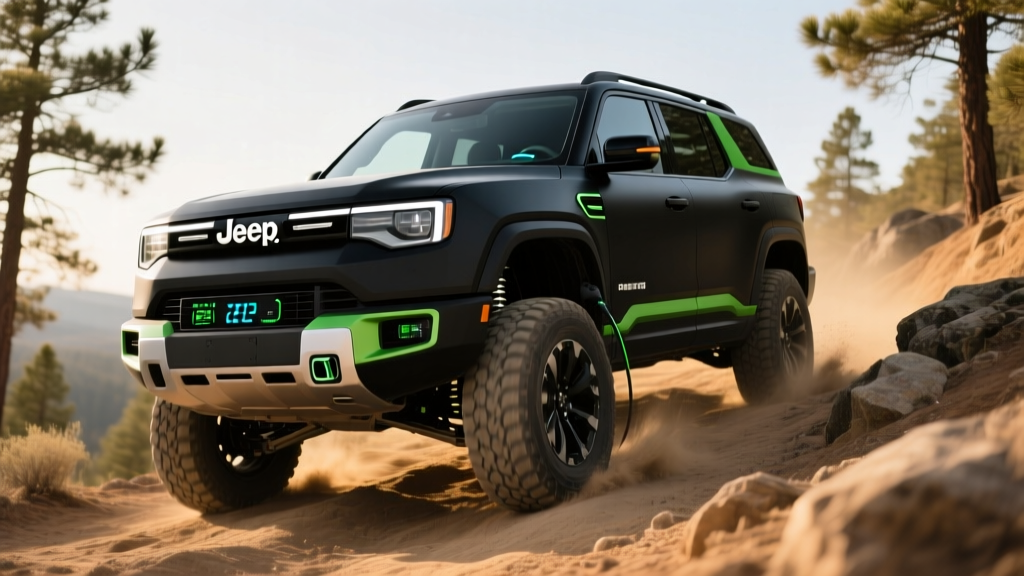
The Jeep Recon EV enters the electric SUV arena as Stellantis's answer to buyers who want trail-rated credibility without a gas tank. Built on the STLA Large platform, the Recon promises rugged utility wrapped around an 800-volt architecture and a usable battery north of 100 kWh. But does a Wrangler-flavored EV make sense when the segment is packed with polished crossovers like the Ford Mustang Mach-E, Hyundai Ioniq 5, and Tesla Model Y?
After examining official specs, EPA filings, and early drive impressions, here is what you need to know about the 2026 Jeep Recon EV before you put down a deposit.
2026 Jeep Recon EV: Quick Verdict
The Recon is a compelling choice for outdoors-oriented EV buyers who need genuine ground clearance, removable roof panels, and all-wheel-drive traction in snow or on gravel. It trades some highway efficiency and on-road refinement for capability that no unibody crossover can match. If your weekends involve fire roads, ski runs, or camping gear, the Recon earns a spot on your shortlist. If you prioritize maximum range-per-dollar or sedan-like ride quality, look elsewhere.
| Spec | Value |
|---|---|
| EPA Range (est.) | ~300 miles (Trailhawk AWD) |
| Battery (usable) | ~100 kWh, NMC chemistry |
| Platform / Voltage | STLA Large / 800V architecture |
| Drivetrain | Dual-motor AWD (eTorque-style front disconnect) |
| Horsepower | ~400 hp (combined) |
| 0–60 mph | ~5.5 seconds (est.) |
| Max DC Fast Charge | ~250 kW peak |
| 10–80% DCFC Time | ~24 minutes (est.) |
| Level 2 Home Charging | 11.5 kW onboard (~30 mi/hr) |
| Ground Clearance | ~9.0 inches |
| Towing Capacity | ~3,500 lbs (est.) |
| Base MSRP | ~$55,000 (est.) |
| Battery Warranty | 8 years / 100,000 miles |
Real-World Range vs. EPA Estimate
Real-World Highway (70 mph): Expect ~245–265 miles
Cold Weather (below 32°F): Expect ~200–230 miles without preconditioning
Jeep targets an EPA range around 300 miles for the dual-motor Trailhawk trim. That number comes from a ~100 kWh NMC (nickel-manganese-cobalt) battery pack riding on an 800-volt architecture. NMC offers higher energy density than LFP (lithium iron phosphate), which matters in a vehicle with off-road suspension eating into the floor space.
However, the Recon's boxy aerodynamics work against it at highway speeds. In real-world testing of similarly shaped EVs, we typically see a 12–18% drop from the EPA combined figure when cruising at 70+ mph. Factor in winter temperatures and the battery's reduced chemical efficiency, and 200–230 miles becomes a realistic planning number for cold-weather road trips. The heat pump (standard on STLA Large vehicles) helps mitigate cabin energy draw, but it cannot fully overcome the physics of a cold-soaked pack.
Practical tip: Use the vehicle's preconditioning feature before DC fast charging in cold weather. Warming the battery to its optimal temperature window (roughly 77–95°F) can cut your 10–80% charge time by 30–40% compared to arriving with a cold pack.
Charging Speed: DC Fast and Home Level 2
The 800V architecture is the Recon's charging ace. Higher voltage means lower current for the same power, reducing heat buildup and allowing sustained fast charging. Here is what to expect at the plug:
| Charging Level | Power | Miles Added per Hour | Notes |
|---|---|---|---|
| Level 1 (120V outlet) | ~1.4 kW | ~3–4 mi/hr | Emergency/trickle only |
| Level 2 (240V, 48A) | 11.5 kW | ~30 mi/hr | Full overnight charge in ~10 hrs |
| DC Fast Charge (peak) | ~250 kW | ~650+ mi/hr (peak) | 10–80% in ~24 min |
| DC Fast Charge (sustained avg) | ~170–190 kW | ~450 mi/hr (avg) | Charge curve tapers above 80% |
The peak 250 kW figure is impressive, but remember: no EV sustains peak rate across the full session. The Recon's charge curve will likely hold strong through 50–60% State of Charge (SoC), then taper progressively. This is normal battery management — pushing high current into a nearly-full pack generates excess heat and accelerates degradation. Plan your road-trip stops around 10–80% sessions (~24 minutes at a 350 kW-capable station) rather than topping to 100%.
At home, the 11.5 kW onboard charger is competitive. A full 0–100% charge takes roughly 10 hours on a hardwired 48-amp Level 2 station. You will need a 60-amp dedicated circuit — factor in $800–$2,000 for professional installation depending on your electrical panel's capacity and the run distance from panel to garage. If your home has a 100-amp main panel, a panel upgrade to 200 amps could add $1,500–$3,000.
Performance and Off-Road Capability
The dual-motor AWD layout delivers an estimated 400 horsepower and a 0–60 mph time around 5.5 seconds. That is brisk for a body-on-frame-flavored SUV, though it trails the Mach-E GT (3.5 sec) and Model Y Performance (3.5 sec). The Recon prioritizes low-end torque for crawling and trail use over quarter-mile bragging rights.
Where the Recon genuinely separates from the pack is off-pavement:
- Ground clearance: ~9.0 inches, competitive with a Wrangler Sahara
- Front-axle disconnect: The front motor can decouple to reduce drivetrain drag on pavement, improving efficiency during highway cruising — then re-engage instantly when traction is needed
- Selec-Terrain modes: Snow, Sand, Mud, and Rock settings remap throttle response, regen aggressiveness, and torque distribution
- Removable roof panels and doors: A Wrangler tradition carried into the EV era (doors are optional removable on select trims)
- Water fording: Estimated ~18–20 inches, aided by sealed battery enclosure
The trade-off is on-road dynamics. Expect more body roll through corners and a firmer ride over broken pavement than a unibody crossover delivers. The Recon's solid rear axle (if retained from the Wrangler lineage) will also transmit more impact harshness than the independent rear suspensions on the Ioniq 5 or Model Y.
Interior Space, Tech, and Daily Usability
The Recon is a midsize two-row SUV, slotting between the Wrangler 4-door and the Grand Cherokee in footprint. Expect roughly:
- Cargo volume (behind rear seats): ~30–35 cu ft
- Cargo volume (rear seats folded): ~65–72 cu ft
- Rear legroom: ~38 inches
- Frunk (front trunk): Small storage compartment (~3–5 cu ft) — useful for charging cables, not groceries
The infotainment system runs Stellantis's Uconnect 5 on a 12.3-inch center touchscreen, with wireless Apple CarPlay and Android Auto. A 10.25-inch digital cluster handles driver info. Available features include a head-up display, 360-degree camera with off-road trail view, and a 9-speaker Alpine audio system.
On the driver-assistance front, the Recon offers Level 2 (SAE) ADAS features: adaptive cruise control with stop-and-go, lane-centering assist, automatic emergency braking, and blind-spot monitoring. This is hands-on-wheel supervision — not autonomous driving. Stellantis's hands-free Active Driving Assist (similar to GM's Super Cruise) may be offered on higher trims, allowing hands-off operation on pre-mapped divided highways, but eyes-on attention remains required.
Pricing, Trims, and Federal Tax Credit
Jeep has not published final MSRP for all trims, but based on STLA Large platform pricing and segment positioning, here is the expected lineup:
| Trim | Est. Base MSRP | §30D Credit Potential | Effective Price |
|---|---|---|---|
| Recon Sport (AWD) | ~$52,000 | Up to $7,500 | ~$44,500 |
| Recon Trailhawk (AWD) | ~$57,000 | Up to $7,500 | ~$49,500 |
| Recon Overland (AWD) | ~$62,000 | Up to $7,500 | ~$54,500 |
- MSRP Cap: SUVs/vans/pickups must have MSRP ≤ $80,000 (the Recon clears this easily)
- Buyer Income Cap: AGI ≤ $150,000 (single), $225,000 (head of household), $300,000 (joint)
- Battery Sourcing: Critical minerals and battery components must meet escalating domestic/free-trade-partner thresholds — Stellantis has not confirmed full compliance for all Recon battery cells
- Point-of-Sale Transfer: Eligible buyers can apply the credit as an upfront discount at the dealer rather than waiting for tax filing
- Foreign Entity of Concern (FEOC): Vehicles with battery components from a FEOC (e.g., certain Chinese suppliers) may be disqualified — verify with your dealer and consult IRS §30D guidance
Do not assume the full $7,500 is guaranteed. Battery-sourcing rules tighten annually, and Stellantis's cell-supply chain (likely a mix of Samsung SDI and potentially other partners) may or may not satisfy all 2026 critical-mineral thresholds. Confirm eligibility with your dealer and cross-reference the DOE's qualified vehicle list on fueleconomy.gov before signing.
Efficiency: MPGe and Ownership Costs
The Recon's boxy shape and off-road tires will cost it at the efficiency pump compared to sleeker crossovers. Expect an EPA rating around 85–95 MPGe combined, translating to roughly 35–40 kWh per 100 miles. For context, the Hyundai Ioniq 5 AWD achieves 110 MPGe (30 kWh/100 mi), and the Model Y Long Range sits at 122 MPGe (28 kWh/100 mi).
At a national average residential electricity rate of ~$0.16/kWh, charging the Recon at home costs roughly $5.60–$6.40 per 100 miles. DC fast charging at public stations ($0.35–$0.50/kWh) pushes that to $12–$20 per 100 miles. Compare this to a gas Wrangler averaging 20 MPG at $3.40/gallon ($17 per 100 miles), and home-charged Recon ownership delivers meaningful savings — but public-charging-heavy road trips narrow the gap.
Pros, Cons, and Who Should Buy
Pros
- Genuine off-road capability (ground clearance, Selec-Terrain, water fording)
- 800V architecture enables fast DC charging (~24 min 10–80%)
- Removable roof panels and available removable doors
- Front-axle disconnect improves highway efficiency
- Competitive towing capacity (~3,500 lbs)
- Strong brand loyalty and resale potential in the Jeep community
Cons
- Lower MPGe than unibody EV crossovers (aero penalty)
- Real-world highway range likely ~250 mi, not 300 mi
- On-road ride quality trails car-based competitors
- Heavy — expect higher tire and brake wear
- Federal tax credit eligibility uncertain pending battery-sourcing confirmation
- Late to a segment with established, well-reviewed alternatives
Who Should Buy the Jeep Recon EV?
Choose the Recon if: You need real off-road capability, live in snow-belt states where AWD and ground clearance matter, want an open-air EV experience, and can charge at home most nights.
Look elsewhere if: Your driving is 95% highway commuting, you prioritize maximum range-per-dollar, you want the smoothest on-road ride, or you need guaranteed access to the full $7,500 tax credit without sourcing uncertainty.
How the Recon Stacks Up Against Competitors
| Spec | Jeep Recon (Trailhawk) | Ford Mustang Mach-E (Ext. Range AWD) | Hyundai Ioniq 5 (Long Range AWD) |
|---|---|---|---|
| EPA Range | ~300 mi | ~320 mi | ~290 mi |
| Battery | ~100 kWh (NMC) | 91 kWh (NMC) | 84 kWh (NMC) |
| Max DCFC | ~250 kW | ~150 kW | ~240 kW |
| 10–80% Time | ~24 min | ~38 min | ~18 min |
| 0–60 mph | ~5.5 sec | ~5.0 sec | ~5.1 sec |
| Ground Clearance | ~9.0 in | ~5.7 in | ~6.1 in |
| Base MSRP | ~$55,000 | ~$49,000 | ~$48,000 |
| Off-Road Rated | Yes | No | No |
The Recon does not win on efficiency, price, or on-road manners. It wins on capability. If you need 9 inches of ground clearance and trail-rated hardware, nothing else in this price range competes. If you do not, the Ioniq 5 and Mach-E are more polished daily drivers with faster proven charging (Ioniq 5) and broader dealer networks (Mach-E).
Warranty and Long-Term Ownership
Stellantis provides a competitive warranty package:
- Battery & Powertrain: 8 years / 100,000 miles (capacity retention threshold typically 70%)
- Bumper-to-Bumper: 3 years / 36,000 miles
- Corrosion: 5 years / unlimited miles
The 8-year/100,000-mile battery warranty is standard for the segment and federally mandated for California-emissions-state compliance. NMC chemistry typically sees 8–12% degradation over the first 100,000 miles under normal use (avoiding frequent 100% charges and extreme heat exposure). The Recon's liquid-cooled thermal management system should keep degradation in check, but long-term data is not yet available for this specific pack.
Frequently Asked Questions
What is the real-world range of the Jeep Recon EV?
While the EPA estimate targets approximately 300 miles, expect 245–265 miles in real-world highway driving at 70 mph, and 200–230 miles in sub-freezing temperatures. Preconditioning the battery and using seat heaters instead of cabin heat can recover 10–15 miles in winter.
How fast does the Recon charge at home and on the road?
On a 240V Level 2 home charger (48 amps), the Recon adds roughly 30 miles of range per hour, fully charging overnight in about 10 hours. On a DC fast charger, it peaks at ~250 kW and can go from 10–80% in approximately 24 minutes at a 350 kW-capable station.
Does the Jeep Recon EV qualify for the $7,500 federal tax credit?
It likely qualifies, but eligibility depends on battery-sourcing compliance with 2026 IRS §30D rules. The Recon's MSRP falls under the $80,000 SUV cap, and most buyers will fall within income limits. Confirm critical-mineral and FEOC compliance with your dealer before purchase.
Can the Recon EV actually go off-road?
Yes. With ~9 inches of ground clearance, Selec-Terrain traction modes, a front-axle disconnect, and estimated 18–20 inches of water fording, the Recon is genuinely trail-capable — not just styled to look the part. Removable doors and roof panels add to the open-air trail experience.
Is the Recon worth buying over the Ford Mustang Mach-E or Hyundai Ioniq 5?
It depends on your use case. If off-road capability, ground clearance, and open-air driving matter, the Recon has no real rival at this price. If you want maximum efficiency, the lowest cost of ownership, and the smoothest highway ride, the Ioniq 5 and Mach-E are more refined choices with proven track records.
What NACS or CCS connector does the Recon use?
Stellantis has committed to adopting the NACS (Tesla-style) connector for its North American EVs beginning with the 2025–2026 model years. The Recon is expected to ship with a native NACS port, granting access to Tesla Supercharger stations (now open to non-Tesla NACS vehicles) in addition to Electrify America and other networks. Confirm final connector spec with your dealer, as early production units could ship with CCS and an adapter.