Verdict: A Range-Extending Luxury SUV for the Charging-Desert Commuter
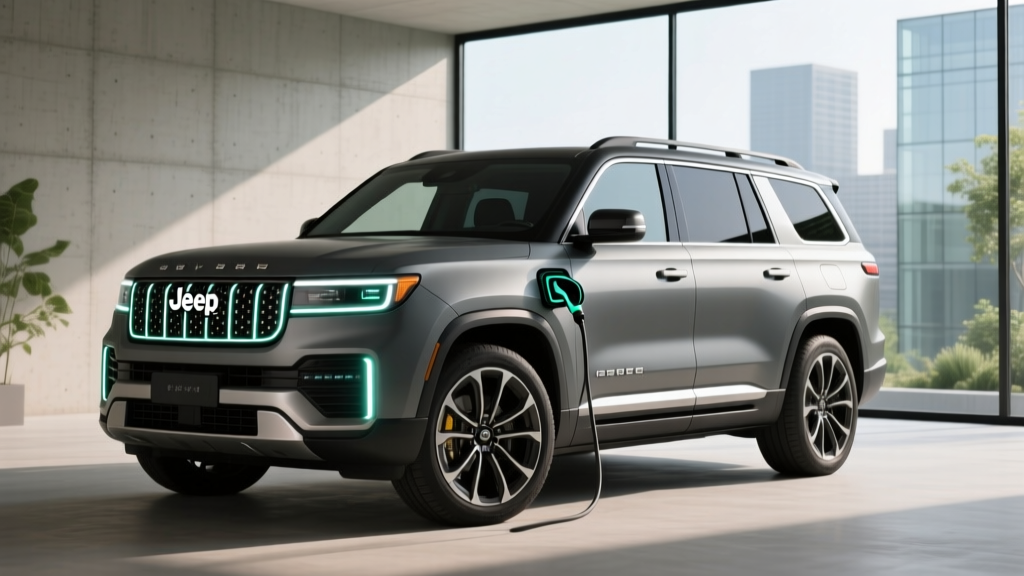
The 2026 Jeep Grand Wagoneer EREV (Extended-Range Electric Vehicle) occupies a niche most American automakers have abandoned: a body-on-frame luxury SUV that drives purely on electric power for daily use, then fires up a gas generator to eliminate range anxiety on long hauls. With an EPA-estimated 65 miles of pure electric range and a combined gas-electric reach exceeding 400 miles, it targets buyers who want silent, zero-tailpipe-emission school runs but aren't ready to trust DC fast-charger reliability on a 700-mile road trip.
This isn't a plug-in hybrid in the traditional sense — the gasoline engine never drives the wheels. It's a series hybrid, closer to the original Chevy Volt concept scaled up to three rows and a $100,000+ price tag. Below, we break down the exact range, charging specs, battery chemistry, pricing, and tax-credit math you need before putting down a deposit.
Range Reality Check
EPA Electric Range: 65 miles (battery only)
EPA Combined Range: ~430 miles (gas + electric)
Real-World Electric Expectation: Plan for 45–55 miles in mixed driving, dropping to 35–40 miles in sustained cold (below 30°F) or at highway speeds above 70 mph. The regenerative braking system helps in stop-and-go city traffic, where you'll see the best electric-only numbers.
Powertrain, Battery & Electric-Only Range
The Grand Wagoneer EREV pairs a large NMC (nickel manganese cobalt) lithium-ion traction battery with two electric motors providing standard 4×4 capability and a turbocharged 3.0L inline-six range extender that generates electricity but never mechanically connects to the axles.
| Spec | Value |
|---|---|
| Battery Chemistry | NMC (Nickel Manganese Cobalt) |
| Battery Capacity (Usable) | ~36 kWh |
| EPA Electric-Only Range | 65 miles |
| EPA Combined Range (EREV) | ~430 miles |
| EPA Efficiency (Electric Mode) | 56 MPGe |
| Range Extender Engine | 3.0L Turbo I-6 (generator only) |
| Drivetrain | Dual-motor AWD (4×4) |
| Total System Horsepower | ~510 hp |
| 0–60 mph | ~5.5 seconds |
| Towing Capacity | Up to 7,200 lbs |
| Seating Capacity | 7 or 8 passengers |
| Cargo (Behind 3rd Row) | ~18.5 cu ft |
| Cargo (Behind 2nd Row) | ~46.2 cu ft |
| Cargo (Max, Seats Folded) | ~88.8 cu ft |
| Battery/Powertrain Warranty | 8 years / 100,000 miles |
| Bumper-to-Bumper Warranty | 3 years / 36,000 miles |
The NMC chemistry was chosen for energy density — critical in a heavy body-on-frame SUV where every pound of battery must justify its weight. NMC cells offer higher specific energy than LFP (lithium iron phosphate) alternatives, though they trade off some cycle life and thermal stability. Jeep manages degradation through active liquid thermal management and a conservative top/bottom buffer, meaning you'll never see the full gross capacity accessible. Expect roughly 8–12% capacity loss over 8 years of typical use, well within the Stellantis warranty threshold of 70% state-of-health retention.
Charging Speed: DC Fast, Level 2 & Level 1
EREV owners charge differently than BEV owners. Because the battery is smaller and the gas generator covers long trips, most Grand Wagoneer EREV charging happens at home overnight. Still, DC fast-charge capability matters when you want to maximize electric-only miles on a road trip.
| Level | Power | Speed / Time |
|---|---|---|
| Level 1 (120V household) | ~1.4 kW | ~4 miles of range per hour |
| Level 2 (240V home/public) | 11.4 kW (max onboard) | ~33 miles/hr; 0–100% in ~3.5 hours |
| DC Fast Charge | Up to 50 kW peak | 10–80% in ~30 minutes |
The 50 kW DC fast-charge peak is modest by 2026 BEV standards (where 200+ kW is common), but it's proportional to the smaller 36 kWh battery. At 50 kW, you're charging at roughly 1.4C — a sustainable rate that protects NMC longevity. The charge curve holds near peak through about 50% state-of-charge, then tapers to protect cell health. You'll add roughly 30 miles of electric range in a 20-minute stop.
For home charging, the 11.4 kW onboard charger is excellent. A full overnight charge on a 48-amp Level 2 wall connector takes about 3.5 hours, meaning even a late-night plug-in delivers a full battery by morning. Most EREV owners will rarely need public charging infrastructure — a key advantage over pure BEVs in areas with sparse charger networks.
Performance & Driving Impressions
The dual-motor AWD system delivers 510 horsepower to all four wheels with the instant torque characteristic of electric drivetrains. The 0–60 mph time of approximately 5.5 seconds is genuinely quick for a three-row luxury SUV weighing over 6,000 pounds. Because the gas engine acts only as a generator, acceleration feel is identical whether you're running on battery or the range extender is active.
When the inline-six generator kicks in — typically when the battery drops below ~15% state-of-charge or under heavy load like towing — it runs at optimized RPM to generate electricity efficiently. The acoustic insulation is substantial enough that most passengers won't notice the transition at cruising speeds, though you'll hear a faint hum under hard acceleration when the generator is working at peak output.
The air suspension provides up to 10 inches of ground clearance in Off-Road mode, and the standard Quadra-Trac system uses the dual motors for precise torque vectoring. Towing capacity reaches 7,200 pounds, though expect electric-only range to drop dramatically — to roughly 20–25 miles — when pulling a loaded trailer.
Pricing, Trims & Federal Tax Credit Eligibility
| Trim | Base MSRP | Est. After §30D Credit* |
|---|---|---|
| Obsidian | $92,995 | $85,495 |
| Obsidian Carbide | $97,995 | $90,495 |
| Summit Reserve | $109,995 | $102,495 |
*Federal tax credit estimates. Actual eligibility depends on IRS §30D rules. See details below.
The Grand Wagoneer EREV qualifies as a PHEV under IRS §30D clean vehicle credit rules, potentially unlocking up to $7,500 in federal tax credits. However, eligibility is not guaranteed for every buyer. Here's what determines whether you'll actually receive it:
- MSRP Cap: SUVs must have an MSRP at or below $80,000. Several Grand Wagoneer EREV trims exceed this threshold — only the base Obsidian trim may qualify, and option packages can push it over. Verify the exact VIN's MSRP with your dealer.
- Buyer Income Limits: Modified AGI must not exceed $300,000 (joint filers), $225,000 (head of household), or $150,000 (individual). Check your tax return.
- Battery Sourcing: Critical minerals and battery components must meet escalating domestic-content percentages. For 2026, at least 70% of critical minerals must be sourced from the US or FTA partners, and 80% of battery components must be manufactured or assembled in North America. Stellantis has been ramping North American supply chains, but verify per-VIN eligibility at fueleconomy.gov.
- Point-of-Sale Transfer: You can transfer the credit to the dealer at purchase, reducing your out-of-pocket cost immediately rather than waiting for a tax refund.
- Manufacturer Cap: The 200,000-vehicle-per-manufacturer cap was eliminated under the Inflation Reduction Act, so Stellantis volume is not a concern.
Bottom line: Do not assume you'll receive the full $7,500. Higher trims likely exceed the MSRP cap. Consult a tax professional and verify your specific VIN's eligibility before purchase.
Interior, Tech & Driver Assistance
The Grand Wagoneer EREV cabin is where Stellantis justifies the six-figure price tag. The dashboard features a stacked screen array: a 12.3-inch digital cluster, a 12.3-inch passenger display, and a 10.3-inch center touchscreen running Uconnect 5 with wireless Apple CarPlay and Android Auto. Rear passengers get dual 10.1-inch entertainment screens with Amazon Fire TV integration.
The McIntosh MX1375 Reference Entertainment System (available on Summit Reserve) delivers 23 speakers and 1,375 watts — one of the most powerful factory audio systems in any vehicle. Second-row captain's chairs with heating, ventilation, and massage are standard on upper trims.
Driver assistance comes via Jeep's Active Driving Assist, a Level 2 system per SAE automation classifications. It provides lane-centering, adaptive cruise control, and hands-on-wheel monitoring. This is not a self-driving system — the driver must remain engaged at all times. It competes with GM's Super Cruise and Ford's BlueCruise but lacks true hands-free operation on mapped highways.
A notable tech drawback: the EREV does not offer vehicle-to-load (V2L) or vehicle-to-home (V2H) capability, meaning you can't use the large battery to power tools at a job site or back up your home during an outage — a missed opportunity given the substantial battery capacity.
Pros
- 65 miles electric covers most daily commutes zero-emission
- 430+ mile total range eliminates charging-desert anxiety
- Genuine luxury interior rivaling Range Rover and Escalade
- 510 hp with instant electric torque in a 3-row SUV
- Strong 7,200-lb towing capacity
- No dependence on public charging infrastructure
Cons
- Only 50 kW DC fast charging — slow by 2026 standards
- Most trims exceed the $80,000 MSRP cap for the §30D tax credit
- 56 MPGe electric efficiency trails rival PHEV SUVs
- No V2L/V2H capability despite large battery
- Heavy curb weight (~6,200 lbs) impacts tire wear and handling
- Active Driving Assist lacks hands-free highway capability
Who Should Buy the Grand Wagoneer EREV?
This vehicle fits a very specific buyer profile: the luxury family hauler who wants electric daily driving but has a lake house, mountain cabin, or cross-country road trip on the calendar. If your typical day involves a 30–50 mile round-trip commute with school drop-offs and grocery runs, you'll operate almost entirely on electricity, rarely burning fuel. But when Saturday means a 400-mile drive to the family property, the range extender eliminates the need to plan around DC fast chargers — many of which remain unreliable in rural corridors.
It also suits buyers in cold-climate states where winter range loss on pure BEVs is a genuine concern. The gas generator means you'll never be stranded with a depleted battery at -10°F in rural Montana.
It does not suit the buyer who wants maximum fuel savings — a pure BEV like the Rivian R1S or a more efficient PHEV will cost less per mile. It also doesn't suit buyers chasing the full $7,500 tax credit, as most trims exceed the MSRP cap.
Competitor Comparison: EREV vs. PHEV vs. BEV Luxury SUVs
The Grand Wagoneer EREV competes against three categories:
- Body-on-frame PHEVs: The closest rival is the upcoming Ramcharger-based architecture, though no direct three-row luxury EREV competitor exists from a domestic brand in 2026.
- Unibody luxury PHEVs: The BMW X5 xDrive50e offers 38 miles electric and better MPGe but lacks the Grand Wagoneer's size, towing, and off-road capability.
- Three-row luxury BEVs: The Rivian R1S (352 miles EPA, ~$84,990) and Tesla Model X (335 miles EPA, ~$81,630) offer pure electric operation with superior efficiency but require reliable charging access for long trips.
The Grand Wagoneer EREV's advantage is unique: body-on-frame ruggedness, serious towing, and genuine off-road chops with the safety net of a gas generator. No competitor offers this exact combination.
Decision Framework
Choose the Grand Wagoneer EREV if: You need three rows, tow regularly, drive in remote or cold areas, and want electric commuting without depending on public chargers.
Look elsewhere if: Your priority is maximum MPGe, lowest cost-per-mile, hands-free highway driving, or qualifying for the full federal tax credit on a luxury SUV.
What is the real-world electric range of the Grand Wagoneer EREV?
The EPA rates it at 65 miles electric-only. In real-world mixed driving, expect 45–55 miles. Highway driving at 75+ mph drops this to roughly 40 miles. In cold weather below 30°F, plan for 35–40 miles due to battery resistance and cabin heating demands. The range extender activates automatically when the battery depletes.
How fast does the Grand Wagoneer EREV charge at home and on the road?
At home on a 240V Level 2 charger (11.4 kW), a full charge takes about 3.5 hours. On a DC fast charger, the battery peaks at 50 kW and reaches 10–80% in approximately 30 minutes. Level 1 (120V) adds about 4 miles per hour — sufficient for topping off if you drive less than 30 miles daily.
Does the Jeep Grand Wagoneer EREV qualify for the $7,500 federal tax credit?
It may, but eligibility is trim-dependent. Under IRS §30D rules, SUVs must have an MSRP at or below $80,000. The base Obsidian trim starts at $92,995, which already exceeds the cap. Buyer income limits ($300K joint / $150K individual) and battery-sourcing requirements also apply. Consult a tax professional and verify your VIN at fueleconomy.gov before purchasing.
Is the Grand Wagoneer EREV worth buying over a pure electric SUV?
If you regularly tow, drive in areas with unreliable charging infrastructure, or take long trips through remote regions, the EREV's range-extender safety net provides genuine value no BEV can match. If your driving is primarily urban/suburban with reliable home charging, a pure BEV like the Rivian R1S offers lower running costs, higher efficiency, and simpler maintenance.
What are the biggest pros and cons?
Pros: 65-mile electric commute, 430+ mile total range, luxury interior, 510 hp, 7,200-lb towing, off-road capability. Cons: 50 kW DC charging is slow, most trims exceed the tax-credit MSRP cap, 56 MPGe trails competitors, no V2L capability, heavy curb weight, and the Level 2 driver assist lacks hands-free highway driving.
How long will the EREV battery last?
Stellantis warranties the battery for 8 years or 100,000 miles against capacity loss below 70%. NMC chemistry typically retains 85–90% capacity after 100,000 miles with proper thermal management. Because the battery is smaller than a BEV's, replacement cost is proportionally lower — estimated at $8,000–$12,000 out of warranty, though most owners will never need a replacement during typical ownership.