Quick Answer: Is the Electric Jeep Grand Cherokee Worth It?
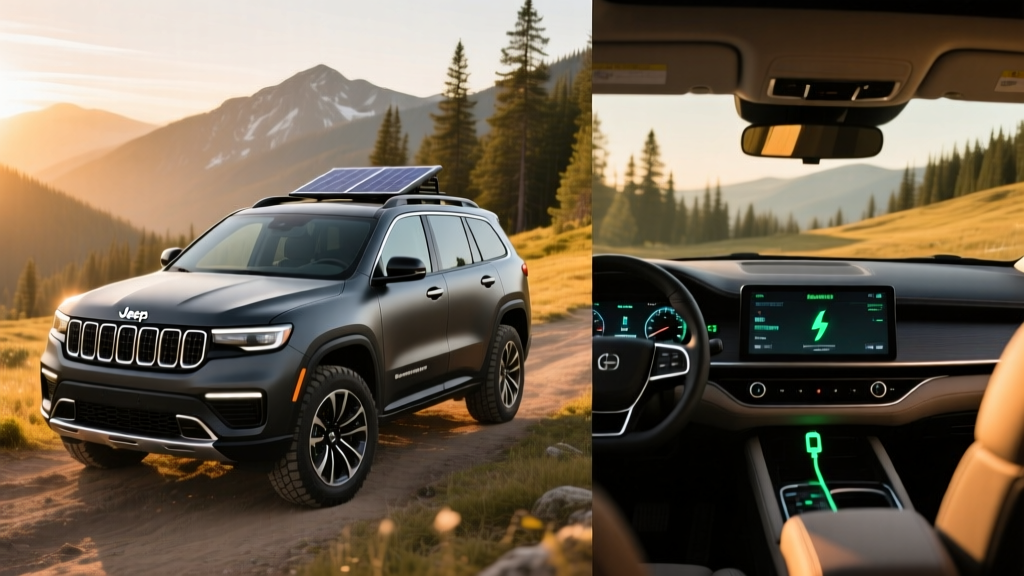
The 2026 Jeep Grand Cherokee 4xe is a plug-in hybrid (PHEV), not a fully electric vehicle. It pairs a 2.0L turbocharged engine with a 17.3 kWh battery pack to deliver an EPA-estimated 25 miles of electric-only range and 56 MPGe combined. Starting at approximately $59,995 (before incentives), it qualifies for a $3,750 federal tax credit under current IRS §30D rules. The 4xe makes sense if you can charge at home nightly and drive under 25 miles daily, effectively running as an EV for commutes while keeping gas-engine range for road trips. If you need a zero-emission, 250+ mile battery-electric SUV, this isn't it — look at the Hyundai Ioniq 5 or Tesla Model X instead.
Grand Cherokee 4xe Powertrain and Electric Range
The Grand Cherokee 4xe combines a 2.0-liter turbocharged inline-four with two electric motors integrated into an eight-speed automatic transmission. Total system output is 375 horsepower and 470 lb-ft of torque. The 17.3 kWh lithium-ion battery pack (NMC chemistry) sits beneath the rear seats, preserving cargo space compared to the gas-only model.
| Specification | 2026 Grand Cherokee 4xe |
|---|---|
| Powertrain | 2.0L Turbo I4 + 2 electric motors (PHEV) |
| Total System Output | 375 hp / 470 lb-ft |
| Battery Capacity | 17.3 kWh (NMC lithium-ion) |
| EPA Electric-Only Range | 25 miles |
| EPA Combined MPGe | 56 MPGe |
| Gas-Only MPG (after battery depletes) | 23 MPG combined |
| Total Driving Range | ~440 miles (gas + electric) |
| 0-60 mph | 6.0 seconds |
| Towing Capacity | 6,000 lbs |
| Base MSRP (4xe trim) | $59,995 |
| Battery Warranty | 8 years / 100,000 miles |
Real-World Range Reality: The EPA 25-mile electric estimate assumes moderate temperatures and mixed driving. Expect 18–22 miles in winter conditions (below 40°F) and up to 27 miles in mild city driving at 35-50 mph. Highway-speed electric-only driving at 70+ mph will deplete the battery in roughly 16-18 miles due to aerodynamic drag. Once the battery is exhausted, the gas engine takes over at 23 MPG combined — notably lower than the Toyota Highlander Hybrid's 35 MPG.
Charging the Grand Cherokee 4xe: What You Need at Home
PHEV charging is simpler than full BEV ownership because the battery is small. The Grand Cherokee 4xe accepts up to 7.2 kW on Level 2 (240V), which fully recharges the 17.3 kWh pack in roughly 2.5 hours. On a standard 120V household outlet (Level 1, ~1.4 kW), a full charge takes approximately 12 hours — feasible for overnight top-ups but slow.
| Charging Level | Power (kW) | 0-100% Time | Best For |
|---|---|---|---|
| Level 1 (120V outlet) | ~1.4 kW | ~12 hours | Occasional top-up, no garage wiring |
| Level 2 (240V, 32A) | 7.2 kW | ~2.5 hours | Daily home charging, full battery by morning |
| DC Fast Charging | Not supported | N/A | N/A — 4xe has no DC fast-charge port |
Home Charging Setup Cost: A dedicated Level 2 home charger (such as a ChargePoint Home Flex or Emporia Level 2) costs $400–$700 for the unit. Professional installation by a licensed electrician typically runs $500–$1,500 depending on panel proximity and whether a 240V circuit already exists. If your home has a standard 200-amp electrical panel with spare capacity, expect a total of $900–$2,200 to get a dedicated Level 2 circuit installed. Older homes with 100-amp panels may require a $2,000–$4,000 panel upgrade.
A key advantage of the 4xe: because the battery is small, even Level 1 overnight charging will recover most of your daily electric range. If you drive 20 miles round-trip and plug into a 120V outlet for 10 hours, you'll add roughly 14 miles of range — enough for many commutes without ever installing a Level 2 charger.
Grand Cherokee 4xe vs. Gas Grand Cherokee vs. Competitors
The 4xe sits between the gas-only Grand Cherokee and fully electric SUVs. Here's how the numbers stack up against its own gas sibling and a key hybrid rival:
| Metric | Grand Cherokee 4xe (PHEV) | Grand Cherokee Gas (3.6L V6) | Toyota Highlander Hybrid (HEV) |
|---|---|---|---|
| Base MSRP | $59,995 | $42,330 | $42,820 |
| EPA Combined Efficiency | 56 MPGe / 23 MPG (gas) | 22 MPG combined | 35 MPG combined |
| Electric-Only Range | 25 miles | 0 miles | 0 miles |
| Total Range | ~440 miles | ~430 miles | ~600 miles |
| Annual Fuel Cost (15k mi/yr) | ~$1,650* | ~$2,380 | ~$1,490 |
| Federal Tax Credit | $3,750 (if eligible) | $0 | $0 |
| Horsepower | 375 hp | 293 hp | |
| Towing Capacity | 6,000 lbs | 6,200 lbs | 3,500 lbs |
*Annual fuel cost assumes 60% of driving within electric range with home charging at $0.14/kWh, and 40% on gas at $3.40/gallon. Source: fueleconomy.gov
The 4xe's advantage over the gas Grand Cherokee is clear: more power, lower running costs, and electric commuting. But the Toyota Highlander Hybrid actually beats the 4xe on pure fuel economy once the battery is depleted (35 vs 23 MPG) and costs $17,000 less up front. The 4xe's case rests on its electric-only commute capability, superior towing, Jeep off-road credibility, and a more premium interior.
Total Cost of Ownership: 5-Year Breakdown
Let's model a realistic 5-year ownership scenario at 15,000 miles per year (75,000 miles total). This assumes home charging access, moderate electricity rates, and the 4xe driver using electric mode for roughly 40% of total miles.
| Cost Category | Grand Cherokee 4xe | Grand Cherokee Gas V6 |
|---|---|---|
| Purchase Price (base MSRP) | $59,995 | $42,330 |
| Federal Tax Credit (§30D) | -$3,750 | $0 |
| Effective Purchase Price | $56,245 | $42,330 |
| Home Charger Install (one-time) | $1,500 | $0 |
| Fuel/Energy (5 years) | $8,250 | $11,900 |
| Maintenance (5 years) | $3,200 | $3,800 |
| Insurance (5 years, avg) | $9,500 | $8,200 |
| Estimated Depreciation (5 yr) | $22,500 | $17,800 |
| Total 5-Year Cost | $101,195 | $84,030 |
| Cost Per Mile | $1.35/mi | $1.12/mi |
Depreciation estimates based on historical Jeep Grand Cherokee resale trends. Insurance varies significantly by driver profile and state. Source: IRS §30D
The 4xe costs roughly $17,000 more over 5 years than the gas Grand Cherokee. The fuel savings ($3,650 over five years) and reduced maintenance ($600) partially offset the higher purchase price and steeper depreciation, but the math doesn't close purely on economics. The 4xe's value proposition is the driving experience — 470 lb-ft of instant electric torque, silent electric commuting, and a premium cabin — not total cost parity.
Federal Tax Credit Eligibility for the 4xe
The Grand Cherokee 4xe currently qualifies for a $3,750 federal tax credit under IRS §30D (the Clean Vehicle Credit). It does not qualify for the full $7,500 because it meets only the critical-minerals requirement and not the battery-component sourcing requirement, which tightened in 2025 and again in 2026.
- Vehicle MSRP cap: SUVs must be under $80,000 MSRP — the 4xe qualifies on most trims (Overland and above may push close).
- Buyer income limits: AGI must not exceed $300,000 (joint), $225,000 (head of household), or $150,000 (single).
- Point-of-sale transfer: As of 2024, you can transfer the credit to the dealer at purchase, reducing your out-of-pocket cost immediately rather than waiting for tax filing.
- Battery sourcing: The 4xe meets critical-minerals thresholds but not battery-component assembly thresholds, hence $3,750 rather than $7,500.
- Assembly: Must be assembled in North America — the Grand Cherokee 4xe is built in Detroit, MI.
Always confirm eligibility with a tax professional and check the latest rules at irs.gov. Credit rules and sourcing requirements have changed annually since 2023.
Common Misconceptions About the Grand Cherokee 4xe
| Myth | Fact |
|---|---|
| "It's a fully electric Jeep." | The 4xe is a plug-in hybrid with a gas engine. Jeep does not currently sell a fully electric Grand Cherokee. The all-electric Jeep Recon and Wagoneer S are separate models. |
| "You can't drive it without charging." | The gas engine works independently. If you never plug in, it drives as a conventional hybrid at 23 MPG — you just miss the electric-only benefit. |
| "The battery will need expensive replacement soon." | Stellantis warranties the 4xe battery for 8 years / 100,000 miles against defects and excessive capacity loss (below 70% state of health). PHEV batteries are smaller and experience fewer deep cycles than BEV batteries, generally lasting the vehicle's life. |
| "It qualifies for the full $7,500 tax credit." | Current §30D rules award only $3,750 due to battery-component sourcing. Income, MSRP, and tax-liability requirements also apply. |
| "25 miles of range is useless." | The average American one-way commute is 16 miles (FHWA data). A nightly charge covers most daily driving on electricity alone. |
Decision Framework: Is the 4xe Right for You?
Choose the Grand Cherokee 4xe if:
- You can charge at home (Level 1 or Level 2) every night
- Your daily round-trip commute is under 25 miles
- You want Jeep capability (towing, Trail Rated off-road on select trims) with lower daily fuel costs
- You regularly take road trips where charging infrastructure is sparse
- You value a premium, quiet electric commute without range anxiety
Choose the gas Grand Cherokee or a different vehicle if:
- You live in an apartment or lack home charging access — the 4xe premium isn't justified on gas alone at 23 MPG
- You drive more than 40 miles daily — the electric range covers only a fraction, and the 23 MPG gas fallback trails hybrid competitors
- Budget is the priority — the gas Grand Cherokee or Toyota Highlander Hybrid saves $15,000+ over 5 years
- You want a true zero-tailpipe-emission vehicle — consider the Hyundai Ioniq 5 (310-mile range) or Tesla Model Y (320-mile range) as battery-electric alternatives
Frequently Asked Questions
Can the Grand Cherokee 4xe drive on electricity alone on the highway?
Yes, but briefly. The 4xe can sustain highway speeds (up to ~80 mph) on electric power alone, but aerodynamic drag at highway speed depletes the 17.3 kWh battery in roughly 16–18 miles. The electric mode is most efficient at city speeds under 50 mph where regenerative braking recaptures energy.
Does the 4xe battery reduce cargo space?
Minimally. The battery pack is mounted under the rear seats. Cargo volume drops by approximately 2 cubic feet compared to the gas-only Grand Cherokee (from 37.7 to ~35.7 cu ft behind the second row). You also lose the spare tire, which is replaced by a tire-inflator kit.
How does cold weather affect the 4xe?
Lithium-ion batteries lose efficiency in cold temperatures. Expect electric-only range to drop to 18–22 miles when temperatures fall below 40°F, and potentially as low as 15 miles in sub-20°F conditions. The gas engine may also activate sooner in cold weather to provide cabin heat, further reducing electric-only driving. The 4xe does include a battery thermal management system to mitigate extreme degradation.
What happens if I never plug it in?
The Grand Cherokee 4xe operates as a conventional hybrid when the battery is depleted, returning 23 MPG combined. You'll still benefit from regenerative braking and stop-start electric assist, but you'll miss the fuel-cost savings and electric-driving experience that justify the $17,000+ price premium over the gas model.
Is there a fully electric Jeep Grand Cherokee coming?
As of early 2026, Jeep has not announced a fully electric Grand Cherokee. Stellantis has introduced the all-electric Wagoneer S (based on the STLA Large platform) and the Jeep Recon (Wrangler-sized electric off-roader), but the Grand Cherokee nameplate remains PHEV-only for now. If a BEV Grand Cherokee is announced, we'll update this page with confirmed specs and availability.