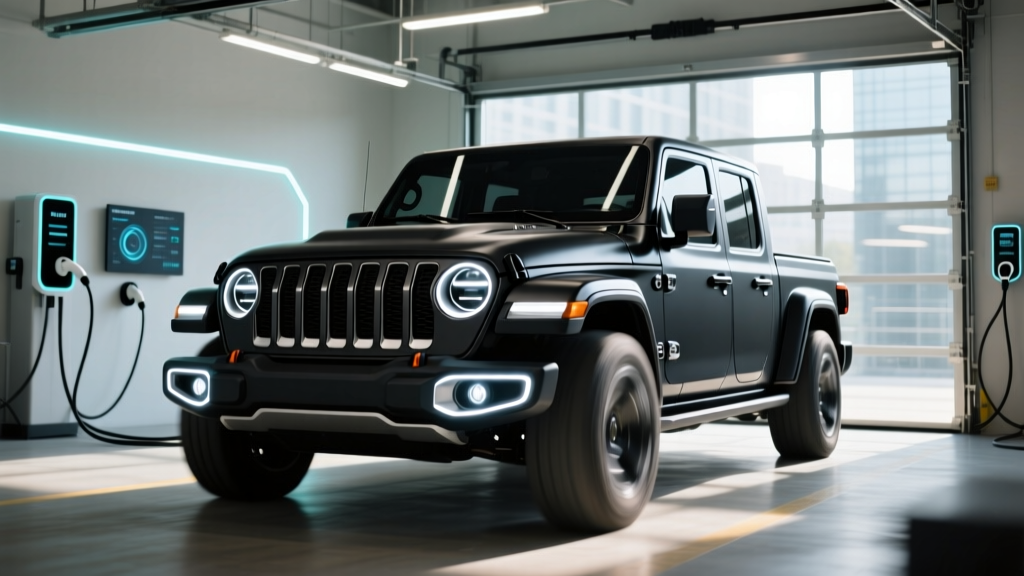
If you're searching for a Jeep Gladiator EV you can buy today, the short answer is: it isn't on sale yet. Stellantis has confirmed an electric Gladiator is in development as part of its broader EV strategy, but as of early 2026, Jeep has not published final EPA range, battery capacity, pricing, or an on-sale date for a battery-electric Gladiator. What we do have are strong signals from the closely related Ram 1500 REV platform, official Stellantis EV announcements, and the current midsize electric-truck landscape. Below, I'll lay out what's confirmed, what's projected, and how an electric Gladiator would compare to the gas Gladiator and rival EV pickups on cost, capability, and daily ownership.
Quick Answer: Jeep Gladiator EV Status
The Jeep Gladiator EV is an announced/upcoming battery-electric midsize pickup. Final specs are not yet published. Expect a dual-motor AWD configuration on the STLA Frame platform, targeting 300+ miles of EPA range and 150+ kW DC fast charging, with pricing likely starting in the mid-$50,000s before incentives. It is not currently available for purchase or reservation.
What Stellantis Has Confirmed (and What We Can Project)
Stellantis has invested heavily in its STLA Frame platform, which underpins the Ram 1500 REV and is designed to support body-on-frame trucks and SUVs across the Jeep, Ram, and Dodge lineups. The company's Dare Forward 2030 strategic plan committed to offering BEV options across all major nameplates, and the Gladiator — as Jeep's only pickup — is a logical candidate.
Based on the Ram 1500 REV's published architecture and Jeep's positioning of the Gladiator as a lifestyle/off-road midsize truck, here's what we can reasonably project:
| Spec | Projected Estimate | Basis |
|---|---|---|
| Platform | STLA Frame | Shared with Ram 1500 REV |
| Battery (usable) | ~92–168 kWh (NMC) | Ram 1500 REV offers two packs |
| EPA Range (est.) | 250–350 mi (depending on pack) | Ram 1500 REV targets up to 500 mi (full-size, larger pack) |
| Drivetrain | Dual-motor AWD (4xe-badged likely) | Jeep's off-road brand requires AWD/4WD |
| Peak DC Fast Charge | ~150–200 kW | STLA Frame 800V architecture capability |
| 10–80% DC Charge Time | ~25–35 min (est.) | Typical for 150–200 kW peak on ~100 kWh pack |
| Horsepower | ~400–650 hp (trim dependent) | Dual-motor configurations |
| Towing Capacity | ~6,000–8,000 lbs (est.) | Gas Gladiator tows 7,700 lbs max |
| Starting MSRP (est.) | $55,000–$60,000 | Midsize EV truck segment pricing |
Note: All figures above are projections based on the STLA Frame platform and segment positioning. They are not confirmed by Jeep. Final EPA certification, pricing, and trim details will be published closer to launch.
Gladiator EV vs. Gas Gladiator: The Real Cost Comparison
For buyers cross-shopping a future Gladiator EV against the current gas-powered Gladiator, the math hinges on five years of ownership. The gas Gladiator with the 3.6L Pentastar V6 returns an EPA-rated 19 MPG combined. Here's how a projected EV version compares on operating costs:
| Category | Gas Gladiator (V6) | Projected Gladiator EV |
|---|---|---|
| Estimated Purchase Price | $40,000–$50,000 | $55,000–$65,000 |
| Federal Tax Credit (§30D) | $0 | Up to $7,500 (if eligible*) |
| Fuel/Energy (5 yrs, 75K mi) | ~$13,800 (at $3.50/gal, 19 MPG) | ~$4,500 (home L2 at $0.14/kWh) to $7,500 (mixed public DCFC) |
| Maintenance (5 yrs) | ~$3,500 (oil, filters, brakes, plugs) | ~$1,500 (cabin filter, tires, wipers, fluid top-offs) |
| Insurance (est. 5 yrs) | ~$9,000 | ~$10,500 (EV premiums typically 10–20% higher) |
| 5-Year Total (approx.) | ~$66,300–$76,300 | ~$64,000–$77,000 |
*§30D Tax Credit Eligibility: Under current IRS rules, the $7,500 federal credit requires meeting battery component and critical mineral sourcing thresholds, buyer income caps ($150K single / $300K joint AGI), and an MSRP cap of $80,000 for trucks. Eligibility can change yearly — verify at purchase time. The credit can be applied as a point-of-sale reduction through a registered dealer.
The takeaway: an electric Gladiator likely won't save you money in the first 2–3 years due to higher upfront cost, but home-charging-heavy owners in states with cheap electricity can break even and pull ahead by year 4–5, especially if the full $7,500 credit applies.
Towing, Off-Road, and the Range Reality Check
This is where honest EV-truck ownership demands clear expectations. The gas Gladiator's appeal is its body-on-frame ruggedness, solid front axle (on Rubicon), and ~7,700-pound max towing. An electric Gladiator will deliver instant torque and likely competitive towing numbers, but the physics of towing with a battery are unforgiving:
- Towing range loss: Expect a 40–60% reduction in range when towing near max capacity. A projected 300-mile EPA range drops to roughly 120–180 miles with a heavy trailer — this is consistent across every EV truck we've tested, from the F-150 Lightning to the Rivian R1T.
- Off-road range impact: Low-range crawling and soft-surface driving (sand, mud) increase energy consumption significantly. Plan for 30–50% range reduction on technical trails.
- Cold-weather loss: In sustained sub-30°F temperatures, expect 15–30% range reduction from the EPA sticker, even with a heat pump (which we'd expect Jeep to include on an STLA Frame vehicle).
- Regen advantage: On mountain descents, regenerative braking can recover meaningful energy — an advantage gas trucks don't have. This partially offsets uphill consumption on round-trip routes.
Real-World Range Callout
Projected EPA range: 250–350 miles (depending on battery pack choice)
Real-world highway (70–75 mph): Expect ~80–85% of EPA, so roughly 200–295 miles
Cold weather (below 30°F): Expect ~70–85% of EPA, so roughly 175–295 miles
Max towing: Expect ~40–60% of EPA, so roughly 100–210 miles
These are projections based on comparable EV trucks. Actual Gladiator EV figures will depend on final battery size, aero, and weight.
Charging: Home, Public, and What You'll Need
If the Gladiator EV follows the STLA Frame architecture, it should support Level 2 AC charging at home and DC fast charging on the road. Here's what that looks like in practice:
| Level | Power (kW) | Miles Added per Hour | Use Case |
|---|---|---|---|
| Level 1 (120V outlet) | ~1.4 kW | ~3–5 mi/hr | Overnight trickle; not practical for daily use on a large pack |
| Level 2 (240V, 48A) | ~11.5 kW | ~30–40 mi/hr | Home daily charging; full overnight refill |
| DC Fast Charge | ~150–200 kW peak | ~400–600 mi/hr (at peak) | Road trips; 10–80% in ~25–35 min |
kW vs. kWh refresher: kW (kilowatts) measures power — how fast energy flows into the battery. kWh (kilowatt-hours) measures energy capacity — how much the battery holds. Think of kW as the hose diameter and kWh as the tank size.
Home charging installation: A Level 2 home charger (like a ChargePoint Home Flex or Tesla Wall Connector) requires a 240V circuit, typically 60A to deliver 48A continuous. Installation costs range from $500–$1,500 if your panel has capacity, to $2,500–$5,000+ if you need a panel upgrade (common in older homes with 100A service). Always get a quote from a licensed electrician before purchasing equipment.
Connector: The industry has largely standardized on NACS (Tesla's connector, now adopted by most major automakers). If the Gladiator EV launches with NACS, it will have native access to Tesla Superchargers — a significant advantage for road-trip charging infrastructure. If it launches with CCS, adapters will be available.
How It Stacks Up Against Rival Electric Trucks
The Gladiator EV won't exist in a vacuum. By the time it arrives, it will face established midsize and full-size electric trucks:
| Truck | Segment | EPA Range | Starting MSRP | Max Tow |
|---|---|---|---|---|
| Rivian R1T (Dual Motor) | Midsize | ~270–420 mi | ~$69,900 | 11,000 lbs |
| Ford F-150 Lightning | Full-size | ~240–320 mi | ~$54,995 | 10,000 lbs |
| Chevrolet Silverado EV | Full-size | ~360–440 mi | ~$55,000 | 10,000 lbs |
| Jeep Gladiator EV (proj.) | Midsize | ~250–350 mi (est.) | ~$55,000–$60,000 (est.) | ~6,000–8,000 lbs (est.) |
The Gladiator's differentiator will be Jeep's off-road credibility — solid-axle articulation (if retained), Trail Rated badge, and removable roof/doors, none of which the Rivian, Ford, or Chevy offer. If you need a convertible off-road truck that's electric, the Gladiator EV would be the only option in the segment.
Common Misconceptions About Electric Trucks
| Myth | Fact |
|---|---|
| "EV batteries need replacing every few years." | Federal law requires EV battery warranties of at least 8 years/100,000 miles. Most NMC and LFP packs retain 85–90%+ capacity at 100K miles based on current degradation data. |
| "You can't tow with an electric truck." | You can — EV trucks often have higher torque and tow ratings than gas equivalents. The limitation is range while towing, not capability. |
| "Charging takes hours on road trips." | At a 150+ kW DC fast charger, a 10–80% charge takes 25–35 minutes — roughly a meal break. The charge curve tapers significantly above 80%, so most road-trippers charge to 80% and move on. |
| "EVs are worse in cold weather." | Range drops 15–30% in sustained cold, but EVs start reliably (no cold-cranking issues), and preconditioning while plugged in preserves range. Cabin heat via heat pump is far more efficient than older resistive systems. |
| "The Gladiator EV will qualify for the full $7,500 tax credit." | Not guaranteed. §30D credit eligibility depends on battery sourcing, critical minerals, buyer income, and MSRP caps. Check IRS.gov at time of purchase. |
Should You Wait for the Gladiator EV or Buy Now?
Decision Framework
- Wait for the Gladiator EV if: You want an electric midsize truck with serious off-road chops (solid axle, removable top), you have reliable home Level 2 charging access, your daily driving is under 150 miles round-trip, and you don't need to tow heavy loads over long distances regularly.
- Buy a gas Gladiator now if: You frequently tow 5,000+ lbs over long distances, you live in a charging desert with limited public DCFC access, you need a truck immediately, or your budget is under $45,000.
- Consider the Gladiator 4xe (PHEV) if: Jeep extends its 4xe plug-in hybrid powertrain to the Gladiator before the full EV arrives. This would offer 25–35 miles of electric-only range for commuting with a gas engine for long hauls — a practical bridge for buyers without reliable fast-charging access on their routes.
- Look at the Rivian R1T if: You want an electric midsize truck you can buy today with proven off-road capability, though it lacks the removable roof/doors and solid-axle articulation that define the Gladiator.
What First-Time EV Truck Buyers Should Know
If the Gladiator EV will be your first electric vehicle, here are the ownership realities that spec sheets don't emphasize:
- Home charging is non-negotiable for convenience. Public-only EV ownership is possible but adds 2–4 hours per week in charging time and significantly higher per-mile energy costs (DCFC averages $0.30–$0.48/kWh vs. $0.10–$0.18/kWh at home). Confirm you can install a 240V Level 2 circuit before committing.
- Preconditioning matters. Battery preconditioning (warming the pack before DC fast charging) dramatically improves charge speed in cold weather. Confirm the Gladiator EV supports navigation-based preconditioning when you route to a charger.
- Tires wear faster. EV trucks are heavy (expect 5,500–6,500 lbs for a Gladiator EV) and produce instant torque. Budget for tire replacement every 25,000–40,000 miles rather than the 50,000+ miles typical of lighter gas vehicles.
- Insurance costs more. EV truck insurance premiums run 10–20% higher than gas equivalents due to higher repair costs and battery replacement risk. Get quotes before purchasing.
- The charge curve is real. Peak DC fast-charge rates (e.g., 200 kW) only apply at low state-of-charge. Above 80% SoC, charging slows dramatically to protect the battery. Plan road-trip stops around 10–80% charges, not 0–100%.
Frequently Asked Questions
When will the Jeep Gladiator EV be available?
Jeep has not announced a specific on-sale date. Based on Stellantis's STLA Frame rollout timeline and the Ram 1500 REV's launch, a Gladiator EV could arrive for the 2027 or 2028 model year. Watch for an official reveal at a major auto show or via Stellantis investor updates.
Will the Gladiator EV be a plug-in hybrid (4xe) or fully electric?
Jeep may offer both. The 4xe plug-in hybrid badge is already established on the Wrangler and Grand Cherokee, and a Gladiator 4xe with ~25–35 miles of electric range could arrive before or alongside a full BEV. Stellantis has committed to BEV options across its lineup, so a full EV is expected.
Will it have a removable roof and doors like the gas Gladiator?
This is unconfirmed but highly likely. The removable roof, doors, and fold-down windshield are core to the Gladiator's identity and differentiate it from every other truck. Jeep would risk alienating its core buyer by removing these features.
How much will it cost to charge a Gladiator EV at home?
Assuming a ~100 kWh usable battery and the national average residential rate of ~$0.16/kWh, a full 0–100% charge would cost roughly $16. For a typical daily drive of 40 miles (~12–15 kWh used), expect about $2.00–$2.40 per day in electricity — roughly one-third the cost of gas for the same distance in a 19 MPG Gladiator.
Can the Gladiator EV power my home or tools?
If Jeep follows Ford's Pro Power Onboard and GM's V2H/V2L capabilities on the STLA Frame platform, bidirectional power (vehicle-to-load for job-site tools, vehicle-to-home for backup power) is a strong possibility. This would be a significant feature for truck buyers who need portable power. Confirm this feature when official specs are released.