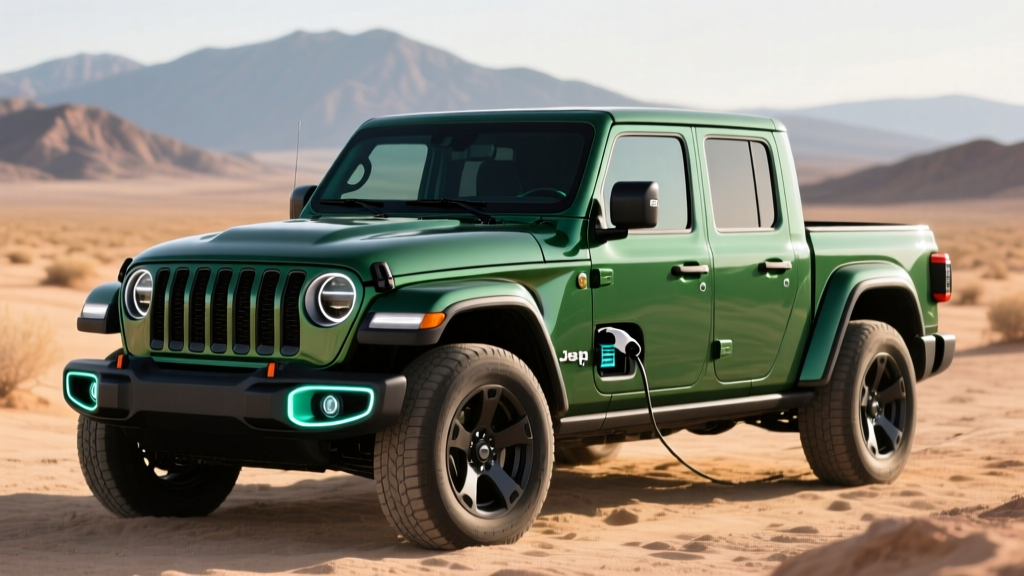
If you're searching for a Jeep Gladiator electric, here's the reality as of early 2026: Stellantis has not yet released a fully electric Gladiator pickup to the U.S. market. What does exist is the Jeep Gladiator 4xe plug-in hybrid (PHEV), which pairs a turbocharged gas engine with an electric motor and a battery pack delivering roughly 25–30 miles of electric-only range. A battery-electric Gladiator remains in Stellantis's long-term electrification roadmap, but no official specs, pricing, or launch date have been confirmed. Below, we break down exactly what you can buy today, what it costs to own, and how to decide whether the 4xe PHEV is the right bridge to full electric — or whether you should wait.
Quick Answer: What Is the Jeep Gladiator Electric?
Currently available: Jeep Gladiator 4xe (PHEV) — ~28 miles electric-only range, ~49 MPGe combined, ~$50,000+ base MSRP.
Not yet available: A fully battery-electric (BEV) Jeep Gladiator. Stellantis has announced EV ambitions across its lineup, but no production Gladiator EV exists for the 2026 model year.
What the Gladiator 4xe PHEV Actually Offers
The Jeep Gladiator 4xe borrows its plug-in hybrid powertrain architecture from the Wrangler 4xe. It pairs a 2.0-liter turbocharged inline-four with two electric motor-generators and a roughly 17.3 kWh battery pack (NMC chemistry). Combined system output sits at approximately 375 horsepower and 470 lb-ft of torque, routed through an 8-speed automatic transmission and Jeep's Selec-Trac or Rock-Trac 4x4 systems depending on trim.
On electric power alone, the EPA rates the Gladiator 4xe at approximately 28 miles of zero-emission driving — enough for short commutes and local errands. Once the battery depletes, it operates as a conventional hybrid with an EPA-estimated ~20 MPG combined in hybrid mode. In full MPGe terms, the sticker reads approximately 49 MPGe when factoring in the electric portion.
| Specification | Gladiator 4xe (PHEV) |
|---|---|
| Powertrain | 2.0L Turbo I-4 + 2 electric motor-generators |
| Combined Output | 375 HP / 470 lb-ft torque |
| Battery Capacity | ~17.3 kWh (NMC lithium-ion) |
| Electric-Only Range (EPA) | ~28 miles |
| Hybrid Mode MPG (EPA) | ~20 MPG combined |
| MPGe (EPA) | ~49 MPGe combined |
| Level 2 Charge Time (0–100%) | ~2.5 hours at 7.2 kW |
| DC Fast Charging | Not available |
| 0–60 mph | ~6.5 seconds (est.) |
| Towing Capacity | ~4,000 lbs (reduced vs. gas model) |
| Base MSRP (2026 est.) | ~$50,000–$55,000+ |
| Federal Tax Credit (§30D) | Up to $3,750 (PHEV, battery ≥7 kWh) |
| Battery Warranty | 8 years / 100,000 miles |
According to fueleconomy.gov, real-world efficiency in PHEVs varies significantly based on how often you recharge. If you charge nightly and drive under 28 miles daily, you may use almost zero gasoline on weekdays. If you never charge, the Gladiator 4xe functions as a heavier, less efficient gas truck getting around 20 MPG — worse than the standard V6 Gladiator's ~19 MPG combined, due to the added battery weight.
EV vs. Gas: How the Gladiator 4xe Compares
The fundamental question for Gladiator buyers is whether the PHEV premium over the gas model pays for itself. Let's run the numbers on a gas Gladiator (3.6L V6, ~19 MPG combined) versus the 4xe, assuming 15,000 miles per year and a mix of charged and uncharged driving.
| Factor | Gas Gladiator (V6) | Gladiator 4xe (PHEV) |
|---|---|---|
| Base MSRP (approx.) | $39,000 | $52,000 |
| Federal Tax Credit | $0 | Up to $3,750 |
| Effective Purchase Price | $39,000 | ~$48,250 |
| Annual Fuel Cost (15k mi) | ~$2,760 (19 MPG, $3.50/gal) | ~$1,400–$2,200 (varies by charge rate) |
| Annual Electricity Cost | $0 | ~$300–$500 (at $0.14/kWh) |
| Combined Annual Energy | $2,760 | $1,700–$2,700 |
| Annual Savings vs. Gas | — | $60–$1,060 |
| 5-Year Energy Savings | — | $300–$5,300 |
| Maintenance (5-yr est.) | ~$3,500 | ~$3,800 (more complex powertrain) |
The 4xe's $9,000+ effective price premium (after tax credit) takes roughly 9–15 years to recoup through fuel savings alone for most drivers. The PHEV makes financial sense primarily if:
- You have reliable home Level 2 charging and a daily commute under 28 miles
- You value the instant electric torque for off-road crawling (the 4xe excels here)
- You want to reduce tailpipe emissions on daily driving while retaining gas-engine range for road trips and towing
Real-World Ownership: What First-Time PHEV Buyers Must Know
Buying a plug-in hybrid is not the same as buying a full EV, and the ownership experience differs in ways that catch many first-timers off guard.
Home Charging Is Non-Negotiable for PHEV Value
The Gladiator 4xe charges at a maximum of 7.2 kW on Level 2 (240V), which refills the 17.3 kWh pack in roughly 2.5 hours. On a standard 120V Level 1 outlet, expect 12–14 hours for a full charge. If you cannot charge at home — whether due to apartment living, street parking, or lack of a dedicated circuit — you will almost never drive on electricity, and the 4xe becomes an expensive, heavier gas truck. Do not buy a PHEV without home charging access.
No DC Fast Charging
Unlike full EVs, the Gladiator 4xe does not support DC fast charging. You cannot top up quickly on a road trip. This is typical for PHEVs — the battery is small enough that Level 2 suffices for overnight replenishment — but it means public charging infrastructure is largely irrelevant to your daily experience.
Cold-Weather Range Loss
The 28-mile electric range shrinks in cold weather. Expect 20–22 miles of electric range at 20°F, as battery chemistry becomes less efficient and cabin heating draws power. The gas engine kicks in sooner, increasing fuel consumption during winter months. This is a universal PHEV and EV limitation, not specific to Jeep.
Towing Capacity Reduction
The standard gas Gladiator can tow up to ~7,700 lbs in select trims. The 4xe's added battery weight and powertrain calibration reduce maximum towing to approximately 4,000 lbs. If towing a boat, camper, or utility trailer is a priority, the PHEV's limitations are significant.
Federal Tax Credit: What You Actually Qualify For
Under current IRS §30D rules, the Gladiator 4xe qualifies as a plug-in hybrid with a battery capacity exceeding 7 kWh. The maximum federal credit for qualifying PHEVs is $3,750 (not the full $7,500 available to some BEVs), subject to these requirements:
- MSRP cap: Pickup trucks must have an MSRP at or below $80,000
- Buyer income limits: AGI ≤ $150,000 (single), $225,000 (head of household), $300,000 (joint)
- Battery sourcing: Critical minerals and battery component requirements apply and may reduce or eliminate the credit depending on supply-chain compliance for the specific model year
- Point-of-sale transfer: You can transfer the credit to the dealer at purchase for an immediate price reduction, or claim it on your tax return
- Final assembly: Vehicle must be assembled in North America
Credit eligibility for specific trims and build dates changes frequently as Stellantis adjusts battery sourcing. Always verify current eligibility on the IRS Clean Vehicle portal or with your tax professional before relying on the credit in your purchase math.
Common Misconceptions About the Gladiator 4xe
| Myth | Fact |
|---|---|
| "The Gladiator electric is available now." | No fully electric Gladiator exists. The 4xe is a plug-in hybrid that still requires gasoline. |
| "I'll never need gas with the 4xe." | Electric-only range is ~28 miles. Longer drives, towing, and cold weather all require the gas engine. |
| "The $7,500 tax credit applies." | PHEVs with qualifying batteries receive up to $3,750, not $7,500. Income, MSRP, and sourcing rules apply. |
| "I can DC fast-charge on road trips." | The 4xe does not support DC fast charging. Level 2 only, ~2.5 hours for a full charge. |
| "Towing is the same as the gas Gladiator." | Max towing drops to ~4,000 lbs due to battery weight and powertrain calibration. |
| "It's a zero-emission vehicle." | Only during the first ~28 miles on a full charge. The gas engine produces emissions on all other driving. |
Decision Framework: Should You Buy, Wait, or Choose Differently?
If / Then Guide for Gladiator Buyers
Buy the Gladiator 4xe if:
- You have home Level 2 charging and a daily commute under 28 miles
- You want electric torque for off-road trails but need gas range for remote areas
- You value the Gladiator's open-air design and bed utility and have no BEV alternative in this segment
- You accept the towing reduction and higher upfront cost
Stick with the gas Gladiator if:
- You cannot charge at home
- You regularly tow over 4,000 lbs
- Your daily driving exceeds 40+ miles and you want simplicity
- The $10,000+ price premium isn't justified by your fuel savings timeline
Wait for a full electric Gladiator if:
- You want 200+ miles of electric range and DC fast charging
- You're willing to wait potentially until 2027–2028 (no confirmed date)
- You want the full $7,500 federal tax credit available to qualifying BEVs
Consider an electric truck alternative now if:
- You need a BEV pickup today: the Ford F-150 Lightning (EPA range up to 320 mi, ~$55,000+), Rivian R1T (EPA range up to 420 mi, ~$70,000+), or Chevrolet Silverado EV (EPA range up to 450 mi, ~$55,000+) are all in production
- You don't need the Gladiator's specific convertible/open-air features
Charging Setup and Costs for the Gladiator 4xe
| Charging Level | Power | 0–100% Time | Equipment Cost | Installation Cost |
|---|---|---|---|---|
| Level 1 (120V) | ~1.4 kW | 12–14 hours | Included (cord) | $0 |
| Level 2 (240V, 32A) | 7.2 kW (max) | ~2.5 hours | $300–$700 | $500–$2,000 |
For most 4xe owners, a Level 2 home charger is the minimum viable setup. A quality 32-amp or 40-amp Level 2 unit (ChargePoint Home Flex, Emporia Vue, or Wallbox Pulsar Plus) costs $300–$700. Professional installation by a licensed electrician typically runs $500–$2,000 depending on whether your electrical panel needs an upgrade (a 200-amp panel is recommended; older 100-amp panels may require a $1,500–$3,000 upgrade). Total first-year home charging investment: $800–$2,700.
At the U.S. average residential electricity rate of roughly $0.14/kWh (EIA data), fully charging the 4xe's 17.3 kWh battery costs about $2.42. That's roughly $0.09 per electric mile, compared to $0.18–$0.20 per mile on gasoline. Over a year of daily 25-mile electric commutes, you'd spend about $220 on electricity versus $460+ on gas — a modest but real saving that compounds over ownership.
The Bottom Line on the Jeep Gladiator Electric
The Jeep Gladiator electric — in the form most buyers imagine, a fully battery-electric midsize pickup with 250+ miles of range — does not exist yet. What Stellantis currently sells is the Gladiator 4xe, a capable plug-in hybrid that delivers meaningful electric-only driving for short commutes, exceptional off-road torque, and the open-air character Jeep buyers want. It is not a substitute for a true BEV, and its economics only pencil out for buyers with home charging, short daily drives, and a willingness to pay a premium for electrified off-road capability.
If a fully electric Gladiator matters to your purchase timeline, monitor Stellantis's official announcements and plan for a possible 2027–2028 debut at the earliest. Until then, the 4xe is the closest electrified Gladiator you can drive off a lot — and for the right buyer with the right charging setup and driving pattern, it's a genuinely compelling truck.
Is there a fully electric Jeep Gladiator available in 2026?
No. As of 2026, Stellantis has not released a battery-electric Jeep Gladiator. The only electrified option is the Gladiator 4xe plug-in hybrid, which combines a gas engine with ~28 miles of electric-only range.
How far can the Gladiator 4xe drive on electric power alone?
The EPA rates the Gladiator 4xe at approximately 28 miles of electric-only range. Real-world results vary: expect 20–22 miles in cold weather (below 30°F) and up to 30 miles in mild conditions with light driving.
Does the Gladiator 4xe qualify for the $7,500 federal tax credit?
No. As a plug-in hybrid, the Gladiator 4xe qualifies for up to $3,750 under IRS §30D rules, subject to buyer income limits, MSRP caps, and battery sourcing requirements. Always verify current eligibility with the IRS or a tax professional.
Can I DC fast-charge the Gladiator 4xe?
No. The Gladiator 4xe supports only Level 1 (120V) and Level 2 (240V) AC charging, with a maximum charge rate of 7.2 kW. A full Level 2 charge takes approximately 2.5 hours.
How much does it cost to charge the Gladiator 4xe at home?
A full charge of the 17.3 kWh battery costs roughly $2.42 at the U.S. average electricity rate of $0.14/kWh. This translates to about $0.09 per electric mile, roughly half the per-mile cost of gasoline.
What is the Gladiator 4xe's towing capacity?
Maximum towing is approximately 4,000 lbs, significantly less than the gas Gladiator's ~7,700-lb maximum, due to the added weight of the battery pack and hybrid powertrain components.