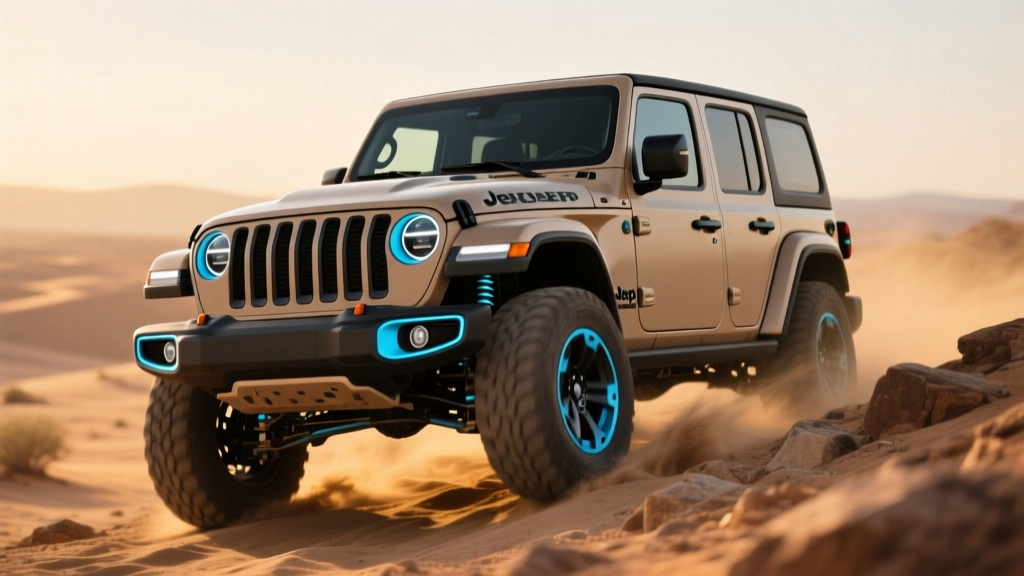
Quick Answer: As of early 2026, Jeep has not yet released a fully electric Wrangler (a true "EV Wrangler" as a BEV). What exists today is the Wrangler 4xe, a plug-in hybrid (PHEV) with ~22 miles of electric-only range and a combined 375 hp / 470 lb-ft of torque. Jeep's parent company Stellantis has signaled an all-electric Wrangler successor is in development on the STLA Large platform, but no official specs, pricing, or release date have been confirmed. If you want an electrified Wrangler right now, the 4xe PHEV is your option — and it's a compelling one for trail use and daily commuting alike.
What the "EV Wrangler" Actually Means in 2026
The search for an "EV Wrangler" typically lands on one of two things: the Wrangler 4xe plug-in hybrid (on sale now) or speculation about a fully battery-electric Wrangler (not yet announced with a firm date). Let's separate fact from rumor.
The 2025/2026 Jeep Wrangler 4xe pairs a 2.0L turbocharged inline-four with two electric motors and a 17.3 kWh (gross) / ~14.5 kWh usable lithium-ion battery pack. It delivers an EPA-estimated 22 miles of electric-only range and 49 MPGe when blending electric and gas operation (fueleconomy.gov). After the battery depletes, it operates as a conventional hybrid, returning roughly 20 MPG combined on gasoline alone.
As for a pure BEV Wrangler: Stellantis has showcased the Recon concept (an electric off-roader positioned as a spiritual companion to the Wrangler) and confirmed the STLA Large platform will underpin future Jeep EVs. However, the Recon is a distinct model — not a Wrangler with a battery. Jeep CEO has stated that the Wrangler nameplate will eventually offer a fully electric variant, but no model year has been locked in. Any specs circulating on forums remain preliminary.
Wrangler 4xe: The Electrified Wrangler You Can Buy Today
Since the BEV Wrangler doesn't yet exist, let's focus on the 4xe — the closest thing to an electric Wrangler on the market — with hard numbers.
| Spec | 2025 Wrangler 4xe (Willys / Sahara / Rubicon) |
|---|---|
| Powertrain | 2.0L turbo I-4 + dual electric motors (PHEV) |
| Combined Output | 375 hp / 470 lb-ft torque |
| Battery (gross / usable) | 17.3 kWh / ~14.5 kWh (NMC chemistry) |
| EPA Electric-Only Range | 22 miles |
| EPA MPGe (blended) | 49 MPGe |
| Gas-Only MPG (after depletion) | ~20 MPG combined |
| 0-60 mph | |
| Level 2 Charge Rate | 7.2 kW (full charge in ~2.5 hours) |
| DC Fast Charging | Not available |
| Towing Capacity | 3,500 lbs |
| Starting MSRP (Willys 4xe) | ~$51,790 (incl. destination) |
| Rubicon 4xe MSRP | ~$60,790+ |
| Battery Warranty | 8 years / 100,000 miles |
Real-World Range Reality: The EPA's 22-mile electric estimate assumes moderate temperatures and mixed driving. In practice, expect 16-19 miles of electric range at highway speeds (65-75 mph), and potentially 14-17 miles in sub-freezing weather. Off-road use in electric mode on trails like Moab's slickrock can drain the pack faster due to low-speed, high-torque demands. The 4xe works best as an electric commuter for short round trips — plug in nightly, and your weekday driving may be nearly gas-free.
Wrangler 4xe vs. Gas Wrangler vs. Ford Bronco: Cost & Capability
Buyers cross-shopping an "EV Wrangler" are usually weighing three options: the 4xe PHEV, the conventional gas Wrangler, and the Ford Bronco (including the Bronco Sport, which lacks a PHEV variant). Here's how the numbers stack up.
| Metric | Wrangler 4xe (PHEV) | Gas Wrangler (2.0L Turbo) | Gas Wrangler (3.6L V6) |
|---|---|---|---|
| Base MSRP | ~$51,790 | ~$39,590 | ~$41,590 |
| Combined HP | 375 hp | 270 hp | 285 hp |
| Combined Torque | 470 lb-ft | 295 lb-ft | 260 lb-ft |
| EPA Combined | 49 MPGe / 20 MPG | ~21 MPG | ~19 MPG |
| Electric-Only Range | 22 miles | 0 | 0 |
| Annual Fuel Cost* | ~$1,450 (blended) | ~$2,350 | ~$2,600 |
| Federal Tax Credit (§30D) | Up to $3,750† | $0 | $0 |
*Annual fuel cost based on 15,000 miles/year, $3.50/gal gas, and 4xe driven 20 mi/day on electricity at $0.14/kWh. †The Wrangler 4xe qualifies for a partial §30D credit — the exact amount depends on battery sourcing and critical mineral content per current-year IRS rules. The credit may be applied at point of sale. Verify eligibility with your tax professional.
The 4xe commands a $10,000-$12,000 premium over a similarly equipped gas Wrangler. The payback period on fuel savings alone (roughly $900/year) stretches beyond 10 years — so the 4xe's value proposition rests on torque for trails, daily electric commuting, and the tax credit, not pure economics.
Real Costs of Owning an Electrified Wrangler
Whether you're eyeing the 4xe now or waiting for a future BEV Wrangler, here's what ownership actually costs.
| Cost Category | Wrangler 4xe (5-Year Est.) | Gas Wrangler V6 (5-Year Est.) |
|---|---|---|
| Purchase Price (base) | $51,790 | $41,590 |
| Federal Tax Credit | -$3,750 (est.) | $0 |
| Effective Purchase | $48,040 | $41,590 |
| Fuel / Electricity (5 yrs) | ~$7,250 | ~$13,000 |
| Maintenance (5 yrs) | ~$3,200 | ~$4,000 |
| Insurance (5 yrs) | ~$11,500 | ~$9,500 |
| Estimated Depreciation | ~$22,000 | ~$18,000 |
| 5-Year Total Cost | ~$91,990 | ~$86,090 |
Key takeaways:
- Home charging is essential. The 4xe's 22-mile electric range only saves money if you plug in nightly. Without home Level 2 charging (a standard 120V outlet works for the 4xe's small battery, adding ~7 miles of range per hour), you're essentially driving a heavy gas Wrangler at 20 MPG.
- Insurance runs higher. PHEV and EV Wranglers carry 15-20% higher premiums on average due to battery replacement costs and higher repair complexity.
- Maintenance is slightly lower. Regenerative braking saves pad wear, and the electric motors have no scheduled service, but the 4xe still has a full internal combustion engine requiring oil changes, coolant service, and transmission fluid.
- Cold weather cuts electric range. At 20°F, expect the 4xe's electric range to drop to 14-16 miles. The engine will kick on more frequently to provide cabin heat unless you precondition while plugged in.
Home Charging Setup: What You Need for a 4xe (or Future BEV Wrangler)
The Wrangler 4xe charges at 7.2 kW on Level 2 (240V), replenishing its 17.3 kWh battery in roughly 2.5 hours. It also charges on a standard 120V Level 1 outlet at about 1.4 kW — sufficient for overnight top-ups given the small pack.
| Charging Level | Power | Time to Full (4xe) | Cost Estimate |
|---|---|---|---|
| Level 1 (120V household) | ~1.4 kW | ~12 hours | Existing outlet (free) |
| Level 2 (240V, home wallbox) | 7.2 kW | ~2.5 hours | $500-$1,200 (charger + install) |
| DC Fast Charging | N/A | N/A | Not supported on 4xe |
If a BEV Wrangler eventually arrives, expect a much larger battery (likely 85-110 kWh) requiring a proper Level 2 home installation. Budget $1,200-$2,500 for a 48-amp wallbox charger plus electrician labor and permits — and potentially $2,000-$5,000 if your home needs a panel upgrade from 100A to 200A service.
Common EV Wrangler Misconceptions — Fact-Checked
| Myth | Fact |
|---|---|
| "The EV Wrangler is available now." | Only the 4xe PHEV is on sale. A pure BEV Wrangler has not been released or given a firm date by Jeep. |
| "The 4xe can't off-road on electric power." | The 4xe's electric motors deliver instant torque (470 lb-ft combined), and Electric mode is fully functional in 4WD Low on Rubicon trims. The battery is sealed and water-ford rated to 31.5 inches. |
| "The battery will need replacing in 5 years." | Stellantis warranties the 4xe battery for 8 years / 100,000 miles against defects and excessive capacity loss (below 70%). Real-world degradation data from 2021-2024 4xe owners suggests 5-8% loss over 3 years — well within warranty thresholds. |
| "You'll save thousands on gas." | Savings are modest: roughly $900/year if you charge nightly and drive under 22 miles daily. Over 5 years, that's ~$4,500 — less than the 4xe's price premium over a gas Wrangler. |
| "The Wrangler 4xe qualifies for the full $7,500 tax credit." | Under current §30D rules, the 4xe typically qualifies for a partial credit (~$3,750) due to battery component and critical mineral sourcing requirements. Check the latest fueleconomy.gov tax credit listings before purchasing. |
Decision Framework: Should You Buy a 4xe, Wait for a BEV Wrangler, or Go Gas?
Choose the Wrangler 4xe if:
- You have home charging access (even a 120V outlet works for the small battery)
- Your daily commute is under 20 miles round-trip
- You want maximum low-end torque for rock crawling and trail use
- You value the ability to run silent in electric mode on nature trails
- You can benefit from the partial §30D federal tax credit
Wait for a BEV Wrangler (or consider the Jeep Recon) if:
- You want 200+ miles of electric range and DC fast charging
- You're not in a rush — no firm release date exists
- You want zero tailpipe emissions and minimal drivetrain maintenance
- You have reliable home Level 2 charging and access to public DC fast chargers for road trips
Stick with the gas Wrangler if:
- You lack home charging access entirely
- You frequently tow near the 3,500-lb limit (the 4xe's electric range evaporates under load)
- You live in a region with extreme cold and long highway commutes
- The $10,000+ price premium for the 4xe doesn't fit your budget
- You want the widest selection of aftermarket modifications (the gas Wrangler has the deepest ecosystem)
What a Future BEV Wrangler Would Need to Succeed
For a fully electric Wrangler to satisfy the off-road community, Jeep will need to solve several engineering challenges:
- Range with a brick-like body: The Wrangler's aerodynamics are terrible by design (removable doors, flat windshield, solid axles). A BEV version would likely need a 100+ kWh battery to achieve 250+ miles EPA — adding significant weight and cost.
- Trail range: Off-roading at low speeds in 4WD Low consumes energy differently than highway cruising. Jeep would need to publish realistic trail-range estimates, not just highway figures.
- DC fast charging: The STLA Large platform supports up to 350 kW peak charging. A BEV Wrangler should target 10-80% in under 25 minutes to be viable for overlanding road trips.
- Weight and breakover angle: A heavy battery pack lowers the center of gravity (good for stability) but may compromise ground clearance and approach/departure angles unless the pack is integrated into the frame rails.
- Pricing: A BEV Wrangler Rubicon could easily start above $70,000, putting it in competition with the Ford F-150 Lightning and Rivian R1T on price — a tough sell for a compact off-roader.
Frequently Asked Questions
Is there a fully electric Jeep Wrangler available in 2026?
No. As of early 2026, Jeep sells the Wrangler 4xe plug-in hybrid with 22 miles of electric-only range. A fully battery-electric Wrangler has been signaled by Stellantis leadership but has no confirmed release date or published specs. The Jeep Recon is an electric off-roader on the STLA Large platform, but it is a separate model — not a Wrangler.
How much does the Wrangler 4xe cost after tax credits?
The 2025 Wrangler 4xe Willys starts at approximately $51,790. Under current IRS §30D rules, it may qualify for a partial federal credit of around $3,750 (exact amount depends on battery sourcing compliance). That brings the effective price to roughly $48,040. State incentives may apply additionally — check your state's energy office for details. Always verify current credit eligibility on irs.gov or with a tax professional.
Can the Wrangler 4xe go off-road in electric mode?
Yes. The 4xe's Electric mode is fully functional in 4WD High and 4WD Low (Rubicon and Sahara trims with the Selec-Trac or Rock-Trac systems). The instant 470 lb-ft of combined torque from the electric motors is excellent for low-speed rock crawling. The battery pack is mounted under the rear seats and sealed for water fording up to 31.5 inches on Rubicon trims.
How long does the 4xe battery last, and what does replacement cost?
Stellantis warranties the 4xe's 17.3 kWh battery for 8 years or 100,000 miles against capacity loss below 70%. Early 4xe models (2021-2022) are showing approximately 5-8% degradation after 3 years of use. A full out-of-warranty battery replacement is estimated at $8,000-$12,000 based on current PHEV battery pricing — though this is rarely needed within the vehicle's typical ownership cycle.
Is the Jeep Recon the same as an electric Wrangler?
No. The Jeep Recon is a standalone all-electric SUV built on Stellantis's STLA Large platform. While Jeep markets it as an off-road-capable electric vehicle with features like electronic locker axles and all-terrain tires, it does not share the Wrangler's body-on-frame architecture, removable doors/roof, or solid-axle suspension. Think of it as a companion to the Wrangler, not a replacement.
What's the real-world fuel economy of the 4xe on a road trip?
Once the 22-mile electric range is depleted, the 4xe operates as a conventional hybrid. Expect 19-21 MPG on the highway at 70-75 mph — comparable to the gas 2.0L turbo Wrangler. On a 500-mile road trip, you'll burn roughly 24-26 gallons of fuel. The 4xe's advantage is strictly in daily short-trip commuting where the battery covers most or all of your miles.