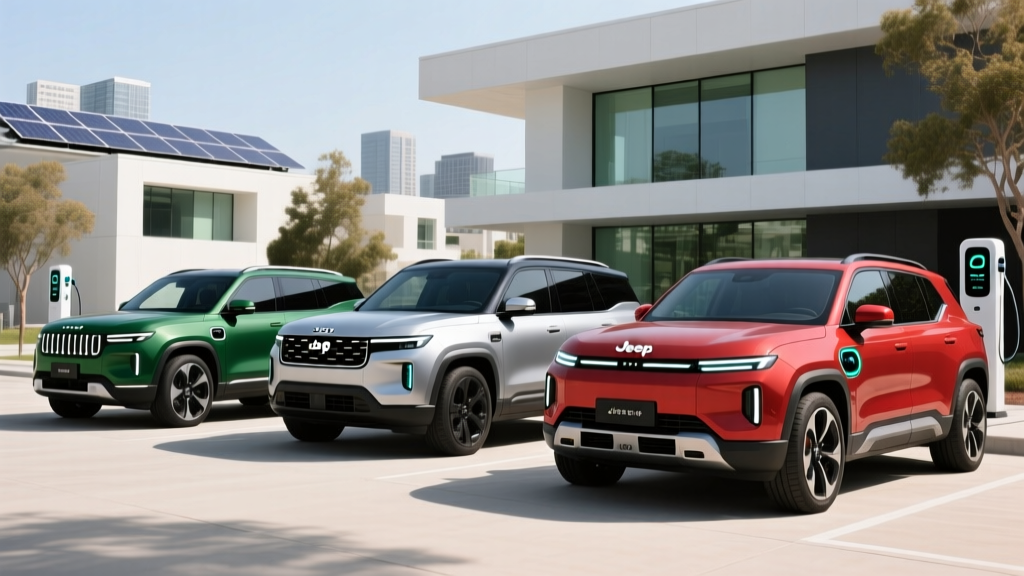
If you're researching Jeep EV vehicles, here's the fast answer: Jeep currently offers one fully electric model for sale in the U.S. — the 2025 Wagoneer S — with the rugged Recon expected to arrive as a 2026 model-year vehicle. The Wagoneer S delivers an EPA-estimated 300 miles of range, a 100 kWh battery pack, and a starting MSRP around $65,200. The Recon targets off-road buyers with an estimated 300+ mile range, Trail Rated capability, and removable doors. Neither qualifies for the full $7,500 federal tax credit under current §30D sourcing rules, though point-of-sale lease credits may apply. For buyers who want a Jeep-branded electrified vehicle today, the Wrangler 4xe and Grand Cherokee 4xe plug-in hybrids remain the immediately available options with 25-26 miles of electric-only range.
Quick Answer: Jeep's EV Lineup at a Glance
- Wagoneer S — On sale now. 300 mi EPA range, 100 kWh battery, ~$65,200 MSRP.
- Recon — Announced for 2026 model year. ~300 mi est. range, off-road focused, est. $55,000+ MSRP.
- Wrangler 4xe / Grand Cherokee 4xe — PHEVs on sale now. 25-26 mi electric-only, ~$50,000-$57,000 MSRP.
Jeep Wagoneer S: The First All-Electric Jeep You Can Buy
The Wagoneer S is built on Stellantis's STLA Large platform and represents Jeep's first purpose-built battery electric vehicle (BEV) sold in the United States. It's a premium two-row SUV aimed squarely at the Tesla Model Y, Ford Mustang Mach-E, and Hyundai Ioniq 5 — though at a higher price point and with Jeep's design language.
| Spec | Value |
|---|---|
| EPA Range | 300 miles (est.) |
| Battery Capacity | 100 kWh (usable, NMC chemistry) |
| Drivetrain | Dual-motor AWD |
| Horsepower | 600 hp |
| 0-60 mph | ~3.4 seconds |
| Max DC Fast Charge | ~200 kW (peak) |
| 10-80% DC Charge Time | ~23 minutes (est.) |
| Level 2 Charging | 11.5 kW onboard charger |
| Charging Port | CCS (NACS adapter expected) |
| Base MSRP | ~$65,200 (Launch Edition) |
| Battery/Powertrain Warranty | 8 years / 100,000 miles |
Real-World Range Reality
The 300-mile EPA estimate assumes mixed driving at moderate temperatures. Expect ~240-260 miles on sustained highway trips at 70+ mph. In sub-freezing conditions (below 32°F), plan for 20-30% range reduction, bringing real-world winter range to approximately 210-240 miles. The NMC battery chemistry is energy-dense but more temperature-sensitive than LFP, making preconditioning before DC fast charging essential in cold weather.
Jeep Recon: The Off-Road EV (Coming 2026)
The Recon is Jeep's answer to the question: can a real off-roader be fully electric? Built on the same STLA Large platform as the Wagoneer S, the Recon features a boxy Wrangler-inspired design, removable doors and roof panels, electronic locking differentials, and Jeep's Trail Rated badge. It's positioned as the electric spiritual successor to the Wrangler for buyers who want zero tailpipe emissions on the trail.
| Spec | Estimated Value |
|---|---|
| Range | 300+ miles (est., not EPA-certified yet) |
| Battery | ~100 kWh (NMC, STLA Large platform) |
| Drivetrain | Dual-motor 4xe AWD with e-lockers |
| Off-Road Features | Trail Rated, Selec-Terrain, removable doors/roof |
| Max DC Fast Charge | ~200 kW (est., platform capability) |
| Expected MSRP | $55,000 - $65,000 (est.) |
| Availability | Expected late 2025 / 2026 model year |
Important caveat: The Recon's specs are preliminary. Jeep has not published final EPA-certified range or pricing. Off-road-focused vehicles typically sacrifice some efficiency for ground clearance and all-terrain tires — expect real-world highway range to fall below 300 miles, especially with aggressive tire compounds. We'll update this section when official EPA data is published on fueleconomy.gov.
Jeep 4xe Plug-In Hybrids: The Electrified Jeeps You Can Buy Today
For buyers who need a Jeep now and want some electric driving without full BEV commitment, the Wrangler 4xe and Grand Cherokee 4xe are proven, widely available options. Both use a 2.0L turbocharged inline-4 paired with an electric motor and a 17.3 kWh battery pack (usable capacity ~14-15 kWh).
| Model | Electric-Only Range | Combined MPGe | Gas-Only MPG | Gas Equivalent MPG | Base MSRP |
|---|---|---|---|---|---|
| Wrangler 4xe | 25 miles | 49 MPGe | 20 MPG | 20 MPG | ~$50,695 |
| Wrangler (gas 2.0T) | — | — | 22 MPG | 22 MPG | ~$39,995 |
| Grand Cherokee 4xe | 26 miles | 56 MPGe | 23 MPG | 23 MPG | ~$57,695 |
| Grand Cherokee (gas V6) | — | — | 22 MPG | 22 MPG | ~$44,995 |
The 4xe models make the most financial sense for drivers with short daily commutes under 25 miles who can charge at home overnight. On electric-only mode, you're paying roughly $0.04-$0.06 per mile (at $0.15/kWh national average) versus $0.17-$0.20 per mile on gasoline at $3.50/gallon. That's a per-mile savings of roughly 70% on your daily commute. However, once the battery depletes, you're driving a heavy hybrid getting gas-vehicle MPG — so the savings depend entirely on your charging habits.
Charging Jeep EVs: What to Expect at Home and on the Road
Charging infrastructure is the single biggest ownership variable for any EV buyer. Here's what Jeep EV owners need to know:
| Level | Power | Miles Added Per Hour | Use Case |
|---|---|---|---|
| Level 1 (120V outlet) | ~1.4 kW | ~4-5 mi/hr | Emergency / overnight trickle |
| Level 2 (240V home) | 11.5 kW | ~35-40 mi/hr | Daily home charging (full charge ~9 hrs) |
| DC Fast Charge | ~200 kW peak | ~600+ mi/hr (peak) | Road trips (10-80% in ~23 min) |
Home charging is critical. A Level 2 home charger (240V, 48-amp circuit) will fully replenish the Wagoneer S's 100 kWh battery overnight. Installation costs typically run $800-$2,500 depending on your electrical panel's capacity and the distance from panel to charger location. If your home has a 200-amp panel with spare capacity, expect the lower end. A panel upgrade to 200A can add $1,500-$3,000.
For public fast charging, the Wagoneer S currently uses a CCS connector. Jeep has indicated NACS (Tesla Supercharger) adapter compatibility, which matters because Tesla's Supercharger network has roughly 2-3x the station count of Electrify America or EVgo in most U.S. markets. Confirm adapter availability with your dealer before purchase.
Common Jeep EV Misconceptions
| Myth | Fact |
|---|---|
| "An electric Jeep can't off-road." | Electric motors deliver instant torque at zero RPM — excellent for rock crawling. The Recon is designed with e-lockers and Trail Rated specs. Range on technical trails is the real concern, not capability. |
| "Jeep EVs qualify for the $7,500 tax credit." | Under current IRS §30D rules, eligibility depends on battery critical-mineral sourcing, MSRP caps ($80,000 for SUVs), and buyer income limits ($300K joint / $150K single). Check current-year eligibility before assuming credit availability. |
| "I can tow as much with an EV Jeep as a gas one." | Towing with any EV reduces range by 40-60%. The Wagoneer S is rated for towing, but a 300-mile range drops to ~130-170 miles when pulling a loaded trailer. Plan charging stops accordingly. |
| "The 4xe charges itself — no plug needed." | The 4xe is a plug-in hybrid. Without plugging in, you're carrying dead battery weight and getting gas-only MPG. The electric savings only materialize with regular Level 1 or Level 2 charging. |
Total Cost of Ownership: Jeep EV vs. Gas Jeep vs. 4xe PHEV
Let's compare 5-year ownership costs for a buyer driving 12,000 miles/year with a 15-mile daily commute (well within the 4xe's electric range).
| Cost Factor | Wagoneer S (BEV) | Wrangler 4xe (PHEV) | Wrangler Gas (2.0T) |
|---|---|---|---|
| Purchase Price (MSRP) | $65,200 | $50,695 | $39,995 |
| Est. Tax Credit | $0-$7,500* | $3,750** | $0 |
| Fuel / Energy (5 yrs) | $4,200 | $5,100 | $10,500 |
| Maintenance (5 yrs) | $2,000 | $3,800 | $4,200 |
| Insurance (5 yrs, est.) | $11,500 | $9,500 | $8,800 |
| Est. Depreciation | $22,000 | $18,000 | $16,000 |
| Total 5-Yr Cost | ~$80,900 - $100,900 | ~$87,095 | ~$79,495 |
*Wagoneer S tax credit depends on current-year §30D battery sourcing compliance. **Wrangler 4xe qualifies for $3,750 under §30D if sourcing requirements are met — verify on the IRS portal. All estimates assume $0.15/kWh electricity, $3.50/gal gas, national average insurance. Your actual costs will vary by state, driving pattern, and electricity rate.
The BEV wins on fuel and maintenance but loses on purchase price, insurance (EV premiums run 15-25% higher on average), and depreciation uncertainty. The 4xe PHEV occupies a practical middle ground. The gas Wrangler has the lowest entry cost but the highest ongoing fuel expense.
Decision Framework: Which Jeep Electrified Vehicle Is Right for You?
Choose Based on Your Situation
Choose the Wagoneer S (BEV) if:
- You have reliable Level 2 home charging access
- Your daily driving is under 200 miles and you take road trips fewer than 5 times/year
- You want a premium, performance-oriented electric SUV (600 hp, 3.4s 0-60)
- You're comfortable with CCS charging or can wait for NACS adapter availability
- Budget allows for a $65,000+ vehicle purchase
Wait for the Recon (BEV) if:
- You need genuine off-road capability (locking diffs, Trail Rated, removable doors)
- You want an EV but refuse to give up the Wrangler aesthetic
- You can wait for 2026 model availability and final EPA certification
Choose the Wrangler 4xe or Grand Cherokee 4xe (PHEV) if:
- Your daily commute is under 25 miles and you can charge at home
- You regularly take long road trips and don't want to plan around DC chargers
- You need proven off-road capability today (Wrangler 4xe)
- You want to reduce fuel costs without full BEV commitment
- Your budget is in the $50,000-$58,000 range
Stick with a gas Jeep if:
- You have no home charging access (apartment, street parking)
- You frequently tow heavy loads over long distances
- You live in an area with sparse public DC charging infrastructure
- Upfront cost is a primary concern and you drive fewer than 10,000 miles/year
First-Time EV Buyer Checklist for Jeep Shoppers
If this is your first electric or plug-in vehicle, run through these practical steps before signing:
- Verify home charging feasibility. Check your electrical panel (200A service is ideal for Level 2). Get a quote from a licensed electrician — $800-$2,500 is typical for a standard install, more if a panel upgrade is needed.
- Test your commute on electric. For the 4xe, your daily round trip must be under 25 miles to maximize electric-only savings. For the Wagoneer S BEV, ensure your typical week fits within 300 miles without mid-week charging.
- Check federal and state incentives. Use the IRS §30D eligibility tool and your state's energy office website. Rules change annually based on battery sourcing requirements.
- Map your road-trip charging. Open PlugShare or the Electrify America app and trace your most common long-distance routes. Identify gaps — some rural corridors still have 50-100 mile stretches without DC fast chargers.
- Get an insurance quote before buying. EV insurance premiums are higher on average. The Wagoneer S's $65K+ price and performance profile will push premiums above a comparable gas SUV.
- Understand cold-weather range loss. If you live in the upper Midwest or Northeast, plan for 20-30% less range in winter. The Wagoneer S includes a heat pump for cabin efficiency, but battery chemistry still loses usable capacity in extreme cold.
Frequently Asked Questions About Jeep EV Vehicles
Does Jeep make a fully electric Wrangler?
Not yet. The closest is the Jeep Recon, which carries Wrangler-inspired styling, Trail Rated off-road hardware, and removable doors — but it's a distinct model, not a Wrangler EV. The Recon is expected for the 2026 model year. The current Wrangler is available as the 4xe plug-in hybrid with 25 miles of electric-only range.
What is the range of the Jeep Wagoneer S?
The Wagoneer S targets an EPA-estimated 300 miles of range from its 100 kWh battery. Real-world highway driving at 70+ mph typically yields 240-260 miles. Cold weather (below freezing) can reduce range to 210-240 miles depending on cabin heat usage and whether the heat pump is active.
How long does it take to charge a Jeep EV at home?
On a Level 2 home charger (240V, 11.5 kW), the Wagoneer S's 100 kWh battery charges from empty to full in approximately 9 hours. In practice, most owners plug in overnight and wake up to a full battery. Level 1 (standard 120V outlet) adds only about 4-5 miles per hour — adequate for the 4xe's smaller 17.3 kWh battery but impractical as a primary charging method for the Wagoneer S.
Do Jeep EVs qualify for the $7,500 federal tax credit?
Eligibility under IRS §30D depends on three factors: battery critical-mineral sourcing, MSRP caps ($80,000 for SUVs), and buyer income limits ($300,000 joint / $150,000 single filer). As of the current tax year, Stellantis-built vehicles face challenges with battery-sourcing requirements. Always verify eligibility through the official IRS clean vehicle credit page or consult a tax professional before assuming credit availability. Lease structures may qualify for a separate commercial credit passed through as a lease discount.
Can I take a Jeep EV off-road?
The Recon is specifically designed for off-road use with electronic locking differentials, Selec-Terrain drive modes, and Trail Rated certification. Electric motors provide instant torque at zero RPM, which is ideal for rock crawling. The practical limitation is range on remote trails — if you're 100 miles from the nearest charger and using 2 kWh/mile on technical terrain, careful planning is essential. The Wrangler 4xe remains the more practical choice for remote off-road adventures today since you can refuel with gas anywhere.
What's the difference between the Wagoneer S and the gas Wagoneer?
Despite the shared name, the Wagoneer S is a completely different, smaller vehicle built on the STLA Large EV platform. The gas Wagoneer is a full-size, body-on-frame SUV with three rows, a starting price above $70,000, and available V8 power. The Wagoneer S is a two-row, unibody electric crossover closer in size to a Grand Cherokee. Think of them as separate product lines sharing a brand name.