The Short Answer on the Jeep Electric Wrangler
As of early 2026, Jeep has not released a fully electric Wrangler (BEV) for sale in the United States. What you can buy is the Wrangler 4xe, a plug-in hybrid (PHEV) with roughly 22 miles of electric-only range and a combined 375 hp from its turbo-hybrid powertrain. Jeep's parent company Stellantis has teased a next-generation battery-electric Wrangler concept, but no production date, EPA range, or MSRP has been confirmed. If you're searching for a "Jeep electric Wrangler" today, the 4xe is the only electrified option — and whether it makes sense depends entirely on your commute length, trail ambitions, and home-charging setup.
What "Electric Wrangler" Actually Means in 2026
The search term "Jeep electric Wrangler" pulls in thousands of queries a month, but it collapses two very different vehicles into one expectation. Here's the reality:
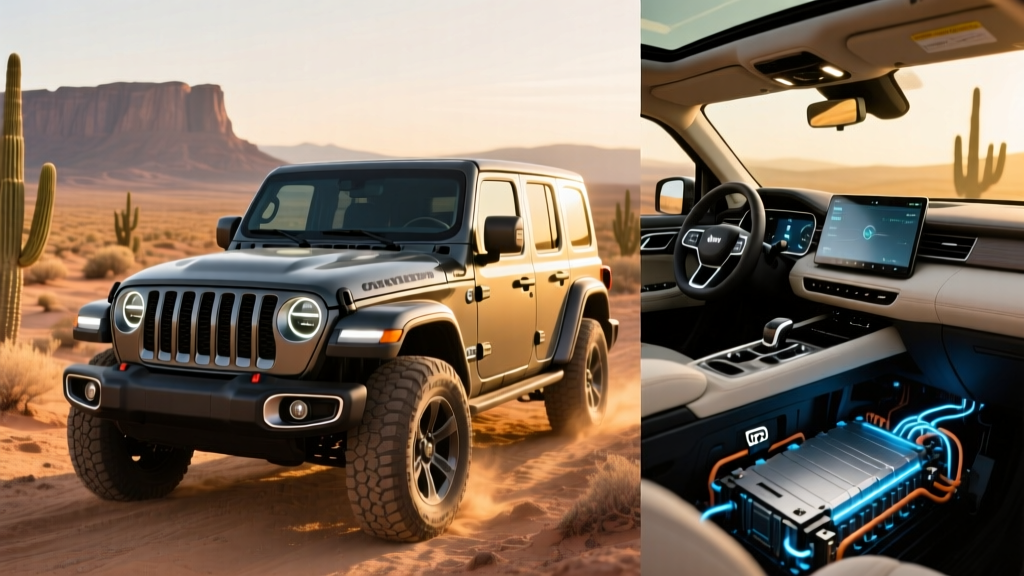
- Wrangler 4xe (PHEV): Currently in production and available at dealerships. It pairs a 2.0L turbocharged four-cylinder engine with two electric motors and a 17.3 kWh battery pack (usable capacity roughly 15.0 kWh). EPA-rated electric-only range is 22 miles; combined gas-electric MPGe is 49. Once the battery depletes, it operates as a conventional hybrid at around 20 MPG combined.
- Wrangler BEV (fully electric): Announced in concept form. Stellantis has signaled intent to electrify the Wrangler lineup as part of its "Dare Forward 2030" plan, but no production-spec battery-electric Wrangler has been priced, EPA-rated, or delivered to US customers as of this writing. Any range, charging, or pricing figures circulating on forums are preliminary estimates — treat them as such.
This distinction matters enormously for buyers. A PHEV and a BEV solve different problems, carry different costs, and impose different lifestyle requirements.
Wrangler 4xe: The Electrified Jeep You Can Actually Buy
For buyers who want electrification and the Wrangler's legendary off-road chops today, the 4xe is the only game in town. Here's what the numbers look like for the current model year:
| Spec | Wrangler 4xe (2026 Model Year) |
|---|---|
| Powertrain | 2.0L Turbo I4 + 2 electric motors (PHEV) |
| Combined Output | 375 hp / 470 lb-ft torque |
| Battery (Total / Usable) | 17.3 kWh / ~15.0 kWh (NMC chemistry) |
| EPA Electric-Only Range | 22 miles |
| EPA Combined MPGe | 49 MPGe |
| Gas-Only MPG (after depletion) | ~20 MPG combined |
| Level 2 Charge Time (0–100%) | ~2 hours at 7.2 kW |
| DC Fast Charging | Not available |
| 0–60 mph | ~6.0 seconds |
| Towing Capacity | 3,500 lbs |
| Battery Warranty | 8 years / 100,000 miles |
| Starting MSRP (Willys 4xe) | ~$51,790 (before incentives) |
A few things jump out from this spec sheet. First, the 22-mile electric range is modest — it covers a short commute or grocery run but won't replace gas for longer drives. Second, the 4xe does not support DC fast charging. That means road-trip charging is limited to Level 2 speeds, which is a meaningful constraint for a vehicle marketed for adventure. Third, the 375 hp and 470 lb-ft of torque give the 4xe genuine trail-credible grunt, especially at low speeds where electric motors excel.
Real-World Range Expectations
The EPA rates the 4xe at 22 miles electric-only. In real-world driving, expect 18–20 miles in mild weather with gentle acceleration. In cold weather (below 35°F), that drops to roughly 14–16 miles due to battery chemistry limitations and cabin heating demand. Highway driving at 70+ mph also reduces electric range significantly — plan for around 15–17 miles at sustained interstate speeds.
EV vs Gas vs PHEV: Wrangler Cost Comparison
Let's put the 4xe up against the gas-only Wrangler and a hypothetical future Wrangler BEV to see where the economics land. This comparison uses a 15,000-mile/year driving profile with 60% city / 40% highway mix.
| Cost Factor | Wrangler Gas (2.0L Turbo) | Wrangler 4xe (PHEV) | Hypothetical Wrangler BEV |
|---|---|---|---|
| Base MSRP | ~$37,790 | ~$51,790 | TBD (est. $55,000–$65,000) |
| Federal Tax Credit (§30D) | $0 | Up to $3,750* | Up to $7,500* (if eligible) |
| Annual Fuel/Energy Cost | ~$2,625 (gas) | ~$1,800 (gas + electric) | ~$675 (electric only) |
| 5-Year Fuel/Energy Total | $13,125 | $9,000 | $3,375 |
| 5-Year Maintenance (est.) | ~$3,500 | ~$3,200 | ~$1,800 |
| 5-Year Total Cost (purchase + fuel + maint.) | ~$54,415 | ~$63,990 (less credit) | TBD |
*Federal §30D tax credit eligibility depends on your adjusted gross income, the vehicle's MSRP (SUVs capped at $80,000), battery component sourcing, and critical mineral requirements. The 4xe qualifies for a partial credit due to its smaller battery; a full BEV could qualify for the maximum if it meets all IRS sourcing requirements. Consult a tax professional for your specific situation. Credit amounts and rules reflect 2026 guidelines.
The takeaway: the 4xe costs more upfront than the gas Wrangler and takes years to close the gap through fuel savings. It makes financial sense primarily if your daily driving falls within that 22-mile electric window and you charge at home on cheap utility rates. A future BEV Wrangler, if priced competitively and paired with home charging, would offer dramatically lower operating costs — but that vehicle doesn't exist yet.
Home Charging and Real-World Ownership
Owning any electrified Wrangler — the 4xe today or a BEV tomorrow — hinges on your charging situation. Let's break down what that looks like practically.
Level 1 Charging (Standard 120V Outlet)
The 4xe can charge from a standard household outlet at roughly 1.4 kW. A full charge from empty takes about 12 hours. For owners with short commutes who plug in every night, this can work — you'll wake up to a full 22-mile electric buffer. But it's slow, and it won't cut it for a future BEV with a much larger battery.
Level 2 Charging (240V Home Installation)
A Level 2 home charger at 7.2 kW fills the 4xe's battery in roughly 2 hours. For a BEV Wrangler with a hypothetical 80–100 kWh battery, that same Level 2 circuit would need 10–14 hours for a full charge — adequate for overnight charging but requiring a dedicated 40-amp or 48-amp circuit.
| Item | Typical Cost Range |
|---|---|
| Level 2 Charger (hardware) | $300 – $700 |
| Electrician labor (standard install) | $500 – $1,500 |
| Permit / inspection | $50 – $300 |
| Electrical panel upgrade (if needed) | $1,500 – $3,000 |
| Total (no panel upgrade) | $850 – $2,500 |
| Total (with panel upgrade) | $2,350 – $5,500 |
If you live in an apartment, rely on street parking, or lack access to a dedicated 240V circuit, the 4xe's short electric range becomes harder to exploit. You'll still save some fuel in hybrid mode, but the cost premium over the gas Wrangler takes longer to justify. For a future BEV Wrangler, home charging access is essentially non-negotiable — public DC fast charging works for road trips but is too expensive and inconvenient for daily use.
Cold Climate Considerations
Wranglers are popular in mountain states and northern climates, which makes cold-weather performance critical. Lithium-ion batteries lose efficiency in cold temperatures — expect 20–30% electric range reduction below freezing. The 4xe mitigates this somewhat because its gas engine can provide cabin heat without draining the battery, but a future BEV Wrangler would rely on a resistive heater or (ideally) a heat pump, which would still draw from the traction battery. If you regularly wheel in sub-freezing conditions, factor this into your range planning.
Off-Road Capability: Does Electrification Help or Hurt?
This is where the Wrangler conversation diverges from every other EV on the market. The 4xe's electric motors deliver instant torque at zero RPM — genuinely useful for rock crawling and technical low-speed trail work. The 4xe also offers a silent electric-only mode, which is a practical advantage on noise-sensitive trails and in camping areas.
However, there are trade-offs:
- Weight: The 4xe is roughly 600–800 lbs heavier than its gas counterpart due to the battery pack and electric motors. That extra mass affects braking distances, suspension articulation on extreme terrain, and tire wear.
- Ground clearance: The battery pack is mounted under the vehicle, and while Jeep engineers have armored it with skid plates, the 4xe's breakover angle is slightly compromised compared to a gas Rubicon on the most extreme trails.
- Range on the trail: Off-road driving is energy-intensive. Low-range crawling, sand, and mud consume fuel and electricity far faster than highway driving. The 4xe's total range (gas + electric) is roughly 370 miles, which is adequate for most trail days but requires planning for remote expeditions.
For a future BEV Wrangler, the concerns amplify. Battery weight would likely exceed 1,500 lbs for a pack large enough to deliver 250+ miles of range. Trail range could drop to 100–150 miles in demanding conditions. And without DC fast charging infrastructure near most trailheads, you'd need to plan recovery carefully. These aren't deal-breakers — Rivian's R1S and the Hummer EV have proven electric off-roaders can work — but they're real constraints that Jeep will need to engineer around.
Common Misconceptions About the Electric Wrangler
| Myth | Fact |
|---|---|
| "The electric Wrangler is available now." | Only the 4xe PHEV is available. A fully electric Wrangler BEV has not entered production as of 2026. |
| "The 4xe is a fully electric vehicle." | It's a plug-in hybrid. It has a gas engine and requires gasoline for trips beyond its 22-mile electric range. |
| "Electric Wranglers can't off-road." | Electric motors deliver excellent low-speed torque for crawling. Weight and range are the real constraints, not capability. |
| "I'll save thousands on fuel with the 4xe." | Savings depend on how much you drive within the 22-mile electric window and your electricity rate. Many owners save $500–$1,000/year — meaningful but not transformative. |
| "The 4xe qualifies for the full $7,500 tax credit." | The 4xe has historically qualified for a partial credit (often $3,750) due to battery sourcing rules. Check fueleconomy.gov for the latest eligibility. |
| "A BEV Wrangler will have 400+ miles of range." | Given the Wrangler's boxy aerodynamics, heavy build, and off-road tires, expect 220–280 miles EPA if and when a BEV version launches. Boxy EVs sacrifice range for capability. |
Decision Framework: Should You Buy, Wait, or Look Elsewhere?
Find Your Path
Buy the Wrangler 4xe if:
- Your daily round-trip commute is under 20 miles and you can charge at home every night
- You want a Wrangler now and value the extra torque and electric-only trail mode
- You take regular road trips where the gas engine eliminates range anxiety
- You're comfortable paying a ~$10,000+ premium over the gas Wrangler for partial electrification
Wait for a BEV Wrangler if:
- You want zero tailpipe emissions and are willing to wait 1–3+ years for production
- You have reliable home Level 2 charging and your daily driving is under 200 miles
- You're willing to accept cold-weather range loss and plan trail trips around charging
- You want to maximize the potential $7,500 federal tax credit on a full BEV
Look at alternatives if:
- You need a fully electric off-roader today → consider the Rivian R1S (EPA range up to 410 mi, quad-motor AWD, starting ~$79,900)
- You want a more efficient PHEV SUV → the Toyota RAV4 Prime offers 42 miles electric range at ~$44,000
- You need serious towing + electric range → watch for the electric Ram 1500 REV or the Ford F-150 Lightning
Frequently Asked Questions
When will the fully electric Jeep Wrangler be available?
Stellantis has not confirmed a production date for a battery-electric Wrangler. Industry estimates place it no earlier than 2027–2028, but this is speculative. Jeep has prioritized other EV launches (such as the Wagoneer S and Recon) ahead of a Wrangler BEV. We'll update this article when official details emerge.
How much does it cost to charge the Wrangler 4xe at home?
Charging the 4xe's ~15 kWh usable battery from empty to full costs roughly $1.80–$3.00 depending on your local electricity rate ($0.12–$0.20/kWh is typical for US residential). Over a year of daily charging, that's approximately $450–$750 in electricity — versus roughly $1,800+ in gasoline for the same miles in a gas-only Wrangler.
Can I take the Wrangler 4xe through water (water fording)?
Yes. Jeep rates the 4xe for up to 31.5 inches of water fording (on Rubicon trims), consistent with the gas Wrangler. The battery pack and electrical components are sealed and armored. However, always inspect underbody components after deep water crossings, as with any Wrangler.
Does the 4xe battery degrade over time?
All lithium-ion batteries degrade. Jeep warranties the 4xe battery for 8 years / 100,000 miles against capacity loss below 70% of original. Real-world data from early 4xe owners (2021–2023 models) suggests 5–10% degradation over the first 3–4 years with normal use — meaning your 22-mile range might become 20 miles by year four. This is within normal PHEV expectations.
Is the Wrangler 4xe eligible for the federal tax credit in 2026?
The 4xe has qualified for a partial §30D clean vehicle credit (typically $3,750) in recent years, subject to battery component and critical mineral sourcing rules that tighten annually. Your personal eligibility also depends on income caps ($300,000 joint / $150,000 single modified AGI) and the vehicle's MSRP (must be under $80,000 for SUVs). Always verify current eligibility on IRS.gov and confirm with your tax advisor before purchasing.
How does the 4xe compare to the gas Wrangler on the trail?
The 4xe's instant electric torque is a genuine advantage in technical rock crawling and low-speed maneuvers. The added weight (roughly 700 lbs) is noticeable in high-speed desert running and on steep, loose climbs where momentum matters. Most trail riders report the 4xe is a capable, if slightly different, experience — the electric mode's silence is a particular favorite for wildlife-area trails and early-morning staging areas.