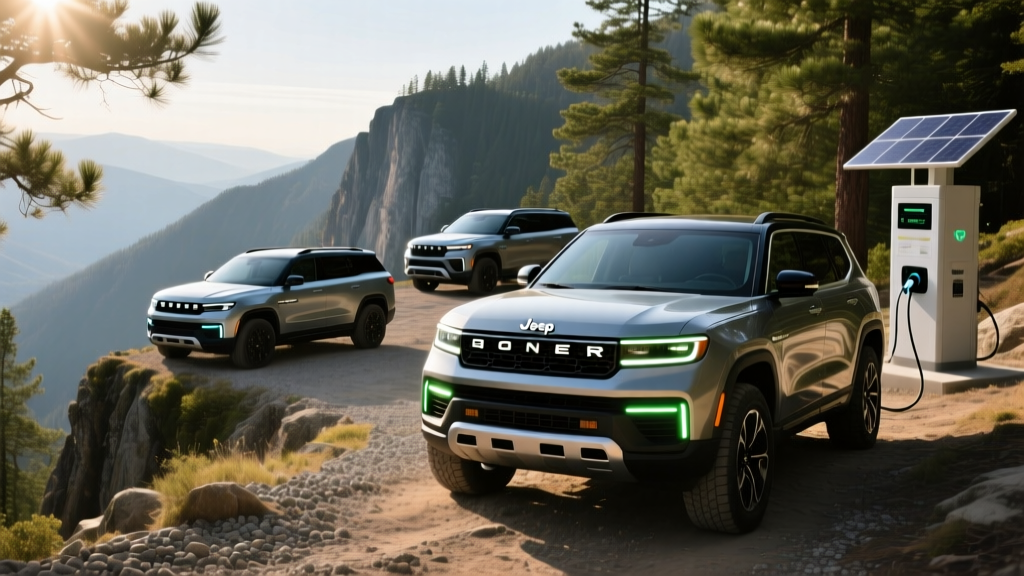
Quick Answer: Jeep's electric lineup in 2026 centers on two purpose-built BEVs: the Wagoneer S (a premium midsize crossover starting around $65,995) and the Recon (an off-road-focused Wrangler alternative starting near $52,000). Both use Stellantis' STLA Large platform with ~100 kWh usable battery packs (NMC chemistry), deliver 300+ miles of EPA-estimated range, and support DC fast charging at up to ~235 kW. Neither qualifies for the full $7,500 federal §30D tax credit as of 2026 due to battery-sourcing rules, though point-of-sale lease incentives may apply. If you need serious off-road capability with electric torque, the Recon is the only real option in its class. If you want a luxury daily driver with Jeep styling, the Wagoneer S competes with the BMW iX and Audi Q8 e-tron—but at a premium price.
Jeep's Electric Lineup: Wagoneer S and Recon at a Glance
Stellantis took a deliberate approach to Jeep electrification. Rather than retrofitting an existing model, both the Wagoneer S and Recon were engineered from the ground up on the STLA Large BEV platform. This matters for packaging: the battery sits low in the chassis, weight distribution is near 50/50, and the electric powertrain enables features like a front-trunk (frunk) and individual axle torque control.
| Spec | Wagoneer S Launch Edition | Recon (Overland Trim) |
|---|---|---|
| EPA Range (est.) | 300 mi | 320 mi |
| Battery (usable) | ~100 kWh, NMC | ~100 kWh, NMC |
| Horsepower | 600 hp (dual motor) | ~500 hp (dual motor) |
| 0–60 mph | 3.4 sec | ~4.5 sec |
| Peak DC Charge Rate | ~235 kW | ~235 kW |
| 10–80% DC Charge | ~23 min | ~24 min |
| Level 2 (240V) Rate | ~11.5 kW | ~11.5 kW |
| Drivetrain | AWD (dual motor) | 4xe AWD w/ locking diffs |
| Ground Clearance | ~7.5 in | ~10.8 in |
| Starting MSRP | $65,995 | ~$52,000 |
| Battery Warranty | 8 yr / 100,000 mi | 8 yr / 100,000 mi |
Real-World Range Reality Check: The Wagoneer S carries a 300-mile EPA estimate, but expect ~240–265 miles on sustained highway driving at 70–75 mph, and as low as ~200–220 miles in sub-freezing temperatures without preconditioning. The Recon's boxy aerodynamics and all-terrain tires will cut highway efficiency further—plan for ~250 miles in mixed driving. These are physics, not flaws: cold reduces lithium-ion reaction rates, and high speed increases drag exponentially.
Charging Speed and Infrastructure: What Jeep Electric Owners Need
Both models support CCS1 connectors natively (with a NACS adapter option for Tesla Supercharger access, which Stellantis now includes). At a 350 kW Electrify America or Ionity station, the ~235 kW peak rate delivers meaningful road-trip capability—but sustained rate matters more than peak.
| Level | Power | Miles Added per Hour | Typical Use Case |
|---|---|---|---|
| Level 1 (120V) | ~1.4 kW | ~4 mi/hr | Overnight top-off only |
| Level 2 (240V / 48A) | ~11.5 kW | ~34 mi/hr | Home daily charging (~9 hr full) |
| DC Fast (peak) | ~235 kW | ~150+ mi in 10 min | Road trips; 10–80% in ~23 min |
Charging-curve reality: The 235 kW peak only holds roughly between 10–40% State of Charge (SoC). Above 60%, the rate tapers significantly—to ~100 kW by 70% and ~50 kW past 85%. This is standard NMC behavior to protect cell longevity. On a road trip, plan stops around 15–20 minutes each if you stay in the 10–80% sweet spot. Charging past 80% is rarely time-efficient unless you're parked overnight at a destination charger.
For home charging, a Level 2 wallbox on a 60-amp circuit (delivering 48A continuous) is the practical minimum. Installation typically costs $800–$2,200 depending on panel proximity and whether your home needs a service upgrade from 100A to 200A. Budget an additional $500–$1,500 if a panel upgrade is required—a common surprise for first-time EV buyers in older homes.
EV vs. Gas: Wagoneer S vs. Grand Cherokee and Recon vs. Wrangler
The most common question from Jeep shoppers: how do these electric models compare to the gas vehicles they'd otherwise buy? Let's run the numbers.
| Metric | Wagoneer S ($65,995) | Grand Cherokee L V6 ($48,000) | Recon (~$52,000) | Wrangler Rubicon ($50,000) |
|---|---|---|---|---|
| Fuel/Energy (5 yr / 75k mi) | ~$4,200 (electric)* | ~$9,750 (gas)** | ~$4,500 (electric)* | ~$11,250 (gas)** |
| Maintenance (5 yr) | ~$1,800 | ~$3,600 | ~$1,800 | ~$3,800 |
| Estimated Insurance (5 yr) | ~$12,500 | ~$9,000 | ~$10,500 | ~$9,200 |
| 5-Year Total Operating Cost | ~$18,500 | ~$22,350 | ~$16,800 | ~$24,250 |
| Operating Savings vs. Gas | ~$3,850 saved | ~$7,450 saved | ||
*Based on $0.14/kWh national average home charging; public DC fast charging adds ~30–50% more. **Based on $3.50/gal, 21 MPG combined (Grand Cherokee) and 18 MPG combined (Wrangler Rubicon). Source: fueleconomy.gov.
The operating-cost advantage is real, but note the upfront price gap. The Wagoneer S costs ~$18,000 more than a comparably equipped Grand Cherokee L at MSRP. Even with $3,850 in five-year fuel and maintenance savings, the EV doesn't close the purchase-price gap without incentives. The Recon vs. Wrangler comparison is closer, with only a ~$2,000 MSRP difference and substantially larger operating savings—making the Recon the stronger financial case for buyers who don't need a removable roof or extreme articulation.
Federal Tax Credit and Incentive Eligibility for Jeep EVs
2026 §30D Federal Tax Credit Checklist (source: IRS.gov):
- MSRP Cap: SUVs must be ≤$80,000 — both Wagoneer S and Recon qualify on base trims.
- Buyer Income Cap: AGI ≤$300,000 (joint) / $150,000 (single) — applies to purchase only.
- Battery Sourcing: Critical minerals and battery components must meet phased-in domestic/FHA-partner thresholds. As of 2026, Stellantis-built EVs do NOT fully meet sourcing requirements for the $7,500 credit on purchase.
- Point-of-Sale Transfer: If eligible, the credit can be applied at purchase as a down-payment reduction — but only if the vehicle qualifies.
- Lease Loophole (§25D commercial credit): Leasing may unlock a $7,500 incentive passed through as a lease credit, regardless of sourcing rules. Confirm with your dealer.
The honest bottom line: don't count on the full $7,500 purchase credit for either model. Lease deals are more likely to include the incentive. Always verify current eligibility on the IRS clean vehicle credit page before signing, as sourcing rules tighten annually.
Common Misconceptions About Jeep Electric SUVs
| Myth | Fact |
|---|---|
| "Electric Jeeps can't off-road." | The Recon includes electronic locking differentials, a Selec-Terrain system, and one-pedal trail control. Electric motors deliver instant torque at 0 RPM — an advantage over gas in low-speed crawling. Water fording depth matches the Wrangler at ~24 inches. |
| "You'll need to charge every day." | With 300+ miles of range and ~34 miles added per hour on Level 2, most owners charge 2–3 times per week during normal commuting. Average US daily driving is ~37 miles (FHWA data). |
| "The battery will need replacing soon." | Stellantis warrants the battery for 8 years/100,000 miles against degradation below 70% capacity. Real-world NMC degradation data from similar packs shows ~8–12% loss over 150,000 miles with proper charging habits (avoiding sustained 100% SoC and frequent DC fast charging above 80%). |
| "It qualifies for the full $7,500 tax credit." | As of 2026, neither model meets the full critical-mineral and battery-component sourcing thresholds. Lease incentives may apply. Always verify at IRS.gov. |
Real-World Ownership: What First-Time Jeep EV Buyers Must Know
Before you sign, consider these practical ownership factors that spec sheets don't cover:
Home charging access is the dealbreaker. If you can install a Level 2 charger at home (garage or driveway with a 240V circuit), daily EV ownership is effortless — you wake up with a full "tank" every morning. If you rely solely on public charging, add 30–45 minutes per week and significantly higher per-mile energy costs (DC fast charging averages $0.35–$0.48/kWh vs. ~$0.14 at home). Apartment dwellers without workplace charging should seriously consider a PHEV like the Wrangler 4xe instead.
Cold climate buyers: precondition or lose range. In temperatures below 32°F, expect 25–35% range reduction if you don't precondition the battery while plugged in. Both models include battery preconditioning via the Uconnect app — use it. A heat pump (standard on both) helps cabin efficiency but doesn't fully offset the chemistry penalty of cold lithium-ion cells.
Insurance costs 20–35% more. EV insurance premiums reflect higher repair costs (specialized high-voltage training, battery replacement risk) and higher vehicle prices. Get quotes before purchasing — a $65,995 Wagoneer S might carry $2,500+/year premiums depending on your state and driving record.
Tire wear accelerates. The instant torque and heavier curb weight (~5,500–6,000 lbs) wear tires 15–25% faster than equivalent gas vehicles. Budget for replacement tires every 30,000–40,000 miles instead of the 50,000+ you might expect from a gas Grand Cherokee.
Decision Framework: Which Jeep Electric Is Right for You?
Choose the Wagoneer S if:
- You want a premium electric SUV with 300+ miles of range and sub-3.5-second 0–60 performance
- Your daily driving is road-focused with occasional light-duty trips
- You're cross-shopping the BMW iX, Audi Q8 e-tron, or Tesla Model X and prefer Jeep's design language
- You have home Level 2 charging and a budget above $65,000
Choose the Recon if:
- You need genuine off-road capability (locking diffs, high ground clearance, all-terrain tires)
- You'd otherwise buy a Wrangler but want lower operating costs and electric torque for crawling
- You value open-air driving (removable roof panels are standard)
- You want the most affordable entry into Jeep's EV lineup (~$52,000)
Stick with gas or PHEV (Wrangler 4xe / Grand Cherokee 4xe) if:
- You can't install Level 2 home charging
- You regularly tow more than 3,500 lbs (EV towing range drops 40–50%)
- You live in a charging desert and frequently drive 300+ mile routes without reliable DC fast chargers
- Your budget is under $45,000
What is the real-world range of the Jeep Wagoneer S?
The EPA estimate is 300 miles. In real-world mixed driving at moderate temperatures, expect ~270–285 miles. Highway-only driving at 75 mph drops this to ~240–260 miles. Sub-freezing temperatures without preconditioning can reduce range to ~200–220 miles.
Does the Jeep Recon qualify for the $7,500 federal EV tax credit?
As of 2026, the Recon does not meet the full battery-sourcing requirements for the $7,500 §30D purchase credit. However, leasing may unlock a comparable incentive through the commercial clean vehicle credit (§25D/45W). Always verify current eligibility at IRS.gov before committing.
Can I take the Jeep Recon off-road like a Wrangler?
Yes, within reason. The Recon offers electronic locking differentials, Selec-Terrain modes, and ~10.8 inches of ground clearance. Its electric motors provide instant torque for low-speed crawling. However, it lacks the Wrangler's solid front axle (limiting extreme articulation), and you'll want to protect the underbody battery on technical trails with skid plates.
How long does it take to charge a Jeep electric SUV at home?
On a Level 2 home charger (240V, 48A / 11.5 kW), a full charge from 0–100% takes approximately 9 hours. Most owners charge from 20–80% overnight, which takes about 5 hours. A standard 120V outlet (Level 1) adds only ~4 miles per hour and is suitable only for emergency top-offs.
What does battery replacement cost for a Jeep EV?
Out-of-warranty battery replacement for a ~100 kWh NMC pack currently runs $18,000–$25,000 including labor. However, Stellantis warranties the battery for 8 years/100,000 miles (capacity retention above 70%), and real-world degradation data from comparable STLA Large packs suggests most batteries will retain 85%+ capacity at 150,000 miles with normal use.