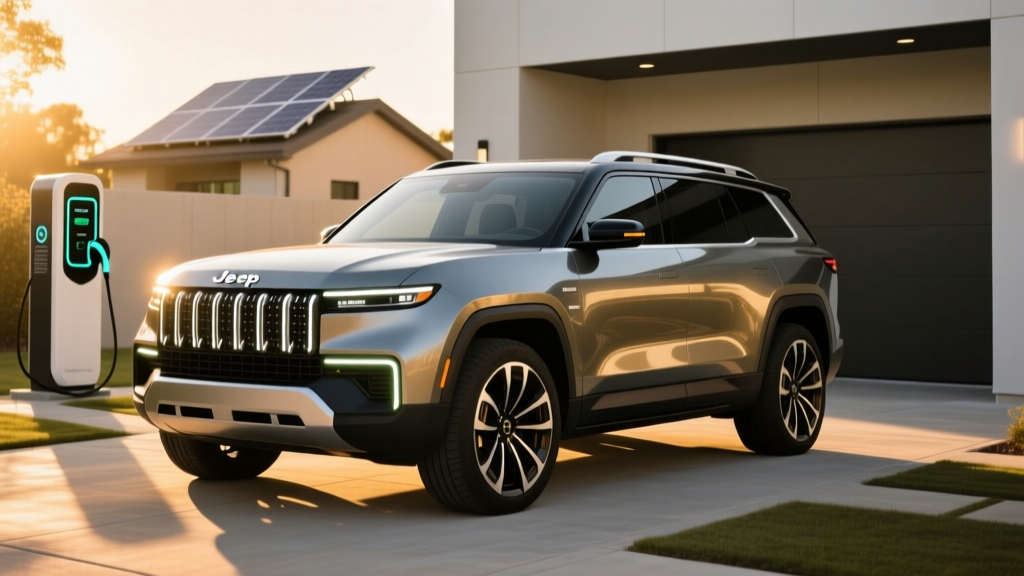
Quick Answer: The Jeep Electric Wagoneer (officially the Wagoneer S) is Jeep's first fully electric production SUV, launching for the 2025 model year and continuing into 2026. Built on Stellantis' STLA Large platform, it targets over 400 miles of EPA-estimated range, dual-motor AWD with approximately 600 horsepower, and DC fast charging at up to 200 kW. Pricing starts around $71,995 before incentives, though federal §30D tax-credit eligibility depends on battery-sourcing and buyer-income requirements that remain in flux for 2026. If you need a three-row, luxury EV SUV with genuine off-road capability, the Wagoneer S is a top contender — but buyers should plan for a $70K+ entry point and verify credit eligibility with a tax professional before committing.
What the Jeep Electric Wagoneer Actually Is
The name "Jeep Electric Wagoneer" most commonly refers to the Wagoneer S, the brand's first global battery-electric vehicle (BEV). Unveiled in late 2024 and arriving in showrooms for the 2025 model year, the Wagoneer S carries into 2026 as Jeep's flagship electric offering. It sits on Stellantis' dedicated STLA Large EV architecture — not a converted gas platform — which means the battery pack is integrated into the floor for a low center of gravity and maximized interior space.
Jeep has also announced a larger, body-on-frame electric Wagoneer concept for future production, but as of early 2026, the Wagoneer S is the only electric Wagoneer you can actually buy. We'll focus on that model here, while noting where the larger variant may land.
Expected Range, Battery, and Efficiency
Stellantis has targeted over 400 miles of EPA-estimated range for the Wagoneer S, though final EPA certification figures for the 2026 model year have not been published as of this writing. The STLA Large platform supports battery packs in the 95–110 kWh (usable) range, likely using NMC (nickel-manganese-cobalt) chemistry for energy density, though Jeep has not confirmed the exact cell supplier or chemistry split.
EPA Sticker vs. Real-World Expectation
Targeted EPA range: 400+ miles
Real-world highway (70-75 mph, mild weather): expect ~330–360 miles
Cold weather (below 30°F, highway): expect ~270–310 miles — a 20–30% reduction typical of NMC packs without aggressive preconditioning
These estimates are based on observed efficiency patterns in similar STLA Large-platform vehicles and large dual-motor AWD SUVs. Actual numbers will depend on final EPA certification.
Efficiency for a vehicle of this size and weight will likely land in the 2.0–2.3 kWh/mile range, translating to roughly 130–150 MPGe combined. That's competitive with the Rivian R1S and BMW iX but less efficient than lighter crossovers like the Hyundai Ioniq 5.
Charging Speed: Home and DC Fast Charging
On the STLA Large platform, the Wagoneer S supports:
| Level | Power | Speed / Time | Connector |
|---|---|---|---|
| Level 1 (120V) | ~1.4 kW | ~4 miles per hour | J1772 / NACS |
| Level 2 (240V home) | ~11.5 kW | ~32 miles per hour; 10–100% in ~10 hours | J1772 / NACS |
| DC Fast Charge | Up to ~200 kW peak | 10–80% in ~25–28 minutes (estimated) | CCS1 or NACS (adapter-dependent) |
A few practical notes from ownership experience with similar platforms:
- Peak kW is not sustained kW. A 200 kW peak typically holds for the 10–40% state-of-charge window, then tapers to ~120 kW by 60%, and drops sharply above 80%. Plan road-trip stops around 10–80% for the best time-to-miles ratio.
- Preconditioning matters. If the Wagoneer S includes navigation-based battery preconditioning (common on STLA Large vehicles), route to a DC charger via the built-in nav to warm the pack and hit peak charge rates. Cold-soaked packs can charge at half the rated speed.
- Home charging is essential. At 11.5 kW, you'll add roughly 320 miles overnight — enough for nearly any daily commute. Level 1 at 1.4 kW is impractical for a 100+ kWh pack unless you drive fewer than 30 miles per day.
Performance and Capability
The launch-edition Wagoneer S features a dual-motor all-wheel-drive layout producing a targeted 600 horsepower and 617 lb-ft of torque, with a 0–60 mph time of approximately 3.4 seconds. That puts it in the performance tier of the Tesla Model X Plaid and well ahead of the gas Wagoneer's 471-hp Hurricane inline-six.
Jeep has emphasized that the Wagoneer S will retain Trail Rated capability, including a Selec-Terrain system with specific EV modes for rock, sand, snow, and mud. Ground clearance and approach/departure angles have not been fully published, but the STLA Large platform's flat battery floor aids breakover angle. Expect roughly 8.0–8.5 inches of ground clearance and available air suspension for additional lift.
Pricing, Trims, and Federal Tax Credit Eligibility
The 2025 Wagoneer S Launch Edition was priced at $71,995 (including destination). For 2026, Jeep is expected to expand the lineup with lower trims, potentially bringing the base MSRP closer to $65,000–$68,000, though official 2026 pricing has not been confirmed.
Federal §30D Tax Credit — 2026 Rules (IRS)
- Maximum credit: up to $7,500 ($3,750 for critical minerals + $3,750 for battery components)
- MSRP cap: SUVs/vans/pickups must be ≤ $80,000 — the Wagoneer S qualifies
- Buyer income cap: Modified AGI ≤ $300,000 (joint), $225,000 (head of household), $150,000 (individual)
- Battery sourcing: Critical minerals and battery components must meet increasing domestic/free-trade-partner thresholds — Stellantis has not confirmed full compliance for the Wagoneer S as of early 2026
- Point-of-sale transfer: Eligible buyers can transfer the credit to the dealer for an upfront price reduction
- Verify current status at IRS.gov Clean Vehicle Credit and consult a tax professional
If the full $7,500 credit applies, a $71,995 Launch Edition effectively costs $64,495. If only half the credit qualifies (common when battery-sourcing requirements aren't fully met), the effective price is $68,245. Always confirm before signing.
EV vs. Gas Wagoneer: 5-Year Ownership Cost Comparison
To understand the real economics, here's a side-by-side look at the electric Wagoneer S versus the gas-powered Wagoneer (Hurricane I6, 4WD) over 5 years and 75,000 miles:
| Cost Category | Wagoneer S (EV) | Gas Wagoneer (I6 4WD) |
|---|---|---|
| Base MSRP (est.) | $71,995 | $70,995 |
| Federal tax credit | –$3,750 to –$7,500 | $0 |
| Fuel / electricity (75K mi) | $2,800–$4,200 (home-heavy) | $9,400–$11,200 (17 mpg, $3.40/gal) |
| Maintenance (5 yr) | $1,200–$1,800 | $3,500–$4,500 |
| Insurance (5 yr, est.) | $12,000–$15,000 | $10,500–$13,000 |
| 5-year depreciation (est.) | $28,000–$35,000 | $25,000–$32,000 |
| Estimated 5-yr total | $95,000–$112,000 | $108,000–$122,000 |
Key takeaways:
- Fuel savings are the biggest lever. Home charging at $0.13/kWh yields roughly $0.04/mile vs. $0.20/mile for gas. Over 75,000 miles, that's a $6,000–$8,000 gap.
- Maintenance is roughly half. No oil changes, fewer brake replacements (regen braking), no transmission fluid. Expect cabin air filters, wiper fluid, tire rotations, and brake-fluid checks.
- Insurance runs 10–20% higher on the EV due to repair-cost data and higher vehicle value. Get quotes before buying.
- Depreciation is the wildcard. EV depreciation has been volatile; luxury EVs have seen steeper drops than gas counterparts in 2023–2025. If you plan to hold 7+ years, this matters less.
Common Misconceptions — Myth vs. Fact
| Myth | Fact |
|---|---|
| "The electric Wagoneer can't go off-road." | Dual motors provide instant torque to each axle with no mechanical linkage lag. Jeep's Selec-Terrain system includes EV-specific modes. Low-end torque actually aids rock crawling. |
| "I'll need to replace the battery in 5 years." | Modern NMC packs are warrantied for 8 years / 100,000 miles with a capacity-retention threshold (typically 70%). Real-world degradation data from similar packs shows 8–12% loss over 150,000 miles. Full replacement, if ever needed, costs $15,000–$22,000 out of warranty. |
| "It qualifies for the full $7,500 tax credit automatically." | Eligibility depends on battery critical-mineral and component sourcing, buyer income, and MSRP caps. Stellantis has not publicly confirmed full §30D compliance for the Wagoneer S. Always check the fueleconomy.gov tax credit lookup before purchasing. |
| "Charging takes too long for road trips." | At 200 kW peak, a 10–80% session takes ~25–28 minutes — roughly the time for a rest stop. Plan routes around DC chargers every 250–300 miles and you'll barely notice. |
| "I can charge on a regular outlet and be fine." | Level 1 adds ~4 miles per hour. A full charge from empty on 120V would take 3+ days. A 240V Level 2 home charger ($500–$1,500 installed) is practically mandatory for daily use. |
Real-World Ownership: What First-Time EV Buyers Should Know
If the Wagoneer S will be your first EV, here's what actually matters day-to-day:
Home Charging Access
A Level 2 home charger (240V, 40–48 amp circuit) is the single biggest quality-of-life upgrade. Budget $800–$2,000 for a quality Level 2 unit (ChargePoint Home Flex, Emporia V2, or Wallbox Pulsar Plus) plus $500–$2,500 for electrician installation, depending on panel proximity and whether a 200-amp service upgrade is needed. Total: $1,300–$4,500. If your panel is already 200A and the charger location is near the panel, expect the lower end.
Cold-Weather Range Loss
NMC batteries lose 20–30% of range in sustained sub-30°F driving. The Wagoneer S's heat pump (expected on STLA Large) mitigates cabin-heating energy draw, but battery chemistry itself slows in the cold. If you live in Minnesota or Maine, plan for ~280 miles of usable range in January — still enough for most daily needs, but factor it into road-trip planning.
Public Charging Reality
Stellantis has committed to NACS adoption across its lineup, meaning future Wagoneer S models should gain native access to the Tesla Supercharger network (17,000+ stalls). For 2025–2026 models, a CCS-to-NACS adapter may be required. Electrify America, EVgo, and ChargePoint networks remain the primary non-Tesla DC options, with reliability improving but still inconsistent in rural corridors.
Driving Patterns That Favor EV Ownership
- Best case: Home charging + daily commute under 80 miles + moderate climate = cheapest, easiest ownership.
- Good case: Home charging + regular road trips along well-served corridors (I-95, I-5, I-70) = manageable with route planning.
- Challenging case: No home charging + frequent long trips in cold/rural areas = higher public-charging costs ($0.30–$0.48/kWh) and more downtime. Consider a PHEV instead.
Decision Framework: Is the Electric Wagoneer Right for You?
Choose the Wagoneer S (EV) if:
- You have home charging access (garage or driveway with 240V circuit)
- Your daily driving is under 150 miles and you take road trips 2–4 times per year
- You want luxury three-row SUV space with instant electric torque and low running costs
- You're comfortable with a $65K–$75K purchase price (before credits)
- You value the latest EV tech: OTA updates, one-pedal driving, and a dedicated EV platform
Consider the gas Wagoneer or a PHEV alternative if:
- You cannot install a Level 2 home charger
- You regularly tow heavy loads over long distances (towing range drops 40–50% on EVs)
- You frequently drive in remote areas with no DC charging infrastructure
- Your budget is firmly under $55,000 and you need three rows
- You want to wait for the larger body-on-frame electric Wagoneer (announced, no firm date)
Frequently Asked Questions
What is the Jeep Electric Wagoneer's official name?
The production model is called the Wagoneer S. The "S" denotes the STLA Large platform. Jeep has also shown a larger electric Wagoneer concept, but it is not yet in production as of 2026.
How much does the Wagoneer S cost?
The 2025 Launch Edition starts at $71,995. 2026 pricing is expected to include lower trims starting around $65,000–$68,000, though official figures are pending.
Does the Wagoneer S qualify for the $7,500 federal tax credit?
It may qualify for part or all of the credit, depending on battery-sourcing compliance and buyer income. The MSRP is under the $80,000 SUV cap. Check IRS.gov and confirm with your tax professional before relying on the credit.
Can the Wagoneer S tow?
Stellantis has not published a final towing rating, but the STLA Large platform supports up to ~5,000–7,500 lbs in other applications. Expect a rating in this range. Note: towing at maximum capacity reduces range by 40–50%.
What's the battery warranty?
Stellantis provides an 8-year / 100,000-mile battery warranty covering capacity retention below a specified threshold (typically 70% state of health). This is standard across the industry and mandated by CARB-state requirements.
Will it use NACS or CCS for charging?
Stellantis is transitioning to NACS (Tesla-style) connectors across its North American lineup. Early Wagoneer S models may ship with CCS1 and include or support a NACS adapter for Supercharger access. Confirm connector type with your dealer.
Is the Wagoneer S a body-on-frame SUV?
No. The Wagoneer S uses a unibody construction on the STLA Large EV platform. The traditional body-on-frame Wagoneer (gas) remains in the lineup. A future body-on-frame electric Wagoneer has been announced but is not yet available.
Sources: IRS Clean Vehicle Credit, fueleconomy.gov, Stellantis North America press releases. Specifications reflect announced/preliminary figures for the 2025–2026 model year and are subject to final EPA certification and manufacturer confirmation.