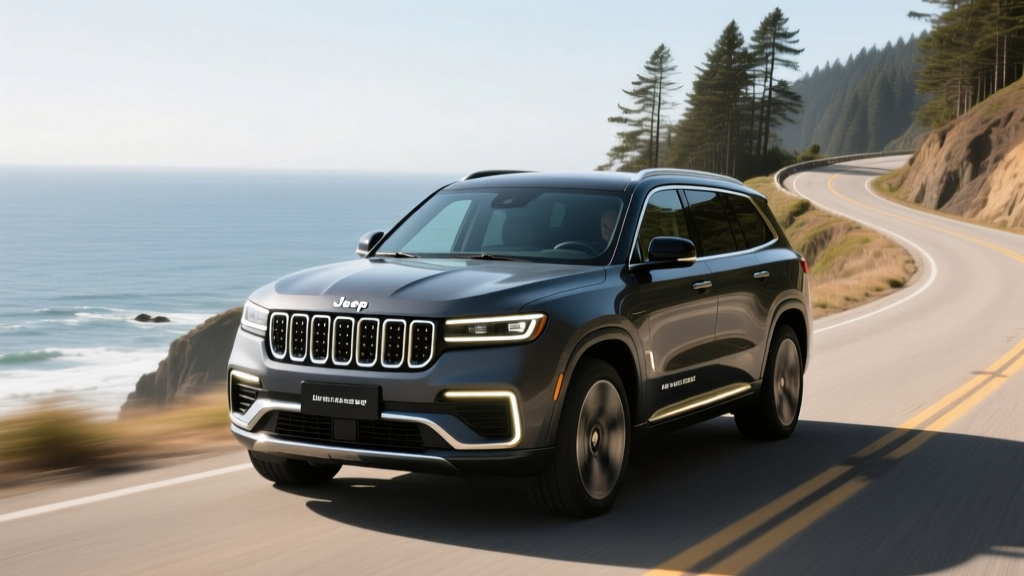
If you're searching for a Jeep electric SUV, the 2025 Wagoneer S is currently the brand's only fully electric model available in the U.S. market. It delivers an EPA-estimated 300 miles of range, 600 horsepower, and DC fast charging that peaks at roughly 150 kW (10–80% in about 28 minutes). Starting at $65,000 before incentives, it targets luxury-minded buyers who want Jeep's off-road heritage repackaged for the electric era. However, its real-world highway range drops closer to 250–270 miles, and at over 5,000 lbs, it's no Wrangler on the trail. Below, we break down everything you need to decide if this electric SUV fits your driving life — or if a plug-in hybrid Wrangler 4xe makes more sense.
Quick Verdict: Is the Wagoneer S the Right Jeep Electric SUV for You?
Buy the Wagoneer S if: You want a premium all-electric Jeep with luxury tech, strong straight-line performance (0–60 in 3.4 seconds), and primarily drive in urban or suburban settings with reliable home charging access.
Consider the Wrangler 4xe (PHEV) instead if: You need serious off-road capability, frequently tow, live in an area with sparse public charging, or want a lower entry price (~$50K) while still driving partially on electricity.
Wait if: You were hoping for an electric Wrangler or Recon at a sub-$50K price point — the Recon is announced but not yet widely available, and pricing is preliminary.
Wagoneer S: The Numbers That Matter
| Spec | Wagoneer S Launch Edition (2025) |
|---|---|
| EPA Range | 300 miles |
| Real-World Range (highway, 70 mph) | ~250–270 miles |
| Real-World Range (cold weather, 20°F) | ~210–240 miles |
| Battery Capacity | 100 kWh (usable ~95 kWh, NMC chemistry) |
| Peak DC Fast Charge Rate | ~150 kW |
| 10–80% DC Charge Time | ~28 minutes |
| Level 2 Charging (240V, 48A) | ~11.5 kW; 0–100% in ~9 hours |
| Horsepower | 600 hp |
| 0–60 mph | 3.4 seconds |
| Drivetrain | Dual-motor AWD |
| Starting MSRP | $65,000 |
| Battery/Powertrain Warranty | 8 years / 100,000 miles |
| Federal §30D Tax Credit | Up to $7,500 (eligibility varies by sourcing/income — see IRS §30D rules) |
⚡ Range Reality Check: The EPA's 300-mile estimate assumes a mix of city and highway driving in moderate temperatures. On a sustained 70+ mph highway trip in summer, expect roughly 250–270 miles before needing a charge. In winter conditions (below 30°F), battery chemistry and cabin heating can reduce range to 210–240 miles. Always precondition the battery before fast charging to avoid painfully slow charge rates in cold weather.
Charging at Home vs. Public Networks: What to Expect
The Wagoneer S uses the CCS1 connector standard for DC fast charging, with Stellantis gradually transitioning to NACS (Tesla Supercharger compatible) on future models. For now, you'll rely on Electrify America, EVgo, and ChargePoint networks for road trips.
| Charging Level | Power (kW) | Miles Added Per Hour | Best For |
|---|---|---|---|
| Level 1 (120V household) | ~1.4 kW | ~3–4 miles | Overnight top-ups only |
| Level 2 (240V, 48A home charger) | ~11.5 kW | ~30–35 miles | Daily home charging (full overnight) |
| DC Fast Charging | Up to ~150 kW peak | ~250+ miles/hr (at peak) | Road trips, 10–80% in ~28 min |
Home charging reality: If you can install a Level 2 home charger, the Wagoneer S is a practical daily driver. A full 48-amp Level 2 installation typically costs $800–$2,000 (equipment + electrician + permit), depending on whether your electrical panel needs an upgrade. Without home charging, relying solely on public DC fast chargers will cost roughly $0.30–$0.50 per kWh — making it more expensive per mile than home charging, though still generally cheaper than gasoline.
Charging curve caveat: The 150 kW peak rate only holds roughly between 10–50% state of charge. Above 80%, charging slows significantly to protect battery health — a 80–100% top-off can add another 20+ minutes. For road trips, plan to charge from 10–80% and move on rather than waiting for a full battery.
Wagoneer S vs. Gas SUV vs. Wrangler 4xe: Cost and Efficiency Comparison
| Metric | Wagoneer S (EV) | Jeep Grand Cherokee (Gas V6) | Wrangler 4xe (PHEV) |
|---|---|---|---|
| Starting MSRP | $65,000 | $44,000 | $50,000 |
| EPA Efficiency | ~85 MPGe combined | ~22 MPG combined | 49 MPGe / 20 MPG (gas-only) |
| Electric-Only Range | 300 miles | N/A | ~22 miles |
| Fuel/Energy Cost Per Mile (national avg) | ~$0.045 (home charging) | ~$0.15 (gas at $3.30/gal) | ~$0.06 (blended) |
| Annual Fuel/Energy (12,000 mi) | ~$540 | ~$1,800 | ~$720 (if charging daily) |
| Estimated §30D Credit | Up to $7,500* | $0 | Up to $3,750* |
| 5-Year Maintenance (est.) | ~$1,200 | ~$3,500 | ~$2,800 |
*Federal tax credit eligibility depends on battery component sourcing, critical mineral requirements, buyer income caps ($150K single / $300K joint), and MSRP caps ($80K for SUVs). Always verify current-year rules on IRS.gov before purchasing. Credits may be applied at point of sale starting 2024.
5-Year Total Cost of Ownership Estimate (12,000 mi/year)
| Category | Wagoneer S | Grand Cherokee Gas | Wrangler 4xe |
|---|---|---|---|
| Purchase (after credit) | $57,500 | $44,000 | $46,250 |
| Energy/Fuel (5 years) | $2,700 | $9,000 | $3,600 |
| Maintenance (5 years) | $1,200 | $3,500 | $2,800 |
| Insurance (est. 5 years) | $10,500 | $7,500 | $8,500 |
| Depreciation (est. 5-yr) | ~$28,000 | ~$18,000 | ~$22,000 |
| Estimated 5-Year Total | ~$99,900 | ~$82,000 | ~$83,150 |
Note: EV insurance premiums tend to run 15–25% higher than comparable gas vehicles due to higher repair costs and battery replacement risk. Depreciation figures are estimates based on current luxury EV resale trends — check Edmunds or Kelley Blue Book for latest projections.
Common Misconceptions About the Jeep Electric SUV Lineup
| Myth | Fact |
|---|---|
| "The Wagoneer S can off-road like a Wrangler." | It has AWD and Selec-Terrain modes, but at 5,300+ lbs with low ground clearance relative to a Wrangler, it's a luxury crossover — not a rock crawler. It handles light trails and snow well, but don't expect Rubicon-level capability. |
| "You'll get the full $7,500 tax credit." | Eligibility depends on your income, the vehicle's battery sourcing compliance, and MSRP caps. Stellantis has worked to qualify, but rules shift. Verify on IRS.gov at the time of purchase. |
| "The battery will need replacing in 5 years." | NMC batteries in modern EVs with active thermal management typically retain 85–90% capacity after 100,000 miles. The 8-year/100,000-mile warranty covers defects and excessive degradation (below 70% capacity). |
| "There's an electric Wrangler available now." | As of 2025, Jeep offers the Wrangler 4xe (plug-in hybrid, ~22 miles electric-only) and the Wagoneer S (full EV). The Jeep Recon (electric off-roader) has been announced but is not yet widely available — specs and pricing are preliminary. |
| "Charging takes too long for road trips." | At a 150 kW DC fast charger, 10–80% takes ~28 minutes — comparable to a gas stop with a meal break. The limitation is charger availability, not speed, on many rural routes. |
Real-World Ownership: Who Should (and Shouldn't) Buy
The Wagoneer S makes the most sense for buyers who:
- Have home charging access — a garage or driveway with a 240V outlet or the ability to install a Level 2 charger. This is non-negotiable for convenient EV ownership.
- Drive mostly urban/suburban routes — where regenerative braking maximizes efficiency and the 300-mile range easily covers a week of commuting.
- Want performance and luxury — the 3.4-second 0–60 time and premium interior (Hudson leather, McIntosh audio, dual 12.3" screens) compete directly with the BMW iX and Mercedes EQE SUV.
- Live in moderate climates — cold-weather range loss is real (15–30%), and while the heat pump helps, extreme cold still hurts.
It's a tougher fit if you:
- Rely on street parking with no charging access — public-only charging is more expensive and less convenient.
- Frequently tow — the Wagoneer S is rated for only ~1,000 lbs of towing. If you need to pull a camper, look at the Rivian R1S (up to 7,700 lbs) or stick with a gas/hybrid SUV.
- Want hardcore off-road capability — the Wrangler 4xe or a future Recon are better choices for trail use.
Decision Framework: Which Jeep Electrified Vehicle Fits Your Life?
Choose the Wagoneer S (full EV) if:
- You have home Level 2 charging and drive <250 miles/day
- You want a luxury performance SUV with low daily energy costs (~$540/year)
- Your typical road trips are under 250 miles between charging stops
- You value instant torque and a quiet cabin over trail capability
Choose the Wrangler 4xe (PHEV) if:
- You need serious off-road capability (solid axles, 10+ inches of ground clearance)
- You can charge at home but also need gas-engine range for remote adventures
- Your daily commute is under 22 miles (covering it entirely on electric)
- You want a lower purchase price and don't mind higher maintenance costs
Wait for the Jeep Recon if:
- You want an electric Jeep with genuine Trail Rated off-road capability
- You're willing to wait for production ramp-up and potentially higher pricing
- Removable doors and a more rugged build are priorities
Frequently Asked Questions
Is the Jeep Wagoneer S eligible for the $7,500 federal tax credit?
It may be, but eligibility depends on several factors: your modified adjusted gross income (must be under $150K single / $300K joint filers), the vehicle's battery component and critical mineral sourcing compliance, and the MSRP cap ($80,000 for SUVs). The Wagoneer S Launch Edition starts at $65,000, so it clears the MSRP cap. Check the latest qualified vehicle list on IRS.gov and consult a tax professional before relying on the credit. The credit can be transferred to the dealer at point of sale as a price reduction.
How much does it cost to charge the Wagoneer S at home?
With the national average electricity rate of ~$0.16/kWh (EIA data), a full charge of the ~95 kWh usable battery costs roughly $15.20, giving you up to 300 miles of range. That works out to about $0.05 per mile — roughly one-third the per-mile cost of gasoline at $3.30/gallon in a 22 MPG SUV. Your actual rate will vary by state; some areas offer time-of-use rates as low as $0.08/kWh overnight.
What's the real highway range at 75 mph?
In independent testing and owner reports, the Wagoneer S delivers approximately 250–270 miles of highway range at sustained 70–75 mph speeds in moderate temperatures (60–80°F). This is a 10–17% reduction from the 300-mile EPA combined estimate, which is typical for large, heavy electric SUVs with less aerodynamic profiles. In winter conditions, expect an additional 10–15% loss.
Does the Wagoneer S support NACS (Tesla Supercharger) charging?
The 2025 Wagoneer S ships with a CCS1 port. Stellantis has announced plans to adopt NACS on future models, and a CCS-to-NACS adapter is expected to be available for access to Tesla's Supercharger network. Confirm adapter availability and compatibility with your dealer before relying on Superchargers for road trips.
How does the Wagoneer S compare to the BMW iX or Mercedes EQE SUV?
The Wagoneer S undercuts both on price ($65K vs. $87K+ for the iX xDrive50) while offering comparable 0–60 performance and similar range. However, the iX offers a more refined ride, a more established dealer network, and slightly faster DC charging (up to 200 kW). The EQE SUV provides a more luxurious interior but starts above $78K. If brand cachet and driving refinement matter most, the Germans win. If value and Jeep brand loyalty matter, the Wagoneer S holds its own.