If you've been searching for a "Jeep Cybertruck," you're not alone — the term pulls consistent interest from buyers who want the rugged, boxy capability of a Jeep Wrangler or Gladiator paired with the electric-truck buzz that Tesla's Cybertruck generated. But here's the straight answer up front: there is no Jeep Cybertruck. Jeep does not currently sell, and has not officially announced, a vehicle by that name as of early 2026.
What Jeep does have is a rapidly evolving electrification strategy under parent company Stellantis, including the Wagoneer S (an all-electric luxury SUV) and the Recon (an electric off-roader positioned as a Wrangler alternative). A Jeep-branded electric pickup truck remains plausible — even likely — but it hasn't been revealed with confirmed specs, pricing, or a sale date.
This guide unpacks what's real, what's rumored, and which electric trucks you can actually buy right now if you want Jeep-like capability with a battery. We'll cover real EPA data, charging speeds, tax credit eligibility, and the competitors that already fill the space a "Jeep Cybertruck" would target.
Why People Search for a Jeep Cybertruck
The search term "Jeep Cybertruck" is a collision of two powerful brand associations: Jeep's legendary off-road credibility and Tesla Cybertruck's polarizing, angular design language. Forum threads and social media renders have fueled speculation for years about what an electric Jeep truck might look like — essentially a battery-electric Gladiator with Cybertruck-style stainless-steel panels or a unibody electric pickup.
Jeep's parent company Stellantis has committed to offering EV options across its brands, and the Jeep brand page currently showcases the Wagoneer S and Recon as its electric vanguard. But a dedicated electric pickup wearing a Jeep badge? That's still in the realm of speculation.
What Jeep Actually Offers in Electric: Wagoneer S and Recon
Before we look at the truck competitors, here's what Jeep's EV lineup actually looks like in 2026. These are confirmed, purchasable vehicles — not concepts.
| Spec | Wagoneer S | Recon |
|---|---|---|
| Body Style | Luxury SUV (2-row) | Off-road SUV (Wrangler-class) |
| Platform | STLA Large | STLA Large |
| EPA Range (est.) | ~400+ mi (target) | ~300+ mi (target) |
| Horsepower | ~600 hp (dual-motor AWD) | TBD (AWD expected) |
| 0-60 mph | ~3.5 sec (target) | TBD |
| Body-on-Frame? | No (unibody) | No (unibody, body-on-frame styling) |
| Pickup Bed? | No | No |
| Starting MSRP (est.) | ~$65,000–$72,000 | ~$55,000–$65,000 |
Neither of these is a pickup truck. The Recon is the closest thing to an electric Wrangler — removable doors, off-road modes, Trail Rated aspirations — but it's still an SUV. If you need a bed, you need to look elsewhere.
The Electric Trucks You Can Actually Buy in 2026
If the "Jeep Cybertruck" search is really about wanting an electric truck with serious off-road chops, here are the real contenders with confirmed EPA data, pricing, and charging specs. These are the vehicles a hypothetical Jeep electric truck would need to beat.
| Spec | Rivian R1T (Dual-Motor) | Tesla Cybertruck (AWD) | Ford F-150 Lightning (Lariat) | Chevrolet Silverado EV (4WT) |
|---|---|---|---|---|
| EPA Range | ~352 mi (Max Pack) | ~340 mi | ~320 mi (Ext. Range) | ~450 mi (Max Range) |
| Battery (kWh) | ~149 kWh (Max) | ~123 kWh | ~131 kWh (Ext.) | ~200 kWh (Max) |
| Peak DC Charge | ~200 kW | ~250 kW (NACS) | ~150 kW | ~200 kW |
| 10–80% DC Time | ~40 min | ~28 min | ~44 min | ~55 min |
| Horsepower | 533 hp (Dual) | 600 hp | 580 hp | 510 hp |
| 0–60 mph | ~4.5 sec | ~3.9 sec | ~3.8 sec | ~4.5 sec |
| Towing Capacity | 11,000 lb | 11,000 lb | 10,000 lb | 10,000 lb |
| Base MSRP | ~$79,900 | ~$79,990 | ~$62,995 | ~$55,000 (WT) |
| Federal §30D Credit | Varies (sourcing) | Eligible (check sourcing) | Eligible (check sourcing) | Eligible (check sourcing) |
For the most current EPA efficiency and range data, always cross-reference fueleconomy.gov, which maintains the official database for all certified vehicles.
Charging Speed: What Matters for Truck Owners
Electric trucks eat more kWh per mile than sedans — often 450–550 Wh/mi loaded or towing — so charging speed is critical for road trips. Here's what each truck delivers at a DC fast charger and at home.
| Truck | Peak DC kW | 10–80% DC Time | Level 2 Home (kW) | Miles/Hr (L2) |
|---|---|---|---|---|
| Rivian R1T | ~200 kW | ~40 min | 11.5 kW | ~16 mi/hr |
| Tesla Cybertruck | ~250 kW | ~28 min | 11.5 kW | ~19 mi/hr |
| F-150 Lightning | ~150 kW | ~44 min | 19.2 kW (opt.) | ~30 mi/hr (19.2 kW) |
| Silverado EV | ~200 kW | ~55 min | 19.2 kW (opt.) | ~27 mi/hr (19.2 kW) |
Key distinction — kW vs kWh: kW (kilowatts) measures power — how fast energy flows into the battery during charging. kWh (kilowatt-hours) measures energy capacity — how much the battery holds total. A 200 kW charger fills a 130 kWh battery faster than a 150 kW charger, but the charge curve tapers significantly above 80% State of Charge (SoC) to protect battery health. That's why the 10–80% time is the most useful metric — the final 20% can take as long as the first 70%.
For home charging, most truck owners will want a Level 2 wallbox on a 240V/60A circuit (the NEMA 14-50 or hardwired connection). Expect $500–$2,500 for professional installation depending on your panel capacity and run distance. A 200-amp electrical panel upgrade can add $1,500–$3,000 if needed. Consult a licensed electrician for your specific setup.
Federal Tax Credit Eligibility: The §30D Rules for Trucks
Under IRS §30D rules, the federal clean vehicle credit offers up to $7,500 for qualifying new EVs — but eligibility depends on several factors that change frequently:
- MSRP Cap: Pickup trucks, vans, and SUVs must have an MSRP at or below $80,000 to qualify. Sedans are capped at $55,000. Most electric trucks fit under the $80K cap in base or mid trims, but loaded models can exceed it.
- Buyer Income Cap: Modified adjusted gross income (MAGI) must not exceed $300,000 (joint filers), $225,000 (head of household), or $150,000 (individual).
- Battery Sourcing: The credit splits into two halves — $3,750 for meeting critical-minerals requirements and $3,750 for battery-component sourcing. These thresholds tighten annually, and some models may qualify for only $3,750 or none at all depending on supply-chain compliance for that model year.
- Point-of-Sale Transfer: As of 2024, buyers can transfer the credit to the dealer at purchase, reducing the upfront price rather than waiting for a tax refund. The dealer must be IRS-registered.
- Final Assembly: The vehicle must undergo final assembly in North America.
Bottom line: Never assume a flat "$7,500 off." Check the specific model year, trim, and your personal income situation. A tax professional can confirm your eligibility before purchase. The IRS maintains the official eligibility list at irs.gov.
Off-Road Capability: Which Electric Truck Is the Most "Jeep-Like"?
If you're searching for a Jeep Cybertruck because you want electric off-road capability, here's how the existing trucks stack up on the trail:
Rivian R1T remains the off-road benchmark among electric trucks. Its quad-motor variants offer individual wheel torque vectoring, 14.9 inches of ground clearance (max), and a Tank Turn feature. The R1T has completed the Rubicon Trail and proven itself in real rock-crawling scenarios. Its gear tunnel (a unique transverse storage compartment between cab and bed) adds practicality no competitor matches.
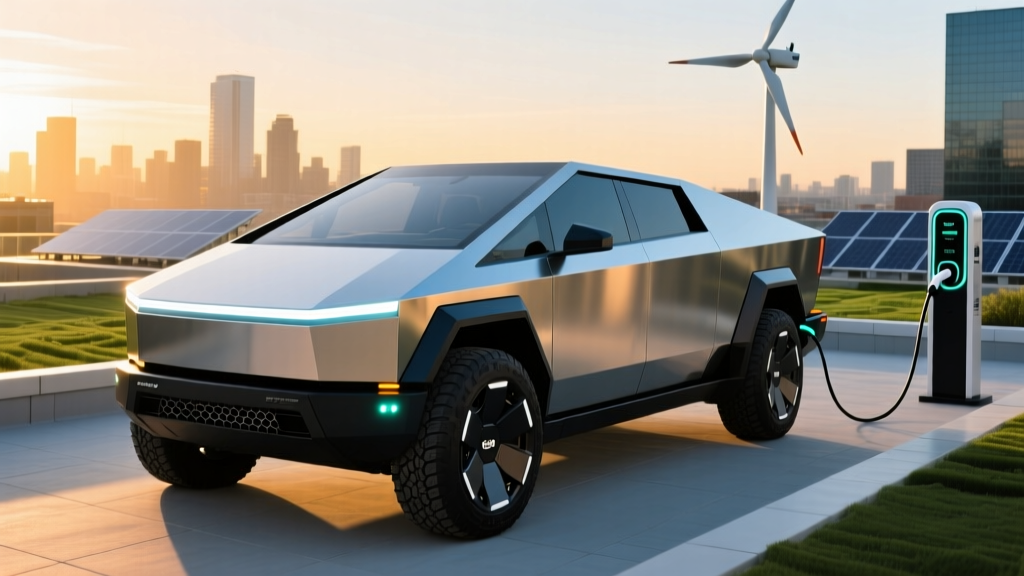
Tesla Cybertruck offers up to 16 inches of ground clearance via adaptive air suspension and an armor-grade stainless-steel exoskeleton. However, its steer-by-wire system and 48V architecture are unproven in sustained off-road abuse. Real-world trail reports from owners are mixed — capable in sand and snow, but the Cybertruck's approach/departure angles and underbody protection lag behind purpose-built off-roaders.
Ford F-150 Lightning and Chevy Silverado EV are competent on forest roads and moderate trails but aren't positioned as rock crawlers. They're work trucks first — think job-site access, not Moab.
For the truest "electric Jeep" experience in 2026, the Jeep Recon (when it reaches full production volume) is the one to watch. It promises Trail Rated certification, removable doors, and serious articulation — just without a pickup bed.
Who Should Wait for a Jeep Electric Truck — and Who Should Buy Now?
- Buy a Rivian R1T now if: You need an electric truck with genuine off-road chops, a usable 4.5-foot bed, and don't mind the ~$80K entry price. It's the closest thing to a "Jeep Cybertruck" that actually exists.
- Buy a Ford F-150 Lightning if: You want a full-size electric truck for work, towing, and daily driving at a more accessible price point (~$55K–$65K). Best value in the segment.
- Buy a Tesla Cybertruck if: You want maximum range efficiency, Supercharger network access, and don't mind the polarizing design. Best charging infrastructure, but off-road credibility is still developing.
- Wait for Jeep if: You specifically want the Jeep brand, Trail Rated heritage, and removable-open-air experience in an electric package — and you don't need a pickup bed (the Recon will likely satisfy this). If you need a bed with a Jeep badge, you may be waiting until 2027 or beyond for any official announcement.
Frequently Asked Questions
Is Jeep making a Cybertruck competitor?
Jeep has not announced an electric pickup truck as of early 2026. The brand's current EV focus is the Wagoneer S (luxury SUV) and Recon (off-road SUV). A Jeep electric truck is plausible given Stellantis's STLA Frame platform designed for body-on-frame trucks, but nothing is confirmed with specs or timing.
What's the closest thing to a Jeep Cybertruck I can buy today?
The Rivian R1T is the closest match — it combines serious off-road capability (14.9 inches of ground clearance, quad-motor torque vectoring) with a practical pickup bed and campervan-friendly features. It's the electric truck most likely to satisfy someone who wants Jeep-level trail performance with a battery.
Does the Rivian R1T qualify for the federal EV tax credit?
Eligibility varies by model year and battery sourcing. The R1T's MSRP falls under the $80,000 truck cap in most trims, and final assembly is in Normal, Illinois. However, critical-mineral and battery-component sourcing requirements under §30D change annually. Check the IRS's current qualifying vehicle list before purchasing and consult a tax professional.
How much does it cost to charge an electric truck at home?
At the U.S. average residential electricity rate of ~$0.17/kWh (EIA data), fully charging a 130 kWh truck battery costs roughly $22. That delivers approximately 250–300 real-world miles, working out to about $0.07–$0.09 per mile — significantly less than a gas truck at $0.18–$0.25 per mile. However, electric trucks consume more energy per mile than EV sedans, so savings are real but not as dramatic as with smaller EVs.
Can electric trucks tow long distances?
Electric trucks can tow their rated capacities (10,000–11,000 lb for most models), but expect range to drop by 40–60% when towing a heavy trailer at highway speeds. A truck rated at 340 miles EPA might deliver only 140–180 miles while towing 8,000 lb. DC fast charging on the road helps, but frequent stops are mandatory. For heavy long-distance towing, a diesel or hybrid truck may still be more practical in 2026.
Will Jeep ever release an electric Gladiator?
Stellantis has invested in the STLA Frame platform specifically for body-on-frame trucks and large SUVs, which could underpin a future electric Jeep truck. However, the current Gladiator is facing questions about its next generation. Jeep has not confirmed an electric Gladiator or any electric pickup. Watch for announcements at major auto shows through 2026–2027.
- Real products with proven EPA range and charging data
- Federal tax credit up to $7,500 (eligibility-dependent)
- Lower per-mile fuel cost vs. gas trucks
- Instant torque for towing and off-road crawling
- Home charging eliminates gas station visits for daily driving
- High upfront cost ($55K–$80K+)
- Range drops significantly when towing or in cold weather
- DC fast charging still slower than refueling a gas truck
- No Jeep-branded electric truck exists yet
- Insurance premiums often higher than gas equivalents
- Charging infrastructure gaps remain in rural/off-road areas
The "Jeep Cybertruck" may not exist, but the electric truck market in 2026 offers genuinely capable options. If off-road performance is your priority, the Rivian R1T earns the top recommendation. If value and practicality matter more, the F-150 Lightning is hard to beat. And if the Jeep badge itself is non-negotiable, keep your eyes on the Recon — and stay patient for whatever Stellantis announces next for its most iconic brand.