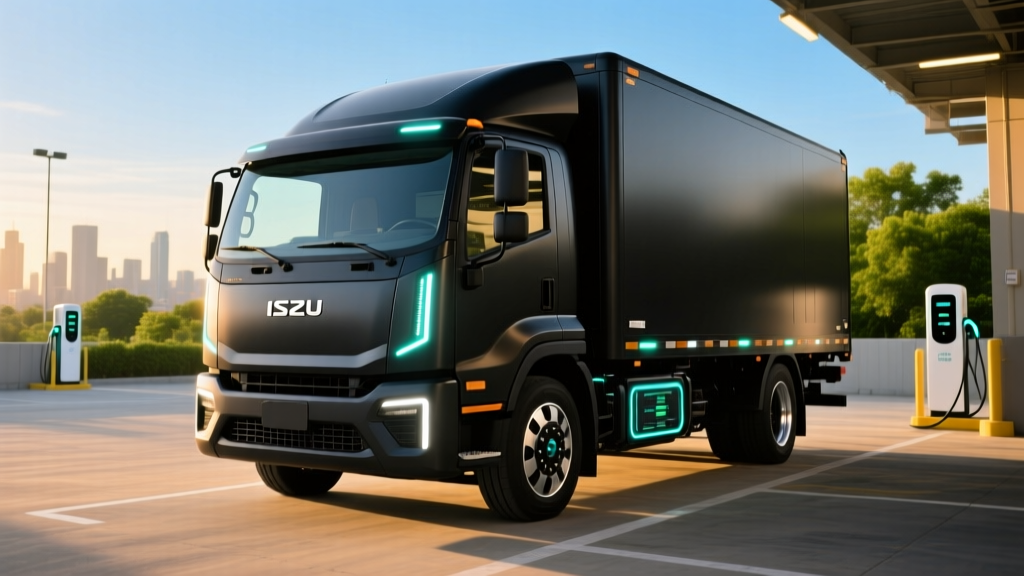
If you manage a commercial fleet or operate a delivery business, you've likely seen the Isuzu N-Series cabover dominate urban routes for decades. Now the question is whether an Isuzu electric truck variant can replace diesel workhorses in real-world duty cycles. Here's the direct answer:
The Isuzu NRR EV (N-Series Electric) is a Class 5 cabover electric truck aimed at last-mile delivery and urban distribution. As of the 2026 model year, Isuzu has been ramping production of battery-electric N-Series variants primarily for fleet customers, with usable battery capacity in the 80–120 kWh range depending on configuration, offering an estimated 100–150 miles of real-world range under typical urban delivery loads. DC fast charging at 50–75 kW peaks gets a 10–80% charge in roughly 60–90 minutes. Pricing starts in the $120,000–$160,000+ range before incentives — significantly higher than a diesel NRR, but with dramatically lower fuel and maintenance costs per mile.
The Isuzu electric truck proposition isn't about range bragging rights — it's about total cost of ownership in stop-and-go urban delivery where regenerative braking, zero idling costs, and minimal drivetrain maintenance create compelling economics. But only if your duty cycle fits the battery. Let's break down exactly what fleet operators and owner-operators need to know.
Isuzu N-Series Electric Truck: Spec Breakdown
Isuzu has taken a measured approach to electrification, leveraging partnerships and existing cabover architecture rather than rushing an unproven platform to market. The N-Series EV is designed for the specific duty cycle where Isuzu already excels: urban delivery, food/beverage distribution, linen/uniform routes, and short-haul logistics.
| Specification | Isuzu NRR EV (Est. 2026 Config) | Isuzu NRR Diesel (2026) |
|---|---|---|
| Class | Class 5 (19,500 lb GVWR) | Class 5 (19,500 lb GVWR) |
| Battery Capacity | ~80–120 kWh usable (LFP chemistry) | ~30 gal diesel tank |
| EPA / Estimated Range | 100–150 mi (varies by payload) | ~350–400 mi |
| Motor Output | ~200–250 kW (268–335 HP) | 210 HP (4HK1-TC diesel) |
| Peak Torque | ~450–600 lb-ft (instant) | 520 lb-ft @ 1,850 rpm |
| DC Fast Charge (Peak) | 50–75 kW (CCS1) | N/A |
| 10–80% Charge Time | ~60–90 min | ~10 min (diesel fill) |
| Level 2 AC Charging | ~7–19 kW | N/A |
| Base MSRP (Est.) | $120,000–$160,000+ | $65,000–$85,000 |
| Warranty | 5 yr / unlimited mi (battery) | 5 yr / 175,000 mi (powertrain) |
Note: Isuzu's electric N-Series configurations vary by upfitter and market. Always confirm exact battery capacity, motor output, and range with your Isuzu dealer for the specific model year and body configuration you're spec'ing.
Real-World Range: What Urban Delivery Actually Looks Like
The EPA doesn't publish range estimates for Class 5 commercial trucks the way it does for passenger EVs. Range for the Isuzu electric truck depends heavily on payload weight, route topography, climate control usage, and stop frequency. Here's how to think about it practically:
Estimated Range: 100–150 miles under typical urban delivery conditions (frequent stops, moderate payload, flat terrain, mild weather). Expect range to drop to 75–110 miles in cold weather (below 35°F) or under maximum payload on hilly routes. Highway-speed driving (sustained 55+ mph) also significantly reduces range compared to stop-and-go urban duty — the opposite of what you'd expect from a diesel.
This is where duty-cycle analysis becomes critical. According to fleet telematics data from NREL's Fleet DNA database, the average urban delivery truck covers 60–90 miles per day across 15–40 stops. If your routes fall within this band — and most last-mile delivery routes do — the Isuzu NRR EV can complete a full shift on a single charge with margin to spare.
However, if your operation involves inter-facility runs, rural delivery, or routes exceeding 120 miles, the current battery capacity becomes a constraint. This is the most common mismatch fleet buyers make: spec'ing an electric truck for a route that occasionally exceeds its range rather than averaging within it.
Cold Weather and Payload Impact
Lithium iron phosphate (LFP) batteries — the chemistry Isuzu favors for commercial applications due to longer cycle life and thermal stability — lose roughly 15–25% of usable capacity in sustained sub-freezing temperatures. Combined with electric cabin heating drawing 3–5 kW continuously, winter range on a 120 kWh pack may realistically drop to 80–100 miles under load.
Fleet operators in northern climates should spec routes conservatively: if your longest winter route is 85 miles, you want at least 100 miles of cold-weather range as a buffer. Depot charging between shifts (opportunity charging) can extend daily coverage.
Charging Infrastructure: Depot Setup and Costs
Unlike consumer EVs that rely on public charging networks, the Isuzu electric truck lives and dies by depot charging infrastructure. Here's what fleet operators need to budget:
| Charging Level | Power (kW) | Miles Added/Hour | Typical Use Case |
|---|---|---|---|
| Level 2 AC (Depot) | 7–19 kW | ~8–20 mi/hr | Overnight charging (8–12 hrs) |
| DC Fast Charge | 50–75 kW | ~50–80 mi/hr | Mid-day opportunity charging |
| High-Power DC | 150+ kW | Not supported (truck-limited) | N/A — truck charge rate is bottleneck |
For a fleet of five Isuzu NRR EVs returning to depot nightly, you'd typically install five Level 2 chargers (19 kW each) on dedicated 100-amp circuits. Here's the realistic cost breakdown:
| Item | Per-Stall Cost | 5-Stall Fleet Cost |
|---|---|---|
| Commercial Level 2 EVSE (networked) | $4,000–$8,000 | $20,000–$40,000 |
| Electrical panel upgrade / transformer | $5,000–$25,000 | $5,000–$25,000 (shared) |
| Trenching, conduit, wiring (per stall) | $3,000–$10,000 | $15,000–$50,000 |
| Permits and utility interconnection | $2,000–$5,000 | $2,000–$5,000 (shared) |
| Network software / management (annual) | $300–$600/yr | $1,500–$3,000/yr |
| Total Estimated Install | $43,500–$123,000 |
The wide range reflects site-specific factors: whether your facility already has sufficient electrical capacity (many older industrial buildings need a service upgrade from 400A to 800A+), distance from the panel to parking stalls, and local utility demand charges. The Alternative Fuels Data Center provides state-specific incentive information that can offset 30–50% of infrastructure costs in many jurisdictions.
Important kW vs kWh distinction: A 19 kW Level 2 charger delivers power at a rate of 19 kilowatts. Charging a 100 kWh battery from empty to full at that rate takes roughly 5.5 hours (100 kWh ÷ 19 kW). The battery stores energy measured in kilowatt-hours (kWh); the charger delivers power measured in kilowatts (kW). Confusing these is the single most common mistake in fleet charging planning.
Electric vs Diesel: Total Cost of Ownership
The Isuzu electric truck carries a purchase premium of roughly $55,000–$80,000 over its diesel counterpart. The question is whether operational savings close that gap within the vehicle's service life. Here's a five-year TCO comparison based on 20,000 miles/year of urban delivery driving:
| Cost Category | Isuzu NRR EV (5 yr) | Isuzu NRR Diesel (5 yr) |
|---|---|---|
| Purchase Price (base) | $140,000 | $75,000 |
| Federal / State Incentives | –$40,000 (est.) | $0 |
| Depot Charging Install (shared) | $12,000 (per truck) | $0 |
| Fuel / Electricity (100k mi total) | $10,000–$14,000 | $35,000–$45,000 |
| Maintenance (5 yr / 100k mi) | $4,000–$7,000 | $12,000–$18,000 |
| DEF Fluid / Emissions Systems | $0 | $2,000–$4,000 |
| Insurance (5 yr) | $18,000–$25,000 | $15,000–$20,000 |
| Estimated Resale Value | $35,000–$50,000 | $25,000–$35,000 |
| Net 5-Year Cost | $109,000–$146,000 | $112,000–$137,000 |
The numbers reveal the core trade-off: the Isuzu electric truck reaches TCO parity with diesel around year 4–6 depending on local electricity rates, fuel prices, incentive availability, and annual mileage. Higher mileage accelerates payback because per-mile energy and maintenance savings compound faster.
Fuel Cost Per Mile: The Electric Advantage
At a commercial electricity rate of $0.12/kWh and an efficiency of ~2.0 kWh/mile (typical for a loaded Class 5 electric truck), energy cost is roughly $0.24/mile. Compare that to diesel at $4.00/gallon and 8 MPG in urban delivery: $0.50/mile. That's a $0.26/mile savings, or $5,200 per year at 20,000 miles.
Maintenance Savings
Electric trucks eliminate oil changes, fuel filters, DEF fluid, DPF regeneration issues, turbocharger failures, and transmission maintenance. Regenerative braking extends brake pad life by 2–3x. Real-world fleet data consistently shows 40–60% lower maintenance costs for electric vs diesel commercial vehicles.
Incentives and Tax Credits: What Fleets Can Claim
The federal incentive landscape for commercial electric trucks differs from consumer passenger vehicles. The §30D clean vehicle credit that applies to personal-use EVs has MSRP caps and income limits that don't apply to fleet purchases. Instead, fleet buyers should investigate:
- IRC §45W Commercial Clean Vehicle Credit: Up to $40,000 for qualified commercial electric vehicles (30% of cost basis, capped at $40,000 for vehicles over 14,000 lb GVWR). Confirm current-year rules at IRS.gov §45W.
- State and utility incentives: Many states (California's HVIP, New York's Truck Voucher Incentive Program) offer $20,000–$100,000+ per vehicle. Utility companies frequently fund make-ready infrastructure.
- Depreciation benefits: Bonus depreciation and §179 expensing may apply to both the vehicle and charging infrastructure.
- CARB and clean-air district grants: In regulated air basins, additional grants may stack with federal incentives.
Always consult a tax professional and confirm current-year incentive availability. Rules change annually and vary by jurisdiction, fleet size, and vehicle sourcing requirements.
Common Misconceptions About Electric Commercial Trucks
| Myth | Fact |
|---|---|
| "Electric trucks can't handle heavy payloads" | The NRR EV maintains its Class 5 GVWR rating. Electric motors deliver peak torque at 0 RPM — better for loaded starts than diesel in many scenarios. |
| "Batteries won't last the life of the truck" | LFP chemistry is rated for 3,000–5,000+ charge cycles before 80% capacity retention. At 100 miles/day and one charge cycle/day, that's 8–13+ years of service. |
| "Charging takes too long for commercial use" | Overnight depot charging (8–12 hours on Level 2) covers 90%+ of daily needs. Mid-day DC fast charging adds ~75 miles in an hour for extended routes. |
| "The grid can't handle fleet charging" | Managed charging software staggers charge times across off-peak hours. Most depot charging occurs between 10 PM and 6 AM when grid demand is lowest. |
| "Electric trucks are unproven in commercial service" | Thousands of electric delivery trucks from multiple OEMs have been in revenue service since 2020+. Isuzu's N-Series platform itself has decades of commercial validation. |
Decision Framework: Is the Isuzu Electric Truck Right for Your Fleet?
Choose the Isuzu NRR EV if:
- Your daily routes are under 100 miles with return-to-depot operations
- You operate in an urban/suburban environment with frequent stops (maximizing regen braking)
- Your facility can accommodate Level 2 depot charging (or you can invest in infrastructure)
- You have access to state/utility incentives that reduce the purchase premium below $30,000
- You're facing clean-air regulations, idling restrictions, or sustainability mandates
- Your fleet operates 5–6 days/week with high annual mileage (accelerating TCO payback)
Stick with the diesel Isuzu NRR if:
- Your routes regularly exceed 130 miles without mid-day charging opportunity
- You operate in extreme cold climates without depot preconditioning capability
- Your facility lacks electrical capacity and a panel upgrade is cost-prohibitive
- You need maximum range flexibility for variable/long-haul routes
- Your annual mileage is under 12,000 miles (savings won't offset premium in vehicle life)
- No state or utility incentives are available in your jurisdiction
What First-Time Electric Truck Buyers Should Know
Transitioning a fleet from diesel to electric involves operational changes beyond the vehicle itself. Based on early-adopter fleet experiences, plan for these realities:
Driver training matters. Electric trucks accelerate differently (instant torque), regenerate braking energy (one-pedal-capable driving), and operate silently. Pedestrian awareness, regenerative braking feel, and charge-management habits require orientation — typically a half-day training session per driver.
Telematics and charge management software are essential. Unlike diesel (fill up and go), fleet EVs require route-to-charge planning. Software like Geotab, Samsara, or OEM-provided platforms track state of charge, optimize charge scheduling, and alert dispatchers when a vehicle doesn't have sufficient charge for its assigned route.
Utility demand charges can surprise you. Commercial electricity billing often includes demand charges based on peak kW draw, not just total kWh consumed. If five trucks plug in simultaneously at 6 PM, you may trigger a demand spike that costs more than the energy itself. Managed charging software that staggers start times is not optional — it's a cost-control necessity.
Battery degradation is gradual, not catastrophic. LFP batteries lose roughly 2–3% capacity per year under normal use. A truck with 120 kWh new will likely have ~105–110 kWh after five years — still sufficient for most urban delivery routes. Battery replacement costs for Class 5 trucks are estimated at $25,000–$45,000, but most packs outlast the vehicle's economic service life.
Frequently Asked Questions
What is the range of the Isuzu electric truck?
The Isuzu N-Series electric truck offers an estimated 100–150 miles of range depending on battery configuration, payload, terrain, and climate. Real-world urban delivery routes with frequent stops typically see the higher end of this range due to regenerative braking. Cold weather (below 35°F) reduces range by 15–25%.
How long does it take to charge the Isuzu NRR EV?
On a 19 kW Level 2 depot charger, a full charge takes approximately 5–7 hours — ideal for overnight charging. On a 50–75 kW DC fast charger, a 10–80% charge takes roughly 60–90 minutes. The truck's onboard charge rate is the bottleneck; connecting to a 150+ kW station won't charge faster than the truck's maximum acceptance rate.
Is the Isuzu electric truck eligible for federal tax credits?
Commercial fleet purchases generally qualify for the IRC §45W Commercial Clean Vehicle Credit rather than the consumer §30D credit. §45W provides up to 30% of the vehicle cost basis (capped at $40,000 for vehicles over 14,000 lb GVWR). Eligibility depends on battery sourcing, vehicle qualification, and current-year IRS rules. Always verify with a tax professional and IRS.gov.
How does the Isuzu electric truck compare to diesel on cost per mile?
Energy cost for the NRR EV is approximately $0.24/mile (at $0.12/kWh commercial electricity) vs $0.50/mile for diesel (at $4.00/gal and 8 MPG urban). Combined with 40–60% lower maintenance costs, the electric truck saves roughly $0.30–$0.40 per mile in operating costs — translating to $6,000–$8,000 annually at 20,000 miles/year.
Can I charge the Isuzu electric truck at public charging stations?
Technically yes, using CCS1-compatible DC fast chargers. However, public charging infrastructure is not designed for Class 5 trucks — parking spaces are too small, charge cables may not reach, and dwell time is impractical for commercial operations. Depot charging is the standard model for electric commercial trucks.
What happens if the battery fails out of warranty?
Isuzu's battery warranty typically covers 5 years with capacity retention guarantees (commonly 70–80% of original capacity). LFP batteries rarely fail catastrophically; they degrade gradually. If replacement is needed after warranty, expect $25,000–$45,000 for a Class 5 pack. However, LFP chemistry is designed for 3,000–5,000+ cycles, meaning most batteries will outlast the truck's primary service life.