Where Are Teslas Actually Built in 2026?
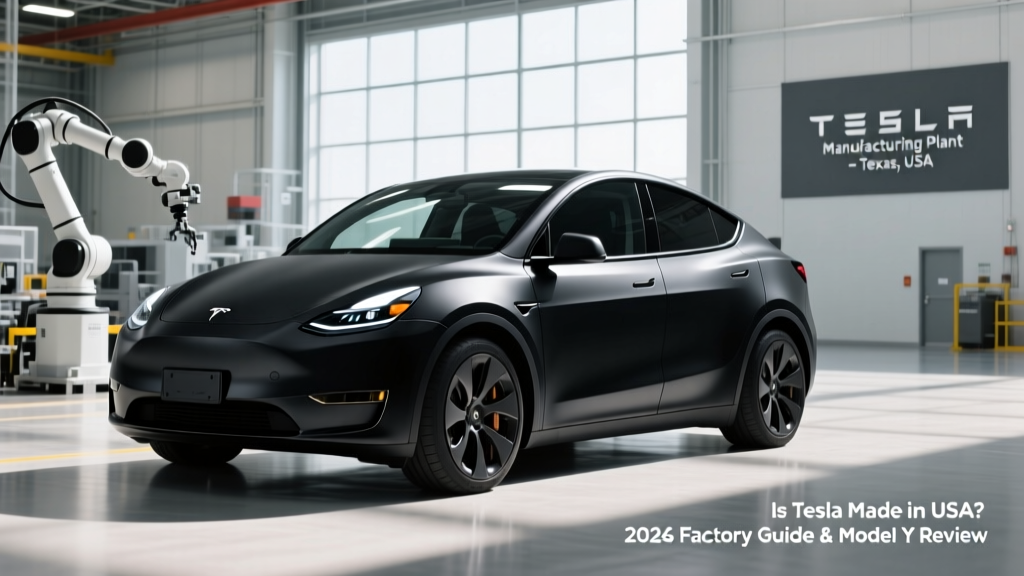
The short answer to "is Tesla made in USA" is yes — the vast majority of Tesla vehicles sold in North America are assembled in American factories, using a high percentage of US-sourced and North American-sourced parts. But Tesla's global manufacturing footprint has expanded considerably, and understanding which plant builds your specific car matters for everything from delivery timelines to federal tax credit eligibility under IRS §30D battery-sourcing rules.
As of the 2026 model year, Tesla operates four primary vehicle assembly plants worldwide:
- Fremont, California — Model S, Model X, Model 3, and Model Y (for certain trims and export markets)
- Gigafactory Texas (Austin) — Model Y (primary US production hub) and Cybertruck
- Gigafactory Shanghai, China — Model 3 and Model Y for Asian, European, and some Canadian markets
- Gigafactory Berlin-Brandenburg, Germany — Model Y for European delivery
If you purchase a Tesla in the United States in 2026, your vehicle almost certainly rolled off a line in Fremont or Austin. The NHTSA American Automobile Labeling Act (AALA) reports consistently rank Tesla vehicles among the highest for domestic and North American parts content — frequently above 70% for the Model Y. Vehicles built in Shanghai or Berlin are generally not imported to the US market.
To ground this discussion in a specific, current vehicle, the rest of this review profiles the 2026 Tesla Model Y Long Range AWD — Tesla's best-selling model and the one most US buyers will take delivery of from Austin.
2026 Tesla Model Y Long Range AWD: Full Spec Breakdown
| Spec | Value |
|---|---|
| EPA Range | 320 miles |
| Battery Capacity (usable) | ~78 kWh |
| Battery Chemistry | NMC (Nickel Manganese Cobalt) — Long Range AWD |
| Peak DC Fast-Charge Rate | 250 kW (Supercharger V3/V4) |
| 10–80% DC Fast Charge Time | ~25 minutes |
| Home Level 2 Charge Rate | 11.5 kW (~44 mi/hr on 48A circuit) |
| 0–60 mph | 4.8 seconds |
| Horsepower | 384 hp (combined dual motor) |
| Drivetrain | Dual-motor AWD |
| MPGe (combined) | 117 MPGe |
| Efficiency | 28 kWh / 100 mi |
| Cargo Volume (rear seats up / folded) | 30.2 / 72.0 cu ft |
| Rear Legroom | 39.5 in |
| Base MSRP | $48,990 (before destination) |
| As-Tested Price (with FSD, Red Paint) | ~$59,490 |
| Battery & Drive Unit Warranty | 8 years / 120,000 miles |
| Limited Vehicle Warranty | 4 years / 50,000 miles |
A few notes on these figures: the 78 kWh usable capacity is managed by a software buffer that protects the pack from full 0% or 100% states, preserving long-term health. The NMC chemistry in the Long Range AWD offers higher energy density than the LFP (lithium iron phosphate) packs found in the base RWD Model Y, which is why it achieves 320 miles from a physically similar pack size. The trade-off is that NMC benefits more from staying between 20–80% for daily use, whereas LFP packs tolerate regular 100% charges.
Real-World Range: What 320 EPA Miles Actually Means
EPA sticker: 320 miles
Real-world highway (70–80 mph, moderate climate): ~265–285 miles
Real-world mixed city/highway (spring/fall): ~290–310 miles
Cold-weather highway (below 32°F): ~220–250 miles
Source: Owner-reported data aggregated by fueleconomy.gov and independent testing.
The Model Y's efficiency — 28 kWh per 100 miles — is among the best in its class. Tesla's heat pump, standard on all 2026 models, recovers waste heat from the drivetrain and cabin to reduce winter range loss compared to resistive heating. Even so, expect 20–30% range reduction in sustained sub-freezing highway driving. If your typical commute is 40–60 miles round trip, the real-world variance matters little. If you regularly drive 250+ mile stretches in winter, plan your Supercharger stops accordingly.
One under-discussed factor: Tesla's navigation-based battery preconditioning. When you route to a Supercharger, the car warms the battery to optimal temperature before you arrive, enabling faster charge acceptance. Skip preconditioning in cold weather and your peak charge rate may drop from 250 kW to under 100 kW for the first several minutes.
Charging Speed: Supercharger Network and Home Setup
Tesla's proprietary Supercharger network — now opening to NACS-equipped vehicles from Ford, Rivian, GM, and others — remains the most reliable public DC fast-charging ecosystem in the US. For the Model Y, here's what charging actually looks like:
| Charging Level | Power (kW) | Miles Added per Hour | Notes |
|---|---|---|---|
| Level 1 (120V household) | ~1.4 kW | ~5 mi/hr | Emergency/trickle only |
| Level 2 (240V, 48A Mobile Connector or Wall Connector) | 11.5 kW | ~44 mi/hr | Full charge overnight (~7 hrs) |
| Level 2 (240V, 32A standard outlet) | 7.7 kW | ~30 mi/hr | Requires NEMA 14-50 outlet |
| DC Fast (Supercharger V3) | Peak 250 kW | ~200 mi in 15 min | 10–80% in ~25 min; tapers above 80% |
| DC Fast (Supercharger V4) | Peak 250 kW (Model Y limited) | Same as V3 | V4 cabinets support higher rates for future vehicles |
The charge curve matters more than the peak number. The Model Y holds near 250 kW from roughly 10–30% state of charge, then steps down through the 200s and 100s as SoC climbs. A 10–80% session takes about 25 minutes; a 10–90% session stretches closer to 40 minutes because of the steep taper above 80%. On road trips, the practical strategy is to charge to 80% and move on — the time penalty for that last 10% is rarely worth it.
For home charging, Tesla's Gen 2 Wall Connector ($475) on a dedicated 60A circuit (48A continuous) delivers the full 11.5 kW the car can accept. Installation costs range from $800 to $2,500 depending on your electrical panel's capacity and the distance from panel to garage. If your home has a 200A service panel with available headroom, expect the lower end. A panel upgrade to 200A or 400A can add $2,000–$5,000 — consult a licensed electrician for your specific situation.
Performance, Interior, and Technology
The 2026 Model Y Long Range AWD's 4.8-second 0–60 time doesn't sound extraordinary next to a Model 3 Performance (2.9 seconds), but the instant torque delivery makes it feel quicker in daily driving than the number suggests. Dual-motor AWD provides confident traction in rain and light snow, and the regenerative braking system is smooth enough for one-pedal driving in most conditions.
The 2026 refresh — which debuted in early 2025 — brought meaningful interior upgrades: ventilated front seats, ambient lighting, a rear-seat touchscreen for climate and media control, acoustic glass on all windows, and a power-folding second row. Build quality from the Austin line has improved measurably over early Fremont cars, though panel-gap variance still occasionally appears.
Standout tech:
- 15.4-inch center touchscreen running Tesla's proprietary OS — responsive, OTA-updatable, with integrated navigation and Supercharger routing
- Autopilot (standard): adaptive cruise + lane centering — SAE Level 2 driver assistance, requires active driver supervision
- Full Self-Driving (Supervised): $8,000 option or $99/month — adds city-street navigation, traffic-light recognition, and automated parking. Still SAE Level 2 despite the name
- Sentry Mode, Dog Mode, Camp Mode, and over-the-air feature updates
- Native NACS connector — no adapter needed for Superchargers; CCS adapter ($250) available for non-Tesla DC networks
Tesla Autopilot and FSD (Supervised) are SAE Level 2 systems. The driver must remain attentive, keep hands available, and be prepared to take over at any moment. These are not autonomous or "self-driving" systems. Only Level 4 services like Waymo operate without a driver in the loop, and those are limited to specific geofenced areas.
Notable drawbacks:
- No Apple CarPlay or Android Auto — Tesla's native interface is the only option
- Rear visibility is compromised by the sloping roofline; the camera-based mirror option helps
- Insurance premiums run 20–40% higher than comparable ICE crossovers in most states
- Service center wait times can stretch to weeks in underserved metro areas
Pricing, Trims, and Federal Tax Credit Eligibility
The 2026 Model Y lineup in the US:
| Trim | Base MSRP | Drivetrain | EPA Range | Federal Credit Eligibility |
|---|---|---|---|---|
| Long Range RWD | $44,990 | RWD | 320 mi | Up to $7,500 (§30D) |
| Long Range AWD | $48,990 | Dual-motor AWD | 307 mi | Up to $7,500 (§30D) |
| Performance | $53,990 | Dual-motor AWD | 285 mi | Up to $7,500 (§30D) |
Does the Model Y qualify for the federal EV tax credit? Yes — as of 2026, all US-built Model Y variants qualify for the full $7,500 under IRS §30D, provided the buyer meets income thresholds. Since Tesla's MSRP is well under the $80,000 SUV cap and the Austin and Fremont plants meet North American final-assembly requirements, the critical variable is the buyer's modified adjusted gross income (MAGI):
- $300,000 max for married filing jointly
- $225,000 max for head of household
- $150,000 max for single filers
Since January 2024, buyers can elect to transfer the credit to the dealer at point of sale, reducing the purchase price directly rather than waiting for a tax refund. Tesla applies this as a line-item deduction at delivery. Battery-sourcing requirements under §30D are complex and updated annually — Tesla's North American battery supply chain has generally met the critical-minerals and battery-component thresholds for the full credit, but confirm current-year eligibility on the DOE Fuel Economy site before ordering, as sourcing rules tighten each year.
Effective price example: A 2026 Model Y Long Range AWD at $48,990 + $1,390 destination = $50,380, minus $7,500 point-of-sale credit = $42,880 before state incentives, taxes, or registration. That positions it against the Hyundai Ioniq 5 ($44,900 base, up to $7,500 credit) and Ford Mustang Mach-E ($42,995 base, partial credit depending on trim).
Who Should Buy the 2026 Model Y?
Choose the Model Y Long Range AWD if:
- You want access to the Supercharger network without adapters for road trips
- Your household needs crossover cargo space (72 cu ft with seats folded) and 300+ mile range
- You value OTA updates, native route-based preconditioning, and integrated trip planning
- You have reliable home Level 2 charging access
Look at competitors if:
- You need Apple CarPlay/Android Auto (Hyundai Ioniq 5, Ford Mach-E, Chevy Equinox EV)
- You want a more traditional dealership service experience
- You need third-row seating (Kia EV9, though it costs significantly more)
- Your budget is under $35,000 and you want to explore the used EV market
The Model Y is best suited for suburban commuters and families who take periodic road trips and have home charging. Its combination of efficiency, Supercharger access, and cargo utility makes it a pragmatic daily driver. It is less ideal for buyers in rural charging deserts, those who prioritize traditional dealer service relationships, or anyone who views CarPlay integration as non-negotiable.
Pros, Cons, and Final Verdict
- Class-leading efficiency (28 kWh/100 mi)
- Supercharger network reliability and coverage
- 320-mile EPA range covers most use cases
- Over-the-air updates add features post-purchase
- 72 cu ft cargo volume rivals midsize SUVs
- Strong resale value relative to EV segment
- Full $7,500 federal credit eligibility (income permitting)
- No Apple CarPlay or Android Auto
- Higher insurance costs than ICE equivalents
- Service center availability varies by region
- FSD (Supervised) remains Level 2 despite price
- Minimalist interior isn't for everyone
- Cold-weather range loss still 20–30% on highways
- Panel-gap inconsistency still occasionally reported
The 2026 Model Y remains the default electric crossover for American buyers who want a proven platform, reliable fast-charging access, and a vehicle built domestically with high North American parts content. It isn't the most luxurious option in its price range, nor the most engaging to drive — but its efficiency, range, and infrastructure advantages make it the most pragmatic. If "is Tesla made in USA" was your starting question, the Austin-built Model Y is the most direct answer.
Frequently Asked Questions
What is the real-world range of the 2026 Model Y Long Range?
The EPA rates it at 320 miles. In mixed real-world driving at moderate temperatures, expect 290–310 miles. Sustained highway driving at 75+ mph drops that to 265–285 miles, and cold-weather highway use (below freezing) can reduce range to 220–250 miles.
How fast does the Model Y charge at home and on the road?
On a 48A Level 2 home charger, it adds about 44 miles of range per hour, fully charging overnight in roughly 7 hours. On a Tesla Supercharger V3, it peaks at 250 kW and charges from 10–80% in about 25 minutes. The charge rate tapers significantly above 80%, so road-trip strategy favors shorter, more frequent stops to 80%.
How much does the Model Y cost after the federal tax credit?
A 2026 Model Y Long Range AWD starts at $48,990 plus $1,390 destination ($50,380 total). With the $7,500 §30D point-of-sale credit applied, the effective price drops to approximately $42,880, assuming the buyer meets IRS income caps ($150K single / $300K joint). State incentives may reduce the cost further — check your state's energy office for current programs.
Does the Tesla Model Y qualify for the full $7,500 federal EV tax credit?
Yes, as of 2026, the US-built Model Y qualifies for the full $7,500 credit under IRS §30D, subject to buyer income limits and annual battery-sourcing requirement updates. The credit can be transferred to Tesla at point of sale as a direct price reduction. Verify current-year eligibility on fueleconomy.gov before ordering.
Is the Model Y worth buying over the Ioniq 5 or Mach-E?
It depends on priorities. The Model Y wins on efficiency, Supercharger access, cargo space, and OTA feature updates. The Hyundai Ioniq 5 offers faster 800V DC charging (10–80% in ~18 min vs. 25 min), Apple CarPlay, and a more conventional interior. The Ford Mach-E provides a sportier driving feel and dealer-network service. All three qualify for the federal credit at comparable trims. Test-drive all three before deciding — the interface and ergonomics differences are significant.
Are any Tesla vehicles made outside the USA?
Yes. Tesla manufactures vehicles in Shanghai (China) and Berlin (Germany) for their respective regional markets. However, Tesla vehicles sold in the United States are assembled in Fremont, California, or Austin, Texas. You will not receive a Shanghai- or Berlin-built car if you order from Tesla in the US.