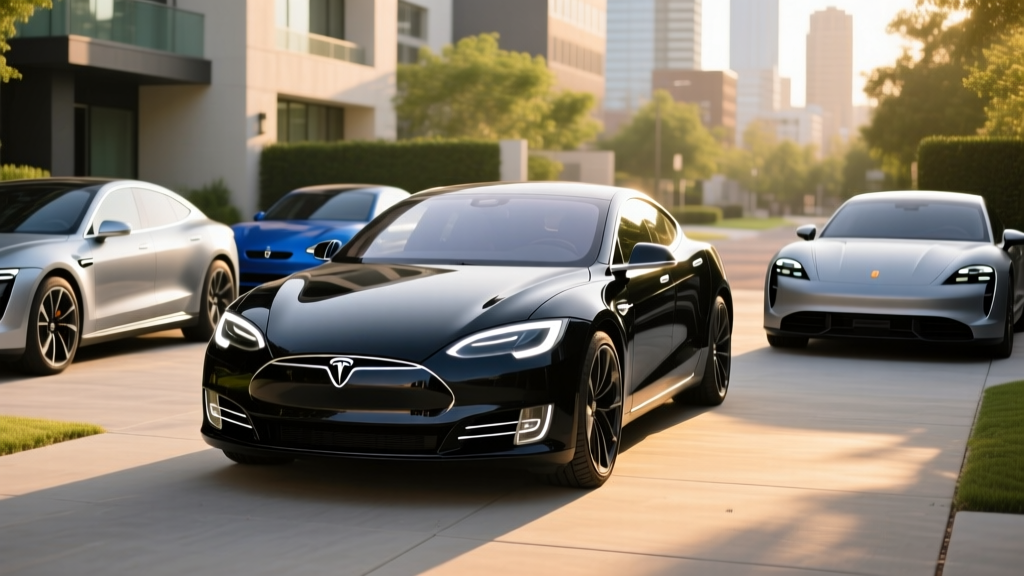
The question "is a Tesla a luxury car?" doesn't have a simple yes-or-no answer — and that's exactly what makes it worth examining. Tesla straddles a strange space in the automotive market: its pricing overlaps with both premium and luxury segments, its tech outpaces legacy luxury brands in some areas while falling short in others, and its build quality remains a polarizing topic among owners. In 2026, with the EV market more competitive than ever, understanding where Tesla actually lands on the luxury spectrum matters more than ever for buyers cross-shopping a BMW i4, a Genesis Electrified GV70, or a Mercedes EQB.
Below, we break down every current-production Tesla model with hard data — EPA range, charging speeds, real-world efficiency, pricing after tax credits, and the ownership experience — to give you a definitive, numbers-driven answer.
The Short Answer: It Depends on the Model
Tesla's lineup spans from the Model 3 Rear-Wheel Drive at roughly $38,990 (before incentives) to the Model X Plaid pushing past $100,000. That's a massive price spread, and the luxury question shifts depending on where you sit within it:
- Model 3 / Model Y: Premium mainstream — competing with BMW 3 Series, Audi A4, Lexus NX on price, not with S-Class or Range Rover.
- Model S / Model X: True luxury pricing and performance, but interior material quality and service infrastructure lag legacy luxury brands.
- Cybertruck: A category unto itself — premium pricing, polarizing design, and capability-focused rather than luxury-focused.
Let's dig into each model with the exact specs that matter.
2026 Tesla Model 3: The Entry Point
The refreshed Model 3 (internally called "Highland" and continuing into 2026 with minor updates) remains Tesla's most accessible sedan. It competes directly with the BMW i4, Hyundai Ioniq 6, and Polestar 2.
| Spec | RWD | Long Range AWD | Performance |
|---|---|---|---|
| Base MSRP | $38,990 | $45,490 | $52,990 |
| EPA Range | 272 mi | 341 mi | 315 mi |
| Battery (usable) | ~57.5 kWh (LFP) | ~75 kWh (NMC) | ~75 kWh (NMC) |
| 0-60 mph | 5.8 sec | 4.2 sec | 2.9 sec |
| Horsepower | 271 hp | 346 hp | 510 hp |
| Drivetrain | RWD | Dual-Motor AWD | Dual-Motor AWD |
| MPGe (combined) | 132 MPGe | 131 MPGe | 121 MPGe |
| Efficiency | 25 kWh/100mi | 26 kWh/100mi | 28 kWh/100mi |
| Cargo (trunk + frunk) | 23 cu ft | 23 cu ft | 23 cu ft |
| Rear Legroom | 35.3 in | 35.3 in | 35.3 in |
Source: fueleconomy.gov and Tesla's official specifications.
The Model 3 Long Range's EPA rating of 341 miles is among the best in the EV market. In real-world highway driving at 70-75 mph, expect 280-310 miles in moderate temperatures. In cold weather (below 30°F), that drops to roughly 230-260 miles due to battery resistance and cabin heating demands. The LFP-equipped RWD model is more resilient to daily 100% charging (Tesla recommends it for LFP), but its smaller battery means real-world highway range sits closer to 210-240 miles.
Charging Speed: Model 3
| Charging Level | RWD (LFP) | Long Range / Performance (NMC) |
|---|---|---|
| Level 1 (120V / 12A) | ~3 mi/hr | ~3 mi/hr |
| Level 2 (240V / 48A) | ~30 mi/hr (11.5 kW) | ~44 mi/hr (11.5 kW) |
| DC Fast Charge (peak) | 170 kW | 250 kW |
| 10-80% DCFC Time | ~25 min | ~25 min |
| Connector | NACS (native) | NACS (native) |
The Model 3's NACS connector gives it native access to Tesla's Supercharger network — over 6,500 stations and 60,000+ connectors in North America as of early 2026. This remains a meaningful practical advantage, as third-party networks (Electrify America, EVgo) still suffer from higher downtime rates. The 250 kW peak charge rate on Long Range/Performance trims is competitive, though rivals like the Hyundai Ioniq 6 (peak 240 kW but with a flatter charge curve) can match or slightly beat real-world 10-80% times.
Charge curve note: Like all EVs, the Model 3 doesn't sustain peak kW throughout the session. You'll see 250 kW only between roughly 10-30% State of Charge (SoC), tapering to ~150 kW by 50% and dropping further above 70%. The 25-minute 10-80% figure accounts for this taper.
2026 Tesla Model Y: The Volume King
The Model Y continues as the best-selling EV in the United States. A significant refresh (codenamed "Juniper") rolled out for the 2025 model year, bringing updated styling, a rear touchscreen, ventilated seats, and improved NVH (noise, vibration, harshness). The 2026 model carries forward with these refinements.
| Spec | Long Range AWD | Performance |
|---|---|---|
| Base MSRP | $44,990 | $51,490 |
| EPA Range | 320 mi | 285 mi |
| Battery (usable) | ~75 kWh (NMC) | ~75 kWh (NMC) |
| 0-60 mph | 4.8 sec | 3.5 sec |
| Horsepower | 384 hp | 510 hp |
| Drivetrain | Dual-Motor AWD | Dual-Motor AWD |
| MPGe (combined) | 122 MPGe | 111 MPGe |
| Cargo (rear seats up) | 30.2 cu ft | 30.2 cu ft |
| Cargo (rear seats folded) | 72.1 cu ft | 72.1 cu ft |
| Rear Legroom | 40.5 in | 40.5 in |
| Towing Capacity | 3,500 lbs | 3,500 lbs |
The Model Y Long Range's 320-mile EPA rating translates to approximately 265-290 miles in sustained highway driving at 70+ mph and 220-250 miles in sub-freezing temperatures. The Juniper refresh improved aerodynamic efficiency and thermal management, narrowing the gap between EPA and real-world figures compared to pre-2025 models. For a family road-tripper, plan charging stops around the 200-230 mile mark in mixed conditions for a comfortable buffer.
Charging specs mirror the Model 3 Long Range: 250 kW peak DCFC, ~25 minutes 10-80%, and 11.5 kW Level 2 at home. The Model Y's NACS port and Supercharger access make it one of the most road-trip-friendly EVs on the market.
2026 Tesla Model S: The Flagship Sedan
The Model S is where Tesla most directly competes with traditional luxury: the Mercedes EQS, BMW i7, Porsche Taycan, and Lucid Air. It's also where the luxury debate gets most nuanced.
| Spec | Long Range | Plaid |
|---|---|---|
| Base MSRP | $79,990 | $94,990 |
| EPA Range | 402 mi | 359 mi |
| Battery (usable) | ~95 kWh (NMC) | ~95 kWh (NMC) |
| 0-60 mph | 3.1 sec | 1.99 sec |
| Horsepower | 670 hp | 1,020 hp |
| Drivetrain | Dual-Motor AWD | Tri-Motor AWD |
| MPGe (combined) | 120 MPGe | 116 MPGe |
| Cargo (trunk + frunk) | 28 cu ft | 28 cu ft |
| Rear Legroom | 35.4 in | 35.4 in |
The Model S Long Range's 402-mile EPA rating remains one of the highest of any production EV sold in the U.S. Real-world highway range sits around 320-360 miles in fair weather, and roughly 270-310 miles in cold conditions. The tri-motor Plaid sacrifices some range for its staggering 1,020 horsepower and sub-2-second 0-60 time — performance that embarrasses supercars costing three times as much.
Charging peaks at 250 kW on V3 Superchargers, though Tesla has been gradually enabling higher rates on newer battery packs. Expect 10-80% in approximately 27-30 minutes given the larger battery. Level 2 charging at 11.5 kW adds roughly 35-40 miles per hour.
Where Model S Falls Short as a Luxury Car
Here's where the luxury question gets uncomfortable for Tesla. Compared to a Mercedes EQS or BMW i7:
- Interior materials: The Model S uses synthetic leather and minimalist trim. It's clean and modern, but lacks the open-pore wood, Nappa leather, massaging seats, and acoustic glass found in similarly priced German competitors.
- Ride quality: The adaptive air suspension is competent but not class-leading. The EQS's AIRMATIC system and the i7's Executive Lounge rear seating offer superior isolation.
- NVH: Improved in recent years, but wind noise at highway speeds still exceeds what you'll experience in a Lucid Air or EQS.
- Service infrastructure: Tesla's service model (mobile rangers + limited service centers) frustrates luxury buyers accustomed to white-glove dealer experiences with loaner vehicles and concierge scheduling.
2026 Tesla Model X: The Luxury SUV Question
| Spec | Long Range | Plaid |
|---|---|---|
| Base MSRP | $84,990 | $99,990 |
| EPA Range | 335 mi | 311 mi |
| Battery (usable) | ~95 kWh (NMC) | ~95 kWh (NMC) |
| 0-60 mph | 3.8 sec | 2.5 sec |
| Horsepower | 670 hp | 1,020 hp |
| Seating | 5, 6, or 7 passengers | 5 or 6 passengers |
| Cargo (behind 3rd row) | 15.3 cu ft | 15.3 cu ft |
| Towing Capacity | 5,000 lbs | 5,000 lbs |
The Model X's falcon-wing rear doors and available three-row seating give it practicality no rival electric SUV matches. But at $85K-$100K, it competes with the BMW iX, Mercedes EQS SUV, and Rivian R1S — all of which offer arguably more refined interiors and, in Rivian's case, more adventurous capability.
The Model X Long Range's 335-mile EPA figure translates to 270-300 miles on the highway in warm weather. The boxy shape and heavy curb weight (~5,100 lbs) penalize efficiency at speed. In cold weather with three rows occupied and climate running, expect closer to 230-260 miles. For towing, range drops dramatically — plan for 150-180 miles when pulling near the 5,000-lb limit.
2026 Tesla Cybertruck: Premium, Not Luxury
The Cybertruck occupies its own category. Starting at $60,990 for the Dual-Motor AWD and reaching $99,990 for the Cyberbeast, it's priced in premium-to-luxury territory. But its stainless-steel exoskeleton, utilitarian bed, and off-road focus place it closer to a Rivian R1T or a loaded Ford F-150 Lightning than to a Range Rover.
| Spec | Dual-Motor AWD | Cyberbeast (Tri-Motor) |
|---|---|---|
| Base MSRP | $60,990 | $99,990 |
| EPA Range | 340 mi | 320 mi |
| Battery (usable) | ~123 kWh (NMC) | ~123 kWh (NMC) |
| 0-60 mph | 4.1 sec | 2.6 sec |
| Horsepower | 600 hp | 845 hp |
| Towing Capacity | 7,500 lbs | 7,500 lbs |
| Bed Length | 6 ft | 6 ft |
| MPGe (combined) | 79 MPGe | 76 MPGe |
The Cybertruck's massive battery and heavy weight result in poor efficiency (over 50 kWh/100mi in real-world use). DC fast charging peaks around 350 kW (enabled by its 800V+ architecture), with 10-80% taking approximately 20-24 minutes. However, real-world range when towing or hauling drops steeply — plan for 180-220 miles highway unloaded, and under 150 when towing heavy.
Federal Tax Credit: What Actually Applies in 2026
The IRS §30D federal EV tax credit remains a key purchase factor, but eligibility is far from universal. Here's the current landscape for Tesla:
- MSRP Cap: Sedans (Model 3, Model S) must be under $55,000. SUVs, pickups, and vans (Model Y, Model X, Cybertruck) must be under $80,000.
- Buyer Income Cap: Modified AGI must not exceed $150,000 (single), $225,000 (head of household), or $300,000 (joint).
- Battery Sourcing: Critical minerals and battery components must meet escalating domestic/free-trade-partner sourcing thresholds. These requirements tighten annually.
- Assembly: Vehicle must undergo final assembly in North America (all Tesla models qualify).
- Point-of-Sale Transfer: Eligible buyers can transfer the credit to the dealer at purchase, reducing the sale price directly.
| Model / Trim | MSRP | §30D Eligible? | Effective Price (with credit) |
|---|---|---|---|
| Model 3 RWD | $38,990 | Yes (partial to full, sourcing-dependent) | ~$31,490 - $38,990 |
| Model 3 Long Range | $45,490 | Yes (partial to full) | ~$37,990 - $45,490 |
| Model 3 Performance | $52,990 | Yes (under $55K sedan cap) | ~$45,490 - $52,990 |
| Model Y Long Range | $44,990 | Yes (SUV, under $80K cap) | ~$37,490 - $44,990 |
| Model Y Performance | $51,490 | Yes | ~$43,990 - $51,490 |
| Model S Long Range | $79,990 | No (exceeds $55K sedan cap) | $79,990 |
| Model S Plaid | $94,990 | No | $94,990 |
| Model X Long Range | $84,990 | No (exceeds $80K SUV cap) | $84,990 |
| Cybertruck Dual-Motor | $60,990 | Yes (pickup, under $80K cap) | ~$53,490 - $60,990 |
| Cybertruck Cyberbeast | $99,990 | No | $99,990 |
Credit eligibility depends on battery component and critical mineral sourcing, which Tesla does not publicly break down by model year. Consult IRS.gov §30D guidance and a tax professional before relying on credit amounts. Partial credits ($3,750) may apply if only one of the two sourcing requirements is met.
Driver Assistance: Autopilot and FSD (Supervised)
Both Tesla Autopilot and Full Self-Driving (Supervised) are SAE Level 2 driver-assistance systems. The driver must remain fully engaged — hands on or near the wheel, eyes on the road — at all times. Tesla FSD is not autonomous driving. Only Level 4 services like Waymo operate without a human driver, and those are geofenced robotaxis, not consumer vehicles.
Tesla includes basic Autopilot (Traffic-Aware Cruise Control + Autosteer) standard on all models. FSD (Supervised) is a $8,000 one-time purchase or $99/month subscription that adds automatic lane changes, Navigate on Autopilot, Autopark, and Smart Summon. As of early 2026, FSD remains a supervised system requiring driver attention, despite Tesla's marketing language.
The competing systems to consider:
- GM Super Cruise: Hands-free on 750,000+ mapped miles of divided highway. Requires eye monitoring but allows true hands-off.
- Ford BlueCruise: Hands-free on 130,000+ miles of pre-mapped highway.
- BMW/Mercedes: Increasingly capable Level 2+ systems, with Mercedes holding regulatory approval for Level 3 (Drive Pilot) in limited conditions in select states.
- Drive you while you sleep, text, or look away
- Navigate unmapped roads or construction zones reliably
- Handle all weather conditions (heavy rain, snow, fog degrade performance)
- Replace an attentive driver — NHTSA has investigated multiple incidents involving Autopilot/FSD misuse
Warranty and Long-Term Ownership
| Coverage | Model 3 / Model Y | Model S / Model X |
|---|---|---|
| Basic Vehicle | 4 yr / 50,000 mi | 4 yr / 50,000 mi |
| Battery & Drive Unit | 8 yr / 120,000 mi (RWD) or 8 yr / 100,000 mi (AWD/Perf) | 8 yr / 150,000 mi |
| Battery Capacity Retention | ≥70% during warranty period | ≥70% during warranty period |
Tesla's battery warranty guarantees that the pack will retain at least 70% of its original capacity during the warranty period. Real-world degradation data from fleet analytics (including Recurrent Auto and TeslaFi community data) shows that most Tesla NMC packs lose approximately 8-12% capacity in the first 100,000 miles, then degrade much more slowly. LFP packs (Model 3 RWD) show even slower degradation and tolerate regular 100% charging better than NMC.
Battery replacement cost if out of warranty: approximately $12,000-$16,000 for a Model 3/Y pack and $18,000-$22,000 for a Model S/X pack at Tesla service centers. Third-party options are emerging but remain limited.
So — Is a Tesla a Luxury Car? The Verdict
- Class-leading performance-per-dollar (especially Plaid models)
- Best-in-class DC charging network (Superchargers)
- Over-the-air updates that add features post-purchase
- Industry-leading software and app integration
- Top safety ratings (IIHS Top Safety Pick+ for Model Y, Model 3)
- Strong resale value relative to other EVs
- Interior material quality below German/Japanese luxury rivals at similar prices
- No massaging seats, limited ambient lighting, no premium audio equaling Burmester/B&W
- Service experience inconsistent — long wait times, limited loaner availability
- No dealership lounge experience; mobile service is convenient but not "luxurious"
- Panel gaps and paint quality still occasionally criticized
- FSD promises have repeatedly outpaced delivery, creating trust friction
- Choose Model 3/Y if: You want a premium EV with the lowest-friction ownership experience, best charging network, and strong efficiency. Ideal for commuters, small families, and road-trippers who value Supercharger access above interior opulence.
- Choose Model S/X if: You want flagship performance and range, accept the minimalist interior philosophy, and prioritize acceleration and tech over traditional luxury materials. Cross-shop the Lucid Air (better interior, similar range) and BMW i7 (more refined ride) before committing.
- Choose Cybertruck if: You need truck capability with EV running costs and don't mind polarizing design. Not a luxury purchase — it's a premium tool.
- Look elsewhere if: White-glove service, hand-stitched interiors, massaging rear seats, and dealer relationships define luxury for you. Genesis, Mercedes, BMW, and Lucid better serve that buyer.
Frequently Asked Questions
What is the real-world range of a Tesla in 2026?
It varies by model and conditions. The Model 3 Long Range achieves roughly 280-310 miles on the highway in warm weather (EPA: 341). The Model Y Long Range delivers about 265-290 real-world highway miles (EPA: 320). The Model S Long Range, the range king, manages 320-360 highway miles (EPA: 402). Subtract 15-25% in freezing temperatures across all models.
How fast does a Tesla charge at home and on the road?
At home on a Level 2 (240V/48A) charger, Teslas add 30-44 miles per hour depending on the model, fully replenishing overnight. On DC fast chargers, most Tesla models peak at 250 kW and charge from 10-80% in approximately 25 minutes. The Cybertruck peaks at ~350 kW thanks to its higher-voltage architecture.
How much does a Tesla cost after tax credits?
The Model 3 RWD can drop as low as ~$31,490 with the full $7,500 §30D credit (if all sourcing requirements are met and you're under income caps). The Model Y Long Range can reach ~$37,490. Model S, Model X, and Cybertruck Cyberbeast exceed MSRP caps and are ineligible. Always verify current sourcing eligibility on IRS.gov.
Is a Tesla worth buying vs. competitors in 2026?
For most buyers prioritizing charging infrastructure, efficiency, and software, yes — the Model 3 and Model Y remain the default EV choices. But the Hyundai Ioniq 6, BMW i4, Rivian R1S, and Lucid Air each beat Tesla in specific areas (interior quality, ride comfort, off-road capability, or range). Cross-shop at least two competitors before deciding.
What are the biggest pros and cons of owning a Tesla?
Pros: Supercharger network, OTA updates, efficiency, performance, app integration, safety ratings, strong resale. Cons: Interior material quality relative to price, service center wait times, FSD overpromising, limited customization options, panel gap inconsistency.
Does a Tesla qualify for the federal EV tax credit?
Several models do, but not all. The Model 3 (all trims under $55K), Model Y (all trims under $80K), and Cybertruck Dual-Motor ($60,990, under $80K pickup cap) are eligible if buyer income limits and battery sourcing requirements are met. The Model S, Model X, and Cybertruck Cyberbeast exceed MSRP caps and do not qualify. Check current-year rules at IRS.gov and consult a tax professional.
Is Tesla considered a luxury brand by industry standards?
It depends on the source. Kelley Blue Book and Edmunds classify Tesla as a luxury brand. Consumer Reports categorizes it as premium/luxury. However, J.D. Power's initial quality and dealer experience studies often rank Tesla below traditional luxury marques. The brand occupies a unique position: luxury pricing and performance in some models, but a service and material-quality experience that doesn't consistently match.