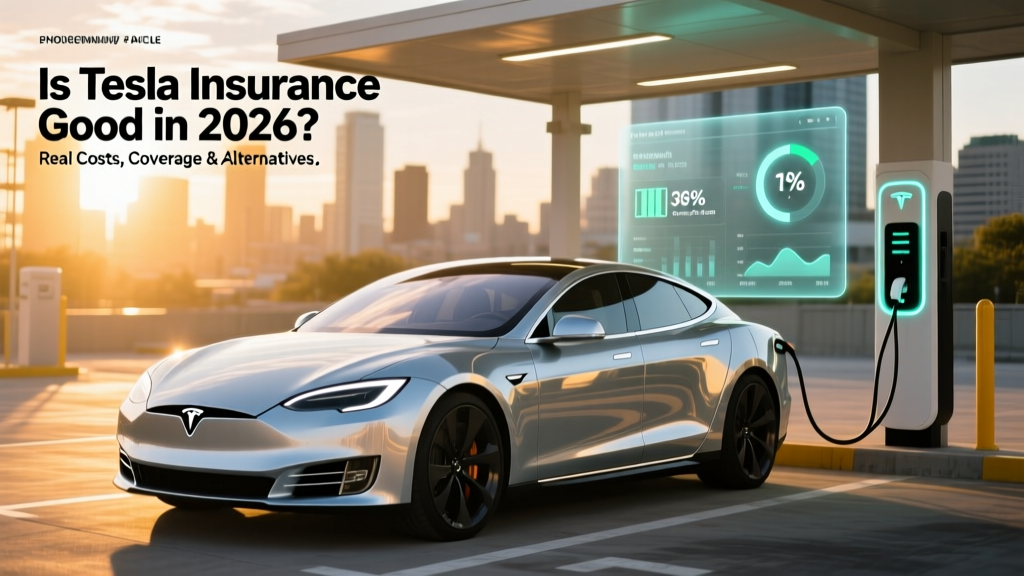
Tesla Insurance has always been a polarizing product. On paper, it promises lower premiums by using your actual driving data. In practice, owner forums are filled with stories of rates doubling overnight after a minor hard-braking event. So is Tesla Insurance good in 2026, or is it a data-harvesting experiment dressed up as a discount?
To answer that, we need to look at the product itself — pricing mechanics, coverage details, state availability — and then ground it in the vehicles it insures. Since the vast majority of Tesla Insurance policies cover the Model Y and Model 3, this review uses the current 2026 Model Y Long Range AWD as the reference vehicle, with full specs, range, and charging data included.
Tesla Insurance: How It Actually Works
Tesla Insurance operates in two modes depending on your state:
- Real-Time Safety Score (Usage-Based): Available in states like Texas, Arizona, Ohio, Colorado, and others. Your premium adjusts monthly based on a 0–100 Safety Score calculated from telemetry data collected by the vehicle — hard braking, aggressive turning, forced Autopilot disengagements, forward collision warnings, and late-night driving.
- Standard (Non-Telemetry): In states where usage-based pricing isn't permitted or hasn't launched, Tesla Insurance prices policies using traditional actuarial factors (age, location, driving history, vehicle model) without real-time driving data.
The Safety Score model is where things get interesting — and controversial. A score above 90 typically yields meaningful discounts. Drop below 70, and your premium can spike well above market rate. The algorithm is opaque; Tesla does not publish the exact weighting of each factor.
2026 Tesla Model Y Long Range AWD — Full Spec Sheet
Since most Tesla Insurance policies are written on the Model Y, understanding what you're insuring matters. Here are the verified 2026 specifications for the volume-selling Long Range AWD trim:
| Spec | Value |
|---|---|
| EPA Range | 320 miles |
| Battery Capacity | ~78 kWh usable (NMC chemistry) |
| Drivetrain | Dual-Motor AWD |
| Horsepower | 384 hp (combined) |
| 0–60 mph | 4.8 seconds |
| Max DC Fast Charge | 250 kW peak (V3 Supercharger) |
| 10–80% DC Charge Time | ~27 minutes |
| Level 2 Home Charge Rate | 11.5 kW (~44 mi/hr) |
| Efficiency | 122 MPGe combined / 28 kWh/100mi |
| Cargo Volume | 76 cu ft (rear seats folded) |
| Rear Legroom | 41.6 inches |
| Battery Warranty | 8 years / 120,000 miles (70% retention) |
| Base MSRP | $44,990 |
| Federal Tax Credit (§30D) | Up to $7,500 (subject to income + sourcing rules) |
Real-World Range: What to Actually Expect
EPA Sticker: 320 miles
Highway (70 mph, 75°F): ~265–285 miles
Cold Weather (30°F, mixed driving): ~210–245 miles
City / Stop-and-Go (regen-heavy): ~295–315 miles
The Model Y's heat pump helps mitigate cold-weather losses compared to older EVs without one, but expect a 20–30% reduction in range during sustained freezing temperatures. Highway driving at 75+ mph also cuts range significantly due to aerodynamic drag — this applies to every EV, not just Tesla.
According to fueleconomy.gov, the 2026 Model Y Long Range AWD achieves 122 MPGe combined. That's competitive within the segment but not class-leading — the Hyundai Ioniq 5 and Kia EV6 post slightly higher efficiency numbers thanks to their 800V architectures enabling faster charging, even if their range is similar.
Charging Speed: DC Fast + Home Level 2
Tesla's Supercharger network remains the gold standard for reliability, and the Model Y Long Range takes full advantage of V3 stalls:
| Charge Level | Power | Speed |
|---|---|---|
| Level 1 (120V outlet) | ~1.4 kW | ~3–4 mi/hr |
| Level 2 (240V, 48A Wall Connector) | 11.5 kW | ~44 mi/hr |
| DC Fast (V3 Supercharger) | 250 kW peak | ~162 mi in 15 min; 10–80% in ~27 min |
| DC Fast (V4 Supercharger) | Up to 250 kW (current Model Y cap) | Similar to V3; future OTA may unlock higher rates |
Charging curve reality: The 250 kW peak only holds between roughly 10–30% State of Charge. Above 50%, the rate tapers significantly — you'll see ~100 kW by 60% and ~50 kW by 80%. This is normal lithium-ion behavior, but it means the "15 minutes for 162 miles" claim only applies if you arrive at a low SoC. If you plug in at 30%, your session will take longer than marketing suggests.
Preconditioning matters: Navigate to a Supercharger using the car's built-in navigation, and the battery will pre-warm to optimal charging temperature. Skip this step (e.g., using a third-party charger without nav preconditioning) and your peak charge rate may drop by 20–40% in cold weather.
Tesla Insurance Premiums: What Owners Actually Pay
Tesla does not publish rate tables, so we rely on owner-reported data aggregated from forums (Tesla Motors Club, Reddit r/TeslaInsurance) and insurance-comparison sites. Here's a representative picture for a 2026 Model Y Long Range:
| Insurer | Est. Monthly | Notes |
|---|---|---|
| Tesla Insurance (Safety Score 95+) | $140–$180 | Best-case; requires consistently safe driving |
| Tesla Insurance (Safety Score 70–85) | $200–$280 | Average driver; score fluctuates monthly |
| Tesla Insurance (Safety Score <70) | $300–$450+ | Penalized; often exceeds traditional carriers |
| State Farm | $190–$250 | Stable; no telemetry required |
| Geico | $170–$230 | Competitive; DriveEasy optional discount |
| Progressive | $185–$260 | Snapshot program available |
The pattern is clear: Tesla Insurance rewards excellent drivers and punishes average ones. If you consistently score above 90, you'll likely beat traditional carriers by 15–30%. But the volatility is real — a single month with several hard-braking events (even in traffic you didn't cause) can spike your next month's premium.
Coverage Details: What Tesla Insurance Includes
Tesla Insurance policies are underwritten by third-party carriers (the specific insurer varies by state). Coverage options include:
- Liability: Bodily injury and property damage (state minimums or higher)
- Collision: Covers your Tesla in an at-fault accident
- Comprehensive: Theft, vandalism, weather damage, animal strikes
- Uninsured/Underinsured Motorist: Available in most states
- Gap Coverage: Covers the difference between actual cash value and your remaining loan balance if totaled — this is a notable inclusion that many traditional carriers charge extra for
What's missing: Tesla Insurance does not currently offer rideshare endorsements (Uber/Lyft), roadside assistance as a standalone add-on, or multi-policy bundling discounts (no home+auto bundle). If you need these, a traditional carrier is the better path.
Federal Tax Credit & Total Cost Context
Understanding the full ownership cost matters when evaluating insurance value. The 2026 Model Y Long Range AWD at $44,990 MSRP may qualify for the IRS §30D federal tax credit of up to $7,500, but eligibility depends on several conditions:
- MSRP cap: SUVs/vans/pickups must be under $80,000 — the Model Y qualifies ✓
- Buyer income cap: Modified AGI ≤ $150,000 (single) or ≤ $300,000 (joint) — verify against your tax situation
- Battery sourcing: Critical minerals and battery components must meet phased-in domestic-content thresholds that tighten annually through 2029. Tesla's supply chain has largely adapted, but verify at the point of sale
- Point-of-sale transfer: You can apply the credit as a down-payment reduction at the dealer rather than waiting for tax-time refund
If you qualify for the full $7,500, your effective purchase price drops to approximately $37,490 — which changes the insurance-to-vehicle-value calculus meaningfully. Always confirm current eligibility with your tax professional and at the Tesla point of sale, as IRS vehicle eligibility lists update periodically.
Tesla Insurance vs. Traditional Carriers: The Decision Framework
- You're a genuinely careful driver who can sustain a Safety Score above 90
- You live in a state where it's offered with usage-based pricing
- You want gap coverage included without paying extra
- You're comfortable with monthly premium variability
- You don't need rideshare coverage or multi-policy bundling
- Your commute involves heavy stop-and-go traffic (FCW false positives will hurt your score)
- You want rate stability — knowing your premium won't change month to month
- You need rideshare, roadside, or home+auto bundle discounts
- You live outside Tesla Insurance's current state footprint
- You share the vehicle with another driver whose habits might lower the score
Pros and Cons
- Competitive rates for top Safety Score drivers (90+)
- Gap coverage included at no extra cost
- Seamless claims integration with Tesla service centers
- No phone calls — everything managed through the Tesla app
- Monthly flexibility; cancel anytime without penalty
- Premium volatility — rates can swing 20–50% month to month
- FCW false positives penalize your Safety Score unfairly
- Limited to ~12 states
- No multi-policy bundling or rideshare endorsement
- Opaque algorithm — you can't fully predict or control your score
- Claims processing quality varies by region and underwriter
Frequently Asked Questions
Does Tesla Insurance track my driving all the time?
Only if you're enrolled in the Safety Score / usage-based program. In states where Tesla Insurance uses traditional underwriting, no real-time telemetry affects your premium. You can also opt out of the Safety Score program in some states, but you'll be moved to a higher base rate.
What happens to my Tesla Insurance rate if I get a speeding ticket?
Traditional violations (tickets, at-fault accidents) affect your rate the same way they would with any carrier — they show up on your motor vehicle record. Separately, the Safety Score captures driving behaviors in real time, so aggressive driving that doesn't result in a ticket can still raise your premium.
Is Tesla Insurance cheaper than Geico or State Farm for a Model Y?
It depends entirely on your Safety Score. Drivers consistently scoring 90+ typically pay $140–$180/month — less than most traditional carriers. Drivers in the 70–85 range often find State Farm or Geico cheaper and more predictable. Always get quotes from at least three carriers before committing.
Does the Model Y still qualify for the $7,500 federal tax credit in 2026?
The Model Y is on the IRS eligible-vehicle list as an SUV under the $80,000 MSRP cap. However, your personal eligibility depends on income limits ($150K single / $300K joint MAGI) and battery-sourcing requirements that tighten each year. Confirm at point of sale and with a tax professional.
What's the real-world range of the 2026 Model Y Long Range?
EPA-rated at 320 miles. Expect 265–285 miles on the highway at 70 mph, 210–245 miles in freezing weather, and up to 315 miles in city driving with heavy regenerative braking. These numbers assume the battery is in good State of Health; degradation of 5–10% over the first 50,000 miles is typical for NMC chemistry.
Can I use Tesla Insurance if I drive for Uber or Lyft?
No. Tesla Insurance does not currently offer a rideshare endorsement. If you drive commercially, you need a traditional carrier with a rideshare add-on — Geico, Progressive, and State Farm all offer this.