If you have ever asked "is Tesla an American car?" you are not alone. The question sits at the intersection of national pride, federal tax policy, and supply-chain reality. Tesla was founded in San Carlos, California, in 2003, is headquartered in Austin, Texas, and operates some of the largest vehicle assembly plants on U.S. soil. But in a globalized auto industry, "American-made" requires a closer look at where vehicles are assembled, where batteries are sourced, and which models qualify for the IRS §30D federal clean vehicle credit.
This guide examines every 2026 Tesla model sold in the United States — the Model 3, Model Y, Model S, Model X, and Cybertruck — through the lens of American manufacturing, real-world EV performance, and buyer economics. Whether you are cross-shopping a Model Y against a Hyundai Ioniq 5 or weighing a Cybertruck against a Ford F-150 Lightning, the data below will ground your decision in specifics, not slogans.
Where Are Teslas Actually Built?
Tesla operates two major vehicle assembly plants in the United States and one in China that supplies some global markets. For U.S. buyers, the origin of your specific vehicle matters for both the "American-made" question and tax-credit eligibility.
| Model | U.S. Assembly Plant | Other Global Plants |
|---|---|---|
| Model 3 | Fremont, California | Giga Shanghai (China), Giga Berlin (Germany) |
| Model Y | Fremont, CA & Giga Texas (Austin) | Giga Shanghai, Giga Berlin |
| Model S | Fremont, California | None |
| Model X | Fremont, California | None |
| Cybertruck | Giga Texas (Austin) | None |
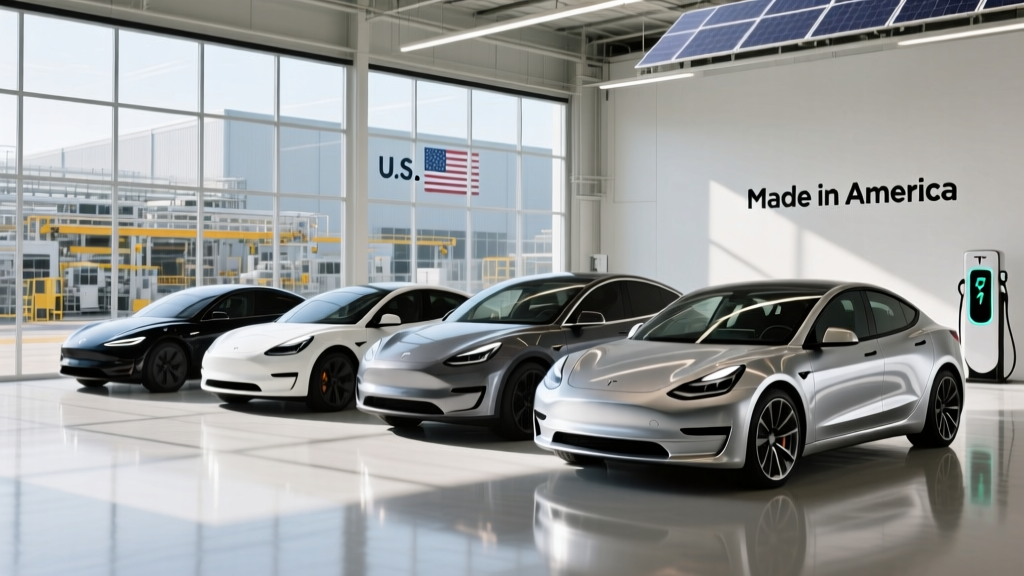
Every Tesla sold in the U.S. market is assembled domestically. The Fremont factory — a former GM-Toyota joint venture facility that Tesla acquired in 2010 — remains the backbone of sedan and SUV production. Giga Texas, which opened in 2022, handles Model Y output and is the exclusive home of the Cybertruck. Tesla's vehicles consistently rank at or near the top of the annual Cars.com American-Made Index, which weighs assembly location, parts sourcing, and engine/transmission origin.
However, "assembled in America" does not automatically mean every component is domestically sourced. Battery cells, in particular, involve global supply chains that directly affect federal tax credit eligibility — a topic we will address in detail below.
2026 Tesla Lineup: Range, Battery, and Charging at a Glance
Below is the full specification breakdown for every current Tesla model available to U.S. buyers. All range figures are EPA estimates; real-world expectations follow.
| Spec | Model 3 Long Range AWD | Model Y Long Range AWD | Model S Long Range | Model X Long Range | Cybertruck AWD |
|---|---|---|---|---|---|
| EPA Range | 363 mi | 320 mi | 402 mi | 348 mi | 340 mi |
| Battery (usable kWh) | ~79 kWh | ~78 kWh | ~100 kWh | ~100 kWh | ~123 kWh |
| Chemistry | NMC (LG) | NMC (Panasonic/LG) | NMC (Panasonic) | NMC (Panasonic) | NMC (Panasonic 4680) |
| Peak DC Fast Charge | 250 kW | 250 kW | 250 kW | 250 kW | 350 kW (est.) |
| 10–80% DC Time | ~28 min | ~28 min | ~35 min | ~35 min | ~22 min |
| Level 2 Home (kW) | 11.5 kW | 11.5 kW | 11.5 kW | 11.5 kW | 11.5 kW |
| 0–60 mph | 4.2 sec | 4.8 sec | 3.1 sec | 3.8 sec | 3.9 sec |
| Horsepower | 346 hp | 384 hp | 670 hp | 670 hp | 600 hp |
| Drivetrain | Dual-Motor AWD | Dual-Motor AWD | Dual-Motor AWD | Dual-Motor AWD | Dual-Motor AWD |
| Efficiency (MPGe) | 134 MPGe | 123 MPGe | 124 MPGe | 116 MPGe | 77 MPGe |
| kWh/100 mi | 25 | 28 | 27 | 29 | 48 |
| Base MSRP | $47,740 | $48,630 | $79,990 | $84,990 | $79,990 |
| Battery Warranty | 8 yr / 120k mi | 8 yr / 120k mi | 8 yr / 150k mi | 8 yr / 150k mi | 8 yr / 120k mi |
Note: The base Model 3 RWD uses a ~60 kWh LFP (lithium iron phosphate) battery from CATL. LFP cells offer longer cycle life and tolerate routine 100% charging, but carry lower energy density and reduced cold-weather range. The RWD Model 3 achieves an EPA 272 mi range at a lower $39,990 MSRP.
Real-World Range: What the EPA Sticker Does Not Tell You
- EPA sticker: 320 miles
- Real-world highway (75 mph, 70°F): ~270–285 miles
- Real-world city/mixed (moderate climate): ~290–310 miles
- Cold-weather mixed (20°F, heater on): ~220–255 miles
Tesla's thermal management system — which includes a heat pump on all current models — is among the best in the industry at mitigating cold-weather losses. Preconditioning the battery while plugged in (using grid power to warm the pack before departure) preserves range and significantly improves DC fast-charge speeds in cold conditions. If you charge at home and precondition before your commute, you will consistently hit the upper end of real-world expectations.
The Cybertruck's relatively low MPGe (77 combined) and high kWh/100mi consumption (48) reflect its mass, frontal area, and all-terrain tires. On a highway trip at 75 mph, expect closer to 240–260 miles of real range from its 340-mile EPA figure. For towing, plan for range reductions of 40–50%.
Charging Speed and Infrastructure: Tesla's Enduring Advantage
Charging speed is defined by two numbers: the vehicle's peak acceptance rate (in kW, a measure of power) and the shape of its charging curve. Peak kW is not sustained throughout the session — as the battery fills, the rate tapers to protect cell health. Here is how Tesla's charging speeds translate to real sessions:
| Charging Level | Power / Rate | Typical Miles Added per Hour | Use Case |
|---|---|---|---|
| Level 1 (120V household) | ~1.2 kW | 3–5 mi/hr | Overnight top-up, emergency |
| Level 2 (240V home, 48A) | 11.5 kW | 35–44 mi/hr | Daily home charging |
| DC Fast (V3 Supercharger) | Up to 250 kW peak | ~170 mi in 15 min (Model 3) | Road trips, public charging |
| DC Fast (V4 Supercharger) | Up to 350 kW peak | ~200+ mi in 15 min (Cybertruck) | Next-gen high-speed corridors |
The Tesla Supercharger network now exceeds 6,500 U.S. stations with over 60,000 individual stalls. Since 2024, Tesla has opened portions of the network to non-Tesla EVs via the NACS (North American Charging Standard) connector, but Tesla owners still benefit from seamless plug-and-charge integration, automatic routing through the navigation system, and the highest reliability rates among public networks (typically 97%+ uptime versus 70–80% for many CCS networks).
On a V3 Supercharger, a Model 3 Long Range will accept up to 250 kW between roughly 10–30% state of charge, then taper progressively. The 10–80% session takes approximately 28 minutes. Above 80%, charging slows dramatically — a 90–100% top-off can add another 20+ minutes. For road trips, plan stops around 10–80% to maximize time efficiency.
For home charging, Tesla's Wall Connector ($475) delivers up to 11.5 kW on a 60-amp circuit (48 amps continuous). Most owners with a 200-amp electrical panel can accommodate this with a standard electrician install ranging from $500 to $2,000 depending on panel proximity and conduit runs. A full 11.5 kW charge replenishes a Model Y Long Range from 10% to 100% in roughly 6.5 hours — ideal for overnight charging.
Federal Tax Credit Eligibility: The Battery-Sourcing Catch
This is where the "American-made" question becomes financially consequential. Under the current IRS §30D clean vehicle credit, a qualifying buyer can receive up to $7,500 — split into two halves of $3,750 each:
- $3,750 — Battery components: Must be manufactured or assembled in North America (phasing percentages increase annually)
- $3,750 — Critical minerals: Must be sourced from the U.S. or a free-trade-agreement country
Additional eligibility requirements include:
- MSRP cap: Sedans/wagons ≤ $55,000; SUVs/pickups ≤ $80,000
- Buyer AGI cap: $300k joint / $225k head of household / $150k individual
- Assembly: Final assembly in North America (all U.S.-sold Teslas qualify)
- Battery sourcing: Must meet escalating critical-mineral and component thresholds
- Transfer: Credit can be transferred to the dealer at point of sale for an immediate price reduction
| 2026 Tesla Model | Base MSRP | Under MSRP Cap? | Est. Federal Credit | Effective Price (est.) |
|---|---|---|---|---|
| Model 3 RWD | $39,990 | Yes (sedan ≤ $55k) | Up to $7,500* | ~$32,490 |
| Model 3 Long Range AWD | $47,740 | Yes (sedan ≤ $55k) | Up to $7,500* | ~$40,240 |
| Model Y Long Range AWD | $48,630 | Yes (SUV ≤ $80k) | Up to $7,500* | ~$41,130 |
| Model S Long Range | $79,990 | No (sedan > $55k) | $0 | $79,990 |
| Model X Long Range | $84,990 | No (SUV > $80k) | $0 | $84,990 |
| Cybertruck AWD | $79,990 | Yes (pickup ≤ $80k) | Up to $7,500* | ~$72,490 |
*Credit amount depends on the buyer's income, the specific battery pack's sourcing compliance in the purchase year, and any updates to IRS rules. The Model 3 RWD's CATL-sourced LFP battery has faced scrutiny under critical-mineral rules — verify current-year eligibility at purchase. Tesla's Panasonic-built NMC cells at the Nevada Gigafactory have historically qualified for the full credit.
Performance, Tech, and Daily Livability
Tesla's powertrain engineering remains a benchmark. The Model S Plaid (not listed above; $89,990 MSRP, ineligible for the credit) delivers 1,020 hp and a 1.99-second 0–60 mph time — figures that were exotic-supercar territory five years ago. But for most buyers, the Long Range AWD variants offer the best balance of performance and practicality.
Interior Space and Cargo
| Model | Front Legroom | Rear Legroom | Cargo (rear seats up) | Cargo (rear seats folded) |
|---|---|---|---|---|
| Model 3 | 42.7 in | 35.2 in | 23 cu ft (trunk + frunk) | N/A (sedan) |
| Model Y | 41.8 in | 37.3 in | 30 cu ft | 72 cu ft |
| Model S | 42.7 in | 35.4 in | 28 cu ft | ~65 cu ft |
| Model X | 41.2 in | 38.4 in | ~15 cu ft (behind 3rd row) | ~88 cu ft |
| Cybertruck | 41.0 in (est.) | 38.0 in (est.) | ~34 cu ft (bed, tonneau closed) | N/A (truck bed) |
The Model Y's hatchback design and available third-row seat (for small children) make it the most versatile Tesla for families. The Model 3, refreshed with the "Highland" update, offers improved cabin materials, ventilated front seats, and rear-seat ventilation — addressing longstanding complaints about minimalist austerity.
Standout Technology
- Infotainment: 15.4-inch center touchscreen with integrated navigation, streaming, gaming, and over-the-air updates. No Apple CarPlay or Android Auto — Tesla's native system is the only option.
- Autopilot (standard): SAE Level 2 driver-assist with adaptive cruise control and lane centering. The driver must remain engaged at all times.
- Full Self-Driving Supervised ($8,000 option): Enhanced Level 2 system with automatic lane changes, traffic-light recognition, and navigation-on-autopilot. Despite the name, this is not autonomous driving — continuous supervision is required.
- Sentry Mode / Dashcam: Continuous multi-camera recording when parked or driving, with cloud-accessible clips.
- Supercharger integration: Navigation automatically routes through Superchargers, preconditions the battery for optimal charge speed, and estimates arrival state of charge.
Notable Drawbacks
- No Apple CarPlay or Android Auto — a dealbreaker for some smartphone-dependent buyers
- Minimalist interior lacks physical controls for climate, mirrors, and glovebox (all screen-operated)
- Panel-gap consistency and paint quality have improved but still draw complaints relative to German luxury competitors
- Insurance costs are above segment average due to repair costs and Tesla's proprietary body structure
- Cybertruck's stainless-steel exoskeleton limits repair options to Tesla-approved body shops
Pros and Cons: The Honest Summary
- Best-in-class Supercharger network reliability and coverage
- Industry-leading efficiency (kWh/100mi) across sedan/SUV lineup
- Over-the-air updates continuously add features post-purchase
- All U.S.-sold models assembled domestically
- Strong resale value relative to most EV competitors
- Heat pump standard on all models (cold-weather advantage)
- No smartphone integration (CarPlay/Android Auto)
- Model S/X priced above federal tax credit caps
- Build quality inconsistencies still reported by some owners
- FSD costs $8,000 and remains Level 2 (not autonomous)
- Cybertruck efficiency is poor; real-world towing range is limited
- Service center wait times can be long in high-density markets
Who Should Buy a Tesla in 2026?
- You road-trip frequently and want the most reliable, widespread DC fast-charging network
- You value efficiency — Tesla's kWh/100mi figures save real money over the vehicle's life
- You want a vehicle assembled in the U.S. with a strong likelihood of qualifying for the full $7,500 credit (Model 3, Model Y, Cybertruck)
- You prefer over-the-air feature updates and a software-first ownership experience
- You are a commuter or small family prioritizing low running costs over traditional luxury finishes
- You require Apple CarPlay/Android Auto or prefer physical buttons and knobs
- You want a luxury sedan experience with traditional dealer service (consider BMW i5, Mercedes EQE)
- You need a 300+ mile real-world highway range while towing (no current EV excels here; consider a PHEV truck)
- You are uncomfortable with Tesla's screen-dependent controls and minimalist cabin
Frequently Asked Questions
Is Tesla an American car?
Yes, for practical and legal purposes. Tesla is a U.S.-headquartered company, and every vehicle sold in the American market is assembled at the Fremont, California, or Austin, Texas factory. Tesla consistently ranks at the top of independent "American-made" vehicle indexes. However, some battery cells and raw materials are globally sourced, which can affect federal tax credit eligibility depending on the model year and specific battery pack.
What is the real-world range of the Tesla Model Y?
The 2026 Model Y Long Range AWD carries an EPA estimate of 320 miles. In real-world mixed driving at moderate temperatures, expect 290–310 miles. Sustained highway driving at 75 mph reduces this to roughly 270–285 miles, and cold weather (below freezing) can drop range to 220–255 miles. Preconditioning while plugged in helps mitigate cold-weather losses.
How fast does a Tesla charge at home and on the road?
At home on a Level 2 Tesla Wall Connector (11.5 kW / 48A), all current Teslas add roughly 35–44 miles of range per hour, fully recharging overnight. On a V3 Supercharger (250 kW peak), a Model 3 or Model Y charges from 10–80% in approximately 28 minutes. The Cybertruck, with its larger pack and higher acceptance rate, can utilize V4 Superchargers at up to 350 kW for a 10–80% charge in roughly 22 minutes.
Does the Tesla Model Y qualify for the $7,500 federal tax credit?
The Model Y Long Range AWD ($48,630 MSRP) falls well under the $80,000 SUV MSRP cap and is assembled in the U.S., satisfying the assembly requirement. Whether it qualifies for the full $7,500 depends on the buyer's adjusted gross income (must be under $300k joint / $150k individual) and the specific battery pack's compliance with critical-mineral and component-sourcing rules for the purchase year. The credit can be transferred to Tesla at point of sale for an immediate price reduction. Verify current eligibility at fueleconomy.gov.
Is a Tesla worth buying versus key competitors like the Hyundai Ioniq 5 or Ford Mustang Mach-E?
Tesla's advantages are efficiency, Supercharger network access, and software integration. The Ioniq 5 charges faster on paper (800V architecture, 10–80% in ~18 minutes at a 350 kW charger) and offers Apple CarPlay, but its public charging network experience is less consistent. The Mach-E offers a more traditional interior and strong driving dynamics. If road-trip charging reliability and lowest cost-per-mile are your top priorities, Tesla remains the strongest choice. If you value interior material quality, smartphone integration, or prefer a non-Tesla brand, the competitors are compelling alternatives.
How long will a Tesla battery last?
Tesla warrants its Long Range and Performance batteries for 8 years or 120,000–150,000 miles (depending on model), whichever comes first, with a minimum 70% capacity retention threshold. Real-world data from high-mileage owners and fleet studies suggest NMC Tesla packs typically retain 85–90% capacity at 100,000 miles. LFP packs (Model 3 RWD) show even slower degradation and tolerate routine 100% charging. Full battery replacement, if ever needed outside warranty, currently ranges from approximately $12,000 to $20,000 depending on the model.