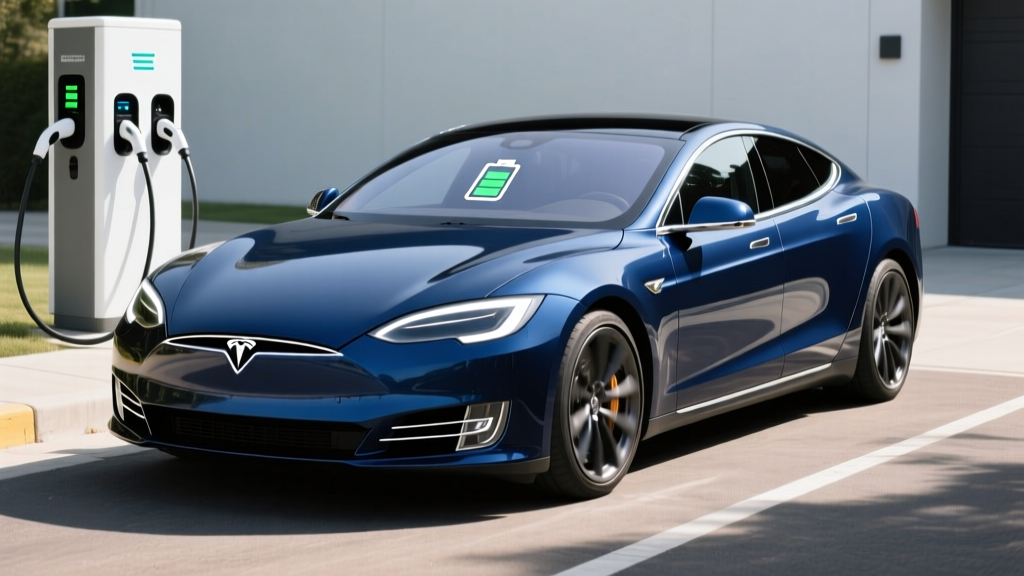
If you're shopping for an electric vehicle in a region that sees rain, snow, or steep grades, you've likely typed "is Tesla all wheel drive" into a search bar. The short answer: yes, Tesla offers all-wheel drive across its entire 2026 lineup, but not every trim comes with it. Tesla's dual-motor AWD system is one of the most widely deployed electric AWD platforms on the road, using independent front and rear motors controlled by software rather than a mechanical driveshaft.
This guide walks through every current Tesla model with AWD, covering real-world range, DC fast-charging speed, battery chemistry, pricing after federal tax credits, and how these vehicles compare against key AWD competitors from Hyundai, Ford, and BMW.
How Tesla's Dual-Motor All-Wheel Drive Works
Unlike a traditional internal-combustion AWD system that uses a transfer case and driveshaft to split torque, Tesla's AWD relies on two physically separate electric motors — one driving the front axle, one driving the rear. Digital torque control happens in milliseconds, adjusting power to each axle based on traction demand. There are no clutches, viscous couplings, or center differentials to maintain.
This architecture delivers three practical advantages:
- Traction response: Torque vectoring occurs in under 10 milliseconds — faster than any mechanical system can react.
- Efficiency: On dry pavement, the front motor (on Long Range trims) can disconnect entirely to reduce drag, operating as a rear-wheel-drive vehicle for better highway efficiency.
- Redundancy: If one motor fails, the vehicle can still drive on the other — a safety benefit no single-motor EV can match.
In Performance trims, Tesla uses a permanent-magnet synchronous reluctance motor up front and a higher-output induction or permanent-magnet motor in the rear, optimizing for both efficiency at cruise and peak power during hard acceleration.
2026 Tesla AWD Models: Full Spec Breakdown
Every Tesla model sold in 2026 is available with dual-motor AWD. Below is a side-by-side comparison of the core specifications that matter to buyers.
| Spec | Model 3 Long Range AWD | Model Y Long Range AWD | Model S AWD | Model X AWD | Cybertruck AWD |
|---|---|---|---|---|---|
| EPA Range | 341 mi | 320 mi | 402 mi | 335 mi | 340 mi |
| Battery (usable) | ~75 kWh (NMC) | ~75 kWh (NMC) | ~95 kWh (NMC) | ~95 kWh (NMC) | ~123 kWh (NMC) |
| Horsepower | ~384 hp | ~384 hp | ~670 hp | ~670 hp | ~600 hp |
| 0–60 mph | 4.2 sec | 4.8 sec | 3.1 sec | 3.8 sec | 3.9 sec |
| Peak DC Charge | 250 kW | 250 kW | 250 kW | 250 kW | 250 kW (800V arch) |
| 10–80% DC Time | ~28 min | ~28 min | ~33 min | ~33 min | ~25 min |
| Level 2 Rate | 11.5 kW (~44 mi/hr) | 11.5 kW (~44 mi/hr) | 11.5 kW (~44 mi/hr) | 11.5 kW (~44 mi/hr) | 11.5 kW (~44 mi/hr) |
| MPGe (combined) | 131 MPGe | 122 MPGe | 120 MPGe | 105 MPGe | ~75 MPGe |
| Cargo Volume | 23 cu ft (rear) | 76 cu ft (rear folded) | 28 cu ft (rear) | 88 cu ft (rear folded) | 67 cu ft (bed + vault) |
| Base MSRP | $47,740 | $52,490 | $79,990 | $84,990 | $79,990 |
| Battery Warranty | 8 yr / 120,000 mi | 8 yr / 120,000 mi | 8 yr / 150,000 mi | 8 yr / 150,000 mi | 8 yr / 120,000 mi |
Sources: fueleconomy.gov, Tesla.com. Pricing reflects base MSRP before destination; specs subject to mid-year updates.
Real-World Range: What the EPA Sticker Doesn't Tell You
EPA estimates assume a mix of city and highway driving at moderate temperatures. Here's what to actually expect:
Model 3 LR AWD: EPA 341 mi → Expect ~280–300 mi highway at 75 mph; ~220–250 mi in sub-30°F weather.
Model Y LR AWD: EPA 320 mi → Expect ~260–280 mi highway; ~210–240 mi in cold weather.
Model S AWD: EPA 402 mi → Expect ~330–360 mi highway; ~270–310 mi in cold weather.
Model X AWD: EPA 335 mi → Expect ~270–295 mi highway; ~220–250 mi in cold weather.
Cybertruck AWD: EPA 340 mi → Expect ~260–290 mi highway (high drag coefficient); ~210–240 mi towing.
The dual-motor AWD system adds ~10–20 mi of range loss vs. single-motor RWD variants due to the second motor's weight and drag, though Tesla's front-motor disconnect partially mitigates this on Long Range trims.
Cold weather hits all EVs hard, but Tesla's heat pump (standard on all 2026 models) recovers waste heat from the drivetrain to warm the cabin, reducing the typical 30–40% winter range loss seen in older EVs to roughly 20–30%. Preconditioning the battery while plugged in — a feature accessible through the Tesla app — is essential for preserving range and enabling peak DC charging speeds in cold temperatures.
Charging Speed: DC Fast Charge and Home Level 2
Tesla's Supercharger network remains the most reliable DC fast-charging ecosystem in North America, and every 2026 Tesla uses the NACS (North American Charging Standard) connector natively. Here's how charging breaks down by level:
| Charging Level | Power | Miles Added per Hour | Typical Use Case |
|---|---|---|---|
| Level 1 (120V) | ~1.4 kW | ~5 mi/hr | Emergency / overnight trickle |
| Level 2 (240V, 48A) | 11.5 kW | ~44 mi/hr | Home daily charging (Wall Connector) |
| DC Fast (V3 Supercharger) | Peak 250 kW | ~200 mi in 15 min | Road trips, public charging |
| DC Fast (V4 Supercharger) | Peak 250–350 kW* | ~250 mi in 15 min* | Newer corridor stations |
*V4 Supercharger peak speeds depend on vehicle architecture; Cybertruck's 800V system can accept higher sustained rates. Model 3/Y peak at 250 kW on V3 and V4 posts.
A critical nuance many buyers miss: peak kW is not sustained kW. A Model 3 Long Range AWD hitting a V3 Supercharger at 10% State of Charge may briefly pull 250 kW, but the charge curve tapers significantly above 50% SoC. The 10–80% time of ~28 minutes reflects this taper. Charging from 80–100% can add another 25–30 minutes — plan your road-trip stops around the 10–80% window for efficiency.
For home charging, the Tesla Wall Connector at 48 amps on a 60-amp circuit delivers 11.5 kW — enough to fully recharge a Model 3 LR from empty overnight in roughly 7 hours. Installation typically costs $500–$2,000 depending on panel proximity and whether your home's electrical panel requires an upgrade from 100A to 200A service.
Pricing and Federal Tax Credit Eligibility
Tesla's AWD lineup spans a wide price range, and the IRS §30D federal tax credit (up to $7,500) has strict eligibility rules that vary by model and buyer. Here's the current landscape:
| Model | Base MSRP | As-Tested (typical) | §30D Eligible? | Effective Price (w/ max credit) |
|---|---|---|---|---|
| Model 3 LR AWD | $47,740 | $50,240 | Yes — meets MSRP, income, and sourcing caps | ~$40,240 |
| Model Y LR AWD | $52,490 | $55,990 | Yes — qualifies under SUV MSRP cap ($80K) | ~$44,990 |
| Model S AWD | $79,990 | $89,990 | No — exceeds $55K sedan MSRP cap | $79,990+ |
| Model X AWD | $84,990 | $94,990 | No — exceeds $80K SUV cap on most configs | $84,990+ |
| Cybertruck AWD | $79,990 | $99,990 | Likely no — exceeds $80K truck cap | $79,990+ |
- MSRP caps: $55,000 for sedans (Model 3); $80,000 for SUVs/trucks (Model Y, Cybertruck)
- Buyer income caps: AGI ≤ $150K single / $225K head of household / $300K joint
- Battery sourcing: Critical minerals and battery components must meet phased-in domestic/free-trade thresholds — Tesla's US-built batteries generally qualify, but verify at fueleconomy.gov
- Point-of-sale transfer: You can apply the credit as a down-payment reduction at purchase rather than waiting for tax filing
Tech, Safety, and Driver Assistance
Every 2026 Tesla AWD model ships with Basic Autopilot (adaptive cruise control + lane centering), which is an SAE Level 2 driver-assistance system — not self-driving. You must keep your hands on the wheel and eyes on the road at all times.
Tesla Autopilot and Full Self-Driving (Supervised) are not autonomous. The driver is fully responsible for vehicle operation. FSD (Supervised) adds automated lane changes, traffic-light recognition, and city-street navigation, but still requires continuous driver supervision. Only Level 4 systems (e.g., Waymo robotaxis in geofenced areas) operate without a human driver.
Key tech features across the AWD lineup:
- 15.4" center touchscreen (Model 3/Y) or 17" touchscreen (Model S/X) with integrated navigation, streaming, and vehicle controls
- Over-the-air updates that regularly add features and refine driving dynamics
- Sentry Mode — 360° camera-based parking surveillance
- HEPA air filtration (Model S/X/Y) with Bioweapon Defense Mode
- Towing: Model Y (3,500 lbs), Model X (5,000 lbs), Cybertruck (11,000 lbs)
Safety ratings remain strong. The Model 3 and Model Y earned IIHS Top Safety Pick+ designations, and NHTSA has awarded 5-star overall ratings across the Tesla sedan and SUV lineup.
Tesla AWD vs. Key Competitors
If you need AWD but aren't committed to Tesla, here's how the top competitors stack up:
| Attribute | Tesla Model Y LR AWD | Hyundai Ioniq 5 AWD | Ford Mustang Mach-E AWD | BMW iX xDrive50 |
|---|---|---|---|---|
| EPA Range | 320 mi | 290 mi | 305 mi | 324 mi |
| Peak DC Charge | 250 kW | 240 kW | 150 kW | 200 kW |
| 10–80% Time | ~28 min | ~18 min (800V) | ~38 min | ~31 min |
| Base MSRP | $52,490 | $52,200 | $48,995 | $87,250 |
| §30D Credit | Yes | Partial* | Yes | No (MSRP cap) |
| Connector | NACS (native) | CCS1 (NACS adapter) | NACS (2025+) | CCS1 |
*Ioniq 5 eligibility varies by battery sourcing — verify on fueleconomy.gov.
The Ioniq 5's 800V architecture gives it a faster 10–80% charge time than the Model Y, but Tesla's Supercharger network reliability and the Model Y's cargo space (76 cu ft) tip the balance for many family buyers. The Mach-E offers a lower entry price but slower DC charging. The BMW iX delivers luxury refinement but at nearly double the cost and without credit eligibility.
Pros, Cons, and Who Should Buy
- Best-in-class Supercharger network with 50,000+ stalls globally
- Industry-leading efficiency (kWh/mi) in AWD class
- OTA updates continuously improve the vehicle post-purchase
- Strong resale value relative to non-Tesla EVs
- Heat pump standard — excellent cold-weather range retention
- Minimalist interior lacks physical controls (climate, mirrors adjusted via screen)
- FSD (Supervised) costs $8,000 extra and remains Level 2
- Panel gap and paint quality inconsistencies persist on some builds
- Service center wait times can stretch weeks in high-demand metro areas
- No Apple CarPlay / Android Auto — Tesla's proprietary OS only
- Commuters in snow-belt states: Model 3 LR AWD offers the best efficiency-to-traction ratio at ~$40K after credit.
- Families needing cargo space: Model Y LR AWD's 76 cu ft with seats folded and available 7-seat config make it the default family EV.
- Road-trippers: Model S AWD's 402-mi EPA range and Supercharger access minimize stops on cross-country drives.
- Truck buyers with towing needs: Cybertruck AWD's 11,000-lb capacity and 800V charging architecture serve heavy-duty use cases — but skip it if you need the tax credit.
Frequently Asked Questions
Is every Tesla all wheel drive?
No. Tesla offers both rear-wheel-drive (single motor) and all-wheel-drive (dual motor) configurations. The base Model 3 and Model Y are available as RWD. The Model S and Model X come exclusively as dual-motor AWD in 2026. The Cybertruck is available in single-motor RWD (base) and dual-motor/tri-motor AWD configurations.
Does Tesla AWD use a traditional driveshaft?
No. Tesla's AWD is fully electric — there is no mechanical connection between the front and rear axles. Two independent motors, one per axle, are controlled by software that adjusts torque distribution in milliseconds.
How much range do you lose with AWD vs. RWD?
Typically 10–20 miles of EPA range compared to an equivalent RWD trim, due to added weight (~100–150 lbs for the second motor) and minor drivetrain drag. Tesla's front-motor disconnect feature on Long Range models partially recovers this during highway cruising.
Is Tesla AWD good in snow?
Yes. The dual-motor system provides excellent traction in snow and ice, and the low center of gravity (battery pack under the floor) reduces rollover risk. Pair AWD with dedicated winter tires for optimal performance — all-season tires significantly reduce snow traction regardless of drivetrain.
Does the Tesla Model 3 AWD qualify for the $7,500 tax credit?
The Model 3 Long Range AWD qualifies for the full $7,500 §30D credit as of 2026, provided the buyer meets income caps (≤$150K single / $300K joint) and the vehicle's battery sourcing meets critical-mineral thresholds. The credit can be transferred at point of sale as a price reduction. Always verify current status at IRS.gov and fueleconomy.gov.
Can I charge a Tesla AWD at non-Tesla chargers?
Yes. All 2026 Teslas use the NACS connector. With the growing adoption of NACS by Electrify America, EVgo, and other networks, plus Tesla's own CCS adapter (included with newer vehicles), you can charge at virtually any public DC fast-charging station in North America.