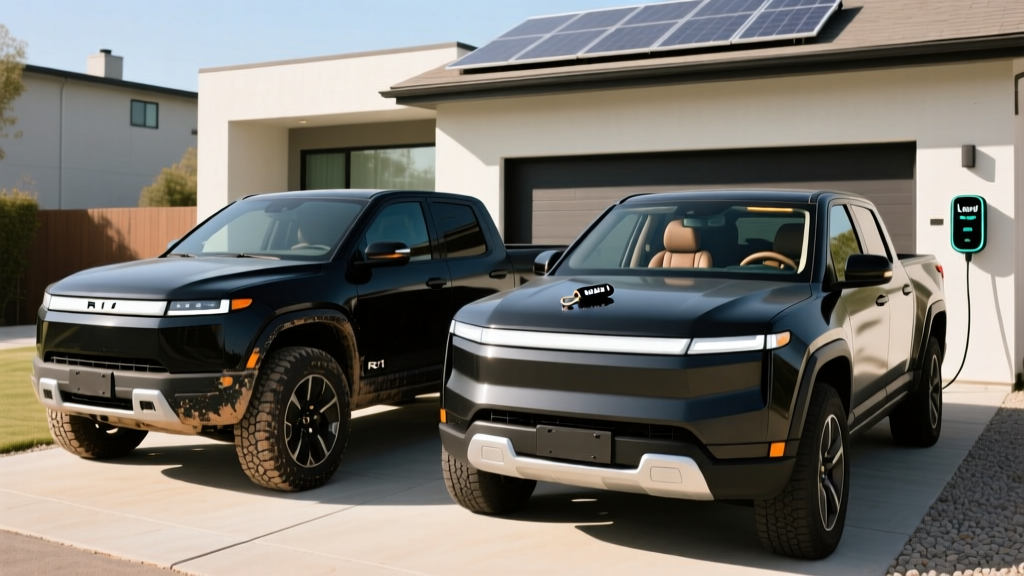
Rivian's R1T pickup and R1S SUV have been on American roads since late 2021, meaning we now have over four years of real-world ownership data to evaluate. For buyers asking "is Rivian reliable?" the answer in 2026 is nuanced: the powertrain and battery systems have proven robust, while early build-quality quirks have been largely addressed through software updates and manufacturing refinements at the Normal, Illinois assembly plant. This profile breaks down exactly what the data shows across both models.
Rivian R1T & R1S: Core Specifications at a Glance
| Spec | R1T (Dual-Motor Standard) | R1S (Dual-Motor Standard) |
|---|---|---|
| EPA Range | 334 miles (Standard Battery+) | 321 miles (Standard Battery+) |
| Battery Capacity | 92 kWh usable (LFP, Standard) / 106 kWh (NMC, Max) | 92 kWh usable (LFP, Standard) / 106 kWh (NMC, Max) |
| Drivetrain | Dual-Motor AWD / Tri-Motor AWD / Quad-Motor AWD | Dual-Motor AWD / Tri-Motor AWD / Quad-Motor AWD |
| Horsepower | 533 hp (Dual) / 850 hp (Tri) / 1,025 hp (Quad) | 533 hp (Dual) / 850 hp (Tri) / 1,025 hp (Quad) |
| 0–60 mph | 4.5s (Dual) / 3.0s (Tri) / 2.5s (Quad) | 4.6s (Dual) / 3.2s (Tri) / 2.6s (Quad) |
| Max DC Fast Charge | 220 kW peak | 220 kW peak |
| 10–80% DC Charge Time | ~21 minutes | ~21 minutes |
| Level 2 Home Charging | 11.5 kW (~25 mi/hr) | 11.5 kW (~25 mi/hr) |
| MPGe (Combined) | 73 MPGe (Dual-Motor Standard) | 69 MPGe (Dual-Motor Standard) |
| Efficiency | 46 kWh/100 mi | 49 kWh/100 mi |
| Towing Capacity | 11,000 lbs | 7,700 lbs |
| Cargo (Bed / Behind 3rd Row) | 54 cu ft bed + 11 cu ft frunk | 104 cu ft max (seats folded) + 11 cu ft frunk |
| Base MSRP (2026) | $69,900 (Dual-Motor Standard) | $74,900 (Dual-Motor Standard) |
| Battery Warranty | 8 years / 120,000 miles | 8 years / 120,000 miles |
| Bumper-to-Bumper | 5 years / 60,000 miles | 5 years / 60,000 miles |
Real-World Range: What EPA Numbers Don't Tell You
Rivian's 2026 Standard Battery+ pack uses LFP (lithium iron phosphate) chemistry in the base configuration, which trades some energy density for superior cycle life and thermal stability. The Max Battery option retains NMC chemistry for maximum range. LFP packs can be charged to 100% daily without accelerated degradation concerns — a significant practical advantage for commuters who want full range available every morning.
For the Max Battery (106 kWh, NMC), the R1T achieves an EPA-estimated 420 miles, but real-world highway driving typically yields 340–370 miles. Towing is the biggest range killer: expect a 40–50% reduction when pulling a 5,000+ lb trailer at highway speeds, bringing effective range to 170–200 miles between charges. This is physics, not a Rivian flaw — every EV truck behaves similarly under tow.
Charging Speed: DC Fast Charging and Home Setup
| Charging Level | Power | Speed (Miles/Hour) | Notes |
|---|---|---|---|
| Level 1 (120V) | 1.4 kW | ~3 mi/hr | Emergency/trickle only; 100+ hrs for full charge |
| Level 2 (240V, 48A) | 11.5 kW | ~25 mi/hr | Full charge in ~9–10 hrs; ideal overnight home charging |
| DC Fast Charge (Standard Battery) | 220 kW peak | ~140 mi in 20 min | 10–80% in ~21 min; tapers significantly above 80% |
| DC Fast Charge (Max Battery) | 220 kW peak | ~150 mi in 20 min | 10–80% in ~24 min; larger pack sustains peak longer |
Rivian's 2026 models use the NACS (Tesla-style) charge port natively, granting seamless access to Tesla Supercharger V3 and V4 stations without an adapter. This was a pivotal shift from the CCS1 port on 2022–2024 models. The charge curve peaks at 220 kW between roughly 15–40% State of Charge, then steps down through the curve. Above 80%, charging slows to under 50 kW to protect battery longevity — plan your road-trip stops to 10–80% for optimal time efficiency.
For home Level 2 charging, Rivian's Wall Charger delivers up to 11.5 kW on a 60-amp circuit (48 amps continuous). Expect a full overnight replenishment. Installation typically costs $800–$2,500 depending on panel proximity and whether your home's electrical panel needs a 200-amp upgrade — a common requirement in older homes. Always consult a licensed electrician for final specs.
Reliability Data: What 4+ Years of Ownership Reveals
The question "is Rivian reliable?" deserves a segmented answer based on what the data actually shows across model years:
Powertrain and Battery: Strong Track Record
Rivian's battery packs and drive units have demonstrated low failure rates. The company's 8-year/120,000-mile battery warranty (covering degradation below 70% State of Health) has been honored without significant owner dispute. LFP chemistry in the Standard pack is expected to outlast the vehicle itself, with projected cycle life exceeding 3,000 full cycles before meaningful degradation. NMC packs in the Max Battery configuration show approximately 5–7% degradation at 60,000 miles based on owner-reported data — well within warranty thresholds.
Build Quality: Year-Over-Year Improvement
Early 2022–2023 production vehicles reported issues with panel gap inconsistencies, wind noise around the A-pillar, and occasional 12V auxiliary battery drain. By the 2025–2026 model years, Rivian's manufacturing maturity has measurably improved. Panel gaps are tighter, the gear tunnel seals better, and the software-defined vehicle architecture has stabilized through dozens of OTA (over-the-air) updates.
Software and Electronics: The Real Frontier
As a software-defined vehicle, Rivian's most common owner complaints center on infotainment glitches, phantom Bluetooth disconnections, and occasional sensor calibration drift in the ADAS suite. These are typically resolved via OTA patches rather than service center visits. Rivian's Driver+ system (a Level 2 driver-assist feature per SAE classification) has improved substantially but still requires active driver supervision — it is not self-driving.
Service Network: Growing but Still Limited
Rivian operates a mix of company-owned service centers and mobile service vans. As of 2026, there are approximately 55 service centers and 200+ mobile service vehicles nationwide. Owners in rural areas may face longer wait times for parts or in-person diagnostics. Mobile service handles roughly 70% of routine maintenance and minor repairs — a genuine advantage over traditional dealer-dependent brands.
Pricing, Trims, and Federal Tax Credit Eligibility
| Trim / Configuration | 2026 MSRP | Est. After §30D Credit | Credit Eligible? |
|---|---|---|---|
| R1T Dual-Motor Standard Battery | $69,900 | ~$62,400 (if eligible) | Subject to sourcing rules |
| R1T Dual-Motor Max Battery | $82,900 | ~$75,400 (if eligible) | Subject to sourcing rules |
| R1T Tri-Motor | $99,900 | ~$92,400 (if eligible) | Subject to sourcing rules |
| R1S Dual-Motor Standard Battery | $74,900 | ~$67,400 (if eligible) | Subject to sourcing rules |
| R1S Dual-Motor Max Battery | $87,900 | ~$80,400 (if eligible) | Subject to sourcing rules |
| R1S Tri-Motor | $104,900 | ~$97,400 (if eligible) | Subject to sourcing rules |
Critical tax credit context: The IRS §30D federal tax credit provides up to $7,500 for qualifying new EVs, but eligibility hinges on three factors that change frequently: (1) MSRP caps — trucks/vans/SUVs must be under $80,000, meaning R1T Dual-Motor Standard qualifies but Max Battery and Tri-Motor trims exceed the cap; (2) buyer income limits — $150,000 single / $300,000 joint AGI; and (3) critical mineral and battery component sourcing requirements that phase in annually. Rivian's North American assembly helps, but specific battery cell sourcing determines whether the full $7,500, partial $3,750, or no credit applies. The credit can be transferred to the dealer as a point-of-sale discount. Always verify current eligibility on fueleconomy.gov before purchasing — rules shift annually.
Who Should Buy a Rivian — and Who Shouldn't
- Class-leading combination of utility, performance, and EV efficiency
- LFP battery option enables daily 100% charging without degradation worry
- NACS port provides native Supercharger access — no adapter hassle
- Software-defined platform improves via regular OTA updates
- Gear tunnel (R1T) and frunk offer creative storage competitors lack
- Mobile service reduces dealer dependency for routine needs
- 11,000-lb towing capacity (R1T) exceeds most EV trucks
- Starting near $70K — premium pricing before options
- Higher trims exceed the §30D MSRP cap, eliminating tax credit
- Service center footprint still thin outside major metros
- Highway efficiency lags sedan-style EVs — 46–49 kWh/100 mi is truck physics
- Towing range reduction is severe (~50%) — plan accordingly
- Insurance premiums run 15–25% above comparable ICE trucks
- Third-row space in R1S is tight for adults on long trips
Best For
- Adventure-oriented families who need towing, off-road capability, and daily-driver practicality
- Home chargers — Rivian ownership is dramatically more convenient with a Level 2 home setup
- Tech-forward buyers who value OTA improvements and a software-first architecture
- One-vehicle households that need truck/SUV utility without a gas backup
Consider Alternatives If
- Your budget tops out below $60K — consider the Ford Maverick hybrid or used EV market
- You tow frequently over 200+ miles — no EV truck handles this gracefully without mid-trip charging
- You lack home charging access — public-only charging adds cost and time friction
- You need a third row with real adult space — the R1S third row is best for children
Rivian vs. Key Competitors: Quick Comparison
Against the Ford F-150 Lightning, the R1T offers more power, better efficiency, and NACS charging — but at a $15,000+ premium. The Lightning remains the value play for fleet and budget-conscious buyers. Against the Tesla Cybertruck, the R1T provides a more conventional (and more practical) truck bed, better build quality consistency, and a growing but less mature Supercharger-native ecosystem. The Chevrolet Silverado EV undercuts on price but trails in performance and software sophistication.
For the R1S, the competitive set includes the Kia EV9 (cheaper, less capable off-road, shorter range) and the Tesla Model X (faster charging, more Supercharger maturity, but aging platform and polarizing design). The R1S occupies a unique niche as a body-on-frame adventure SUV with genuine off-road chops.
Frequently Asked Questions
Is Rivian reliable enough for a daily driver?
Yes, for most owners. The powertrain and battery systems have proven dependable over 4+ years of real-world use. The most common issues are software-related and typically resolved via OTA updates. If you live near a Rivian service center or in a mobile-service coverage area, daily-driver reliability is strong.
What is the real-world range of the Rivian R1T?
The EPA rates the R1T Dual-Motor Standard Battery+ at 334 miles. Real-world highway driving in moderate weather yields approximately 275–295 miles. In cold weather (below 30°F), expect 230–260 miles. Towing cuts range roughly in half.
How fast does a Rivian charge at home and on the road?
At home on a Level 2 (240V, 48A) charger, the R1T and R1S add approximately 25 miles of range per hour, with a full charge taking 9–10 hours. On a DC fast charger, they peak at 220 kW and charge from 10–80% in approximately 21 minutes (Standard Battery) or 24 minutes (Max Battery).
Does the Rivian R1T qualify for the $7,500 federal EV tax credit?
It depends. The R1T Dual-Motor Standard at $69,900 is under the $80,000 MSRP cap for trucks, but the full credit depends on battery component and critical mineral sourcing requirements that tighten annually. Higher trims exceeding $80,000 MSRP are ineligible. Buyer income limits ($150K single / $300K joint) also apply. Verify current eligibility at fueleconomy.gov and consult a tax professional.
How much does it cost to maintain a Rivian?
Rivian's EV powertrain eliminates oil changes, spark plugs, and transmission fluid. Routine maintenance includes cabin air filter replacement, wiper fluid, brake fluid checks, and tire rotation. Owners report annual maintenance costs of $200–$500 — significantly less than comparable gas trucks. Tires are the largest recurring expense; EV trucks wear tires faster due to high torque and weight. Budget $800–$1,400 for a set of four all-terrain tires every 30,000–40,000 miles.
Is the Rivian battery warranty better than competitors?
Rivian offers an 8-year/120,000-mile battery warranty guaranteeing at least 70% State of Health retention. This exceeds the industry-standard 8-year/100,000-mile coverage from most competitors and reflects confidence in both LFP and NMC pack longevity.
Can Rivian handle cold weather?
Yes, with caveats. Rivian includes a heat pump on 2025+ models for efficient cabin heating, which reduces cold-weather range loss compared to resistive heaters. Expect 20–30% range reduction in sub-freezing temperatures. Preconditioning the battery while plugged in (using the Rivian app) restores charging speed and recovers some range. The battery thermal management system actively warms the pack in cold conditions.
Final Verdict: Is Rivian Worth It in 2026?
The data supports Rivian as a reliable choice for buyers who understand what they're purchasing: a premium, software-defined electric truck/SUV with genuine capability. The battery and powertrain have held up well across four model years. Build quality has measurably improved. The NACS charging standard and LFP battery option address two of the biggest practical concerns for new EV buyers.
The honest caveats: Rivian is expensive, the service network is still maturing, and higher trims price out of federal tax credit eligibility. If your use case aligns — home charging available, adventure/utility needs, budget above $65K — the R1T and R1S deliver a combination of capability and EV efficiency that no competitor fully matches in 2026. If you're budget-constrained or lack home charging, a Ford F-150 Lightning or a plug-in hybrid may serve you better today.