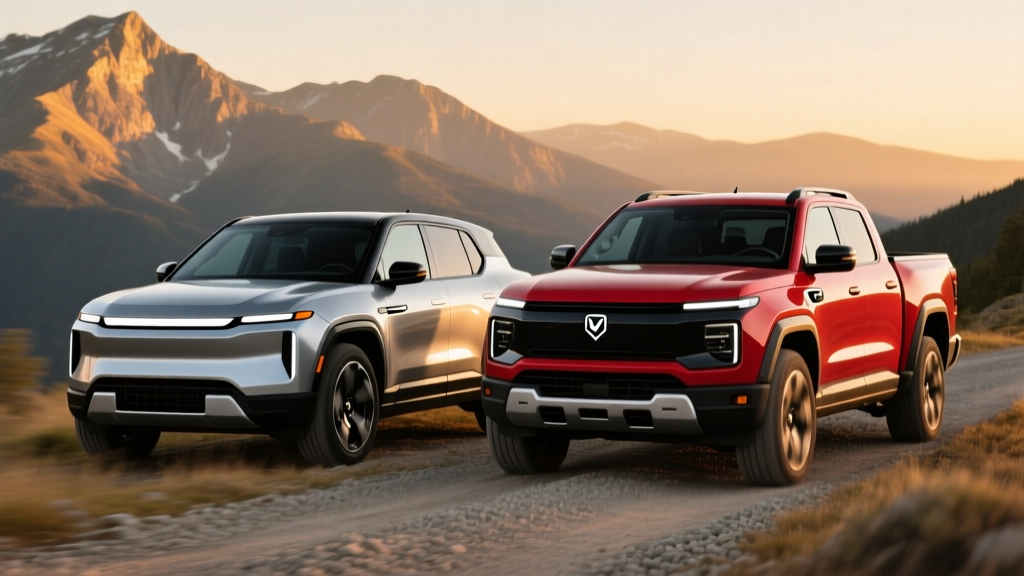
If you've been searching is Rivian an electric car, the short answer is yes — Rivian is a fully electric vehicle manufacturer, producing no gasoline or hybrid models. The Irvine, California-based automaker currently sells two vehicles in the U.S.: the R1S three-row SUV and the R1T pickup truck. Both are built on Rivian's skateboard platform and run exclusively on battery-electric powertrains.
But the real question buyers are asking isn't whether Rivian is electric — it's whether these vehicles deliver on range, charging speed, towing capability, and value in a market now crowded with competitors like the Tesla Model X, Ford F-150 Lightning, Chevrolet Silverado EV, and Hyundai Ioniq 9. Below is a data-driven profile of Rivian's 2026 lineup, with the exact numbers you need to decide.
Rivian R1S and R1T: Quick Specs at a Glance
| Spec | 2026 R1S (Dual-Motor, Standard Battery) | 2026 R1T (Dual-Motor, Standard Battery) |
|---|---|---|
| EPA Range | 270 miles | 270 miles |
| Battery (usable) | ~92 kWh (NMC) | ~92 kWh (NMC) |
| Max DC Fast Charge | 200 kW (peak) | 200 kW (peak) |
| 10–80% DCFC Time | ~30 minutes | ~30 minutes |
| Level 2 Home Charging | 11.5 kW (~25 mi/hr) | 11.5 kW (~25 mi/hr) |
| 0–60 mph | 4.5 sec (Dual-Motor) | 4.5 sec (Dual-Motor) |
| Horsepower | 533 hp (Dual-Motor) | 533 hp (Dual-Motor) |
| Drivetrain | AWD (dual-motor) | AWD (dual-motor) |
| Max Towing | 7,700 lbs | 11,000 lbs |
| MPGe (combined) | 73 MPGe | 70 MPGe |
| Base MSRP | $75,900 | $69,900 |
| Battery/Powertrain Warranty | 8 yr / 175,000 mi | 8 yr / 175,000 mi |
Note: Rivian also offers a Max Battery pack (~128 kWh, NMC) on select trims, pushing EPA range to approximately 352 miles on the R1S and 328 miles on the R1T. Tri-Motor and Quad-Motor configurations produce up to 1,025 hp and drop 0–60 times to the low 3-second range, at a significant price premium.
Real-World Range: What the EPA Sticker Doesn't Tell You
EPA Estimated Range: 270 miles (Standard Battery, Dual-Motor)
Real-World Expectation:
- Mixed city/highway (moderate climate): ~245–260 miles
- Sustained highway driving (75+ mph): ~220–240 miles
- Cold weather (below 32°F / 0°C): ~190–220 miles (15–30% reduction)
- While towing (R1T, ~5,000 lb trailer): ~130–160 miles
The R1S and R1T are heavy vehicles — curb weights exceed 6,700 lbs for the R1S and 6,900 lbs for the R1T. That mass, combined with the boxy aerodynamic profile (especially on the R1T), means efficiency drops noticeably at highway speeds. According to fueleconomy.gov, the R1S Dual-Motor Standard achieves 73 MPGe combined (46 kWh/100 mi), which is below rivals like the Tesla Model X (102 MPGe combined).
Rivian does include a heat pump across the lineup, which helps mitigate cold-weather range loss compared to resistive heating systems. Preconditioning the battery while plugged in before departure also recovers meaningful range in freezing temperatures — a feature accessible through the Rivian app.
Charging Speed: DC Fast Charging and Home Level 2
| Charging Level | Power / Rate | Speed (approx.) | Notes |
|---|---|---|---|
| Level 1 (120V household) | 1.4 kW | ~3 mi/hr | Emergency/trickle only |
| Level 2 (240V home, 48A) | 11.5 kW | ~25 mi/hr | Full charge in ~9.5 hours |
| DC Fast Charge (Standard Battery) | 200 kW peak | 10–80% in ~30 min | Tapers significantly above 80% |
| DC Fast Charge (Max Battery) | 220 kW peak | 10–80% in ~36 min | Larger battery, slightly longer |
Rivian uses the NACS (North American Charging Standard) connector on all current-production vehicles, giving native access to the Tesla Supercharger network — over 25,000 stalls in North America. This is a major practical advantage over CCS-only vehicles that rely on Electrify America or EVgo for DC fast charging.
The charge curve on the Standard Battery peaks at 200 kW between roughly 15–35% SoC, then tapers to ~120 kW by 60%, and drops below 50 kW past 85%. This is typical behavior for NMC lithium-ion packs — the battery management system protects cell longevity by reducing current as the pack fills. On a road trip, plan your stops around 10–80% charges rather than topping off to 100% unless you have time to wait.
For home charging, Rivian's Wall Charger delivers up to 11.5 kW on a 60A circuit (48A continuous). Expect a full overnight charge from near-empty. Most owners who drive 40–60 miles daily will only need to plug in every other night. Installation cost for a Level 2 home setup typically ranges from $800–$2,500 depending on panel proximity and local permit requirements.
Performance and Drivetrain
Every Rivian comes with standard all-wheel drive. The base Dual-Motor configuration uses one motor per axle, producing 533 hp and 610 lb-ft of torque. The 0–60 mph time of 4.5 seconds (R1S/R1T Dual-Motor) is quick for a vehicle of this size — for context, the Ford F-150 Lightning Extended Range does it in ~5.0 seconds.
For buyers wanting more, the Tri-Motor setup (available on Adventure and Ascend trims) adds a third motor to the rear axle, producing approximately 850 hp and dropping 0–60 to the low 3-second range. The performance-oriented Quad-Motor variant (one motor per wheel) was offered in limited early production and has been superseded by the Tri-Motor for the 2026 model year.
Off-road capability is a genuine differentiator. Rivian's air suspension provides up to 14.9 inches of ground clearance in the highest setting, and the vehicles feature tank turns (braking one side while driving the other) for tight trail maneuvers. Approach, departure, and breakover angles are competitive with body-on-frame off-roaders.
Pricing, Trims, and Federal Tax Credit Eligibility
| Trim / Config | R1S MSRP | R1T MSRP | §30D Credit Eligible? |
|---|---|---|---|
| Dual-Motor, Standard Battery (Adventure) | $75,900 | $69,900 | R1T: Yes (if under $80k cap & buyer qualifies); R1S: No (exceeds $80k SUV cap) |
| Dual-Motor, Max Battery (Adventure) | $83,400 | $77,400 | R1T: Yes (if under $80k cap); R1S: No |
| Tri-Motor (Ascend) | $105,900 | $99,900 | No (exceeds MSRP cap) |
The IRS §30D federal tax credit provides up to $7,500 for qualifying new EVs, but eligibility hinges on several factors that change frequently:
- MSRP cap: SUVs/pickups/vans must have an MSRP at or below $80,000; sedans at or below $55,000. The R1T qualifies as a pickup ($80k cap); the R1S qualifies as an SUV ($80k cap).
- Buyer income cap: Modified adjusted gross income (MAGI) must not exceed $150,000 (single), $225,000 (head of household), or $300,000 (joint filers).
- Battery sourcing: Critical minerals and battery components must meet escalating domestic-content thresholds. Verify current-year compliance on the IRS qualified vehicles list.
- Point-of-sale transfer: Eligible buyers can transfer the credit to the dealer at purchase, reducing the upfront price rather than waiting for a tax refund.
For 2026, the R1T Dual-Motor Standard Battery at $69,900 falls under the $80,000 pickup cap and may qualify for the full $7,500 credit if the buyer meets income and sourcing requirements. The R1S at $75,900 sits under the $80,000 SUV cap, so it may also qualify — but adding the Max Battery or higher trims pushes it over. Always confirm eligibility on the IRS qualified vehicles list before purchasing, as battery-sourcing compliance can change mid-year.
Cargo, Passenger Space, and Practicality
R1S (three-row SUV):
- Cargo behind 3rd row: 20.5 cu ft
- Cargo behind 2nd row (3rd row folded): 56.4 cu ft
- Max cargo (all rear rows folded): 104.7 cu ft
- Front trunk (frunk): 11.1 cu ft
- Second-row legroom: 36.5 inches
- Third-row legroom: 30.4 inches (best for children)
R1T (crew-cab pickup):
- Bed length: 54 inches (4.5 ft) — shorter than a traditional full-size truck bed
- Gear Tunnel: 11.7 cu ft of enclosed, lockable storage accessible from both sides — a signature Rivian feature
- Frunk: 11.1 cu ft
- Max payload: ~1,760 lbs
- Max towing: 11,000 lbs (best-in-class for electric pickups)
- Rear-seat legroom: 38.2 inches
The R1T's Gear Tunnel is one of the most practical innovations in the electric truck segment — ideal for storing camping gear, tools, or groceries in a sealed, illuminated compartment. However, the 54-inch bed is shorter than the F-150 Lightning's 66-inch bed, which matters if you regularly haul long lumber or plywood sheets.
Tech, Driver Assistance, and Ownership Experience
Rivian runs a vertically integrated software stack with a 15.6-inch center touchscreen, a 12.3-inch digital instrument cluster, and a companion app that handles remote preconditioning, charging management, and vehicle location. Over-the-air (OTA) updates are frequent and have meaningfully added features post-purchase (new drive modes, range improvements through software-optimized thermal management, and UI refinements).
The Rivian Driver+ suite includes adaptive cruise control, lane centering, and automatic lane changes on divided highways. This is a SAE Level 2 driver-assistance system — the driver must remain attentive with hands on the wheel at all times. It is not a self-driving or hands-free system like GM's Super Cruise or Ford's BlueCruise (which allow hands-off on mapped highways). Rivian has signaled future hands-free capability but has not yet deployed it as of the 2026 model year.
Driver Assistance Limitation: Rivian Driver+ is an SAE Level 2 system. It requires active driver supervision — hands on the steering wheel and eyes on the road. It does not navigate intersections, stoplights, or unmapped roads autonomously. It is not "self-driving."
Notable tech highlights include a built-in air compressor (accessible from the bed and a 120V/240V outlet for powering tools or camp equipment), camp kitchen accessories that integrate into the Gear Tunnel, and a pet-friendly rear cargo area with climate monitoring.
Pros, Cons, and Who Should Buy a Rivian
Pros
- Class-leading 11,000-lb towing (R1T) with integrated trailer brake controller
- NACS connector = native Tesla Supercharger access
- Exceptional off-road capability with air suspension
- Unique Gear Tunnel storage (R1T)
- Strong build quality and OTA software improvements
- 8-year / 175,000-mile battery warranty (above industry average of 100k–150k)
Cons
- High base price — most configurations exceed $80,000, limiting tax credit access
- Below-average efficiency (MPGe) vs. lighter, more aero competitors
- DC fast charging peaks at 200–220 kW — slower than Hyundai/Kia's 350 kW capability
- R1T bed is shorter than competing electric pickups
- Driver+ is capable but not hands-free like Super Cruise/BlueCruise
- Service center network still expanding — may require mobile service or travel in some regions
Best for: Adventure-oriented buyers who need genuine off-road capability and towing, want a distinctive vehicle with strong build quality, and have home charging access. The R1T suits outdoor professionals, campers, and boat/trailer owners. The R1S fits active families who want three rows but find the Tesla Model X too car-like and the Mercedes EQS SUV too expensive.
Not ideal for: Budget-conscious buyers (the Ford F-150 Lightning starts ~$15,000 lower), efficiency-maximizing commuters (the Tesla Model X or Hyundai Ioniq 9 deliver more MPGe), or anyone needing a full-size 6.5-foot truck bed.
Frequently Asked Questions
Is Rivian an electric car company or do they make gas vehicles?
Rivian exclusively manufactures battery-electric vehicles (BEVs). They produce no gasoline, diesel, or hybrid models. The R1S SUV and R1T pickup are fully electric, powered by large lithium-ion NMC battery packs.
What is the real-world range of the Rivian R1S and R1T?
The EPA rates the Standard Battery Dual-Motor models at 270 miles. In real-world mixed driving, expect 245–260 miles in moderate weather, 220–240 miles on sustained highway trips, and 190–220 miles in freezing temperatures. The Max Battery variant extends EPA range to 328–352 miles depending on model and configuration.
How fast does a Rivian charge at home and on the road?
At home on a 240V Level 2 charger (11.5 kW), you'll add roughly 25 miles per hour of charging — a full charge overnight in about 9.5 hours. On DC fast chargers, the Standard Battery peaks at 200 kW, reaching 10–80% in approximately 30 minutes. Charging slows significantly above 80% to protect battery health.
Does the Rivian R1S or R1T qualify for the $7,500 federal tax credit?
It depends on trim, configuration, and your income. The R1T Dual-Motor Standard ($69,900) and R1S Dual-Motor Standard ($75,900) fall under the $80,000 MSRP cap for pickups and SUVs, respectively. However, you must also meet IRS income limits ($150k single / $300k joint) and the vehicle must comply with current-year battery sourcing rules. Check the IRS qualified clean vehicle list before purchasing.
Is Rivian worth buying over the Ford F-150 Lightning or Tesla Model X?
If you prioritize off-road capability, towing (11,000 lbs on R1T), and adventure features like the Gear Tunnel, Rivian has no direct equal. The F-150 Lightning is more affordable and has a longer bed, but less ground clearance and off-road prowess. The Model X is more efficient and has a more mature Supercharger-integrated experience, but offers no serious off-road or towing capability. Your use case determines the winner.
What is Rivian's battery warranty?
Rivian provides an 8-year / 175,000-mile warranty on the battery pack and drive unit, which is above the industry standard of 8 years / 100,000 miles. The warranty covers defects and excessive capacity degradation (typically defined as falling below 70% of original capacity, though confirm exact terms with Rivian at purchase).
Can Rivian use Tesla Superchargers?
Yes. Current-production Rivian vehicles are equipped with the NACS connector, providing native access to the Tesla Supercharger network without an adapter. This is one of the strongest charging-network advantages in the EV market today.