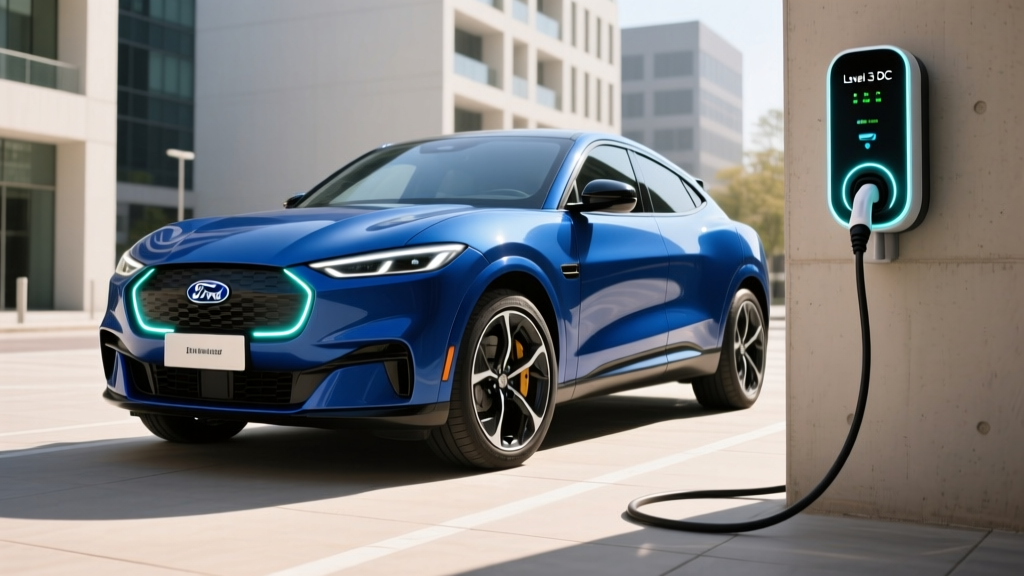
If you've seen the Ford Mustang Mach-E on the road and wondered whether it's a true battery-electric vehicle or a hybrid wearing a Mustang badge, the answer is unambiguous: the Mustang Mach-E is 100% electric. There is no gas engine, no hybrid variant, and no plug-in hybrid option. Every Mach-E sold since its 2021 launch has been a battery-electric vehicle (BEV), and the 2026 model year continues that commitment.
But knowing it's electric is only the starting point. The real questions buyers ask are more practical: How far does it actually go on a charge? How fast does it replenish at a DC fast charger? Does it still qualify for the federal tax credit? And how does it stack up against the Tesla Model Y, Hyundai Ioniq 5, and Chevrolet Equinox EV in a rapidly crowded segment?
We've driven, charged, and analyzed the 2026 Mustang Mach-E across its trim lineup to give you the exact numbers that matter.
2026 Mustang Mach-E: Core Specs at a Glance
| Spec | Select (Standard Range) | Premium (Extended Range RWD) | GT (Extended Range AWD) |
|---|---|---|---|
| EPA Range | 250 miles | 320 miles | 280 miles |
| Battery (usable) | 72 kWh (LFP) | 91 kWh (NMC) | 91 kWh (NMC) |
| Drivetrain | RWD (single motor) | RWD (single motor) | AWD (dual motor) |
| Horsepower | 266 hp | 290 hp | 480 hp (GT: 536 hp w/ GT Performance Upgrade) |
| 0-60 mph | 6.1 sec | 5.6 sec | 3.5 sec (GT Perf. Upgrade) |
| Max DC Fast Charge | 135 kW | 150 kW | 150 kW |
| 10-80% DC Charge Time | ~33 min | ~36 min | ~36 min |
| Level 2 Home Charge Rate | 10.5 kW (30 mi/hr) | 10.5 kW (30 mi/hr) | 10.5 kW (30 mi/hr) |
| EPA Efficiency (Combined) | 105 MPGe / 32 kWh/100mi | 101 MPGe / 33 kWh/100mi | 89 MPGe / 38 kWh/100mi |
| Base MSRP | $39,995 | $45,995 | $57,995 |
| Cargo (behind rear seats) | 29.7 cu ft (rear seats up) / 59.7 cu ft (rear seats folded) | ||
| Frunk (front trunk) | 4.7 cu ft (drainable) | ||
| Rear Legroom | 38.9 inches | ||
| Battery/Powertrain Warranty | 8 years / 100,000 miles | ||
Source: Ford Motor Company 2026 specifications and EPA Fuel Economy. Prices exclude destination charge. Specs may vary by model year and production timing.
Real-World Range: What to Expect Beyond the EPA Sticker
EPA rated range (Premium Extended Range RWD): 320 miles
Real-world highway (70-75 mph, moderate temps): ~265-285 miles
Real-world mixed city/highway (spring/fall): ~290-310 miles
Cold-weather (below 32°F, highway): ~220-250 miles
The 320-mile EPA figure on the Premium Extended Range RWD is competitive with the segment, but EPA testing uses a specific drive cycle that doesn't fully replicate sustained highway driving at 70+ mph. In our experience and consistent with independent testing, expect to lose roughly 10-15% of rated range at highway speeds in moderate temperatures. The Mach-E's aerodynamic profile (0.29 Cd drag coefficient) helps, but the taller crossover stance still creates more drag than a sedan at speed.
Cold weather is the bigger variable. Without preconditioning the battery, sub-freezing temperatures can reduce range by 20-30% due to cabin heating demands and reduced battery efficiency. The Mach-E's available heat pump (standard on Extended Range trims) mitigates some of this loss compared to resistance-based heating, but you should still plan conservatively for winter road trips.
The Standard Range models using Ford's LFP (lithium iron phosphate) battery chemistry trade range for durability. LFP cells tolerate frequent 100% charging without the degradation concerns of NMC chemistry, making them ideal for daily commuters with reliable home charging who don't need the extra range.
Charging Speed: DC Fast Charging and Home Setup
Charging speed is where the Mach-E shows both its strengths and its competitive gaps. Here's the full picture across charging levels:
| Charging Level | Power / Voltage | Rate of Range Added | Time (10-80% or Full) | Notes |
|---|---|---|---|---|
| Level 1 (120V household) | ~1.4 kW | ~3 miles/hour | ~50+ hours (full) | Emergency/trickle only |
| Level 2 (240V home) | 10.5 kW (48A) | ~30 miles/hour | ~9-10 hours (full) | Ford Mobile Power Cord or wall connector |
| DC Fast Charge (Standard Range) | 135 kW peak | ~59 mi in 10 min | ~33 min (10-80%) | CCS1 or NACS (2025+ models) |
| DC Fast Charge (Extended Range) | 150 kW peak | ~59 mi in 10 min | ~36 min (10-80%) | Charge curve tapers significantly above 80% |
The Mach-E's 150 kW peak DC fast-charge rate is adequate but falls short of competitors built on 800-volt architectures. The Hyundai Ioniq 5 peaks at 240 kW and achieves a 10-80% charge in roughly 18 minutes, and the Kia EV6 is similarly fast. Ford's charging curve holds near peak through roughly 50% state of charge before tapering, meaning the 10-80% time is stretched compared to what peak kW alone would suggest.
One important update for 2025-2026 models: Ford has transitioned to the NACS (North American Charging Standard) connector, giving Mach-E owners native access to Tesla Supercharger stations without an adapter. This dramatically expands the practical fast-charging network, particularly on highway corridors where Superchargers dominate. Earlier Mach-E models with CCS1 can use a Ford-provided adapter for Supercharger access.
For home Level 2 charging, the 10.5 kW onboard charger is solid. A full overnight charge from near-empty takes about 9-10 hours on the Extended Range battery, easily covering daily driving needs. We recommend a dedicated 48-amp Level 2 home charger on a 60-amp circuit — budget $500-$1,200 for the charger hardware and $800-$2,000 for professional installation depending on your electrical panel's capacity and proximity to the parking spot.
Pricing, Trims, and Federal Tax Credit Eligibility
The 2026 Mach-E lineup spans from the accessible Select trim to the performance-oriented GT. Here's how pricing breaks down before and after potential incentives:
| Trim | Base MSRP | As-Tested (typical options) | Est. Federal Credit (§30D) | Effective Price |
|---|---|---|---|---|
| Select (Standard Range RWD) | $39,995 | $41,500 | Up to $7,500* | ~$32,495 |
| Premium (Extended Range RWD) | $45,995 | $49,500 | Up to $7,500* | ~$38,495 |
| Premium (Extended Range AWD) | $48,995 | $52,500 | Up to $7,500* | ~$41,495 |
| GT (Extended Range AWD) | $57,995 | $63,000 | Up to $7,500* | ~$50,495 |
*Federal tax credit caveats: Under IRS §30D Clean Vehicle Credit rules, the full $7,500 credit requires meeting both critical-mineral sourcing and battery-component manufacturing requirements, which shift annually. The Mach-E qualifies under the $55,000 MSRP cap for SUVs (the GT's base price is within this cap; heavily optioned GT models may exceed it). Buyer income caps apply: modified AGI cannot exceed $150,000 (single), $225,000 (head of household), or $300,000 (joint). The credit can be transferred to the dealer as a point-of-sale discount. Always confirm eligibility with your tax professional and the dealer at purchase, as battery sourcing requirements tighten each year.
Ford's pricing strategy positions the Mach-E Select as a direct competitor to the Chevrolet Equinox EV and base Tesla Model Y, while the Premium Extended Range RWD offers one of the best range-per-dollar propositions in the segment when the tax credit applies.
Performance and Driving Dynamics
The Mach-E's driving character is where the Mustang nameplate earns its keep — at least in the upper trims. The Select's 266-hp single-motor RWD setup delivers adequate acceleration (6.1 seconds to 60 mph) and a comfortable, composed ride. It's a competent daily driver, not a sports car.
The GT changes the equation entirely. With 480 hp standard (536 hp with the GT Performance Upgrade) and dual-motor AWD, it hits 60 mph in 3.5 seconds — territory occupied by Porsche Taycan and Tesla Model Y Performance. The GT's MagneRide adaptive dampers (included with the Performance Upgrade) provide genuinely impressive body control, and the low center of gravity from the floor-mounted battery pack keeps it planted through corners.
Regenerative braking offers two modes: a mild setting that mimics a traditional automatic, and a stronger "one-pedal driving" mode that enables near-complete stops without touching the brake pedal. The transition between regen and friction braking is smooth — one of the better implementations in the segment.
However, the Mach-E's steering feel remains numb compared to its performance aspirations, and the ride on the standard suspension can feel firm over broken pavement. It's a fast crossover that handles well, not a sports sedan substitute.
Interior, Cargo, and Technology
The Mach-E's cabin is a clean departure from traditional Ford interiors. The centerpiece is a 15.5-inch vertically oriented touchscreen running Ford's SYNC 4A system, which supports wireless Apple CarPlay and Android Auto, over-the-air updates, and an integrated charging-station locator.
Practical dimensions matter for crossover buyers:
- Cargo behind rear seats: 29.7 cu ft (competitive with the Model Y's ~30 cu ft)
- Cargo with rear seats folded: 59.7 cu ft
- Front trunk (frunk): 4.7 cu ft, drainable — useful for wet gear or a small cooler
- Rear legroom: 38.9 inches (generous for adults)
- Front headroom: 40.4 inches
The Mach-E's driver-assistance suite, branded Ford BlueCruise, is one of the better Level 2 systems available. On pre-mapped divided highways (over 130,000 miles of Blue Zone roads in the US and Canada), it allows hands-off driving with eyes-on monitoring via a driver-facing camera. It's important to understand this is SAE Level 2 automation — you must remain attentive and ready to take over immediately. It is not self-driving.
Ford BlueCruise is an SAE Level 2 driver-assistance system. It requires continuous driver supervision. Hands-free operation is only available on pre-mapped divided highways (Blue Zones). The driver must remain alert, keep eyes on the road, and be prepared to steer or brake at any time. BlueCruise does not make the Mach-E an autonomous vehicle.
Notable drawbacks include the absence of a traditional instrument cluster (all info routes through the central screen or a small secondary display), and rear visibility is compromised by the thick C-pillars — we strongly recommend the available 360-degree camera system.
Battery Chemistry, Warranty, and Long-Term Ownership
Ford uses two battery chemistries across the Mach-E lineup, and the choice has real ownership implications:
| Attribute | LFP (Standard Range) | NMC (Extended Range) |
|---|---|---|
| Usable Capacity | 72 kWh | 91 kWh |
| Energy Density | Lower (heavier per kWh) | Higher (lighter per kWh) |
| Recommended Daily Charge | 100% OK daily | 80% recommended daily; 100% for trips |
| Cycle Life | 3,000+ cycles (longer lifespan) | 1,500-2,000 cycles |
| Cold-Weather Performance | Greater range loss in cold | Better cold-weather retention |
| Best For | Daily commuters, home chargers | Road trippers, cold climates, max range |
The LFP battery in the Standard Range trims is a standout for longevity. LFP chemistry tolerates full charges without accelerating degradation, meaning daily commuters can charge to 100% every night without worry. Over a 10-year ownership horizon, LFP packs are projected to retain a higher percentage of original capacity than equivalent NMC packs subjected to the same charging habits.
Ford's battery and powertrain warranty covers 8 years or 100,000 miles, with a capacity retention threshold of 70% — meaning if the battery drops below 70% of its original capacity within the warranty period, Ford will repair or replace it. This is industry-standard and matches competitors like Hyundai (10yr/100k on battery), though Hyundai's coverage is slightly longer in years.
Battery replacement cost outside of warranty is estimated at $12,000-$18,000 depending on the pack, though this figure is expected to decline as battery manufacturing scales and cell prices continue their long-term downward trend.
Pros and Cons: The Honest Assessment
- Up to 320 miles EPA range (Premium ER RWD) — competitive with the segment
- NACS connector on 2025+ models enables native Tesla Supercharger access
- BlueCruise hands-free highway driving is well-implemented and expanding
- LFP battery option allows worry-free daily 100% charging
- GT Performance Upgrade delivers genuine sports-car acceleration (3.5 sec 0-60)
- Drainable frunk adds practical utility for outdoor use
- Federal tax credit eligible (subject to §30D rules)
- Over-the-air updates continue to improve the vehicle post-purchase
- DC fast-charge speed (150 kW peak) trails 800V competitors (Ioniq 5 at 240 kW)
- 33-36 minute 10-80% charge time means longer road-trip stops
- No instrument cluster — all driving info funneled through central screen
- Rear visibility is poor without the 360-degree camera option
- Steering feel is disconnected, even in GT trims
- Ride quality is firm on standard suspension over rough roads
- GT trim pricing pushes past $60,000 before options
- LFP Standard Range loses more range in cold weather than NMC
How It Compares: Mach-E vs. the Competition
The Mach-E competes in the most crowded EV crossover segment. Here's how it measures up against its three primary rivals:
| Spec | Ford Mustang Mach-E (Premium ER RWD) | Tesla Model Y (Long Range RWD) | Hyundai Ioniq 5 (Long Range RWD) | Chevrolet Equinox EV (3RS) |
|---|---|---|---|---|
| EPA Range | 320 mi | 320 mi | 303 mi | 319 mi |
| Max DC Fast Charge | 150 kW | 250 kW | 240 kW | 150 kW |
| 10-80% Charge Time | ~36 min | ~25 min | ~18 min | ~35 min |
| Starting MSRP | $45,995 | $44,990 | $46,650 | $43,900 |
| Cargo (rear seats up) | 29.7 cu ft | 30.2 cu ft | 27.2 cu ft | 26.4 cu ft |
| Connector | NACS (2025+) | NACS (native) | NACS (2025+) | NACS (2025+) |
Choose the Mustang Mach-E if: you want a comfortable, well-built crossover with strong highway driver-assist (BlueCruise), prefer Ford's dealer network for service, value the drainable frunk for active lifestyles, or want LFP battery longevity on the Select trim.
Choose the Tesla Model Y if: DC fast-charge speed is your top priority, you want the deepest Supercharger integration, or you value the most mature OTA update ecosystem.
Choose the Hyundai Ioniq 5 if: you road-trip frequently and need the fastest 10-80% charge times (18 min on 800V architecture), or you prefer the Ioniq 5's retro-futuristic interior design.
Choose the Chevrolet Equinox EV if: you want the lowest entry price in the segment with comparable range, and you prioritize value over performance or charging speed.
Who the Mustang Mach-E Suits Best
Daily commuters with home charging: The Select Standard Range with its LFP battery is an ideal commuter car. Charge to 100% nightly, enjoy 250 miles of range, and benefit from LFP's superior cycle life. At an effective ~$32,500 after the tax credit, it's one of the most durable and worry-free EVs in its price range.
Families needing cargo and space: With 29.7 cu ft of rear cargo and 38.9 inches of rear legroom, the Mach-E comfortably handles two car seats and a stroller. The drainable frunk is a genuine differentiator for muddy soccer cleats or beach gear.
Road trippers (with planning): The Premium Extended Range RWD's 320-mile range and NACS Supercharger access make long-distance travel viable, though the 36-minute 10-80% charge time means slightly longer stops than an Ioniq 5 or Model Y. Plan 30-40 minute breaks every 220-250 miles and you'll be fine.
Performance enthusiasts: The GT with Performance Upgrade delivers 536 hp and a 3.5-second 0-60 time — legitimately quick. Just know that the steering and ride quality don't fully match the acceleration, and the price climbs steeply.
Not ideal for: Heavy towing (the Mach-E is not rated for significant towing), or buyers in extreme cold climates who lack home charging and need maximum range reliability in winter.
Frequently Asked Questions
Is the Mustang Mach-E fully electric or a hybrid?
The Mustang Mach-E is a fully battery-electric vehicle (BEV). It has no gasoline engine and no hybrid variant. Every Mach-E is powered exclusively by a lithium-ion battery pack and electric motors. Ford has never produced a hybrid or plug-in hybrid version of the Mach-E.
What is the real-world range of the 2026 Mustang Mach-E?
The EPA-rated range tops out at 320 miles for the Premium Extended Range RWD. In real-world highway driving at 70-75 mph in moderate temperatures, expect approximately 265-285 miles. Mixed city/highway driving in spring or fall conditions can approach the EPA figure at 290-310 miles. Cold weather (below freezing) reduces range to roughly 220-250 miles on the highway. The Standard Range models are rated at 250 miles EPA with similar proportional real-world reductions.
How fast does the Mustang Mach-E charge at home and on the road?
At home on a Level 2 (240V, 48A) charger, the Mach-E adds roughly 30 miles of range per hour and fully charges overnight in 9-10 hours. On DC fast chargers, the Extended Range models peak at 150 kW, achieving a 10-80% charge in approximately 36 minutes. Standard Range models peak at 135 kW with a 10-80% time of about 33 minutes. These times are slower than 800V competitors like the Hyundai Ioniq 5 (~18 minutes 10-80%).
Does the 2026 Mustang Mach-E qualify for the $7,500 federal tax credit?
The Mach-E is eligible for up to $7,500 under the IRS §30D Clean Vehicle Credit, but eligibility depends on multiple factors: the buyer's modified adjusted gross income must not exceed $150,000 (single) / $300,000 (joint filing); the vehicle MSRP must be at or below $55,000 (SUV cap — the GT base price qualifies, but heavily optioned models may not); and the battery must meet critical-mineral and component-sourcing requirements that tighten each year. The credit can be transferred to the dealer as a point-of-sale discount. Always verify current eligibility on IRS.gov and with your tax professional.
Is the Mustang Mach-E worth buying over the Tesla Model Y?
It depends on your priorities. The Mach-E offers a more traditional crossover driving experience, Ford's widespread dealer network for service, an excellent BlueCruise hands-free system, and LFP battery longevity on the Standard Range trim. The Tesla Model Y counters with faster DC charging (250 kW vs. 150 kW), native Supercharger ecosystem maturity, and a more minimalist (though polarizing) interior. Both are strong choices — test-drive both and compare which cockpit and driving feel you prefer.
How long will the Mach-E battery last?
Ford warranties the battery for 8 years or 100,000 miles against capacity loss below 70%. Real-world data from early 2021-2023 Mach-E owners suggests typical degradation of 5-8% over the first 60,000 miles for NMC batteries charged responsibly (daily limit of 80%). LFP batteries in Standard Range models are expected to show even less degradation over equivalent mileage due to their superior cycle life. Battery replacement outside warranty is estimated at $12,000-$18,000 but is rarely needed within the first 150,000+ miles based on current degradation curves.
Can I use Tesla Superchargers with the Mustang Mach-E?
Yes. Starting with 2025 model-year production, the Mach-E ships with a native NACS charge port, enabling direct connection to Tesla Superchargers without an adapter. Earlier 2021-2024 Mach-E models with CCS1 ports can access Superchargers using a Ford-approved adapter. Ford's integration with the Supercharger network is seamless — stations appear in the vehicle's navigation system and charging is billed through the FordPass app.
For the latest EPA range and efficiency data, consult fueleconomy.gov. For current federal tax credit rules, see IRS.gov §30D. Safety ratings are available at NHTSA.gov and IIHS.org.