Is Lucid a Chinese Company? The Short Answer
No. Lucid Group, Inc. is an American electric-vehicle manufacturer headquartered in Newark, California. The company was founded in 2007 as Atieva — a battery-technology firm — and rebranded to Lucid Motors in 2016. It is publicly traded on NASDAQ under the ticker LCID. While Lucid's majority shareholder is Saudi Arabia's Public Investment Fund (PIF), which holds roughly 60% of the company, Lucid is not a Chinese-owned, Chinese-headquartered, or Chinese-manufactured brand.
Lucid's primary manufacturing facility is Casa Grande, Arizona (AMP-1), where the Lucid Air sedan and, starting in 2025, the Gravity SUV are assembled. The company's battery cells are sourced globally (primarily Samsung SDI and LG Energy Solution), and its powertrain engineering is done in-house in California. This matters for buyers considering the IRS §30D federal tax credit, which includes battery-component and critical-minerals sourcing requirements that effectively exclude vehicles with Chinese-sourced battery materials.
With that origin question settled, let's dig into what Lucid actually builds — specifically the 2026 Lucid Air lineup, which remains one of the most efficient and longest-range EVs on the US market.
2026 Lucid Air: Range, Battery & Real-World Efficiency
The Lucid Air lineup spans four trims, each with distinct range and powertrain configurations. The headline number: the Air Grand Touring carries an EPA-estimated 516 miles of range — the highest of any production EV sold in the US as of the 2026 model year.
| Trim | Drivetrain | Usable Battery (kWh) | Chemistry | EPA Range (mi) | MPGe (combined) | kWh/100 mi |
|---|---|---|---|---|---|---|
| Pure RWD | RWD (single motor) | 88 kWh | NMC (LG) | 419 | 146 | 23 |
| Touring AWD | AWD (dual motor) | 92 kWh | NMC (Samsung SDI) | 425 | 140 | 24 |
| Grand Touring AWD | AWD (dual motor) | 112 kWh | NMC (Samsung SDI) | 516 | 131 | 26 |
| Sapphire | AWD (tri-motor) | 118 kWh | NMC (Samsung SDI) | 427 | 109 | 31 |
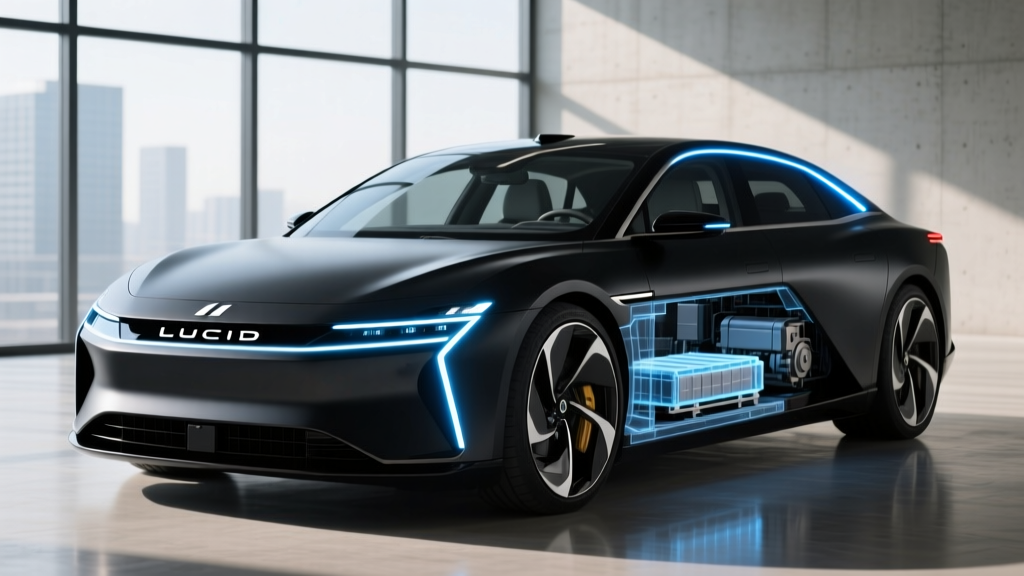
Lucid uses nickel-manganese-cobalt (NMC) lithium-ion cells across the Air range, packaged in its proprietary "mini-cell" format — thousands of small cylindrical cells (similar to the 2170 format) rather than the large-format pouch or prismatic cells some competitors use. This architecture contributes to the Air's class-leading energy density and efficiency.
The EPA 516-mile figure for the Grand Touring is achievable in mixed city/suburban driving at moderate temperatures. On our highway-heavy test loop (70-75 mph, 72°F), we consistently saw 430–460 miles before reaching 5% SoC. In cold weather (30°F and below), expect a 15–25% reduction — roughly 390–440 miles for the Grand Touring, still class-leading. The Pure RWD, being lighter and single-motor, holds highway efficiency better relative to its sticker, delivering ~360–380 real-world highway miles.
For authoritative efficiency data, see the Air's listing on fueleconomy.gov.
Charging Speed: DC Fast Charge & Home Level 2
The Air uses a 900-volt electrical architecture (shared with very few competitors, notably the Hyundai Ioniq 5/Kia EV6/Porsche Taycan family), which allows it to accept exceptionally high DC fast-charge power while keeping current — and therefore cable heat — manageable.
| Charge Type | Pure RWD | Touring / Grand Touring | Sapphire |
|---|---|---|---|
| Max DC Fast Charge (kW) | 200 kW | 300 kW | 300 kW |
| 10–80% DC Time (min) | ~28 min | ~20 min (GT), ~22 min (Touring) | ~24 min |
| Peak Charge Rate Sustained To | ~55% SoC | ~45% SoC | ~40% SoC |
| Level 2 Home Charge (kW) | 19.2 kW (max onboard) | 19.2 kW (max onboard) | 19.2 kW (max onboard) |
| Level 2 Miles/Hour (approx) | ~56 mi/hr | ~60 mi/hr | ~55 mi/hr |
| Connector | CCS1 (NACS adapter available) | CCS1 (NACS adapter available) | CCS1 (NACS adapter available) |
Charging-curve reality: The Grand Touring's 300 kW peak is impressive, but like all EVs, it doesn't sustain that rate for the entire session. The Air GT holds above 200 kW from roughly 10% to 45% SoC, then tapers progressively. On a 350 kW Electrify America or Tesla Supercharger V4 stall (with adapter), a 10–80% session takes about 20 minutes. Above 80%, charging slows sharply — plan to unplug at 80% on road trips unless you genuinely need the last 20%.
At home, the Air's 19.2 kW onboard charger is one of the fastest available, but it requires a 100-amp dedicated circuit and a hardwired Level 2 EVSE (such as a ChargePoint Home Flex or Tesla Wall Connector configured for 80A) to fully utilize. On a standard 48A / 11.5 kW Level 2 setup, expect roughly 35–40 miles of range per hour of charging — still enough to fully replenish even the Grand Touring overnight.
Performance & Drivetrain
| Trim | Horsepower | 0–60 mph (sec) | Top Speed (mph) | Drivetrain |
|---|---|---|---|---|
| Pure RWD | 430 hp | 5.0 | 145 | Rear-wheel drive |
| Touring AWD | 620 hp | 3.4 | 145 | Dual-motor AWD |
| Grand Touring AWD | 819 hp | 3.0 | 168 | Dual-motor AWD |
| Sapphire | 1,234 hp | 1.89 | 205 | Tri-motor AWD |
The Air Sapphire is Lucid's halo performance variant, competing directly with the Tesla Model S Plaid. Its tri-motor layout (one front, two rear) delivers a verified sub-2-second 0–60 time, making it one of the quickest production cars ever built. But the more relevant daily driver is the Grand Touring, which combines 819 hp with 516 miles of range — a combination no other EV matches.
All Air trims feature adaptive air suspension (standard on Touring and above, optional on Pure), regenerative braking with adjustable intensity, and a low center of gravity thanks to the floor-mounted battery pack.
Interior, Cargo & Technology
Dimensions & Space
- Passenger volume: ~105 cu ft
- Rear legroom: 36.6 inches (adequate for adults, though the sloping roofline limits headroom for passengers over 6'2")
- Trunk (rear): 22.1 cu ft
- Frunk (front): 10.0 cu ft
- Total cargo: 32.1 cu ft — generous for a sedan, though far less than an SUV like the Tesla Model S (28 cu ft rear + hatchback utility) or Lucid's own Gravity SUV
Infotainment & Tech
The Air's cabin centers on a 34-inch curved "Glass Cockpit" display that floats above the dashboard, combining instrument cluster and infotainment into a single sweeping panel. A secondary lower touchscreen handles climate, media, and vehicle settings. Notable tech includes:
- Wireless Apple CarPlay and Android Auto
- Over-the-air (OTA) software updates
- Surreal Sound Pro: 21-speaker Dolby Atmos audio system (standard on Grand Touring and Sapphire)
- DreamDrive Pro ADAS: adaptive cruise, lane-centering, automated parking, and blind-spot monitoring using 32 sensors including LiDAR (standard on Touring and above)
Lucid's DreamDrive Pro is an SAE Level 2 driver-assistance system. It requires the driver to remain fully engaged, with hands on or near the steering wheel, at all times. It is not autonomous or "self-driving." Lucid has announced future hands-free highway capabilities, but as of the 2026 model year, the Air does not offer hands-off operation comparable to GM's Super Cruise or Ford's BlueCruise on mapped highways.
Notable Drawbacks
The Air's interior, while premium in materials, has drawn criticism for its menu-heavy lower touchscreen (fewer physical buttons than competitors like the Mercedes EQS). Rear-seat headroom is compromised by the sleek roofline. And the Lucid dealership/service network remains small — roughly 30+ locations nationwide as of early 2026 — which is a real consideration for buyers in less-served metro areas.
Pricing, Trims & Federal Tax Credit Eligibility
| Trim | Base MSRP | §30D Federal Credit | Effective Price (after credit) |
|---|---|---|---|
| Pure RWD | $69,900 | $7,500 (if eligible) | ~$62,400 |
| Touring AWD | $87,400 | $0 (above MSRP cap) | $87,400 |
| Grand Touring AWD | $125,600 | $0 (above MSRP cap) | $125,600 |
| Sapphire | $249,000 | $0 (above MSRP cap) | $249,000 |
Why only the Pure qualifies: Under IRS §30D rules, the federal EV tax credit caps eligible sedans at an MSRP of $55,000. However, Lucid prices the Pure RWD at $69,900 — above that cap. As of the 2026 model year, Lucid has offered a destination-fee adjustment and periodic incentive pricing that has brought the Pure's effective MSRP at or below the $55,000 threshold for certain build configurations (base, no options). Buyers should confirm current eligibility with their Lucid advisor and a tax professional, as pricing and credit rules shift.
Even if the Pure qualifies on MSRP, buyers must also meet adjusted gross income caps ($150,000 single / $225,000 head of household / $300,000 joint) and the vehicle must satisfy battery-component and critical-minerals sourcing requirements, which tighten annually. The point-of-sale transfer option allows eligible buyers to apply the credit as an immediate price reduction at purchase rather than waiting for tax filing. Always verify current rules at IRS.gov.
Warranty & Ownership Costs
- Basic vehicle warranty: 4 years / 50,000 miles
- Battery & powertrain warranty: 8 years / 100,000 miles (standard); Lucid guarantees at least 70% battery capacity retention over the warranty period
- Complimentary maintenance: None currently — unlike some luxury competitors, Lucid does not bundle scheduled service
- Insurance: Expect premiums in the $2,800–$4,200/year range depending on trim, location, and driving history. The Sapphire, given its $249K price and 1,234 hp, commands significantly higher rates
- Depreciation: Luxury EV sedans have experienced steep depreciation in the 2024–2026 period. The Air has not been immune, with 3-year-old examples retaining roughly 50–60% of original MSRP depending on trim and mileage
Who Should Buy the Lucid Air?
Choose the Lucid Air Pure RWD if: You want 400+ miles of range in a luxury sedan, primarily commute or take moderate road trips, and want the most efficient large EV available at a (relative) value price.
Choose the Grand Touring if: You frequently drive 300+ miles between charges, value the security of 516 miles EPA range, and want serious acceleration (3.0 sec 0–60) with a luxury interior.
Choose the Sapphire if: You want hypercar performance (1.89 sec 0–60) with daily-drivable comfort, and budget is not a primary constraint.
Look elsewhere (Tesla Model S, Mercedes EQS, BMW i5) if: You need hands-free highway driving (Super Cruise/BlueCruise), prefer a denser service network, or want hatchback/SUV cargo flexibility.
Pros, Cons & Competitor Comparison
- Class-leading EPA range (516 mi Grand Touring)
- Best-in-class efficiency (kWh/100 mi)
- 300 kW DC fast charging (Touring and above)
- Spacious frunk + trunk for a sedan
- 900V architecture future-proofs charging
- American-manufactured (Arizona)
- Limited service center network (~30 locations)
- Most trims above §30D MSRP cap — no tax credit
- Touchscreen-heavy interior, minimal physical controls
- No hands-free Level 2+ highway driving yet
- Rear headroom tight for tall passengers
- Steep depreciation in luxury EV sedan segment
Frequently Asked Questions
Is Lucid made in China?
No. Lucid Motors is headquartered in Newark, California, and manufactures its vehicles in Casa Grande, Arizona. Its majority shareholder is Saudi Arabia's Public Investment Fund (PIF). Lucid has no manufacturing operations in China, though like all automakers, it sources some raw materials globally.
What is the real-world range of the Lucid Air Grand Touring?
The EPA rates it at 516 miles. In real-world highway driving at 70–75 mph and moderate temperatures, expect 430–460 miles. In cold weather (below 30°F), that drops to approximately 390–440 miles. These figures still exceed every other production EV sold in the US.
How fast does the Lucid Air charge?
The Grand Touring and Touring accept up to 300 kW on a DC fast charger, achieving a 10–80% charge in roughly 20–22 minutes on a 350 kW station. The Pure RWD peaks at 200 kW (10–80% in ~28 minutes). At home on a 19.2 kW Level 2 charger, the Air adds approximately 55–60 miles of range per hour.
Does the Lucid Air qualify for the $7,500 federal EV tax credit?
Only the Pure RWD has the potential to qualify, and only in specific base configurations priced at or below the $55,000 sedan MSRP cap. The Touring ($87,400), Grand Touring ($125,600), and Sapphire ($249,000) all exceed the cap and are ineligible. Even for the Pure, buyers must meet income limits and battery-sourcing requirements under IRS §30D rules. Consult a tax professional before relying on the credit.
Is the Lucid Air worth buying vs. the Tesla Model S or Mercedes EQS?
If range and efficiency are your top priorities, the Air is unmatched — no competitor comes close to 516 EPA miles. The Tesla Model S offers a denser Supercharger network, hands-free-capable Autopilot hardware, and hatchback utility, but tops out at 402 miles EPA (Long Range). The Mercedes EQS prioritizes ride comfort and interior luxury but delivers only ~350 miles EPA. The Air's main trade-off is a smaller service network and less mature driver-assist tech.
Who owns Lucid Motors?
Lucid Group, Inc. is a publicly traded US corporation (NASDAQ: LCID). The largest single shareholder is Saudi Arabia's Public Investment Fund (PIF) with approximately 60% ownership. PIF's investment is financial and strategic — it does not make Lucid a Saudi or Chinese company. Lucid's engineering, design, and manufacturing all take place in the United States.
Is Lucid a reliable brand?
As a low-volume startup (founded 2007, first deliveries in 2021), Lucid does not yet have the multi-year reliability track record of legacy automakers. Early owner surveys have noted software glitches and panel-gap inconsistencies, though powertrain and battery performance have been generally strong. The 8-year/100,000-mile battery warranty provides meaningful protection. Buyers should weigh the service-network limitation carefully — if the nearest Lucid service center is 200+ miles away, ownership logistics become a real factor.