The Short Answer
Yes, an electric car is usually cheaper to own over 5 years — but only if you can charge at home and drive under ~20,000 miles annually. A typical EV saves $4,000–$7,000 in fuel and maintenance over five years compared to a gas sedan, and the federal §30D tax credit (up to $7,500 at point of sale) can erase the higher sticker price. However, if you rely entirely on public DC fast charging, live in a cold climate with short trips, or pay high insurance premiums on a luxury EV, the savings can shrink or vanish entirely.
Purchase Price: The Upfront Gap Is Narrowing
The single biggest misconception about EV ownership is that electric cars cost dramatically more than gas equivalents. In 2026, that gap has closed significantly — especially after incentives.
Take a concrete comparison: the 2026 Chevrolet Equinox EV 2LT starts at $33,600 (MSRP) with 315 miles of EPA range. A comparable 2026 Honda CR-V EX AWD starts around $33,350. Before incentives, the EV costs $250 more. After the §30D federal credit (which the Equinox EV qualifies for at point of sale), the EV is actually $7,250 cheaper to acquire.
But the credit has strict eligibility rules under current IRS §30D guidelines:
- MSRP caps: $80,000 for SUVs/pickups/vans; $55,000 for sedans
- Income limits: $150,000 single / $225,000 head of household / $300,000 joint (modified AGI)
- Battery sourcing: Critical mineral and component requirements phase in annually — not every EV qualifies for the full $7,500
- Point-of-sale transfer: You can apply the credit as a down payment reduction at the dealer, so you don't have to wait until tax filing
Always verify a specific vehicle's current eligibility on fueleconomy.gov, as battery sourcing compliance changes frequently.
Fuel vs. Electricity: Where the Real Savings Live
This is where EVs pull ahead decisively — if you charge at home.
| Scenario | EV (Chevy Equinox EV) | Gas (Honda CR-V AWD) |
|---|---|---|
| Efficiency | 115 MPGe / 29 kWh/100 mi | 30 MPG combined |
| Home charging ($0.16/kWh avg) | $696/year | — |
| Public DC fast charging ($0.48/kWh avg) | $2,088/year | — |
| Gasoline ($3.40/gal avg) | — | $1,700/year |
| Annual savings (home charging) | $1,004/year in EV's favor | |
| Annual savings (public DC only) | Gas wins by ~$388/year | |
The math is stark: home charging at typical residential rates ($0.13–$0.20/kWh depending on your utility) makes an EV roughly 60% cheaper to "fuel" per mile than a 30-MPG gas crossover. But at public DC fast charging rates — which in 2026 average $0.40–$0.55/kWh on networks like Electrify America and EVgo — the EV can actually cost more per mile than a fuel-efficient gas car.
This is the single most important variable in the "is it cheaper to have an electric car" calculation. Home charging access determines whether you save or overspend on energy.
Maintenance: The Quiet Advantage
EVs have far fewer moving parts than internal combustion vehicles. There's no engine oil to change, no transmission fluid, no spark plugs, no timing belt, no exhaust system, and no catalytic converter. Regenerative braking also extends brake pad life significantly — many EV owners report original brake pads at 80,000+ miles.
According to industry maintenance cost analyses, the average EV owner spends roughly $0.061 per mile on maintenance over the vehicle's life, compared to $0.101 per mile for a gas car. Over 75,000 miles, that's a $3,000 maintenance savings.
What you will spend money on with an EV:
- Tire rotation/replacement: EVs are heavier (the Equinox EV weighs ~4,700 lbs vs. ~3,600 lbs for the CR-V) and deliver instant torque, wearing tires 15–25% faster. Budget for a set of four tires every 35,000–45,000 miles instead of 50,000+.
- Cabin air filter: Same as a gas car, $25–$50 every 15,000–20,000 miles.
- Wiper fluid, wiper blades, brake fluid flush: Identical intervals and costs.
- Battery coolant: Some manufacturers recommend coolant service at 100,000+ miles (~$200–$400).
Insurance: The Hidden Cost Nobody Warns You About
EV insurance premiums run 15–30% higher on average than equivalent gas vehicles. The reasons are straightforward: EVs have higher repair costs after collisions (specialized high-voltage components, aluminum-intensive structures, and fewer qualified body shops), and their higher purchase prices translate to higher replacement values.
For a 2026 Equinox EV, expect annual premiums around $2,100–$2,600 depending on your profile, versus $1,600–$2,000 for a CR-V. That's $400–$700 more per year, or $2,000–$3,500 over five years — a significant chunk of your fuel savings eaten back.
Some insurers now offer EV-specific policies with discounts for low annual mileage or bundling with home charging equipment. Always get quotes from at least three carriers before purchase.
Home Charging Installation: A One-Time Cost That Pays Off
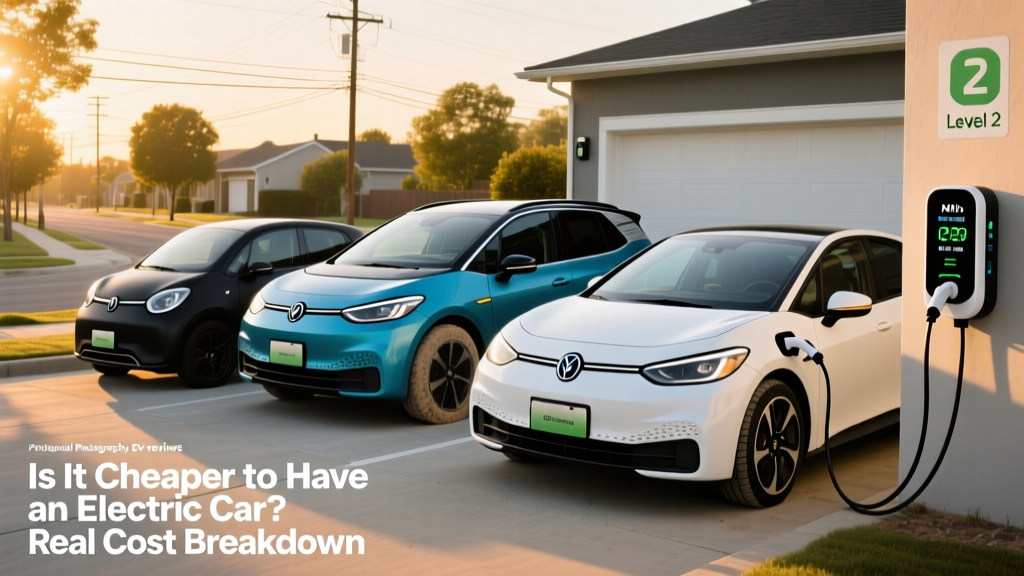
If you're buying an EV, a Level 2 home charger is nearly essential for convenience and cost savings. Here's what that investment looks like:
| Item | Low End | High End | Notes |
|---|---|---|---|
| Level 2 charger (40A/48A, hardwired) | $350 | $700 | ChargePoint Home Flex, Emporia, Wallbox |
| Electrician labor (240V circuit run) | $500 | $2,000 | Depends on panel proximity |
| Electrical panel upgrade (if needed) | $1,500 | $3,500 | 100A→200A service upgrade |
| Permit & inspection | $50 | $300 | Varies by municipality |
| Total (no panel upgrade) | $900–$3,000 | Most homes with 200A panels | |
| Total (with panel upgrade) | $2,400–$6,500 | Older homes with 100A service | |
Important: always hire a licensed electrician for 240V circuit work. A NEMA 14-50 outlet or hardwired connection requires proper wire gauge (typically 6 AWG copper for 50A circuits), GFCI protection where required by local code, and proper grounding. Your utility may also offer rebates of $200–$500 for Level 2 installation — check with your provider.
A 48-amp Level 2 charger delivers roughly 11.5 kW of power, adding about 35–40 miles of range per hour of charging. Overnight (8 hours), that's 280–320 miles — more than enough to fully replenish most EVs daily.
The 5-Year Total Cost of Ownership
Let's put it all together with a realistic 5-year/75,000-mile scenario comparing the 2026 Chevy Equinox EV 2LT against the 2026 Honda CR-V EX AWD:
| Cost Category | Equinox EV 2LT | CR-V EX AWD |
|---|---|---|
| MSRP | $33,600 | $33,350 |
| §30D federal tax credit | −$7,500 | $0 |
| Net acquisition cost | $26,100 | $33,350 |
| Home charger install | $1,800 | $0 |
| Fuel/energy (75k mi, home charging) | $3,480 | $8,500 |
| Maintenance (75k mi) | $2,100 | $4,200 |
| Insurance (5 years) | $11,500 | $9,000 |
| Estimated depreciation (5 yr) | $12,000 | $10,500 |
| Total 5-year cost | $56,980 | $65,550 |
| Net savings (EV vs. gas) | $8,570 in EV's favor | |
In this scenario, the EV saves nearly $8,600 over five years. The savings are driven primarily by the tax credit and lower fuel/maintenance costs, partially offset by higher insurance and the home charger installation. Depreciation remains a wildcard — EV resale values have been volatile, though stabilizing as the market matures.
Common Misconceptions, Corrected
| Myth | Fact |
|---|---|
| "EV batteries need replacing every 5 years" | Federally mandated battery warranty is 8 years/100,000 miles (capacity retention ≥70%). Most NMC and LFP packs are lasting 150,000–200,000+ miles before hitting 80% state of health. |
| "Charging an EV costs more than gas" | Only true if you exclusively use public DC fast chargers at $0.45+/kWh. Home charging at $0.16/kWh averages $4.64 per 100 miles vs. $11.33 for a 30-MPG gas car. |
| "EVs don't work in cold weather" | Range drops 15–30% in sub-freezing temps (a 315-mi EPA EV may deliver 220–265 real-world winter miles). With a heat pump and preconditioning, EVs are daily-drivable in cold climates — you just need more range buffer. |
| "The power grid can't handle EVs" | Most EVs charge overnight during off-peak hours when grid demand is low. A single EV charging at 7–11 kW adds roughly the load of a central AC unit. Utility time-of-use rates reward off-peak charging with lower per-kWh costs. |
| "All EVs qualify for the $7,500 tax credit" | The §30D credit depends on battery sourcing, vehicle MSRP caps, buyer income limits, and final assembly. Always check current eligibility on fueleconomy.gov before purchasing. |
Decision Framework: Is an EV Cheaper for You?
Choose an EV if:
- You can install a Level 2 charger at home (garage, carport, or driveway with electrical access). This is the #1 factor determining whether an EV saves you money.
- Your daily commute is under 60 miles round trip — you'll rarely need public charging and can handle most driving on a single overnight charge.
- You qualify for the §30D tax credit — the $7,500 point-of-sale reduction fundamentally changes the acquisition math.
- Your electricity rate is below $0.25/kWh — or your utility offers time-of-use rates with cheaper overnight charging ($0.08–$0.12/kWh off-peak in some markets).
- You plan to keep the vehicle 5+ years — the fuel and maintenance savings compound over time, and the battery warranty covers you through year 8.
Stick with gas or consider a hybrid if:
- You live in an apartment or lack home charging access — relying on public DC fast charging at $0.45+/kWh erases most fuel savings and adds significant inconvenience.
- You regularly drive 300+ miles in a single day — road-tripping in an EV is viable but adds 20–40 minutes of charging per stop, which may not fit your lifestyle.
- You live in an extreme cold climate AND take mostly short trips — short trips in sub-zero weather are the worst-case scenario for EV range (battery can't warm up, cabin heating draws heavily). A PHEV like the Toyota RAV4 Prime may be a better fit.
- Your annual mileage is very low (under 8,000 mi/yr) — fuel savings scale with miles driven. At low mileage, the higher insurance cost may outweigh the fuel savings.
- You don't qualify for the §30D credit — without the $7,500 incentive, the acquisition gap takes much longer to close through operational savings alone.
Frequently Asked Questions
What does it cost to charge an EV at home per month?
For an average driver covering 1,250 miles per month in an EV rated at 30 kWh/100 mi (typical for a compact SUV), you'll use about 375 kWh monthly. At the US average residential rate of $0.16/kWh, that's roughly $60/month — compared to about $142/month in gasoline for a 30-MPG gas car at $3.40/gallon.
Do EVs really save money on maintenance?
Yes. Without oil changes, transmission service, spark plugs, timing belts, or exhaust repairs, EV maintenance costs are typically 40–50% lower than gas vehicles over the same mileage. Budget roughly $400–$600/year for an EV vs. $800–$1,200/year for a gas car. The main EV-specific cost is faster tire wear due to vehicle weight and instant torque.
Will I need to replace the EV battery, and what does it cost?
Battery replacement is rare within the first 10–12 years. The federal warranty mandate requires manufacturers to cover the battery for 8 years/100,000 miles with at least 70% capacity retention. Real-world degradation data from fleets shows most NMC and LFP packs retain 85–92% capacity at 100,000 miles. If replacement is eventually needed out of warranty, costs range from $5,000–$15,000 depending on the pack size, though prices continue to decline.
Does an EV increase my electric bill significantly?
Yes, your electric bill will increase — but by less than you'd spend on gas. Charging 15,000 miles annually adds roughly 4,500 kWh to your annual electricity usage (about $720 at $0.16/kWh). Your gas bill drops to zero, saving $1,700+ annually. Net result: you save approximately $1,000/year on energy.
Is a plug-in hybrid (PHEV) a cheaper option than a full EV?
A PHEV like the 2026 Toyota RAV4 Prime (42 miles electric-only range, 38 MPG combined after battery depletion) can be cheaper if you have short commutes but need gas flexibility for road trips. You'll save on fuel for daily driving while eliminating range anxiety. However, PHEVs carry both an engine and a battery, so maintenance costs are higher than a pure EV, and the §30D credit is smaller (up to $7,500 based on battery capacity, but many PHEVs qualify for less). For most buyers with home charging, a full BEV delivers greater long-term savings.