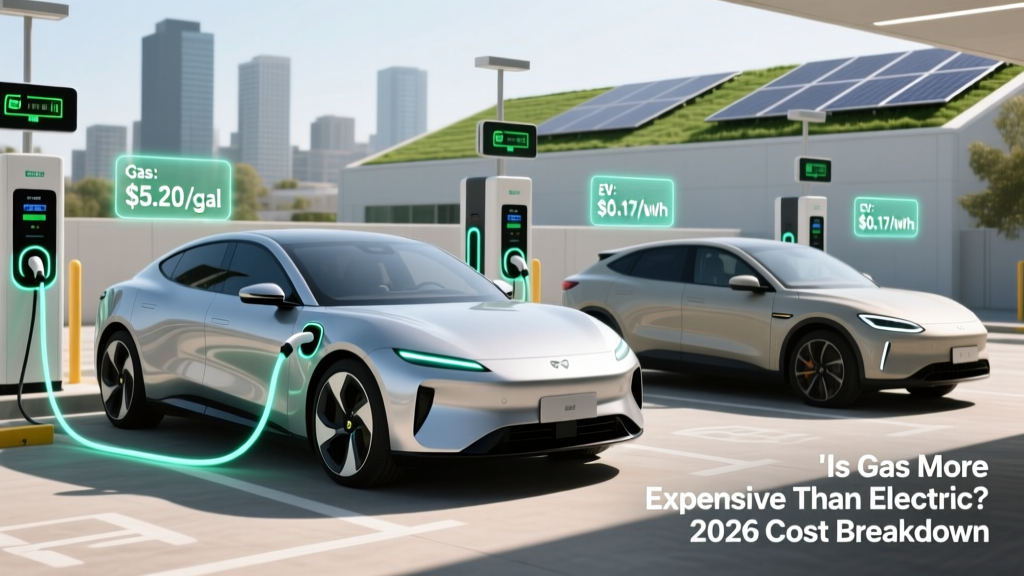
The Quick Answer: Is Gas More Expensive Than Electric?
Yes, in most scenarios gas is more expensive than electric on a per-mile and 5-year total cost basis — but the size of your savings depends heavily on three factors: whether you can charge at home, your local electricity vs. gas prices, and your annual mileage. A typical EV owner charging at home saves $800–$1,500 per year on fuel alone compared to a 27-MPG gas car. However, if you rely exclusively on public DC fast charging at $0.40–$0.60/kWh, your "fuel" cost can match or exceed gasoline. Upfront purchase price, insurance premiums, and federal tax credit eligibility (§30D) further shift the math.
Let's put real 2026 numbers behind that answer so you can calculate whether an EV or a gas car costs you less over five years of ownership.
Fuel vs. Charging: The Per-Mile Cost Showdown
The single biggest operational difference between an EV and a gas car is how you pay for energy. To compare them fairly, we need to convert both to cost per mile.
Gas car baseline (2026 Toyota Camry LE, 2.5L): EPA combined 32 MPG. At the 2026 national average of $3.35/gallon, that's $0.105 per mile.
EV baseline (2026 Tesla Model Y Long Range AWD): EPA efficiency 28 kWh/100 mi (roughly 120 MPGe). Your cost per mile depends entirely on where you charge:
| Energy Source | Rate | Cost / Mile (Model Y) | Annual Cost (12,000 mi) |
|---|---|---|---|
| Home Level 2 (national avg. $0.16/kWh) | $0.16/kWh | $0.045 | $540 |
| Home with solar ($0.06/kWh effective) | $0.06/kWh | $0.017 | $204 |
| Time-of-use off-peak ($0.09/kWh) | $0.09/kWh | $0.025 | $300 |
| Public Level 2 (ChargePoint, avg. $0.25/kWh) | $0.25/kWh | $0.070 | $840 |
| DC Fast Charging (Electrify America, avg. $0.48/kWh) | $0.48/kWh | $0.134 | $1,608 |
| Tesla Supercharger (avg. $0.35/kWh) | $0.35/kWh | $0.098 | $1,176 |
| Gas Car (Camry LE, 32 MPG, $3.35/gal) | $1,256 | ||
Key insight: Home charging at residential electricity rates is 55–70% cheaper per mile than gasoline. But exclusive DC fast charging at $0.48/kWh is actually more expensive than gas. This is why home charging access is the single most important variable in the EV cost equation.
Also factor in charging losses: roughly 10–15% of the kWh drawn from your panel never reaches the battery (heat, onboard charger inefficiency). A car rated at 28 kWh/100 mi may draw 32 kWh/100 mi from the wall. The table above uses wall-draw figures for home charging and dispensed figures for public charging.
5-Year Total Cost of Ownership: EV vs. Gas
Fuel is just one line item. A real comparison needs to include purchase price, tax incentives, insurance, maintenance, and depreciation over a realistic ownership horizon.
| Cost Category | Tesla Model Y LR AWD | Toyota Camry LE |
|---|---|---|
| Base MSRP | $44,990 | $29,995 |
| Federal §30D Tax Credit | –$7,500 (if eligible*) | $0 |
| Effective Purchase Price | $37,490 | $29,995 |
| 5-Year Fuel/Energy (home L2) | $2,700 | $6,280 |
| 5-Year Maintenance | $1,200 | $3,400 |
| 5-Year Insurance (avg.) | $10,500 | $7,200 |
| Estimated 5-Year Depreciation | $17,200 | $11,400 |
| 5-Year Total Cost | $69,090 | $58,275 |
| Cost Per Mile (all-in) | $1.15 | $0.97 |
*The IRS §30D credit requires meeting buyer income caps ($150K single / $300K joint MAGI), vehicle MSRP caps ($55K sedans / $80K SUVs/trucks), and battery critical-mineral and component sourcing thresholds that tighten annually. The Model Y qualifies at up to $7,500 in 2026 if assembled in North America and battery sourcing rules are met. Confirm eligibility at the point of sale — rules change frequently.
With the full $7,500 credit and home charging, the Model Y's 5-year cost gap over the Camry narrows to roughly $10,800 — largely driven by higher insurance and depreciation on the more expensive vehicle. Without the credit, or if you rely on DC fast charging, the EV costs meaningfully more.
However, if you compare vehicles in the same price bracket — say, a $38K Hyundai Ioniq 5 (after credit) vs. a $38K Honda Accord Sport — the EV often wins on TCO because the purchase price gap disappears and the fuel/maintenance savings accumulate.
Maintenance Costs: Where EVs Consistently Win
EVs have dramatically fewer moving parts than internal combustion vehicles. No oil changes, no spark plugs, no timing belts, no transmission fluid flushes, no exhaust system repairs. Regenerative braking also means brake pads often last 100,000+ miles.
Based on fueleconomy.gov maintenance schedules and industry data, here's what typical 5-year maintenance looks like:
- Gas car (Camry): Oil changes (~$50 × 10), brake pads (~$300 × 2), air filters, coolant flush, transmission fluid — ~$3,400 over 5 years
- EV (Model Y): Cabin air filter, tire rotation, wiper fluid, brake fluid check — ~$1,200 over 5 years
The caveat: EV tires wear 20–30% faster due to instant torque and heavier vehicle weight. Budget an extra $200–$400 per tire set. You'll likely need one extra tire replacement over 60,000 miles compared to a gas car.
Insurance, Depreciation, and the Hidden Costs
Insurance premiums for EVs average 15–25% higher than comparable gas cars. Reasons include higher repair costs after collisions (specialized parts, battery safety protocols, certified technician requirements), and higher vehicle values. A Model Y might cost $175/month to insure vs. $120/month for a Camry, depending on your state, driving record, and coverage levels.
Depreciation has been volatile for EVs. From 2022–2024, aggressive Tesla price cuts and a flood of off-lease EVs drove used EV values down sharply. By 2026, depreciation has stabilized but still runs slightly higher than Toyota/Honda gas cars, which hold value exceptionally well. Expect a Model Y to retain roughly 50–55% of its value after 5 years vs. 60–65% for a Camry.
One often-overlooked cost: home charger installation. A Level 2 (240V, 48-amp) home charger like the ChargePoint Home Flex or Tesla Wall Connector costs $500–$700 for the unit plus $500–$2,000 for electrician labor, depending on panel proximity and whether you need a 200-amp service upgrade. Total: $1,000–$2,700. Factor this into year-one costs.
Real-World Variables That Change the Math
The national averages above don't apply equally to everyone. Your personal cost equation shifts based on these factors:
Climate and Range Loss
Cold weather reduces EV range by 20–40% in sub-freezing temperatures because battery chemistry slows and cabin heating draws significant energy (3–5 kW continuous). A Model Y rated at 320 miles EPA may deliver 200–250 real-world miles at 20°F. Gas cars lose efficiency in cold too, but the penalty is smaller (roughly 10–15%) and doesn't affect refueling speed. If you live in Minnesota or Maine, your effective "fuel economy" drops more than a Floridian EV owner's.
Driving Patterns
EVs are most efficient in stop-and-go city driving where regenerative braking recovers energy. Highway driving at 75+ MPH is where EVs are least efficient (aerodynamic drag scales with the square of velocity). A gas car's MPG is more consistent across driving conditions. If your commute is 90% highway at 80 MPH, your real-world EV efficiency may be 35–40 kWh/100 mi instead of the EPA-rated 28.
Home Charging Access
If you own a home with a garage or driveway, installing a Level 2 charger is straightforward and your per-mile cost stays at $0.03–$0.05. If you live in an apartment without charging infrastructure, you'll depend on public chargers at $0.25–$0.60/kWh — potentially erasing your fuel cost advantage entirely. Some utilities and municipalities offer shared-charging programs, but access remains a real barrier for roughly 30% of US households.
Local Electricity and Gas Prices
Electricity rates vary enormously: $0.10/kWh in Louisiana vs. $0.30+/kWh in California and Hawaii. Gas prices swing similarly: $2.80/gal in Mississippi vs. $4.80/gal in California. In high-electricity-cost states, the EV fuel advantage narrows considerably unless you have solar or time-of-use rates.
Myths vs. Facts: Common Misconceptions
| Myth | Fact |
|---|---|
| "EVs are always cheaper to own than gas cars." | EVs have lower operating costs but higher purchase prices, insurance, and sometimes depreciation. TCO depends on credit eligibility, charging access, and mileage. At low annual miles (<8,000), the fuel savings may not offset the premium. |
| "Charging an EV costs more than gas." | Only if you rely exclusively on premium DC fast charging at $0.50+/kWh. Home charging at $0.12–$0.16/kWh is consistently 50–70% cheaper per mile than gasoline. |
| "EV batteries need replacing every few years, costing $20K." | Modern NMC and LFP batteries degrade roughly 1–2% per year. Most retain 85–90% capacity at 100,000 miles. Federal warranty mandate is 8 years/100,000 miles minimum at 70% capacity retention. Full replacements are rare and covered under warranty in most cases. |
| "EVs are worse for the environment because of electricity generation." | Even on a coal-heavy grid, EVs produce fewer lifecycle emissions than gas cars over 5+ years of driving (per Argonne National Laboratory and EPA analysis). On a renewable-heavy grid, the advantage is dramatic. |
| "You'll save $10,000+ over 5 years going electric." | Possible, but only with the full tax credit, home charging, high annual mileage, and a comparable-price gas alternative. Realistic savings are $2,000–$8,000 over 5 years for most buyers. |
Decision Framework: Should You Choose Electric or Gas?
Choose an EV if:
- You have home or workplace Level 2 charging access
- You drive 10,000+ miles per year (more miles = more fuel savings)
- You qualify for the §30D federal tax credit (income under $150K single / $300K joint; vehicle under MSRP cap)
- You live in a moderate or warm climate (less cold-weather range penalty)
- You value instant torque, one-pedal driving, and lower routine maintenance
- You can absorb a higher insurance premium (~$50–$70/month more)
Choose a gas car or hybrid if:
- You lack reliable home or workplace charging (apartment, street parking)
- You drive fewer than 8,000 miles per year (fuel savings won't offset the price premium)
- You regularly tow heavy loads or drive 400+ miles in a single day in remote areas
- You live in extreme cold (below 0°F regularly) and need maximum range predictability
- You're on a tight purchase budget under $28,000 where EV options are limited
- You want maximum resale value predictability (Toyota/Honda gas models hold value well)
Consider a PHEV (plug-in hybrid) if:
- You want electric commuting (25–45 miles EV range) but gas flexibility for road trips
- You have home charging but occasional long-range needs beyond 300 miles
- Models like the Toyota RAV4 Prime (42 mi EV, 38 MPG combined gas) or Hyundai Tucson PHEV (33 mi EV) offer the best of both
First-Time EV Buyer Checklist
If you're leaning electric, run through these practical steps before signing:
- Audit your charging access. Can you install a 240V/48-amp Level 2 charger at home? Get an electrician quote before buying the car. If your panel is 100 amps and maxed out, a 200-amp upgrade can cost $1,500–$3,000.
- Check your utility rates. Look up your $/kWh on your electric bill. If you're above $0.22/kWh, investigate time-of-use plans that offer off-peak rates of $0.06–$0.10/kWh overnight.
- Verify tax credit eligibility. Use the IRS qualified vehicle list and confirm the specific VIN's battery sourcing meets 2026 critical-mineral and component thresholds. The dealer must provide a seller report at point of sale.
- Calculate your real-world range needs. Take the EPA range, subtract 20% for highway driving and 15% more for cold weather. If the result covers 95% of your daily driving with margin, the car works. For the remaining 5%, plan your DC fast charging stops.
- Get insurance quotes before purchasing. EV insurance varies wildly by carrier. Some insurers (like Tesla Insurance in select states) offer usage-based rates that can be cheaper than traditional carriers.
- Understand the battery warranty. Federal minimum is 8 years / 100,000 miles with at least 70% capacity retention. Most manufacturers match or exceed this. LFP chemistry batteries (found in standard-range Tesla models and some others) tend to have longer cycle life but lower energy density.
Frequently Asked Questions
Is electricity cheaper than gas per mile in every state?
No. In states with high electricity rates (Hawaii, California, Massachusetts at $0.25–$0.35/kWh) and relatively low gas prices, the per-mile advantage shrinks to 20–30% with home charging. In states with cheap electricity (Louisiana, Idaho, Washington at $0.08–$0.12/kWh), the EV advantage can exceed 70%. Check your specific utility rate and local gas price to calculate your personal number.
Do EVs really save money on maintenance?
Yes, consistently. Consumer Reports estimates EV maintenance costs at roughly $0.061/mile vs. $0.101/mile for gas cars — a savings of about $0.04/mile or $480/year at 12,000 miles. The savings come from eliminating oil changes, reducing brake wear (regen braking), and having fewer mechanical components that can fail.
What happens to my cost savings if I only use public chargers?
Your fuel cost advantage shrinks dramatically or disappears. At $0.48/kWh (average DC fast charging), a Model Y costs $0.134/mile — more than a 32-MPG gas car at $3.35/gal ($0.105/mile). Public charging should supplement home charging for road trips, not replace it. If you can't charge at home, a PHEV or hybrid may be a smarter financial choice.
Does the $7,500 tax credit make EVs cheaper than gas cars upfront?
It narrows the gap significantly but rarely eliminates it entirely. A $45,000 EV becomes $37,500 after the credit — still more than a $30,000 gas car. However, when you factor in 5 years of fuel and maintenance savings ($4,000–$7,000), the effective total cost can be comparable or lower. The credit is also now available as a point-of-sale transfer, so you don't need to wait until tax filing to benefit.
How much does a home Level 2 charger cost to install?
Expect $1,000–$2,700 total: $500–$700 for the charger unit (Tesla Wall Connector, ChargePoint Home Flex, Emporia Level 2) plus $500–$2,000 for licensed electrician labor. The cost varies based on the distance from your electrical panel to the charger location and whether your home needs a panel upgrade from 100A to 200A service. Some utilities offer rebates of $200–$500 for charger installation.
Are EVs more expensive to insure?
On average, yes — about 15–25% higher premiums than comparable gas cars. This is due to higher repair costs (specialized parts, battery safety protocols) and higher vehicle values. Shop quotes from multiple carriers before purchasing. In some cases, manufacturer-affiliated insurance programs offer competitive rates.