Quick Answer: Is Electrical Energy Renewable?
The short answer: Electrical energy itself is not inherently renewable or non-renewable — it depends entirely on how it's generated. As of 2025, approximately 23% of U.S. electricity comes from renewable sources like wind, solar, and hydroelectric, according to the U.S. Energy Information Administration (EIA). Another ~18% comes from nuclear (zero-carbon but not classified as renewable). That means roughly 59% of U.S. grid electricity still comes from fossil fuels — primarily natural gas (~43%) and coal (~15%).
However, the renewable share is growing rapidly. U.S. solar capacity alone has more than doubled since 2020, and the EIA projects renewables will supply over 30% of U.S. electricity by 2027. For EV owners, this means your car's upstream emissions footprint is shrinking every year — even if you never install a solar panel.
If you're researching whether to buy an EV and wondering whether it's truly "cleaner" than a gas car, the grid mix question is central. Let's break down what this means for real-world EV ownership, charging costs, emissions comparisons, and the practical decisions you'll face.
How the U.S. Grid Mix Affects Your EV's Environmental Impact
The electricity that charges your EV comes from a regional grid, and grid composition varies dramatically by state. An EV charged in Washington state (where ~75% of electricity is hydroelectric) has a vastly different carbon footprint than one charged in West Virginia (where coal still dominates at ~70%).
Here's what the national average looks like for a typical EV driver:
| Metric | Average EV (U.S. Grid Mix) | Average Gas Car (27 MPG) |
|---|---|---|
| CO₂ per mile (upstream + tailpipe) | ~170 g/mi (2025 avg grid) | ~400 g/mi |
| CO₂ per mile (renewable-heavy grid) | ~50-80 g/mi | ~400 g/mi |
| Annual emissions (12,000 mi/yr) | ~2.0 metric tons (avg grid) | ~4.8 metric tons |
| 5-year emissions trend | Declining as grid greens | Static |
Key insight: Even on the dirtiest U.S. grids, an EV produces fewer lifecycle emissions per mile than a comparable gas car. The Union of Concerned Scientists has consistently found that over 90% of U.S. residents live in regions where driving an EV generates fewer emissions than a 50 MPG gasoline car. And unlike a gas car, your EV gets "cleaner" over time as the grid adds more wind, solar, and battery storage.
Renewable vs. Non-Renewable Energy Sources Explained
Understanding whether electrical energy is renewable requires knowing the source categories:
| Source | Renewable? | Share of U.S. Electricity (2025) | CO₂ Emissions |
|---|---|---|---|
| Natural Gas | No (fossil fuel) | ~43% | High |
| Coal | No (fossil fuel) | ~15% | Very High |
| Nuclear | No (finite fuel), but zero-carbon | ~18% | Near Zero |
| Wind | Yes | ~11% | Zero (operational) |
| Solar | Yes | ~7% | Zero (operational) |
| Hydroelectric | Yes | ~5% | Near Zero |
| Biomass/Other | Partially | ~1% | Variable |
For EV owners, the practical takeaway is that roughly 23% of every kWh you charge is sourced from renewables on the national average — but that figure could be 80%+ in states like Iowa, South Dakota, or Washington, and under 10% in states heavily reliant on coal or gas.
EV Charging Costs: Renewable Grid vs. Fossil Grid
One of the most common questions from first-time EV buyers: does the source of electricity affect what I pay to charge?
The answer is nuanced. Your utility rate is set by your local provider and doesn't change based on whether a particular electron came from a solar panel or a gas plant. However, states with high renewable penetration often have lower or more stable electricity rates over time because wind and solar have zero fuel costs.
| Scenario | Avg Electricity Rate | Cost to Charge 300 mi (75 kWh battery) | Cost per Mile |
|---|---|---|---|
| Home Level 2 (national avg, $0.17/kWh) | $0.17/kWh | $12.75 | $0.043 |
| Home Level 2 (CA, $0.30/kWh) | $0.30/kWh | $22.50 | $0.075 |
| Home Level 2 (WA, $0.11/kWh, hydro-heavy) | $0.11/kWh | $8.25 | $0.028 |
| DC Fast Charging (public, $0.35-$0.50/kWh) | $0.42/kWh avg | $31.50 | $0.105 |
| Gas car equivalent (27 MPG, $3.40/gal) | — | $37.78 | $0.126 |
Real-world note: Even in high-rate states like California, home-charging an EV costs roughly 40-50% less per mile than fueling a gas car. In states with cheap, renewable-heavy electricity (Washington, Idaho, parts of Texas with wind), the savings can exceed 75%. Public DC fast charging narrows the gap but is still typically cheaper than gas on a per-mile basis.
Can You Make Your EV Charging 100% Renewable?
Yes — and many EV owners do. Here are the practical pathways:
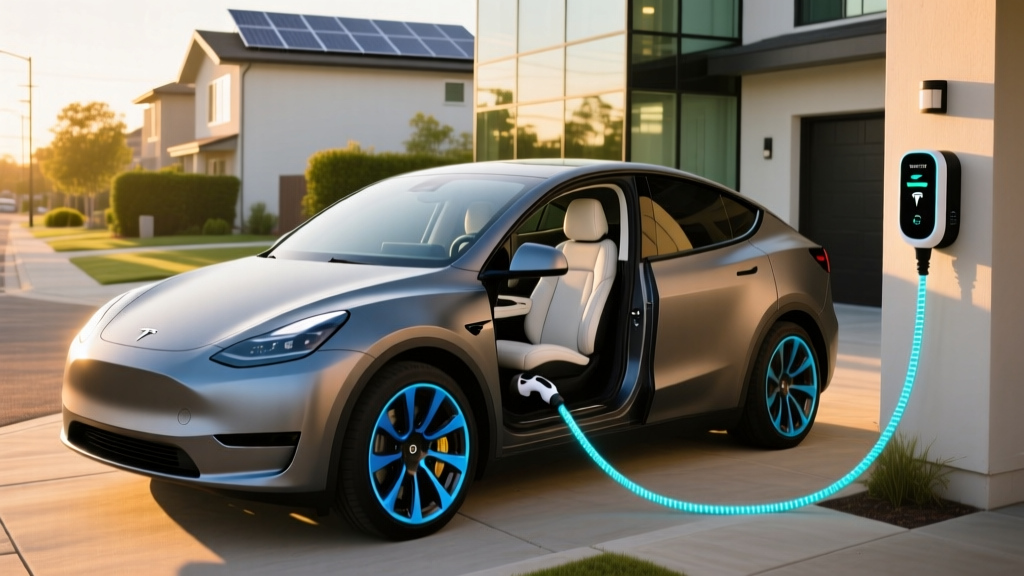
- Rooftop solar + home charger: A typical 8 kW residential solar system ($20,000-$28,000 before incentives, per Energy.gov) can generate enough electricity to cover both household use and EV charging in many climates. Payback periods range from 6-10 years depending on local rates and the 30% federal solar tax credit.
- Community solar programs: If you can't install panels (apartment, shaded roof), many utilities offer community solar subscriptions where you buy a share of a local solar farm and receive credits on your bill.
- Green energy utility plans: Providers like Xcel Energy, Austin Energy, and Portland General Electric offer 100% renewable plans, often for a small premium of $3-$8/month.
- Time-of-use (TOU) optimization: Charging during off-peak hours (typically 10 PM - 6 AM) means you're drawing from the grid when the renewable share is often higher (wind tends to peak overnight) and rates are lowest.
Home charging access caveat: Not every EV buyer can charge at home. If you live in an apartment or lack a dedicated parking spot with outlet access, public charging becomes your primary option — and public networks like Electrify America and EVgo increasingly source from renewable-heavy grids or purchase renewable energy certificates (RECs).
EV vs. Gas vs. Hybrid: Which Is Actually Cleaner?
Let's compare a popular EV, a comparable hybrid, and a conventional gas car across real ownership metrics:
| Metric | 2026 Tesla Model 3 RWD | 2026 Toyota Prius (HEV) | 2026 Honda Civic (Gas, 33 MPG) |
|---|---|---|---|
| Base MSRP | $38,990 | $28,350 | $25,350 |
| Federal tax credit (§30D) | Up to $7,500 (if eligible) | $0 | $0 |
| Effective price (after credit) | ~$31,490 | $28,350 | $25,350 |
| EPA range / MPG | 341 mi (EPA) | 57 MPG combined | 33 MPG combined |
| Fuel/energy cost per mile | $0.043 (home, nat'l avg) | $0.060 ($3.40/gal) | $0.103 ($3.40/gal) |
| Annual fuel cost (12,000 mi) | ~$516 | ~$716 | ~$1,236 |
| 5-year fuel cost | ~$2,580 | ~$3,580 | ~$6,180 |
| CO₂ per mile (avg U.S. grid/gas) | ~170 g | ~250 g | ~400 g |
| Maintenance cost (5 yr est.) | ~$1,500 | ~$2,800 | ~$3,200 |
What this shows: The EV has the highest sticker price but the lowest operating costs. After the §30D credit, the effective purchase gap narrows significantly. Over five years, the Model 3 saves roughly $3,600 in fuel and $1,700 in maintenance compared to the gas Civic — enough to offset most of the remaining price difference. The Prius sits in between: cheaper to buy than the EV, but you'll never eliminate tailpipe emissions, and it doesn't get cleaner as the grid evolves.
Note on the §30D credit: Eligibility depends on buyer income caps ($150K single / $300K joint), vehicle MSRP caps ($55K cars / $80K SUVs/trucks), and battery component/mineral sourcing requirements. Always verify current-year rules at IRS.gov and consult a tax professional. The credit can now be transferred to the dealer at point of sale as an upfront discount.
Common Misconceptions About EVs and Renewable Energy
| Myth | Fact |
|---|---|
| "EVs are just coal-powered cars" | Even on coal-heavy grids, large power plants are more efficient than small car engines. An EV on the average U.S. grid still emits ~57% less CO₂ per mile than a 27 MPG gas car. |
| "The grid can't handle millions of EVs" | Most EV charging happens overnight when grid demand is low. Studies by the National Renewable Energy Laboratory show that managed charging (TOU rates, smart chargers) keeps grid stress minimal through at least 30 million EVs. |
| "EV battery production makes them worse than gas cars" | Manufacturing an EV does produce ~1-2 more tons of CO₂ than a gas car (mainly from battery production). But the EPA and multiple lifecycle studies show this "carbon debt" is repaid within 6,000-20,000 miles of driving, after which the EV is net cleaner for its entire life. |
| "Renewable energy is too unreliable for EV charging" | Grid-scale battery storage has grown over 500% since 2020. Modern grids manage variable renewables with storage, demand response, and interconnection — reliability has not declined in high-renewable states like Texas or California. |
| "I need solar panels to make my EV green" | No. The grid is getting cleaner every year. An EV bought today on today's grid is already cleaner than a gas car — and gets cleaner automatically as utilities retire coal plants and add wind/solar. |
Decision Framework: Is an EV Right for Your Situation?
Use this practical framework to decide:
Choose an EV if:
- You have access to home or workplace Level 2 charging (240V, 7-11 kW)
- Your daily driving is under 200 miles (covers 95%+ of U.S. drivers)
- Your state grid has meaningful renewable share or is trending greener
- You want the lowest per-mile operating cost and are eligible for §30D credits
- You value zero tailpipe emissions in your community
Choose a PHEV (plug-in hybrid) if:
- You lack reliable home charging but want some electric driving
- You regularly take road trips exceeding 300+ miles through areas with sparse DC fast charging
- You want to reduce fuel use without any range compromise
- Models like the Toyota RAV4 Prime (42 mi electric, 38 MPG gas) or Jeep Wrangler 4xe (22 mi electric) fit your needs
Choose a conventional hybrid (HEV) if:
- You have zero charging access (street parking, no outlet)
- Your budget is under $28,000 and you need maximum fuel efficiency now
- You drive in extreme cold climates where EV range loss (15-30% below 20°F) is a concern
Wait or reconsider if:
- You live in a rural charging desert with no DC fast chargers within 50+ miles
- You regularly tow heavy loads (towing can cut EV range by 40-50%)
- Your local electricity rates exceed $0.35/kWh with no off-peak discount
Frequently Asked Questions
Is the electricity I use to charge my EV considered renewable?
Only the portion that matches your grid's renewable share. On the national average, about 23% of your charging electricity comes from renewables. You can increase this to 100% by installing solar panels, subscribing to a community solar program, or switching to a green energy utility plan.
Does charging an EV on a coal-heavy grid still help the environment?
Yes. Even on the most coal-dependent U.S. grids, an EV produces fewer grams of CO₂ per mile than an average gasoline car. Large power plants are thermally more efficient than small internal combustion engines, and they're subject to emissions controls that individual cars are not. Plus, the grid mix improves over time — your gas car never gets cleaner.
How much does it cost to charge an EV at home vs. buying gas?
At the national average residential rate of ~$0.17/kWh, fully charging a 75 kWh battery costs about $12.75 — providing roughly 300 miles of range. That same 300 miles in a 27 MPG gas car at $3.40/gallon costs about $37.78. Home EV charging is roughly 65% cheaper per mile on average.
Will the power grid be able to support more EVs in the future?
Current grid infrastructure can support tens of millions of EVs, especially since most charging occurs during off-peak overnight hours when excess capacity exists. Utilities are investing in managed charging programs, grid-scale battery storage, and distribution upgrades. The transition is gradual — EVs still represent under 10% of vehicles on the road — giving the grid time to adapt.
What's the best way to ensure my EV runs on renewable energy?
The most direct approach is rooftop solar paired with a Level 2 home charger. If that's not feasible, look for your utility's green energy or renewable energy certificate (REC) program. Many utilities offer 100% renewable plans for a modest monthly premium. Charging during overnight hours also tends to draw from a higher renewable share due to wind generation patterns.