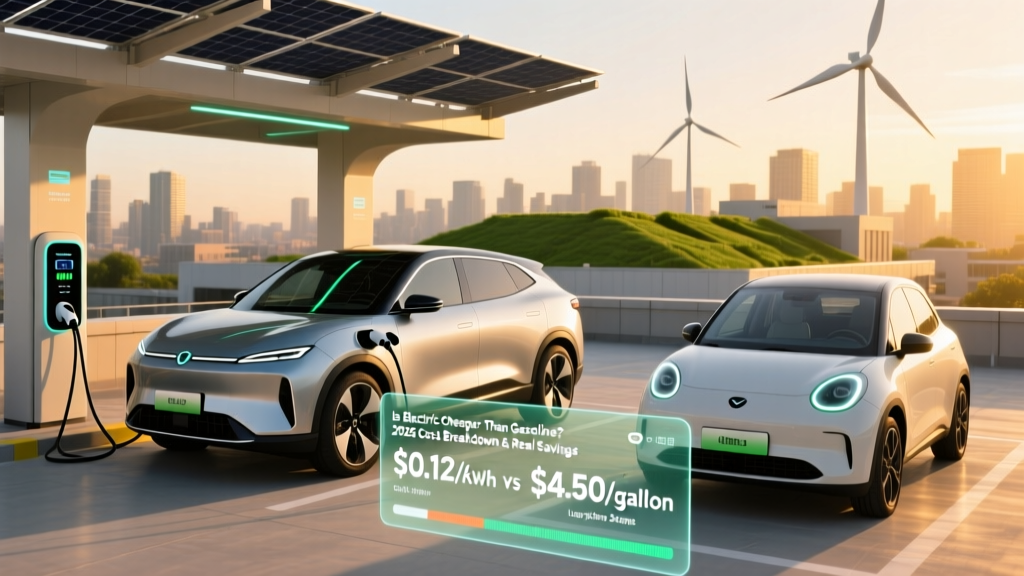
Quick Answer: Is Electric Cheaper Than Gasoline?
Yes, in most cases — but the savings depend heavily on how you charge. A typical EV owner who charges primarily at home saves $800–$1,500 per year on fuel compared to a 27 MPG gas car, and $400–$700 per year on maintenance. However, the upfront purchase price of an EV is still $3,000–$8,000 higher on average before incentives. If you qualify for the federal §30D tax credit (up to $7,500) and charge at home, an EV usually reaches cost parity within 2–4 years. If you rely entirely on public DC fast charging, fuel savings shrink to $100–$400 annually, and break-even can stretch beyond 6 years.
The Real Cost of Driving Electric vs. Gas in 2026
The sticker price is only the beginning. To answer whether an electric vehicle is truly cheaper than a gasoline car, you need to compare the total cost of ownership across five categories: purchase price, fueling (electricity vs. gasoline), maintenance, insurance, and depreciation. Let's walk through each with concrete 2026 numbers.
Purchase Price and Incentives
The average transaction price for a new EV in early 2026 sits around $45,000, compared to roughly $38,000 for a comparable gas-powered compact SUV. That $7,000 gap narrows significantly with incentives. The IRS §30D federal tax credit provides up to $7,500 for qualifying new EVs — but eligibility is not universal. Per current IRS rules, the credit requires:
- Vehicle MSRP under $55,000 (sedans/wagons) or $80,000 (SUVs/pickups)
- Buyer modified adjusted gross income under $150,000 (single) or $300,000 (joint)
- Battery components and critical minerals meeting North American sourcing thresholds that tighten annually
- The credit can now be transferred to the dealer as a point-of-sale discount
Many popular models — including certain trims of the Tesla Model Y, Hyundai Ioniq 5, and Chevrolet Equinox EV — qualify for the full $7,500 as of 2026, but always verify specific VIN eligibility on fueleconomy.gov before purchasing, as battery sourcing rules change frequently.
Fueling Costs: Electricity vs. Gasoline by the Numbers
This is where EVs make their strongest case — provided you charge smartly. Let's compare a representative EV and gas car over 12,000 miles per year (the U.S. average).
| Scenario | EV (e.g., Hyundai Ioniq 5 SEL, 3.6 mi/kWh) | Gas Car (e.g., Toyota RAV4 LE, 30 MPG combined) |
|---|---|---|
| Home charging (Level 2, $0.14/kWh avg) | $467/year | N/A |
| Gasoline ($3.45/gal national avg) | N/A | $1,380/year |
| Public DC fast charging only ($0.48/kWh avg) | $1,600/year | N/A |
| Mixed (70% home / 30% public) | $807/year | N/A |
The takeaway: Home charging delivers savings of roughly $913/year versus gasoline. Even a mixed 70/30 charging pattern saves over $570 annually. But if you rely exclusively on public DC fast chargers — where rates from networks like Electrify America and EVgo can reach $0.40–$0.60/kWh — you'll actually spend more than a fuel-efficient gas car. This is the single biggest variable most cost calculators gloss over.
Understanding the Units: kW vs. kWh
A quick clarification that trips up many first-time EV buyers: kW (kilowatts) measures power — how fast energy flows, like the flow rate of a gas pump. kWh (kilokilowatt-hours) measures energy — the total amount stored or consumed, like gallons in a tank. When you see a charger rated at 150 kW, that's its maximum delivery rate. When you see a battery rated at 77.4 kWh, that's its total capacity. Your cost per kWh is what you pay for energy; the kW rating determines how quickly you get it.
Maintenance, Insurance, and Depreciation
Maintenance Savings
EVs have far fewer moving parts than internal combustion vehicles. There are no oil changes, no spark plugs, no timing belts, no exhaust systems, and no multi-speed transmissions. Brake wear is dramatically reduced thanks to regenerative braking, which uses the motor to slow the car and recapture energy. According to fueleconomy.gov, the average EV maintenance cost runs about $0.061 per mile compared to $0.101 per mile for a gas car — a savings of roughly $480/year at 12,000 miles.
What you will still pay for: tire rotations (EVs are heavier and wear tires faster), cabin air filter replacement, brake fluid checks, and eventually coolant flushes for the battery thermal management system. Budget roughly $300–$500/year for EV maintenance versus $700–$1,100 for a gas equivalent.
Insurance Costs
This is where EVs often cost more. Average EV insurance premiums run 15–25% higher than comparable gas vehicles, primarily because EV repair costs after collisions are higher (battery pack replacement can total a vehicle). For a typical EV, expect to pay $1,800–$2,400/year for full coverage versus $1,400–$1,900 for a gas equivalent — an added cost of roughly $300–$500/year. Shop quotes from multiple carriers; some insurers now offer EV-specific discounts.
Depreciation
EV depreciation has historically been steeper than gas cars, driven by rapid technology improvements, Tesla price cuts, and buyer uncertainty about long-term battery health. However, as battery warranties have standardized around 8 years/100,000 miles and models like the Ioniq 5 and Model Y have proven durable, the gap has narrowed. Expect a mainstream EV to retain roughly 45–55% of its value after 5 years, compared to 50–60% for a popular gas SUV. The tax credit, if applied at purchase, partially offsets this by lowering your effective cost basis.
5-Year Total Cost of Ownership Comparison
Let's put it all together with a realistic 5-year, 60,000-mile scenario comparing a 2026 Hyundai Ioniq 5 SEL (AWD, 77.4 kWh NMC battery, EPA 290 miles) against a 2026 Toyota RAV4 LE (AWD, gas).
| Cost Category | 2026 Hyundai Ioniq 5 SEL (EV) | 2026 Toyota RAV4 LE (Gas) |
|---|---|---|
| MSRP | $47,950 | $33,500 |
| Federal §30D tax credit | −$7,500 | $0 |
| Effective purchase price | $40,450 | $33,500 |
| Fueling (5 years, 70% home / 30% public) | $4,035 | $6,900 |
| Maintenance (5 years) | $2,000 | $4,250 |
| Insurance (5 years) | $10,500 | $8,250 |
| Estimated resale value (year 5) | −$22,000 | −$18,500 |
| Net 5-year cost | $34,985 | $34,400 |
At near-parity on 5-year cost, the EV pulls ahead in years 6–10 as fuel and maintenance savings compound while the gas car faces increasing repair costs (transmission, exhaust, engine components). By year 8, the Ioniq 5 owner typically leads by $2,000–$4,000 in cumulative savings — and that gap widens if gas prices rise.
Common Misconceptions About EV Costs
| Myth | Fact |
|---|---|
| "EVs always save money on fuel." | Only if you charge at home or at low-cost public chargers. Exclusive DC fast charging at $0.48+/kWh can cost more than gasoline per mile. |
| "Battery replacement will cost $20,000." | Full pack replacement on mainstream models runs $8,000–$15,000 in 2026, but most batteries retain 85–92% capacity at 150,000 miles. The 8-year/100,000-mile federal warranty covers defects and excessive degradation (below 70% capacity). |
| "EVs are always more expensive to buy." | After the $7,500 federal credit, several EVs (Chevrolet Equinox EV at ~$26,000 effective, Nissan Leaf at ~$22,000 effective) undercut gas equivalents on effective purchase price. |
| "Charging takes too long to be practical." | Home Level 2 charging (7–11 kW) adds 25–40 miles per hour — more than enough to replenish daily driving overnight. DC fast charging on modern platforms peaks at 200–350 kW, reaching 10–80% in 18–25 minutes. |
| "Cold weather makes EVs impractical." | Cold reduces range by 15–30% in freezing temperatures due to battery chemistry and cabin heating demands. A 290-mile EPA EV may deliver 200–240 real-world miles at 20°F. Preconditioning the battery while plugged in mitigates this and preserves fast-charge speed. |
Real-World Ownership Considerations
Do You Have Home Charging Access?
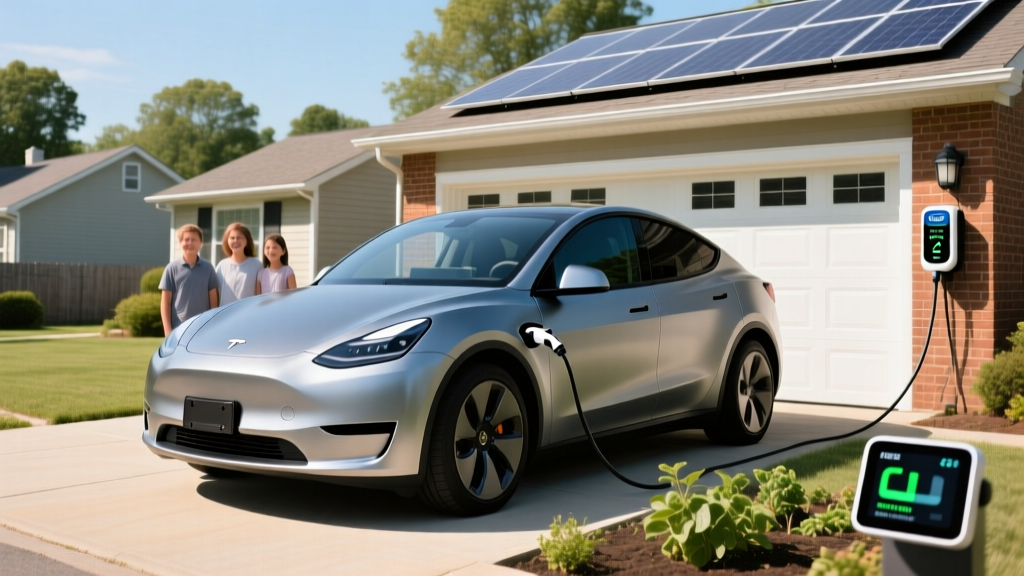
This is the single most important question for cost savings. Roughly 75% of EV owners charge at home, and it accounts for the bulk of their fueling. A Level 2 home charger (240V, 32–48 amps) costs $500–$1,200 for the unit plus $800–$2,500 for professional installation by a licensed electrician, depending on whether your electrical panel needs an upgrade. If you live in an apartment or lack dedicated parking, public charging becomes your primary source — and your costs rise accordingly.
What Are Your Driving Patterns?
If your daily commute is under 50 miles round-trip, even a modest-range EV with a 60 kWh battery handles it effortlessly with home charging. If you regularly drive 200+ miles between cities, you'll need a vehicle with 300+ miles of EPA range and fast DC charging capability (peak 200+ kW) — and you'll spend more time and money on road-trip charging. For frequent long-distance drivers, a plug-in hybrid (PHEV) like the Toyota RAV4 Prime (42 miles electric-only, 38 MPG combined on gas) may deliver better economics.
What Is Your Climate?
In mild climates (Southern California, Southeast), EVs operate near their EPA range year-round. In cold-winter regions (Upper Midwest, Northeast), expect a 15–30% range reduction in sustained sub-freezing temperatures. Vehicles equipped with a heat pump — standard on the Ioniq 5, Tesla Model Y, and many 2026 models — reduce cabin heating energy draw by 30–50% compared to resistive heaters, partially recovering cold-weather range.
Decision Framework: Should You Go Electric?
Choose an EV if:
- You have access to home charging (garage, driveway, or workplace Level 2)
- Your daily driving is under 80 miles and most trips are under 200 miles
- You qualify for the §30D federal tax credit (check income and vehicle eligibility on irs.gov)
- You plan to keep the vehicle 5+ years (savings compound over time)
- You value instant torque, quiet operation, and one-pedal driving
Choose a hybrid (HEV) or plug-in hybrid (PHEV) if:
- You lack reliable home or workplace charging
- You frequently drive 300+ miles in areas with sparse charging infrastructure
- You live in an extreme-cold climate and want zero range-compromise flexibility
- Your budget is under $30,000 and you need maximum upfront affordability (a Toyota Prius HEV starts at ~$28,000, achieves 57 MPG combined)
Stick with gasoline (for now) if:
- You drive fewer than 5,000 miles/year (fuel savings won't offset the EV premium)
- You cannot install or access any Level 2 charging and DC fast chargers are more than 15 minutes away
- You need heavy towing capacity (5,000+ lbs) on a tight budget — EV trucks like the F-150 Lightning handle towing but range drops 40–50% under load
Frequently Asked Questions
How much does it cost to charge an EV at home per month?
At the U.S. average residential electricity rate of $0.14/kWh and 1,000 miles/month of driving, expect to spend $38–$50/month on home charging for a typical EV getting 3.0–3.6 miles per kWh. Compare that to $115/month for gasoline at $3.45/gal and 30 MPG.
Are EVs really cheaper to maintain long-term?
Yes. With no engine oil, transmission fluid, spark plugs, timing belts, or exhaust systems, routine maintenance drops to tire rotations, cabin filters, wiper fluid, and brake inspections. Regenerative braking extends pad life to 100,000+ miles in many cases. The main long-term cost variable is the traction battery, but degradation data shows most NMC and LFP packs retain 85–92% capacity at 150,000 miles, and federal warranty mandates cover 8 years/100,000 miles minimum.
What happens if my EV battery fails out of warranty?
Full battery pack replacement costs $8,000–$15,000 depending on the model and chemistry. However, catastrophic failure is rare; most degradation is gradual. Some independent shops now offer module-level repair (replacing individual bad cells rather than the entire pack) for $2,000–$5,000. LFP (lithium iron phosphate) batteries, found in standard-range Teslas and some newer models, offer longer cycle life and slower degradation than NMC, though at the cost of lower energy density and reduced cold-weather performance.
Do I qualify for the $7,500 federal EV tax credit?
Eligibility depends on three factors: your income (under $150K single / $300K joint filers), the vehicle's MSRP (under $55K for cars, $80K for SUVs/trucks), and the battery's critical-mineral and component sourcing. As of 2026, sourcing requirements are stringent, and not every EV qualifies for the full amount. The credit can be applied as a point-of-sale discount through a registered dealer, reducing your out-of-pocket cost immediately. Always confirm eligibility on fueleconomy.gov and consult a tax professional for your specific situation.
Is a plug-in hybrid cheaper than a full EV?
A PHEV can be cheaper if your daily commute fits within its electric-only range (typically 25–45 miles on current models) and you charge nightly, using gas only for longer trips. You avoid range anxiety and public-charging dependency. However, PHEVs have smaller batteries (10–20 kWh), meaning less electric savings overall, and you still carry maintenance costs for the gasoline engine. For a single-car household that regularly takes 300+ mile trips, a PHEV is often the most cost-effective bridge to electrification.