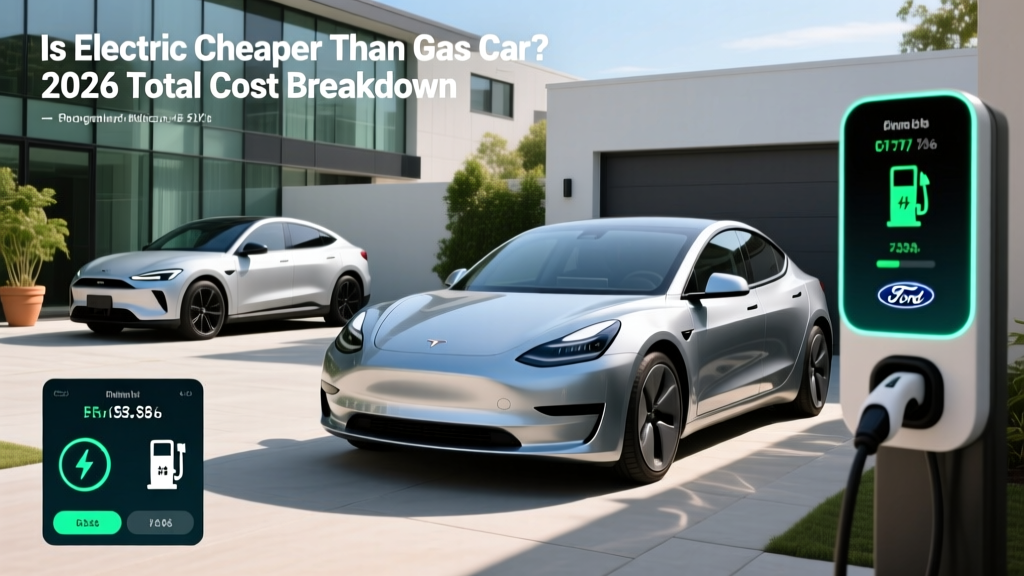
The Short Answer: It Depends on Your Situation
For most buyers in 2026, an EV becomes cheaper than a comparable gas car within 2 to 4 years of ownership — but only if you can charge at home and drive 10,000+ miles annually. The upfront price gap has narrowed dramatically (many EVs now start under $35,000), fuel savings average $800–$1,500 per year depending on your local electricity rates, and maintenance costs run roughly 40–50% lower. However, if you rely entirely on public DC fast charging, live in an apartment without charging access, or drive fewer than 6,000 miles per year, a hybrid or efficient gas car may still cost less over five years. The math changes based on your electricity rate, driving habits, and whether you qualify for the federal §30D tax credit.
Purchase Price: The Upfront Gap in 2026
The sticker price of EVs has fallen significantly. Tesla's Model 3 starts around $38,990, the Chevrolet Equinox EV begins near $33,600, and the Hyundai Kona Electric opens at $32,975. Meanwhile, a comparable gas-powered compact SUV like the Honda CR-V starts at $31,450 and the Toyota RAV4 at $30,250. That means the raw MSRP gap is typically $2,000–$6,000 for mainstream models.
But the effective price gap is often much smaller thanks to the IRS §30D federal tax credit, which offers up to $7,500 for qualifying new EVs — and as of 2024, can be transferred to the dealer at the point of sale, effectively reducing the purchase price on the spot. Eligibility is not universal, though. Here are the current constraints:
- MSRP cap: Vans, SUVs, and pickup trucks must be priced at or below $80,000; sedans and other body styles at or below $55,000.
- Buyer income cap: Modified adjusted gross income (MAGI) must not exceed $300,000 (joint filers), $225,000 (head of household), or $150,000 (individual).
- Battery sourcing: The vehicle must meet critical-mineral and battery-component requirements that shift annually — fewer models qualify each year as rules tighten.
- Assembly: Final assembly must occur in North America.
Always verify a specific model's eligibility on the IRS clean vehicle credit page before committing. Manufacturers sometimes change battery suppliers mid-year, which can affect qualification.
Fueling vs. Charging: Where the Real Savings Live
This is where EVs typically win big — but the savings vary enormously depending on how and where you charge. Let's compare a 2026 Tesla Model 3 Rear-Wheel Drive (132 MPGe combined, ~27 kWh/100 mi) against a 2026 Honda Civic 2.0L (33 MPG combined).
| Scenario | EV (Tesla Model 3 RWD) | Gas (Honda Civic 2.0L) | Annual EV Savings |
|---|---|---|---|
| Home charging at $0.16/kWh (national avg.) | $518 | $1,273 (at $3.50/gal) | $755 |
| Home charging at $0.28/kWh (CA/MA avg.) | $907 | $1,273 | $366 |
| Home solar (effective $0.06/kWh) | $194 | $1,273 | $1,079 |
| 100% public DC fast charging ($0.48/kWh avg.) | $1,555 | $1,273 | −$282 (EV costs more) |
| Mixed: 80% home / 20% public DCFC | $630 | $1,273 | $643 |
The takeaway is clear: home charging is the single biggest factor in whether an EV saves you money on energy. If you charge exclusively on public DC fast chargers at $0.40–$0.55/kWh (common on Electrify America and EVgo networks in 2026), you may actually spend more per mile than a 33-MPG gas car. But with Level 2 home charging on an average utility rate, the EV wins by $600–$1,100 per year.
One often-overlooked detail: electricity rates vary by time of day. Many utilities offer off-peak EV charging rates as low as $0.06–$0.10/kWh overnight. If your utility offers a dedicated EV time-of-use (TOU) plan, plug in after 9 PM and your per-mile cost drops below even the most efficient hybrid.
Maintenance and Repair Costs
EVs have far fewer moving parts than internal combustion vehicles — no oil changes, no spark plugs, no transmission fluid flushes, no timing belts. Regenerative braking also dramatically extends brake pad life; many EV owners report original brake pads at 80,000+ miles.
According to data from Consumer Reports and the U.S. Department of Energy, EV maintenance costs average roughly $0.061 per mile compared to $0.101 per mile for gas cars. Over five years at 12,000 miles annually, that translates to:
- EV maintenance (5 years): ~$3,660
- Gas car maintenance (5 years): ~$6,060
- Savings: ~$2,400
However, EVs aren't maintenance-free. Tire wear tends to be 10–20% faster due to higher vehicle weight and instant torque, so budget for tire replacements roughly every 30,000–40,000 miles instead of 45,000–55,000. Cabin air filters, wiper fluid, and washer blades still need attention. And while battery replacements are rare in the first 10 years (most manufacturers warranty 8 years/100,000 miles at 70% capacity retention), an out-of-warranty pack replacement can run $8,000–$18,000 depending on the model.
Insurance: The Cost Most Buyers Overlook
EV insurance premiums are typically 15–25% higher than for comparable gas cars. Reasons include higher repair costs after collisions (specialized labor, battery safety protocols), more expensive replacement parts, and higher vehicle values. According to industry data, the average annual EV insurance premium in 2026 is approximately $2,100–$2,600, compared to $1,700–$2,100 for a similarly priced gas vehicle.
That means an extra $300–$600 per year in insurance costs — a figure that partially offsets fuel and maintenance savings. Always get insurance quotes for the specific EV model and trim you're considering before buying. Some insurers offer dedicated EV discounts; Tesla Insurance (available in select states) and a handful of mainstream carriers have competitive EV-specific rates.
Depreciation: The Wild Card
EV depreciation has been volatile. In 2023–2024, aggressive Tesla price cuts sent used EV values tumbling, and some models lost 40–50% of their value in the first two years. By 2026, the market has stabilized somewhat, but EVs still tend to depreciate faster than top-selling gas vehicles like the Toyota RAV4 or Honda CR-V, which hold value exceptionally well.
Average 5-year depreciation estimates:
- Mainstream EV (e.g., Hyundai Ioniq 5, VW ID.4): 45–55%
- Tesla Model 3/Y: 40–50%
- Gas compact SUV (e.g., RAV4, CR-V): 35–42%
- Hybrid (e.g., RAV4 Hybrid, Prius): 30–38%
Depreciation matters enormously for total cost of ownership. If you buy a $40,000 EV that retains $18,000 after five years, you've lost $22,000 to depreciation. A $33,000 RAV4 Hybrid retaining $20,500 has cost you just $12,500 in depreciation — a $9,500 gap that can erase years of fuel savings. Buying used (2–3 years old) dramatically reduces this hit, as the first owner absorbs the steepest depreciation curve.
5-Year Total Cost of Ownership: Side by Side
| Cost Category | Tesla Model 3 RWD ($38,990) | Honda Civic ($26,450) | Toyota Prius ($29,450) |
|---|---|---|---|
| Purchase price (after incentives) | $31,490 (est. $7,500 credit) | $26,450 | $29,450 |
| Fuel / energy (5 years) | $2,590 | $6,365 | $3,820 |
| Maintenance (5 years) | $3,660 | $6,060 | $4,800 |
| Insurance (5 years) | $12,500 | $9,500 | $10,000 |
| Depreciation (5-year loss) | $15,500 | $11,200 | $10,800 |
| Total 5-Year Cost | $65,740 | $59,575 | $58,870 |
In this scenario, the Model 3 with a full $7,500 tax credit still costs roughly $6,000–$7,000 more over five years than the Civic or Prius, primarily due to higher insurance and depreciation. But this changes significantly under different conditions:
- With solar charging ($0.06/kWh): EV energy cost drops to ~$970 over 5 years, saving ~$1,600.
- If gas hits $4.50/gallon: Civic fuel cost rises to ~$8,190, narrowing the gap by ~$1,800.
- Buying a 2-year-old Model 3 used: Depreciation loss drops to roughly $8,000–$10,000, making the EV competitive or cheaper overall.
- Higher annual mileage (18,000+ mi/yr): Fuel savings compound, often pushing the EV ahead by year 3.
Real-World Ownership Considerations
Numbers on a spreadsheet don't capture everything. Here are practical factors that affect whether an EV is the cheaper — and smarter — choice for you:
Home charging access: This is the make-or-break factor. A Level 2 home charger (240V, typically 7.7–11.5 kW) adds 25–44 miles of range per hour of charging and costs $500–$2,000 to install, depending on whether your electrical panel needs an upgrade. Without home charging, you'll rely on public infrastructure at significantly higher per-kWh costs and less convenience.
Climate: In cold weather (below 30°F), EVs lose 15–30% of their rated range due to battery chemistry and cabin heating demands. A Model 3 with an EPA-rated 341 miles may deliver only 240–270 miles in a Minnesota winter. If your daily commute is short, this isn't a dealbreaker — but it matters for road trips and high-mileage drivers in northern states.
Driving patterns: EVs are most efficient in stop-and-go city driving where regenerative braking recaptures energy. Highway driving at 75+ MPH reduces efficiency by 10–15% compared to the EPA combined rating. If you drive mostly highway miles, your real-world range and energy savings will be lower than the sticker suggests.
Charging speed and road trips: Most 2026 EVs charge at 150–250 kW peak on DC fast chargers, with 10–80% times of 18–30 minutes. But peak rate is not sustained rate — charging slows significantly above 80% to protect the battery. Plan for 25–40 minute stops every 200–250 miles on long trips. The EPA's fueleconomy.gov site lists real-world efficiency data for every model.
Common Misconceptions
| Myth | Fact |
|---|---|
| "EVs always save you money." | Only with home charging, moderate-to-high mileage, and favorable electricity rates. Public-only charging can cost more than gas. |
| "The battery will need replacing in 5 years." | Modern LFP and NMC batteries routinely last 150,000–200,000+ miles with less than 15% degradation. Most are warrantied for 8 years/100,000 miles at 70% capacity. |
| "Everyone qualifies for the $7,500 tax credit." | Eligibility depends on MSRP caps, buyer income, battery sourcing, and North American assembly. Many popular EVs do not qualify in 2026 due to tightening sourcing rules. |
| "EVs are cheaper to insure." | EV insurance is typically 15–25% more expensive due to higher repair costs and specialized parts. |
| "I'll save on maintenance forever." | You save on powertrain maintenance, but tire wear is faster and eventual battery replacement (if needed post-warranty) is a major expense. |
Decision Framework: Should You Go Electric?
Choose an EV if:
- You can install a Level 2 charger at home (garage, driveway, or workplace with charging).
- You drive 10,000+ miles per year — higher mileage means faster payback on fuel savings.
- Your utility offers competitive electricity rates (under $0.20/kWh) or a dedicated EV TOU plan.
- You qualify for the §30D tax credit or your state offers additional EV incentives.
- You mostly drive in moderate climates or can accept 20–30% winter range loss.
- You're buying used (2–3 years old) to avoid the steepest depreciation.
Choose a Hybrid (HEV/PHEV) if:
- You live in an apartment or condo without charging access and can't install a home charger.
- You drive fewer than 8,000 miles per year — fuel savings won't offset the EV premium.
- You frequently take long road trips through areas with sparse charging infrastructure.
- You live in an extremely cold climate and need consistent range year-round without compromise.
- You want the lowest total cost of ownership with zero charging hassle — the Prius and RAV4 Hybrid are hard to beat on pure economics.
Stick with Gas if:
- Your budget is under $25,000 and you're buying used — the used EV market is still limited at this price point.
- You tow heavy loads regularly — EV range drops 30–50% when towing, and few affordable EVs are rated for serious towing.
- You need maximum cargo flexibility and the lowest upfront cost possible.
Frequently Asked Questions
What is the cheapest EV to own in 2026?
The Chevrolet Equinox EV (starting ~$33,600, eligible for the full $7,500 credit for qualifying buyers) and the Hyundai Kona Electric (~$32,975) are among the most affordable new EVs when incentives are applied. For used buyers, a 2023–2024 Tesla Model 3 or Nissan Leaf can be found well under $25,000, though the Leaf's CHAdeMO connector limits DC fast-charging options.
How much does it cost to charge an EV at home per month?
At the national average electricity rate of $0.16/kWh and driving 1,000 miles per month in an EV averaging 3.0 miles/kWh (like the Hyundai Ioniq 6), expect roughly $53 per month. That's equivalent to about $1.77 per gallon of gasoline — dramatically less than the $3.50+ national gas average.
Do EVs really have lower maintenance costs?
Yes, for powertrain-related maintenance. No oil changes, no transmission service, no exhaust system repairs, and regenerative braking extends brake pad life to 80,000+ miles in many cases. However, EVs go through tires faster due to weight and torque, and you'll still pay for cabin filters, wipers, and fluid top-offs. Overall, expect to spend about 40% less on routine maintenance.
Is a plug-in hybrid (PHEV) cheaper than a full EV?
A PHEV like the Toyota RAV4 Prime or Jeep Wrangler 4xe can be cheaper than a full EV if you have a short commute (under 30 miles) that fits within the electric-only range (25–42 miles for most PHEVs) and can charge at home. You get daily electric driving with gas flexibility for road trips. However, PHEVs have both an electric and gas powertrain to maintain long-term, and they typically don't qualify for the full $7,500 federal credit (most qualify for $3,750 or none at all in 2026).
What happens if my EV battery fails after the warranty?
Battery failure before 150,000 miles is statistically uncommon for modern LFP and NMC chemistries. Gradual degradation (losing 10–20% capacity over 10 years) is the norm, not sudden failure. If a replacement is needed out of warranty, costs range from approximately $8,000 for a Nissan Leaf pack to $15,000–$18,000 for larger packs in vehicles like the Ford F-150 Lightning. Third-party refurbishment and module-level repair services are growing, often cutting replacement costs by 40–50%.
How do I check if a specific EV qualifies for the federal tax credit?
Visit the IRS Clean Vehicle Credit page and cross-reference the manufacturer's listed eligible models. Also confirm your income falls below the MAGI caps ($150K individual / $300K joint) and the vehicle's MSRP is within limits ($55K for sedans, $80K for SUVs/trucks). Rules can change mid-year, so verify close to your purchase date. For personalized guidance, consult a tax professional.