The Short Answer: BYD Is Not Selling Cars in the USA Yet
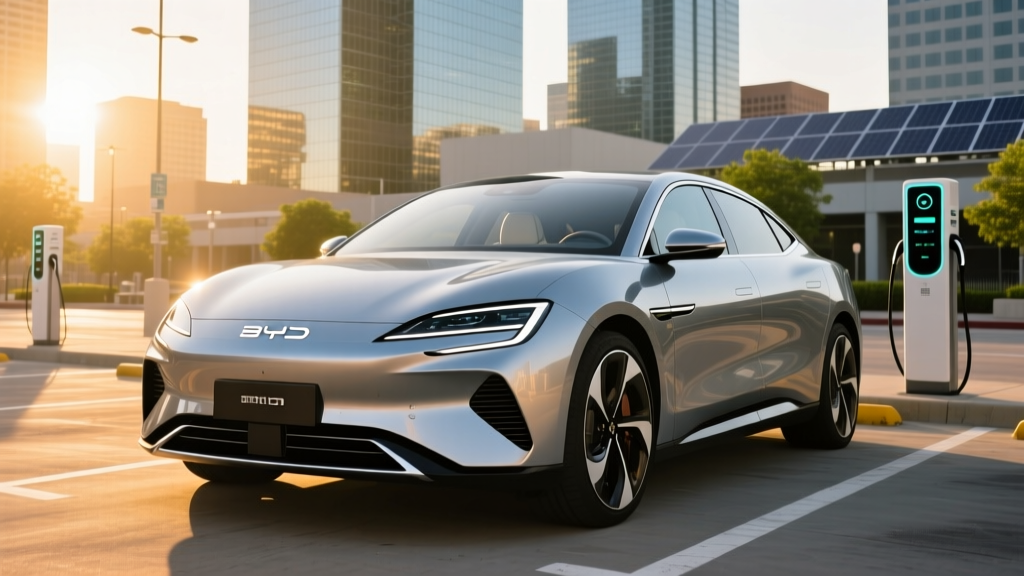
If you've been searching is BYD coming to USA, you're not alone. BYD (Build Your Dreams) is the world's largest producer of plug-in electric vehicles, surpassing Tesla in total NEV sales globally. Yet as of early 2026, BYD does not sell passenger cars in the United States. The company operates a commercial vehicle division in California — building electric buses and heavy-duty trucks — but its consumer EV lineup remains absent from American showrooms.
The barriers aren't about vehicle quality or technology. They're primarily political and economic. A combination of 100%+ tariffs on Chinese-made EVs, federal battery-sourcing restrictions under the Inflation Reduction Act, and national security concerns around connected-vehicle software have effectively walled off the US market. Here's exactly what that means for American EV shoppers eyeing BYD's increasingly competitive global lineup.
Why BYD Hasn't Entered the US Passenger Car Market
The Tariff Wall
In May 2024, the Biden administration raised tariffs on Chinese-made electric vehicles from 25% to 100% under Section 301 trade provisions. These tariffs were upheld and reinforced through 2025 and into 2026. For a vehicle like the BYD Seal — which starts around €45,000 (roughly $48,000) in Europe — a 100% tariff would push the landed cost near $96,000 before dealer margins, eliminating the price advantage that makes BYD competitive globally.
Additional tariffs exist on Chinese-made lithium-ion batteries (25%) and critical minerals, compounding the cost problem even if BYD attempted to partially assemble vehicles elsewhere.
Connected Vehicle Ban
In September 2024, the US Department of Commerce proposed rules under the Information and Communications Technology and Services (ICTS) framework that would ban the sale of connected vehicles containing Chinese-manufactured hardware and software. This rule, phased in through 2027, targets the very telematics, ADAS sensors, and infotainment systems that define modern EVs. Even if BYD built a US factory, integrating Chinese-designed software stacks (like BYD's DiLink infotainment and DiPilot ADAS) would likely require a complete ground-up redesign for the American market.
The IRA Battery-Sourcing Problem
Under IRS §30D rules, any vehicle containing battery components from a "foreign entity of concern" (FEOC) — which includes Chinese companies — is disqualified from the $7,500 federal tax credit. Since BYD vertically manufactures its own Blade batteries, any BYD vehicle would be categorically ineligible, further eroding its value proposition against credit-eligible competitors.
Which BYD Models Could Theoretically Compete in the US?
If trade policy shifted, BYD's global lineup includes several vehicles that would be strong contenders in American segments. Here's what we know from international-market specifications — keeping in mind these are WLTP figures, which typically run 10-15% higher than EPA estimates.
| Model | Segment | Battery (kWh) | WLTP Range | Est. EPA Range | 0-60 mph | Drivetrain |
|---|---|---|---|---|---|---|
| BYD Dolphin | Subcompact | 60.4 kWh (LFP) | 265 mi | ~225 mi | 7.0s | FWD |
| BYD Atto 3 | Compact SUV | 60.5 kWh (LFP) | 260 mi | ~220 mi | 7.3s | FWD |
| BYD Seal | Midsize Sedan | 82.5 kWh (LFP) | 354 mi | ~300 mi | 5.9s (RWD) / 3.8s (AWD) | RWD or AWD |
| BYD Han | Full-Size Sedan | 85.4 kWh (LFP) | 320 mi | ~270 mi | 3.9s (AWD) | AWD |
Note: EPA estimates are author projections based on typical WLTP-to-EPA conversion ratios. Actual EPA certification would require US-market testing. All batteries are BYD's proprietary Blade cell (LFP chemistry).
BYD Blade Battery: The LFP Advantage
Every BYD passenger EV uses the company's Blade Battery — a lithium iron phosphate (LFP) cell in a cell-to-pack configuration. LFP chemistry offers several advantages American buyers should understand:
- Safety: LFP cells are significantly more thermally stable than NMC, with a much higher threshold for thermal runaway. BYD's nail-penetration test demonstrates this convincingly.
- Longevity: LFP typically sustains 3,000+ full charge cycles before reaching 80% capacity — roughly double many NMC packs.
- 100% SoC charging: Unlike NMC, LFP can (and should) be regularly charged to 100% without accelerating degradation, giving you the full usable capacity daily.
- Trade-off: LFP has lower energy density (roughly 160 Wh/kg vs. NMC's 250+ Wh/kg) and worse cold-weather performance — expect 25-35% range loss at 20°F, compared to 15-25% for NMC.
Charging Specs: How Fast Would BYD EVs Charge on US Networks?
BYD vehicles sold in Europe and Asia use CCS2 or GB/T connectors. For the US market, they would need CCS1 (current standard) or NACS (Tesla's connector, now adopted by most major automakers for 2025+ models). Here's what we know from international-market testing:
| Level | BYD Seal (82.5 kWh) | BYD Dolphin (60.4 kWh) | Notes |
|---|---|---|---|
| Level 1 (120V, 1.4 kW) | ~4 mi/hr | ~3 mi/hr | Emergency/trickle only |
| Level 2 (240V, 7-11 kW) | ~28 mi/hr (11 kW onboard) | ~22 mi/hr (7 kW onboard) | Full charge overnight (8-10 hrs) |
| DC Fast Charge | Peak 150 kW, 10-80% in ~26 min | Peak 88 kW, 10-80% in ~29 min | Charge curve tapers significantly above 80% |
Charging reality check: BYD's DC fast-charging speeds lag behind competitors. The Hyundai Ioniq 5 peaks at 240 kW (10-80% in ~18 minutes) and the Tesla Model 3 Highland at 250 kW (10-80% in ~15 minutes). BYD's 150 kW peak on the Seal means longer road-trip stops — a meaningful disadvantage on American highway corridors where 350 kW chargers are increasingly common.
One notable advantage: BYD's LFP Blade battery handles repeated DC fast charging with less degradation stress than NMC packs, since LFP chemistry tolerates high-SoC and high-current scenarios more gracefully over the long term.
Pricing, Tax Credits, and What BYD Would Cost in America
Here's where the math gets brutal for any BYD US launch scenario. Let's project what a BYD Seal would cost if imported today, versus credit-eligible competitors already on American soil:
| Vehicle | Base MSRP | §30D Tax Credit | Effective Price | EPA Range |
|---|---|---|---|---|
| BYD Seal (projected, if imported) | ~$48,000 + 100% tariff = ~$96,000 | $0 (FEOC battery) | ~$96,000 | ~300 mi (est.) |
| Tesla Model 3 Long Range | $42,490 | $7,500 (if eligible) | ~$34,990 | 363 mi |
| Hyundai Ioniq 6 SE | $37,500 | $7,500 (if eligible) | ~$30,000 | 361 mi |
| Chevrolet Equinox EV 2LT | $33,600 | $7,500 (if eligible) | ~$26,100 | 319 mi |
Tax Credit Eligibility: The FEOC Disqualifier
Under current IRS §30D rules, the $7,500 federal EV tax credit requires:
- MSRP caps: $55,000 for sedans; $80,000 for SUVs/pickups/vans
- Income caps: $150,000 single / $300,000 married filing jointly (modified AGI)
- Battery sourcing: No battery components from a Foreign Entity of Concern (FEOC) — effective 2024
- Critical minerals: Increasingly strict requirements for US- or FTA-partner-sourced minerals
BYD is a Chinese-headquartered, state-linked manufacturer. Its Blade Battery cells are produced in China. This means any BYD vehicle is automatically disqualified from the §30D credit under the FEOC provision — regardless of price, income, or where the car is assembled. This isn't a gray area; it's a categorical exclusion.
BYD vs. the Competition: How Do the Specs Stack Up?
Setting aside the tariff and tax-credit issues, how would BYD's vehicles compare on pure specs against what's available in US showrooms today?
✅ BYD Strengths
- LFP Blade battery: best-in-class thermal safety and cycle life
- Competitive interior materials and build quality at price point
- Rotating center touchscreen (15.6") on Seal and Han
- Standard V2L (vehicle-to-load) on most models — power devices from your car
- Strong global service network (would need US buildout)
❌ BYD Weaknesses for US Buyers
- DC fast charging 25-40% slower than Hyundai/Kia E-GMP and Tesla
- ADAS (DiPilot) behind Tesla FSD, GM Super Cruise, and Ford BlueCruise in SAE Level 2 refinement
- No US dealer network — zero service infrastructure
- Software ecosystem untested with US apps/services
- LFP cold-weather range loss is significant in northern US climates
Warranty (International — US Terms Unknown)
In European and Australian markets, BYD offers:
- Vehicle warranty: 6 years / 93,000 miles (150,000 km)
- Battery warranty: 8 years / 124,000 miles (200,000 km), retaining ≥70% capacity
These terms are competitive but don't exceed the US-standard 8-year/100,000-mile battery warranty offered by Hyundai, Kia, and Tesla. Whether BYD would match or exceed US warranty norms is unknown.
Could BYD Enter the US Market? Three Possible Scenarios
Scenario 1: Full US Factory Build (Unlikely Before 2030)
BYD could theoretically build a US or Mexico assembly plant, but the FEOC battery rule means the Blade Battery pack would still disqualify the vehicle from tax credits. A US battery plant would require billions in investment and years of construction. BYD has prioritized factory builds in Thailand, Brazil, Hungary, Indonesia, and Turkey — all markets without prohibitive tariffs.
Scenario 2: Technology Licensing or Joint Venture
BYD could license its Blade Battery technology or e-Platform 3.0 architecture to a non-Chinese automaker. This would be similar to how Toyota licensed hybrid tech. However, BYD's vertically integrated model (they make everything in-house) makes partial licensing complex.
Scenario 3: Policy Shift (Depends on Political Climate)
If US-China trade relations thawed and Section 301 tariffs were reduced, BYD could enter the market competitively. Given the current bipartisan consensus on restricting Chinese EV imports, this scenario has a low probability through at least 2028.
What Should US EV Buyers Do Instead?
If you're drawn to BYD because of its value proposition — competitive range, LFP battery longevity, and aggressive pricing — here are the closest US-market alternatives that actually qualify for incentives:
| If You Wanted... | Buy This Instead | Why |
|---|---|---|
| BYD Dolphin (budget EV) | Chevrolet Equinox EV | ~$26K after credit, 319 mi range, US-built |
| BYD Seal (Tesla-fighter sedan) | Tesla Model 3 / Hyundai Ioniq 6 | Better charging, Supercharger access, tax credit eligible |
| BYD Atto 3 (compact SUV) | Hyundai Ioniq 5 / Kia EV6 | Faster charging (240 kW), NACS, strong US dealer network |
| BYD LFP battery tech | Tesla Model 3 RWD (LFP variant) | CATL-sourced LFP, ~272 mi, ~$31K after credit |
Frequently Asked Questions
Does BYD sell any vehicles in the United States?
BYD sells electric buses and commercial trucks through its Lancaster, California facility, but does not sell passenger cars (sedans, SUVs, or hatchbacks) in the US as of 2026. There are no announced plans or timelines for a US consumer launch.
Why are Chinese EVs banned from the US?
They aren't technically banned — but 100% import tariffs on Chinese-made EVs (under Section 301), connected-vehicle hardware/software restrictions (ICTS rules), and FEOC battery-sourcing disqualifications for tax credits make it economically impossible for Chinese automakers to compete. A Chinese EV would need to cost roughly double its global price to land in the US.
Can I import a BYD vehicle to the US myself?
Importing a non-US-certified vehicle is extremely difficult. The car would need to meet all FMVSS safety standards, EPA emissions requirements (even EVs have certification needs), and pass a 25-year import exemption wait — or go through a costly registered-importer modification process. The 100% tariff would also apply. It's not practical.
Is BYD building a factory in Mexico to export to the US?
BYD announced a factory in Mexico, but the company has stated it is intended for the Mexican and Latin American domestic market, not US export. Even vehicles assembled in Mexico with Chinese-sourced battery components would face FEOC disqualification from US tax credits and potentially USMCA tariff complications.
What is BYD's Blade Battery and why is it significant?
The Blade Battery is BYD's proprietary LFP (lithium iron phosphate) cell designed in a long, thin "blade" form factor that doubles as a structural component. It offers superior thermal stability (resists thermal runaway even under nail penetration), 3,000+ cycle life, and lower cost than NMC. The trade-off is lower energy density and worse cold-weather performance.
Will BYD ever be available in the US?
Not under current trade and tax policy. A meaningful shift would require tariff reduction, a change to the FEOC battery rule, and resolution of the connected-vehicle software ban — all of which depend on US-China geopolitical dynamics. The most realistic timeframe for any BYD passenger vehicle presence in the US is post-2028, and even that is speculative.