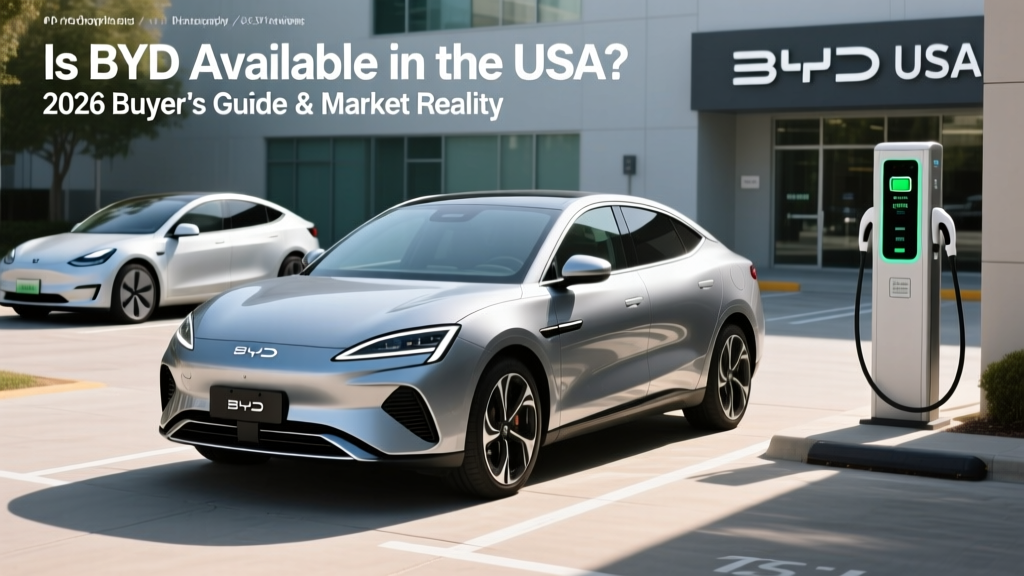
The Short Answer: BYD Passenger Cars Are Not Sold in the USA
If you've been searching whether BYD is available in the USA, the direct answer for 2026 is no — BYD does not sell passenger electric vehicles to US consumers. Despite being the world's largest plug-in electric vehicle manufacturer by volume, BYD has no retail presence for cars, SUVs, or trucks in the United States.
BYD does operate in the US commercial vehicle space — specifically electric buses and heavy-duty trucks through its Lancaster, California facility — but that operation has been effectively frozen from new federal contracts since the 2020 National Defense Authorization Act prohibited federal transit agencies from purchasing BYD buses. For everyday buyers looking at a BYD Seal, Atto 3 (Yuan Plus), Dolphin, or Han, there is no authorized dealer network, no EPA-certified models, and no path to purchase one new in America today.
This guide explains why BYD isn't in the US market, what models you're seeing in global headlines, what it would cost if they did arrive, and which available EVs deliver comparable specs right now.
Why BYD Hasn't Entered the US Passenger Car Market
Three structural barriers keep BYD out of American driveways in 2026:
- Tariffs. The US imposes a 27.5% import tariff on Chinese-built automobiles. In May 2024, the Biden administration announced an increase to 100% tariffs on Chinese EVs under Section 301 trade provisions, a rate that remains in effect in 2026. A $30,000 BYD Seal would effectively cost $60,000+ before shipping, compliance, and dealer markup — eliminating the price advantage that makes BYD competitive globally.
- Political and national-security concerns. BYD has faced scrutiny over data security, battery supply-chain dominance, and ties to Chinese state investment. Congress has repeatedly moved to restrict BYD's US footprint.
- Regulatory homologation. Selling cars in the US requires EPA certification, NHTSA compliance (FMVSS standards), and state-by-state dealer licensing. BYD has not submitted passenger models for EPA range/efficiency testing, meaning no BYD car appears on fueleconomy.gov.
BYD's global expansion has instead focused on Europe, Southeast Asia, Australia, Latin America, and the Middle East — markets without punitive tariffs on Chinese EVs.
BYD's Global EV Lineup: What American Buyers Are Missing
While you can't buy them stateside, BYD's 2025-2026 global lineup is extensive. Below are approximate global-market specs (note: these are not EPA-certified figures, as BYD doesn't sell here — WLTP ranges typically overstate versus EPA by 10-15%).
| Model | Battery (kWh) | Chemistry | WLTP Range | Peak DC Charge | 0-62 mph | Approx. Global Price |
|---|---|---|---|---|---|---|
| Dolphin | 60.4 | LFP (Blade) | ~265 mi | 88 kW | 7.0 s | $28,000 AUD |
| Atto 3 (Yuan Plus) | 60.5 | LFP (Blade) | ~260 mi | 88 kW | 7.3 s | $35,000 AUD |
| Seal (RWD) | 82.5 | LFP (Blade) | ~355 mi | 150 kW | 5.9 s | €47,000 |
| Seal (AWD Perf.) | 82.5 | LFP (Blade) | ~325 mi | 150 kW | 3.8 s | €53,000 |
| Han EV | 85.4 | LFP (Blade) | ~320 mi | 120 kW | 7.9 s | €55,000 |
BYD's signature technology is its Blade Battery — a lithium iron phosphate (LFP) cell arranged in a structural pack that offers excellent thermal stability and cycle life, though at lower energy density than NMC chemistries used in most long-range US EVs.
What a BYD Would Cost in the US — Hypothetically
If the 100% tariff were somehow waived and BYD homologated a model like the Seal for US sale, here's how the math might land based on global pricing and typical US compliance costs:
| Item | Amount |
|---|---|
| Global MSRP equivalent | ~$48,000 |
| 100% Section 301 tariff | +$48,000 |
| Shipping, compliance, dealer | +$5,000 |
| Effective US MSRP | ~$101,000 |
| Federal §30D tax credit | $0 (China-sourced battery/critical minerals fail sourcing rules) |
| Net cost to buyer | ~$101,000 |
The economics simply don't work. A BYD Seal would compete against a Tesla Model 3 Long Range AWD (~$47,000 MSRP, EPA 341 mi) or Hyundai Ioniq 6 (~$42,000, EPA 361 mi) — both of which may qualify for partial or full IRS §30D clean vehicle credits depending on battery sourcing and buyer income.
- Vehicle MSRP cap: $55,000 (sedans), $80,000 (SUVs/trucks/vans)
- Buyer AGI cap: $150k single / $300k joint
- Battery components must be manufactured or assembled in North America (phased thresholds)
- Critical minerals must be US-sourced or from FTA partners — China is excluded
- Point-of-sale transfer available at participating dealers
Even if BYD established US assembly, its battery and critical-mineral supply chain runs through China, which disqualifies its vehicles from the §30D credit under current law.
Best US-Market Alternatives to BYD Models
If a specific BYD model caught your eye, here are comparable EVs you can actually buy in the US in 2026, with EPA-certified specs:
| BYD Target | US Alternative | EPA Range | Battery | Base MSRP | §30D Eligible? |
|---|---|---|---|---|---|
| Dolphin | Chevrolet Bolt EV | 259 mi | 65 kWh NMC | ~$28,000 | Yes (partial) |
| Atto 3 | Hyundai Kona Electric | 261 mi | 65 kWh NMC | ~$33,000 | Partial |
| Seal RWD | Tesla Model 3 LR RWD | 341 mi | ~75 kWh NMC | ~$42,500 | Partial |
| Seal AWD | Hyundai Ioniq 6 LR AWD | 316 mi | 77.4 kWh NMC | ~$48,000 | Partial |
| Han EV | BMW i5 eDrive40 | 295 mi | 84 kWh NMC | ~$68,000 | Likely no (MSRP cap) |
BYD's Blade Battery: The Tech That Made Headlines
The most legitimate reason American EV enthusiasts follow BYD is its Blade Battery technology. Introduced in 2020 and now in its second generation, the Blade uses LFP chemistry in long, thin cells that double as structural pack members.
LFP advantages vs. NMC:
- Superior thermal stability — far lower fire risk in nail-penetration tests
- Longer cycle life — 3,000+ full cycles vs. ~1,500-2,000 for NMC
- Can be charged to 100% regularly without accelerated degradation
- No cobalt or nickel — fewer supply-chain and ethical concerns
LFP trade-offs:
- Lower energy density — heavier packs for equivalent range
- Reduced cold-weather performance — greater range loss below freezing
- Less precise state-of-charge estimation (flatter voltage curve)
Tesla already uses LFP packs (sourced from CATL) in US-market Model 3 RWD variants, so American buyers aren't entirely missing the LFP story — they're just getting it from a different supplier.
Will BYD Ever Sell Cars in America?
As of 2026, BYD executives have publicly stated they have no near-term plans to enter the US passenger-vehicle market. The tariff wall, political climate, and battery-sourcing rules make entry economically unviable under current conditions.
Possible future scenarios that could shift this:
- Mexico or Brazil assembly for export — BYD is building plants in both countries, but US rules of origin and critical-mineral sourcing would still block §30D credit eligibility.
- Tariff relief via trade negotiation — politically unlikely in either direction given bipartisan hawkishness on Chinese EVs.
- Used-import loophole — some grey-market importers bring in non-US-spec vehicles under the 25-year rule; irrelevant for new EVs.
Bottom line: don't delay an EV purchase waiting for BYD to arrive. The market has moved on.
Pros & Cons: The BYD Situation for US Buyers
Pros (If BYD Were Available)
- Blade LFP battery offers exceptional longevity and safety
- Aggressive pricing in global markets
- Broad model range from subcompact to luxury sedan
- Strong build quality in recent-generation vehicles
- Rotating center screen and tech-forward interiors
Cons (US Market Reality)
- Not sold in the USA — no dealers, no EPA certification, no parts network
- 100% tariff makes pricing uncompetitive even if imported
- Zero §30D tax credit eligibility under current sourcing rules
- No US-spec NACS charging connector (global models use CCS2 or GB/T)
- Uncertain long-term software support and OTA updates in US
- Resale value would be unpredictable without established brand presence
Frequently Asked Questions
Can I import a BYD from Canada or Mexico?
No. Canadian and Mexican BYD sales are either nonexistent or (in Mexico's case) limited. Even if you imported one, it would lack EPA/NHTSA certification, making it illegal for road registration in most states. Insurance would also be essentially unavailable.
Does BYD make any vehicles sold in the USA?
BYD manufactures electric buses at its Lancaster, California facility, but these are sold only to transit agencies, not consumers. New federal contracts with BYD have been restricted since 2020.
Is BYD the biggest EV company in the world?
By total plug-in vehicle sales (BEV + PHEV combined), BYD has traded the #1 spot with Tesla multiple times in 2023-2025. In pure BEV volume, Tesla still leads in most quarters, but BYD's combined NEV (new energy vehicle) sales frequently exceed 3 million units annually.
What US EV is closest to a BYD Seal?
The Tesla Model 3 Long Range and Hyundai Ioniq 6 are the closest US-market equivalents — similar size, range (300-340 mi EPA), and performance. Both offer established charging networks and service infrastructure that a hypothetical BYD import could not match.
Will BYD's Blade Battery tech come to US EVs?
Indirectly, yes. LFP chemistry is already in US-market Tesla Model 3 RWD and Ford Mustang Mach-E SR. BYD has also begun supplying Blade cells to select non-Chinese OEMs, though none have announced US-spec models using BYD packs as of 2026.
Should I wait for BYD to launch in the US before buying an EV?
No. There is no announced timeline, no homologation activity, and the tariff structure makes BYD uncompetitive even if it entered. Current US EVs from Tesla, Hyundai/Kia, Ford, GM, BMW, and others offer competitive range, charging, and full §30D credit pathways.
Final Verdict
Is BYD available in the USA? Not for passenger vehicles, and not for the foreseeable future. The combination of 100% tariffs, battery-sourcing disqualifications from the §30D credit, and a charged political environment keeps the world's largest EV maker on the sidelines of the American market.
For US buyers, the practical move is to evaluate the strong EVs already here. If BYD's LFP Blade Battery technology appeals to you, look at the Tesla Model 3 RWD (LFP pack, EPA 272 mi, ~$38,000) as the closest domestic analog. If range and value matter more, the Hyundai Ioniq 6, Chevrolet Equinox EV, or Tesla Model 3 Long Range deliver EPA-certified, tax-credit-eligible, fully warrantied transportation with no import drama.