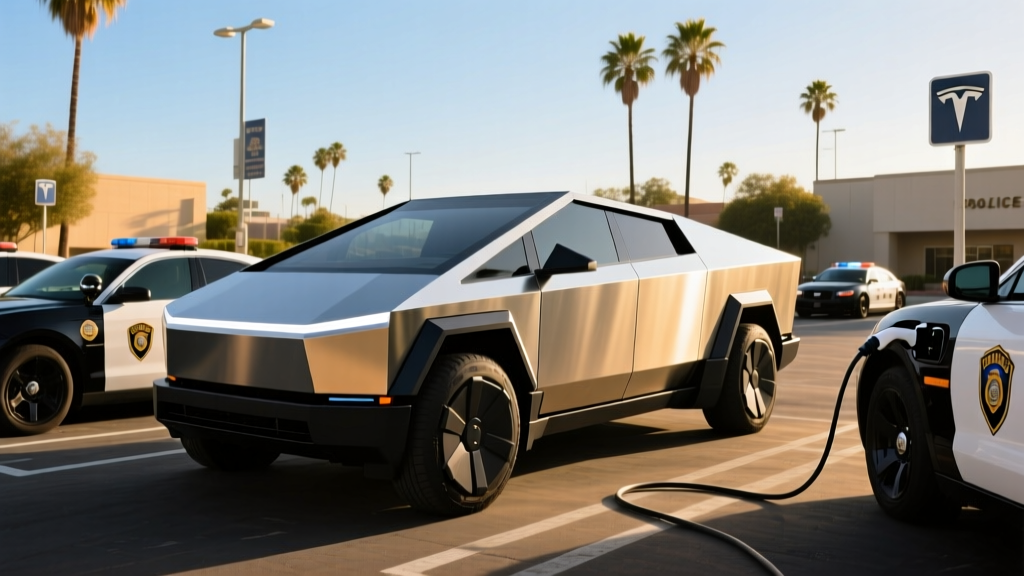
When the Irvine Police Department (IPD) rolled a Tesla Cybertruck into its patrol fleet, it wasn't just a PR stunt — it was one of the highest-profile law-enforcement EV pilots in the country. The move drew national attention, sparked debate about taxpayer spending, and raised a practical question every fleet manager and EV buyer is now asking: does the Cybertruck actually work as a daily-duty vehicle, or is it a stainless-steel novelty?
Whether you're a municipal procurement officer, an EV-curious truck buyer, or simply someone who saw the Irvine Police Cybertruck on the news and wants the real numbers, this review breaks down the Cybertruck AWD — the variant IPD selected — with the spec-level rigor police fleets and private buyers both need.
Quick Verdict: The Irvine Police Cybertruck in Context
The Cybertruck AWD that IPD added to its fleet is Tesla's mid-tier dual-motor configuration. It offers a compelling mix of acceleration, range, and payload capacity, but its angular geometry, panel-gap variability, and service-center dependency make it a more complex fleet proposition than a conventional Ford F-150 Lightning or Chevrolet Silverado EV. For Irvine — a city with mild weather, robust charging infrastructure, and short-to-medium patrol routes — the math works. For harsher climates or rural jurisdictions, the calculus shifts considerably.
| Attribute | Value |
|---|---|
| EPA Range | 340 miles (est.) |
| Battery Capacity | ~123 kWh usable (NMC chemistry) |
| Drivetrain | Dual-motor AWD |
| Horsepower | 600 hp |
| 0-60 mph | 3.9 seconds |
| Max DC Fast Charge | 250 kW (peak) |
| 10-80% DC Charge | ~28 minutes |
| Level 2 Home Charging | 11.5 kW (~34 mi/hr) |
| MPGe (combined) | 79 MPGe |
| Towing Capacity | 7,500 lbs |
| Payload | 2,500 lbs |
| Base MSRP | $79,990 (before dest.) |
| Battery Warranty | 8 years / 120,000 miles |
Range and Efficiency: EPA Sticker vs. Patrol Reality
Real-World Expectation: In mixed suburban/highway patrol driving at 70 mph, expect approximately 270–290 miles. In sustained cold weather (below 35°F), range can drop 20–30%, yielding roughly 230–260 miles. For Irvine's mild SoCal climate, real-world range closely tracks the EPA figure during city patrol cycles with frequent regenerative braking.
The Cybertruck AWD's efficiency is a sore point compared to sedan-class EVs. At roughly 52 kWh per 100 miles (combined), it consumes significantly more energy per mile than a Tesla Model Y (28 kWh/100 mi) or even the Rivian R1T (48 kWh/100 mi). The stainless-steel exoskeleton and 6,800+ lb curb weight are the culprits. For a police fleet running 80–120 miles per shift with overnight depot charging, this is manageable. For high-mileage highway interdiction units, the energy cost adds up.
According to fueleconomy.gov, the Cybertruck AWD's combined MPGe of 79 places it well below the efficiency of lighter electric trucks and SUVs, but on par with other full-size electric pickups in the segment.
Charging Speed: DC Fast Charge and Depot Level 2
Charging logistics are the make-or-break factor for any police EV fleet. The Irvine Police Cybertruck benefits from proximity to Tesla Supercharger stations and the ability to install Level 2 depot chargers at IPD facilities.
| Charging Level | Power (kW) | Speed (miles/hr) | Notes |
|---|---|---|---|
| Level 1 (120V) | 1.4 kW | ~4 mi/hr | Emergency/trickle only |
| Level 2 (240V, 48A) | 11.5 kW | ~34 mi/hr | Overnight depot charging |
| DC Fast (Tesla Supercharger V3) | 250 kW peak | ~200+ mi/hr (peak) | 10-80% in ~28 min; tapers sharply above 85% |
| DC Fast (CCS via adapter) | Up to 150 kW | ~120 mi/hr (peak) | Requires Tesla CCS adapter; limited to non-Tesla networks |
The Cybertruck's 800V-class architecture allows it to accept up to 250 kW at a V3 Supercharger, but the charge curve tapers aggressively past 80% State of Charge. Fleet operators should plan for 10-80% charging windows of roughly 28 minutes and avoid scheduling around full 100% fills unless overnight Level 2 is available. The NMC battery chemistry supports frequent fast charging better than older chemistries, but Tesla's battery management system still limits sustained peak rates to protect long-term State of Health.
For IPD's use case — where vehicles return to a depot each shift — Level 2 chargers at 11.5 kW can replenish a full battery in roughly 10–11 hours, fitting neatly into an overnight schedule.
Performance and Drivetrain: More Than a Showpiece
The dual-motor AWD Cybertruck produces 600 horsepower and rockets to 60 mph in 3.9 seconds — performance figures that make it one of the quickest vehicles in any police fleet, anywhere. For pursuit scenarios or rapid response, the instant torque delivery of electric motors eliminates the lag of turbocharged gasoline engines.
The AWD system uses independent front and rear motors with torque vectoring, providing confident traction on wet roads and light off-road terrain. Ground clearance of approximately 16 inches (in standard mode) and approach/departure angles rival dedicated off-road trucks, though IPD's suburban patrol environment rarely demands this capability.
One notable drawback: the Cybertruck's steer-by-wire system, while precise, removes traditional steering feedback. Some drivers — particularly those transitioning from conventional patrol vehicles — report an adjustment period. The yoke-style steering wheel (standard on some trims, optional on others) further divides opinion and may not suit all fleet drivers.
Pricing, Tax Credits, and Fleet Economics
The Cybertruck AWD starts at approximately $79,990 (MSRP, before destination fees). The Irvine Police Department's specific unit likely included upfitting costs for light bars, radios, cage partitions, and department livery — adding an estimated $15,000–$25,000 on top.
| Item | Amount |
|---|---|
| Base MSRP (AWD) | $79,990 |
| Destination Fee | $1,995 |
| Federal §30D Tax Credit | Up to $7,500 (see eligibility below) |
| Effective Price (if credit applies) | ~$74,485 |
| Fleet/Police Upfitting (est.) | $15,000–$25,000 |
Federal tax credit eligibility is not automatic. Under IRS §30D rules, the Cybertruck qualifies as a light truck (MSRP cap: $80,000), so the base AWD model squeaks under the limit. However, buyer income caps apply ($150,000 single / $300,000 joint filers), and critical-mineral and battery-component sourcing requirements must be met. Municipal fleet purchases may be eligible under the separate Commercial Clean Vehicle Credit (§45W) rather than §30D. Consult IRS guidance and a tax professional for your specific situation. Rules are current for 2026 and subject to legislative change.
Interior, Cargo, and Technology
The Cybertruck's interior is minimalist by design — some would say Spartan. A single 18.5-inch touchscreen dominates the dashboard, handling navigation, climate, cameras, and vehicle settings. There is no traditional instrument cluster. Rear passengers get a secondary 9.4-inch touchscreen, but rear legroom (approximately 38 inches) is tighter than a Ford F-150 Lightning's rear seat.
Cargo capacity is a strong point for fleet use:
- Bed volume: ~67 cubic feet (lockable tonneau cover standard)
- Front trunk (frunk): ~7 cubic feet
- Bed length: 6 feet
- Towing: 7,500 lbs (adequate for light trailers, not heavy-duty fleet hauls)
For police use, the lockable bed is valuable for secure equipment storage. However, the stainless-steel bed surface scratches easily, and the powered tonneau cover adds a mechanical failure point not present in conventional truck beds.
Standout tech features:
- Tesla Vision camera system (no ultrasonic sensors — camera-only parking assist)
- Autopilot standard (SAE Level 2 driver assist — not self-driving)
- Over-the-air software updates
- Bioweapon Defense Mode (HEPA cabin filtration — useful for hazmat-adjacent scenes)
- 240V bed outlet (V2L capability for powering equipment at scenes)
Warranty, Service, and Fleet Maintenance
Tesla provides the following warranty coverage for the Cybertruck:
- Battery & Drive Units: 8 years / 120,000 miles (whichever comes first), with minimum 70% capacity retention
- Vehicle Limited Warranty: 4 years / 50,000 miles
For a police fleet vehicle averaging 25,000–35,000 miles per year, the battery warranty expires in roughly 3.5–5 years — a concern for long-term fleet planning. However, Tesla's NMC cells in the structural battery pack have demonstrated strong cycle-life performance in real-world data, and most EV batteries outlast their warranty periods with gradual (not cliff-like) degradation.
The bigger fleet concern is service dependency. Tesla does not operate traditional dealership service bays. Repairs rely on Tesla Service Centers or mobile rangers. In Irvine, proximity to multiple Tesla service locations in Orange County mitigates this risk. In rural jurisdictions, a single body-panel repair could sideline the vehicle for weeks.
Pros and Cons: The Irvine Police Cybertruck Scorecard
Pros
- 340-mile EPA range covers most patrol shifts without mid-shift charging
- Instant torque and 3.9s 0-60 for rapid response
- Lockable 67 cu ft bed with powered tonneau for secure gear storage
- Low per-mile energy cost vs. gasoline (~$0.04–$0.06/mi on depot charging vs. $0.18–$0.22/mi gas)
- Minimal scheduled maintenance (no oil, transmission fluid, or spark plugs)
- V2L 240V outlet powers scene equipment without a generator
- HEPA cabin filtration for hazmat/smoke scenarios
Cons
- High acquisition cost ($80K+ base, before upfitting)
- Stainless-steel body panels are difficult to repair; limited collision-center network
- Rear-seat legroom tight for partitioned patrol use
- Steer-by-wire and yoke require driver retraining
- Efficiency poor vs. lighter EVs (52 kWh/100 mi combined)
- Camera-only parking assist struggles in tight depot spaces
- No Apple CarPlay / Android Auto — Tesla-only infotainment ecosystem
Is the Irvine Police Cybertruck Worth It vs. Competitors?
The Cybertruck isn't the only electric truck in the fleet conversation. Here's how it stacks up against the two most relevant alternatives for law-enforcement buyers:
| Attribute | Tesla Cybertruck AWD | Ford F-150 Lightning Lariat | Rivian R1T Dual-Motor |
|---|---|---|---|
| EPA Range | 340 mi | 320 mi (Ext. Range) | 352 mi (Max Pack) |
| Base MSRP | $79,990 | $69,995 | $87,600 |
| 0-60 mph | 3.9s | ~4.0s | ~4.5s |
| Max DC Charge | 250 kW | 150 kW | 220 kW |
| Towing | 7,500 lbs | 7,700 lbs | 11,000 lbs |
| Service Network | Tesla Service Centers | Ford Commercial Dealers | Rivian Service + Mobile |
| Fleet Upfitting Ecosystem | Limited | Extensive (existing police upfitters) | Growing |
Choose the F-150 Lightning if: Your department needs established police upfitting partners, conventional service infrastructure, and a lower entry price. The Lightning remains the pragmatic fleet choice in 2026.
Choose the Rivian R1T if: You need maximum towing and off-road capability, and your budget supports a premium acquisition.
Frequently Asked Questions
What is the real-world range of the Irvine Police Cybertruck?
The Cybertruck AWD carries an EPA-estimated 340 miles of range. In Irvine's mild climate and suburban patrol cycles, real-world range closely tracks this figure — approximately 300–320 miles with regenerative braking on stop-and-go routes. Highway-heavy patrol routes at 70+ mph will see 270–290 miles. Cold-weather jurisdictions should budget for 20–30% range loss.
How fast does the Cybertruck charge at a depot or on the road?
At a Tesla V3 Supercharger (250 kW peak), the Cybertruck charges from 10–80% in approximately 28 minutes. On a Level 2 depot charger at 11.5 kW, a full charge takes roughly 10–11 hours — ideal for overnight fleet rotation. DC charging on non-Tesla networks via CCS adapter is limited to ~150 kW.
Does the Cybertruck qualify for the federal EV tax credit?
The Cybertruck AWD's base MSRP of $79,990 falls under the $80,000 light-truck cap for the §30D credit. However, eligibility depends on buyer income limits ($150K single / $300K joint), battery-sourcing requirements for critical minerals and components, and point-of-sale transfer rules. Municipal fleets may qualify under §45W (Commercial Clean Vehicle Credit) instead. Always verify current-year rules at irs.gov and consult a tax professional.
How much does the Irvine Police Cybertruck cost after tax credits?
If the full $7,500 §30D credit applies, the effective base price drops to approximately $74,485. However, police upfitting (light bar, cage, radio, livery) adds $15,000–$25,000, bringing the realistic as-deployed cost to roughly $90,000–$100,000. Fleet purchases using §45W may see different credit calculations.
Is the Cybertruck a good police vehicle compared to the F-150 Lightning?
The Cybertruck offers superior acceleration, longer EPA range, and lower per-mile energy costs. The F-150 Lightning offers a far more mature police upfitting ecosystem, conventional dealer service, and a lower entry price. For most departments in 2026, the Lightning is the more pragmatic choice. The Cybertruck works best in tech-forward, mild-climate fleets with Tesla infrastructure access — exactly Irvine's profile.
What are the biggest drawbacks of the Cybertruck for fleet use?
The top concerns are: (1) stainless-steel body repair difficulty and limited collision-center availability, (2) high acquisition cost relative to competitors, (3) steer-by-wire retraining requirements, (4) tight rear-seat space for partitioned patrol configurations, and (5) Tesla's closed infotainment ecosystem lacking Apple CarPlay/Android Auto, which complicates integration with some fleet management software.
Who is the Cybertruck best suited for outside of police fleets?
The Cybertruck AWD fits tech-forward buyers who want a distinctive electric truck with strong range and acceleration, primarily drive in suburban/urban environments, and have reliable home or workplace charging. It is less suited for heavy-towing users, cold-climate drivers without garage charging, or buyers who prioritize service convenience and traditional dealer relationships.
Sources: EPA range and efficiency data via fueleconomy.gov; Tesla Cybertruck specifications via tesla.com; IRS §30D credit rules via irs.gov.