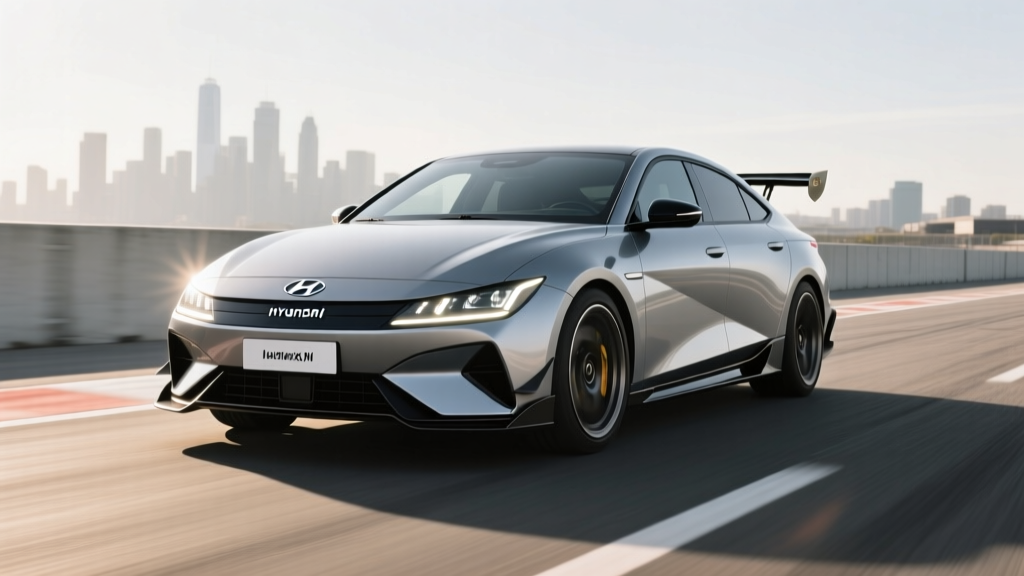
The Hyundai Ioniq 6 N is a paradox wrapped in a wind-cheating silhouette. It's a 641-horsepower electric sports sedan that can hit 60 mph in 3.3 seconds, yet it also serves as a daily commuter with respectable range and access to Hyundai's increasingly robust Supercharger-adapter ecosystem. If you've been searching for Ioniq 6 N horsepower figures and wondering whether the performance justifies the range trade-off, this review gives you every number that matters — from real-world highway efficiency to DC fast-charging taper curves.
For 2026, the Ioniq 6 N carries forward the formula introduced with its debut: a dual-motor all-wheel-drive powertrain, an 84.0 kWh NMC (nickel-manganese-cobalt) battery, N-tuned adaptive suspension, and Hyundai's N e-Shift software that simulates gear changes for drivers who miss the engagement of a manual. It remains the only electric sedan in Hyundai's N performance lineup, slotting above the Ioniq 5 N crossover in aerodynamic efficiency but below it in cargo practicality.
Performance: Ioniq 6 N Horsepower, 0-60, and Drivetrain Specs
The headline number is 641 horsepower (478 kW) with N Grin Boost engaged — a temporary overboost function that unlocks maximum output for short bursts. Without it, the dual-motor setup produces 601 hp. Torque peaks at 568 lb-ft across both axles.
| Spec | Value |
|---|---|
| Powertrain | Dual-motor AWD |
| Horsepower (N Grin Boost) | 641 hp (478 kW) |
| Horsepower (Standard) | 601 hp (448 kW) |
| Torque | 568 lb-ft |
| 0-60 mph | 3.3 seconds |
| Top Speed | 162 mph (electronically limited) |
| Battery Usable Capacity | 84.0 kWh (NMC) |
| Drivetrain | AWD with torque vectoring |
On the road, the Ioniq 6 N's horsepower delivery is immediate and relentless. The N e-Shift system — which simulates an 8-speed dual-clutch transmission complete with synthetic shift shock — is a polarizing feature. Track-day enthusiasts appreciate the engagement; efficiency-focused drivers will want to leave it off and enjoy the seamless single-speed pull. The N-tuned adaptive dampers and reinforced chassis make this sedan feel planted at speed, with noticeably less body roll than the Ioniq 5 N despite sharing the same E-GMP platform.
EPA Range and Real-World Efficiency
Real-World Expectation: Plan for ~210–230 miles on highway road trips at 70+ mph. In cold weather (below 32°F), expect 175–200 miles depending on cabin heating use and terrain. City driving with regenerative braking can approach or slightly exceed the EPA sticker.
The Ioniq 6 N's 260-mile EPA estimate trails the standard Ioniq 6 Long Range (which achieves up to 361 miles in SE RWD trim). That gap comes from the N's heavier dual-motor setup, stickier performance tires, and more aggressive power delivery. The MPGe rating sits at approximately 90 MPGe combined, translating to roughly 37 kWh per 100 miles — thirsty by EV standards, but expected for a 641-hp performance machine.
According to fueleconomy.gov, the Ioniq 6 N's efficiency penalty is the cost of its performance hardware. If maximum range is your priority, the standard Ioniq 6 is the clear pick. If you want N-level performance, you accept the range compromise as part of the package.
Charging Speeds: DC Fast, Level 2, and the Charge Curve Reality
The Ioniq 6 N uses Hyundai's 800-volt E-GMP architecture, which remains one of the fastest-charging platforms available in any production EV. Here's what the numbers look like across charging levels:
| Charging Level | Power / Rate | Time or Miles Added |
|---|---|---|
| DC Fast Charge (Peak) | Up to 240 kW (350 kW charger) | 10–80% in ~18 minutes |
| DC Fast Charge (150 kW station) | ~150 kW sustained | 10–80% in ~25 minutes |
| Level 2 (Home/Public AC) | 10.9 kW (48A) | ~32 miles per hour of charging |
| Level 1 (120V outlet) | ~1.4 kW | ~4 miles per hour of charging |
The 800V architecture is the Ioniq 6 N's charging secret weapon. On a 350 kW DC fast charger — the kind found at Electrify America and select Tesla Supercharger stations (with Hyundai's included NACS adapter for 2026) — the battery pulls close to peak rate through roughly 55% state of charge before tapering. You'll see 240 kW in ideal thermal conditions, but sustained average from 10-80% is closer to 175–190 kW. This is still best-in-class territory.
For home charging, a 48-amp Level 2 wallbox on a 60-amp circuit delivers a full charge from 10% to 100% in roughly 8 hours — overnight-ready. If your home electrical panel supports a 240V/60A circuit (most modern 200-amp panels do), installation typically runs $800–$1,500 including the charger unit and electrician labor, assuming no panel upgrade is needed.
Preconditioning matters: The Ioniq 6 N's battery thermal management system will precondition the pack when you navigate to a DC fast charger in the infotainment system. This is critical in cold weather — without preconditioning, peak charge rates can drop by 40–50%. Always route through the car's nav for fast-charging stops.
Pricing, Trims, and Federal Tax Credit Eligibility
The 2026 Hyundai Ioniq 6 N is offered in a single, well-equipped trim. There's no base-model dilution — you get the full N treatment standard.
| Item | Amount |
|---|---|
| Base MSRP (Ioniq 6 N) | $71,900 |
| Destination Charge | $1,395 |
| As-Tested (with Performance package) | ~$74,500 |
| Federal §30D Tax Credit (if eligible) | Up to $7,500 (point-of-sale transfer available) |
| Estimated Net Price (after max credit) | ~$64,400 |
Federal EV tax credit eligibility under IRS §30D is not guaranteed for every buyer. For 2026, the rules require:
- MSRP cap: Sedans must have an MSRP at or below $55,000. The Ioniq 6 N at $71,900 exceeds this cap, which likely disqualifies it from the new-vehicle §30D credit.
- Buyer income limits: AGI must not exceed $150,000 (single), $225,000 (head of household), or $300,000 (joint).
- Battery sourcing: Critical minerals and battery components must meet phased-in domestic/free-trade-partner sourcing thresholds.
Because the Ioniq 6 N's MSRP exceeds the $55,000 sedan cap, most buyers should not expect to claim the $7,500 federal credit on a new purchase. Always verify with a tax professional and check the latest IRS guidance before assuming eligibility. Some state-level incentives (such as those in California, Colorado, and New York) may still apply regardless of MSRP, but these vary by jurisdiction.
Interior, Cargo, and Technology
Inside, the Ioniq 6 N uses Hyundai's dual 12.3-inch curved display setup with the latest ccNC (Connected Car Navigation Cockpit) infotainment software. Wireless Apple CarPlay and Android Auto are standard. The N-specific digital cluster includes track-oriented readouts: battery temperature, G-force meter, lap timer, and N e-Shift gear indicator.
Cargo and passenger space remain a sore point relative to competitors:
- Rear trunk: 11.2 cubic feet (sedan-style trunklid, not a hatchback — a significant practicality limitation)
- Frunk (front trunk):strongtd> 0.5 cubic feet (enough for charging cables, not much else)
- Rear legroom: 35.1 inches
- Front legroom: 42.3 inches
- Front headroom: 39.4 inches
The sloping roofline and sedan trunk make the Ioniq 6 N impractical for bulky cargo compared to the Ioniq 5 N's hatchback layout. If you regularly haul gear, dog crates, or strollers, the crossover sibling is the more rational choice.
On the technology front, Hyundai's Highway Driving Assist 2 (HDA2) provides SAE Level 2 driver assistance — adaptive cruise control with lane centering. This is a hands-on-wheel, eyes-on-road system. It is not autonomous driving. The N-specific additions include N Brake Regeneration (adjustable regen levels optimized for track use), N Launch Control, and N Drift Optimizer (for closed-course use only).
Battery Warranty and Long-Term Ownership
Hyundai backs the Ioniq 6 N's battery and powertrain with one of the strongest warranties in the segment:
- Battery: 10 years / 100,000 miles (capacity retention threshold: 70%)
- Powertrain: 10 years / 100,000 miles
- New-vehicle limited: 5 years / 60,000 miles
- Roadside assistance: 5 years / unlimited miles
The 84.0 kWh NMC battery uses liquid-cooled thermal management, which is essential for preserving long-term health given the high discharge rates the N demands. Based on industry degradation data for Hyundai's E-GMP platform, expect approximately 5–8% capacity loss over the first 100,000 miles under normal use. Frequent track use with repeated high-C-rate discharges and DC fast charging could accelerate this slightly, though the thermal management system is designed to mitigate abuse.
Ioniq 6 N vs. Key Competitors
At roughly $72,000, the Ioniq 6 N competes with several high-performance EVs. Here's how it stacks up against the two most relevant rivals:
| Spec | Hyundai Ioniq 6 N | Tesla Model 3 Performance | BMW i4 M50 |
|---|---|---|---|
| Horsepower | 641 hp | 510 hp | 536 hp |
| 0-60 mph | 3.3 sec | 2.9 sec | 3.7 sec |
| EPA Range | 260 mi | 296 mi | 227 mi |
| Battery (usable) | 84.0 kWh (NMC) | 79 kWh (NMC) | 81.5 kWh (NMC) |
| Peak DC Charge | 240 kW | 250 kW | 205 kW |
| 10-80% DC Time | ~18 min | ~18 min | ~27 min |
| Base MSRP | $71,900 | $54,990 | $69,900 |
| Cargo (rear) | 11.2 cu ft | 23 cu ft (hatch) | 16.6 cu ft (hatch) |
The Model 3 Performance wins on price and range. The Ioniq 6 N wins on raw horsepower, track-focused hardware (adaptive dampers, N e-Shift, launch control), and 800V charging headroom. The BMW i4 M50 offers the most premium interior but charges the slowest and costs nearly as much. Per IIHS ratings, the standard Ioniq 6 platform has earned Top Safety Pick+ status, though the N variant's specific crash-test data should be confirmed for 2026.
Pros
- 641 hp and 3.3-second 0-60 — genuine sports-sedan performance
- 800V architecture delivers best-in-class DC fast charging (~18 min 10-80%)
- N-tuned chassis, adaptive dampers, and torque vectoring for real track capability
- 10-year/100,000-mile battery warranty
- NACS adapter included for Tesla Supercharger access
- Unique styling with class-leading 0.21 Cd drag coefficient
Cons
- 260-mile EPA range is modest for the price point
- 11.2 cu ft trunk is small; no hatchback opening
- MSRP exceeds §30D sedan cap — likely ineligible for $7,500 federal credit
- N e-Shift synthetic gear changes feel gimmicky to some drivers
- Rear-seat headroom is tight for tall passengers due to roofline
- Frunk is nearly useless at 0.5 cu ft
Who Should Buy the Ioniq 6 N?
Choose the Ioniq 6 N if: You want a genuine performance EV with track-ready hardware, value ultra-fast 800V charging for road trips, and don't need cargo space or maximum range. It's ideal for driving enthusiasts who commute daily but hit canyon roads or track events on weekends.
Look elsewhere if: You need family-hauler practicality (Ioniq 5 N or Kia EV6 GT offer more cargo), you want 300+ miles of range (standard Ioniq 6 or Tesla Model 3), or you're counting on the federal tax credit to bring the price down (the MSRP cap disqualifies it).
Frequently Asked Questions
What is the real-world range of the Ioniq 6 N?
The EPA rates the Ioniq 6 N at 260 miles. In real-world highway driving at 70–80 mph, expect 210–230 miles. In cold weather (below freezing), that can drop to 175–200 miles. City driving with regenerative braking recovers some efficiency, and you may match or slightly exceed the EPA figure in stop-and-go conditions.
How fast does the Ioniq 6 N charge at home and on DC fast chargers?
On a 350 kW DC fast charger, the Ioniq 6 N peaks at approximately 240 kW and charges from 10% to 80% in about 18 minutes. On a 150 kW station, plan for roughly 25 minutes. At home on a 48-amp Level 2 charger (10.9 kW), a full charge takes about 8 hours. The 800V architecture is what enables these class-leading DC speeds.
Does the Ioniq 6 N qualify for the federal EV tax credit?
Likely not. The IRS §30D credit caps sedan MSRP at $55,000, and the Ioniq 6 N starts at $71,900. Even if you meet income and battery-sourcing requirements, the price cap almost certainly disqualifies it. Consult a tax professional and check current IRS guidance for the latest rules. State incentives may still apply.
How much horsepower does the Ioniq 6 N have?
The Ioniq 6 N produces 641 horsepower (478 kW) with N Grin Boost engaged and 601 hp in standard driving mode. Torque is rated at 568 lb-ft. The dual-motor AWD system delivers power to all four wheels with torque vectoring.
Is the Ioniq 6 N worth buying over the Tesla Model 3 Performance?
It depends on your priorities. The Model 3 Performance is roughly $17,000 cheaper, offers 36 more miles of EPA range, and has a far more practical hatchback trunk. The Ioniq 6 N counters with more horsepower (641 vs. 510), a more engaging track-oriented chassis, N-specific driving modes, and 800V charging architecture. If performance and driving feel matter most, the Ioniq 6 N earns its premium. If value and daily practicality lead your decision, the Model 3 wins.
What is the Ioniq 6 N's battery warranty?
Hyundai covers the Ioniq 6 N's battery for 10 years or 100,000 miles, whichever comes first, with a capacity retention threshold of 70%. The powertrain carries the same 10-year/100,000-mile coverage. This is among the best battery warranties in the performance EV segment.