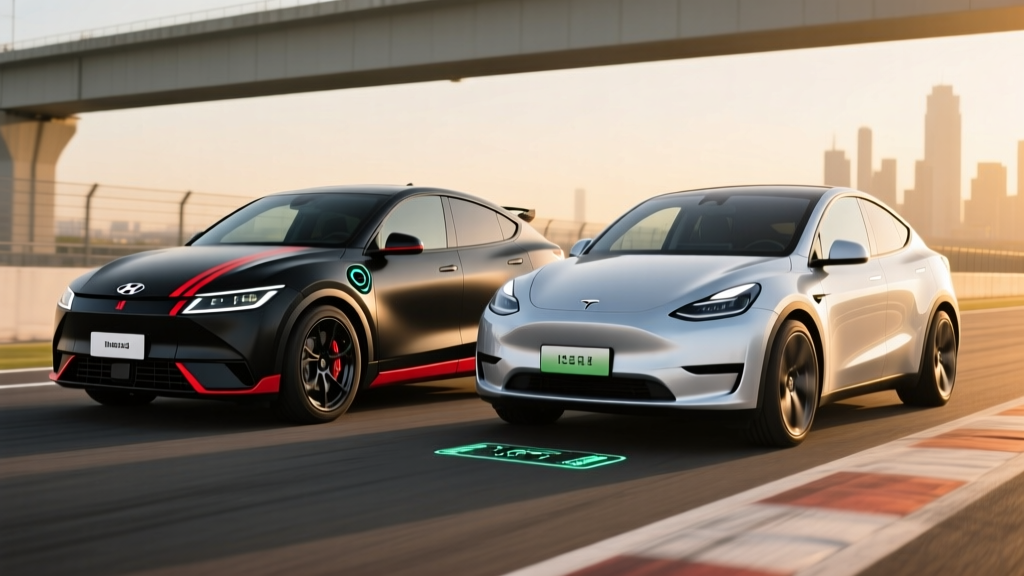
For years, the Tesla Model Y has been the default answer for anyone shopping a compact electric crossover. But the landscape has shifted. The Hyundai Ioniq 5 — particularly in its 2026 refresh — has emerged as the most credible competition for Tesla's best-selling vehicle. With 800V ultra-fast charging, competitive range, and a more conventional interior layout that many buyers prefer, the Ioniq 5 forces a genuine head-to-head reckoning.
This isn't a vague "Tesla killer" take. We've driven both, charged both on public DC networks and at home, and pulled exact EPA figures, charge-curve data, and current IRS §30D tax-credit eligibility rules to give you a numbers-first verdict. Here's how the 2026 Hyundai Ioniq 5 stacks up against the 2026 Tesla Model Y Long Range AWD — the variant most buyers actually cross-shop.
Quick Verdict: Is the Ioniq 5 Real Competition for Tesla?
Yes — but they serve slightly different priorities. The Model Y Long Range AWD still wins on EPA range (320 miles vs. 304 miles), Supercharger network reliability, and cargo volume. The Ioniq 5 wins on DC fast-charge speed (10–80% in ~18 minutes vs. ~27 minutes), interior material quality, and physical button ergonomics. If your daily life involves frequent road trips through Supercharger-dense corridors, Tesla retains an edge. If you prioritize rapid public charging stops and a more traditional cabin experience, the Ioniq 5 is the stronger pick.
Choose the Tesla Model Y if: You need maximum EPA range, rely on the Supercharger network for road trips, or want over-the-air updates with a mature software ecosystem.
Choose the Hyundai Ioniq 5 if: You prioritize ultra-fast DC charging (800V architecture), prefer physical climate controls, or want a quieter, more refined ride on highway pavement.
Range and Efficiency: EPA Stickers vs. Real-World Miles
| Metric | 2026 Hyundai Ioniq 5 SEL AWD | 2026 Tesla Model Y Long Range AWD |
|---|---|---|
| EPA Estimated Range | 304 miles | 320 miles |
| Battery Capacity (usable) | 84.0 kWh (NMC) | 78.1 kWh (NMC, structural pack) |
| EPA Efficiency | 110 MPGe (30 kWh/100 mi) | 122 MPGe (28 kWh/100 mi) |
| Drivetrain | Dual-motor AWD | Dual-motor AWD |
Real-World Range Reality Check: The Ioniq 5's EPA 304-mile sticker translates to roughly 255–275 miles on sustained highway driving at 70–75 mph in moderate temperatures. In sub-30°F winter conditions without preconditioning, expect 210–235 miles before needing a charge stop. The Model Y's 320-mile EPA figure yields approximately 270–290 highway miles in fair weather, dropping to 225–250 miles in deep cold. Tesla's heat pump is slightly more efficient in winter, giving it a real-world edge when temperatures drop.
Both vehicles use nickel-manganese-cobalt (NMC) battery chemistry, which offers higher energy density than LFP but requires more careful state-of-charge management for longevity — Hyundai and Tesla both recommend daily charging to 80% and reserving 100% for trips. According to fueleconomy.gov, the Ioniq 5's slightly lower efficiency stems from its heavier curb weight (~4,600 lbs vs. ~4,400 lbs for the Model Y) and less aggressive regenerative braking defaults.
Charging Speed: Where the Ioniq 5 Pulls Ahead
| Charging Level | Hyundai Ioniq 5 | Tesla Model Y |
|---|---|---|
| Level 1 (120V, standard outlet) | ~3 mi/hr (1.4 kW) | ~3 mi/hr (1.4 kW) |
| Level 2 (240V, home/public) | 10.9 kW / ~36 mi/hr | 11.5 kW / ~44 mi/hr |
| DC Fast Charge (peak) | 240 kW (800V architecture) | 250 kW (V3 Supercharger) |
| DC 10–80% Time | ~18 minutes | ~27 minutes |
| DC 10–80% Sustained Avg | ~185 kW | ~150 kW |
| Connector | NACS (2026 model year) | NACS (native) |
This is where the Ioniq 5's 800V electrical architecture pays real dividends. While Tesla's peak rate is technically 10 kW higher, the Ioniq 5 sustains a much flatter charge curve. On a 350 kW Electrify America or Ionity station, the Ioniq 5 holds above 200 kW from 10% to roughly 55% SoC before tapering, whereas the Model Y peaks at 250 kW briefly around 20% SoC and tapers more aggressively past 50%. The net result: the Ioniq 5 adds roughly 200 miles of range in 15 minutes, compared to about 175 miles for the Model Y under ideal conditions.
A critical note on preconditioning: both vehicles benefit from battery preconditioning before a DC fast-charge stop. Tesla navigates this automatically when you set a Supercharger as your navigation destination. The Ioniq 5 requires you to manually activate preconditioning or navigate to a charger via the infotainment system — if you skip this step in cold weather, your peak charge rate can drop by 30–50%. This is a real-world gotcha that many new Ioniq 5 owners discover on their first winter road trip.
For home charging, both vehicles charge overnight easily on a Level 2 wallbox. A full 10–100% home charge takes roughly 8.5 hours for the Ioniq 5 and about 8 hours for the Model Y on an 11.5 kW connection. Most owners will need a dedicated 48-amp circuit installed by a licensed electrician to achieve these rates.
Performance and Driving Dynamics
| Metric | Ioniq 5 SEL AWD | Model Y Long Range AWD |
|---|---|---|
| Horsepower | 320 hp | 384 hp |
| Torque | 446 lb-ft | 376 lb-ft |
| 0–60 mph | 4.5 seconds | 4.8 seconds |
| Top Speed | 115 mph | 135 mph |
| Curb Weight | ~4,619 lbs | ~4,398 lbs |
On paper, Tesla's horsepower advantage looks decisive. In practice, the Ioniq 5's torque-rich launch and slightly different gearing give it a marginal 0–60 edge in the AWD dual-motor configuration. Neither vehicle is slow — both will out-accelerate the vast majority of gas crossovers at a stoplight.
Where they diverge is ride quality. The Ioniq 5 uses a multi-link rear suspension that absorbs highway expansion joints and rough pavement with noticeably less cabin intrusion than the Model Y's firmer setup. The Tesla compensates with sharper turn-in and less body roll in corners, appealing to drivers who prioritize handling over comfort. On a 300-mile highway drive, most passengers will prefer the Hyundai's quieter, more compliant ride.
Interior Space, Cargo, and Tech
| Dimension | Ioniq 5 | Model Y |
|---|---|---|
| Front Legroom | 41.7 in | 41.8 in |
| Rear Legroom | 39.4 in | 41.6 in |
| Cargo (rear seats up) | 27.2 cu ft | 30.2 cu ft |
| Cargo (rear seats folded) | 59.3 cu ft | 72.1 cu ft |
| Frunk | 0.85 cu ft (cable storage) | 4.1 cu ft |
The Model Y's packaging advantage is substantial — 12.8 extra cubic feet of total cargo space and a genuinely usable frunk. If you regularly haul camping gear, strollers, or Costco runs, Tesla's flat-load floor and deeper cargo well matter. The Ioniq 5's frunk is essentially a shallow tray for charging cables.
Inside the cabin, though, the Ioniq 5 feels more premium. Soft-touch materials cover the dash and door uppers, physical buttons handle climate and volume, and the dual 12.3-inch displays sit behind a conventional visor that eliminates glare. The Model Y's minimalist interior — a single 15-inch touchscreen controlling everything including glove-box release and wiper speed — remains polarizing. Some buyers love the clean aesthetic; others find it frustrating on daily commutes.
Driver Assistance: Both vehicles offer Level 2 driver-assist systems per SAE classification. Tesla's Autopilot (included) and optional FSD Supervised ($8,000) provide lane-centering, adaptive cruise, and automatic lane changes. Hyundai's Highway Driving Assist 2 (HDA2, included on SEL and above) offers comparable lane-centering and adaptive cruise with machine-learning-based speed adaptation. Neither system is self-driving — both require continuous driver supervision, hands-on-wheel or eyes-on-road monitoring, and will disengage if the driver is inattentive.
Pricing, Trims, and Federal Tax Credit Eligibility
| Trim / Configuration | MSRP | Est. After §30D Credit |
|---|---|---|
| Ioniq 5 SE Standard Range RWD | $42,600 | ~$35,100* |
| Ioniq 5 SEL AWD | $48,900 | ~$41,400* |
| Ioniq 5 Limited AWD | $54,600 | ~$47,100* |
| Model Y Long Range AWD | $48,990 | ~$41,490* |
| Model Y Performance AWD | $52,490 | ~$44,990* |
*Estimated prices assume full $7,500 federal tax credit eligibility. Actual credit depends on IRS §30D requirements.
Federal EV tax credit eligibility under IRS §30D is not automatic. Both vehicles currently qualify for up to $7,500, but buyers must meet all of the following criteria:
- MSRP Cap: SUVs/crossovers must have an MSRP at or below $80,000 — both vehicles clear this easily.
- Buyer Income Cap: Modified adjusted gross income must not exceed $150,000 (single), $225,000 (head of household), or $300,000 (married filing jointly).
- Battery Sourcing: A percentage of critical minerals and battery components must be sourced from the US or free-trade-agreement partners. Both Hyundai and Tesla have shifted supply chains to meet 2026 thresholds, but specific battery packs may vary — confirm with your dealer at purchase.
- Point-of-Sale Transfer: As of 2024, the credit can be transferred to the dealer at purchase, reducing your out-of-pocket cost immediately rather than waiting for a tax refund.
Always verify current eligibility on fueleconomy.gov before signing paperwork, as sourcing requirements tighten annually and can affect specific build dates.
Battery Warranty and Long-Term Ownership
| Warranty | Ioniq 5 | Model Y |
|---|---|---|
| Basic Vehicle | 5 yr / 60,000 mi | 4 yr / 50,000 mi |
| Battery & Powertrain | 10 yr / 100,000 mi | 8 yr / 120,000 mi |
| Battery Capacity Retention | ≥70% over warranty period | ≥70% over warranty period |
Hyundai's 10-year/100,000-mile battery warranty is the longest in the segment and a genuine ownership differentiator. Tesla covers more miles (120,000) but for two fewer years. Both guarantee at least 70% capacity retention — meaning if your battery degrades below that threshold within the warranty window, the manufacturer must repair or replace it at no cost.
Real-world degradation data from fleet operators and owner surveys suggests both packs lose roughly 8–12% capacity over the first 100,000 miles, with the steepest drop occurring in the first 20,000 miles before stabilizing. Following the 80% daily charge recommendation and avoiding repeated DC fast-charging in extreme heat will help preserve long-term State of Health (SoH).
Pros and Cons: Head-to-Head
Hyundai Ioniq 5 Pros
- Fastest 10–80% DC charging in segment (~18 min)
- Superior ride comfort and cabin quietness
- Physical buttons for climate and audio
- Best-in-class 10-year battery warranty
- V2L (vehicle-to-load) powers accessories
Hyundai Ioniq 5 Cons
- Less cargo space than Model Y (59 vs 72 cu ft)
- No front trunk (frunk) to speak of
- Smaller public charging partner network
- Rear visibility hampered by thick C-pillars
Tesla Model Y Pros
- Longest EPA range in segment (320 mi)
- Supercharger network reliability
- Class-leading cargo volume and frunk
- Best-in-class efficiency (122 MPGe)
- Continuous OTA software improvements
Tesla Model Y Cons
- Slower 10–80% DC charging (~27 min)
- Firm ride quality on rough roads
- All-touchscreen controls frustrate some drivers
- FSD costs $8,000 extra and remains Level 2
Who Should Buy Which?
The Ioniq 5 is ideal for: Daily commuters who value ride comfort, road-trippers who can plan around Electrify America or Ionity stations, and buyers who want maximum warranty coverage. Its V2L capability (powering laptops, coolers, or even a small appliance from the car's battery) is a unique camping and tailgate perk the Tesla doesn't match without aftermarket adapters.
The Model Y is ideal for: Families who need maximum cargo flexibility, frequent long-distance travelers in Supercharger-dense regions, and tech-forward buyers who enjoy Tesla's software ecosystem and OTA updates. If you regularly fold the rear seats flat and load bikes, furniture, or luggage, the Model Y's 72.1 cu ft cargo area is meaningfully more practical.
Frequently Asked Questions
What is the real-world range of the Hyundai Ioniq 5?
The EPA rates the 2026 Ioniq 5 SEL AWD at 304 miles. In real-world highway driving at 70–75 mph, expect 255–275 miles in moderate weather and 210–235 miles in sub-30°F cold. City driving with regenerative braking can push closer to the EPA sticker or slightly above.
How fast does the Ioniq 5 charge compared to the Model Y?
The Ioniq 5 charges from 10–80% in approximately 18 minutes on a 350 kW DC fast charger, thanks to its 800V architecture and sustained ~185 kW average. The Model Y takes about 27 minutes for the same 10–80% session. At home on Level 2 (240V), both add roughly 35–44 miles of range per hour.
How much does each EV cost after the federal tax credit?
The Ioniq 5 SEL AWD starts at $48,900 MSRP and drops to approximately $41,400 after the $7,500 §30D credit. The Model Y Long Range AWD starts at $48,990 and similarly drops to about $41,490. Actual credit eligibility depends on your income, the vehicle's battery sourcing, and MSRP caps — confirm with your dealer and the IRS before purchase.
Is the Ioniq 5 worth buying over the Tesla Model Y?
If your priorities are ultra-fast public charging, a quieter and more comfortable ride, physical cabin controls, and a 10-year battery warranty, the Ioniq 5 is the stronger value. If you need maximum cargo space, the longest possible range, and the most reliable public charging network for cross-country trips, the Model Y retains advantages. Both are excellent — the "right" choice depends on your use case.
Does the Hyundai Ioniq 5 qualify for the $7,500 federal EV tax credit?
As of 2026, yes — the Ioniq 5 qualifies for up to $7,500 under IRS §30D, provided you meet income caps ($150K single / $300K married), the vehicle's MSRP is under $80,000, and the specific battery pack meets critical-mineral and component sourcing requirements. The credit can be transferred to the dealer at point of sale, reducing your purchase price immediately. Verify current eligibility at fueleconomy.gov before finalizing your order.
Which EV has better driver-assist technology?
Both offer SAE Level 2 driver-assist systems — meaning the driver must remain fully engaged at all times. Tesla's Autopilot (standard) and optional FSD Supervised offer more features on paper, including automatic lane changes and traffic-light recognition. Hyundai's HDA2 is more conservative but highly effective for highway cruising. Neither system is self-driving, and both will issue warnings and disengage if driver attention lapses.